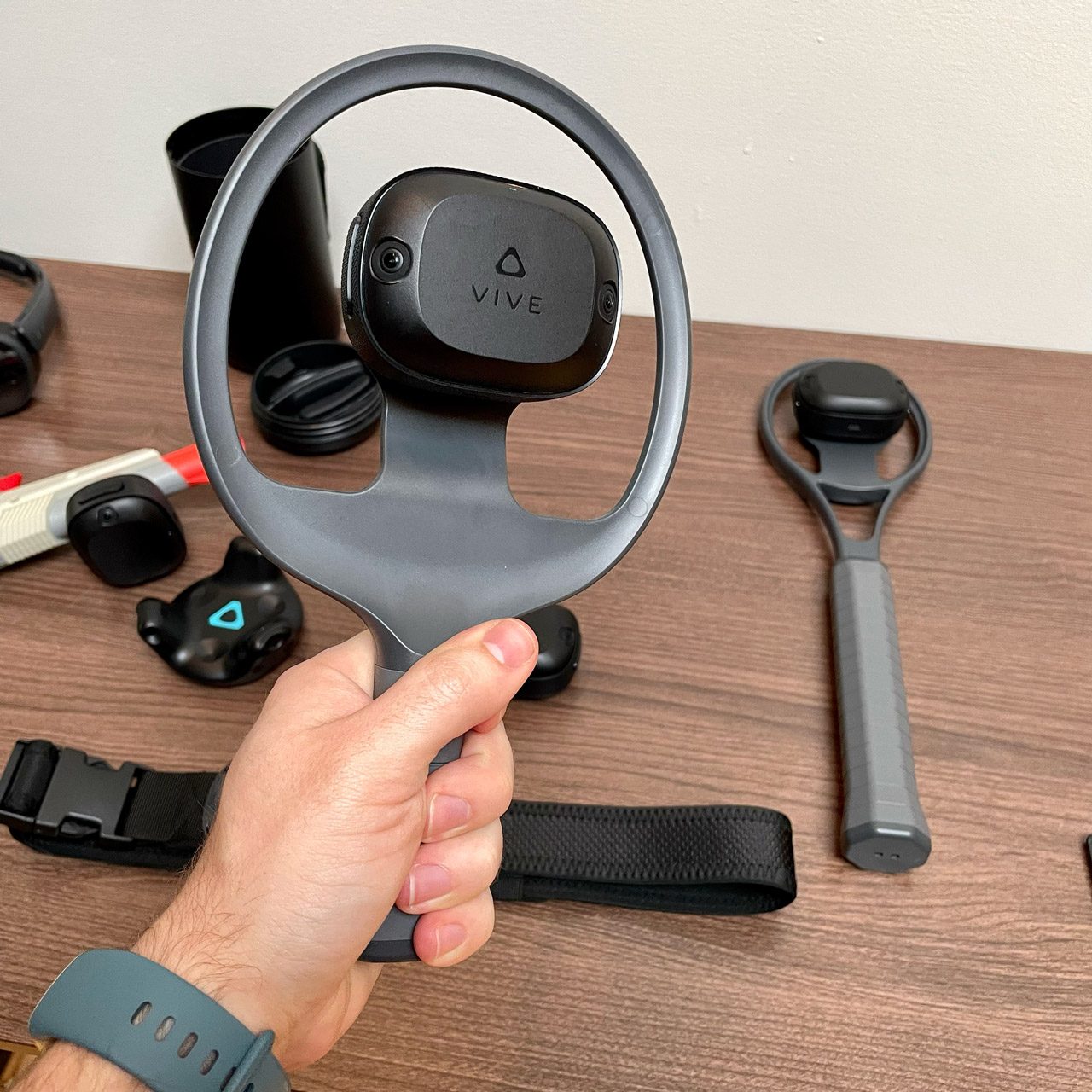
Didn’t get a Quest 2 this holiday season, which includes a free copy of Beat Saber and Resident Evil 4? Although the beat-slashing rhythm game and zombie-slaying classic aren’t part of the deal anymore, for a limited time new Quest 2 owners can nab both GOLF+ and Space Pirate Trainer DX.
Meta is including the two games as a bonus when you buy a new Meta Quest 2 between February 5th and June 3rd, 2023. New Quest 2 owners must activate their headsets by June 17th, 2023 and the offer must be redeemed within 14 days of device activation.
The deal represents $50 in content, which you can get either by buying a 156 or 256 version of Quest 2, priced at $400 and $500 direct from Meta.
GOLF+ ($30 value)
Rated by users as the most popular paid Quest 2 game in January by review count, GOLF+ offers up some serious driving and putting, letting you join friends for a round at both free courses and paid DLC premium courses, including Pebble Beach, Pinehurst No. 2, The Ocean Course at Kiawah Island, and more.
Realism is the main focus: you can customize the contents of your golf bag with a ton of different irons as you take on the game’s many courses, either solo in online multiplayer. As the PGA Tour’s official VR golf game, more courses are also coming down the pipeline in February, including THE PLAYERS Championship and the WM Phoenix Open.
Space Pirate Trainer DX has been the go-to wave shooter since the early days of VR, but don’t let its age fool you: it’s still one of the slickest sci-fi shooting games around, feeling like a mix of Space Invaders and some sort of Mandalorian combat simulator from a galaxy far far away.
While primarily a single-player game, if you have the physical space and a Quest 2-owning friend, you can also play Space Pirate Arena, which basically gives you a 1v1 all-out battle similar to how you might play paintball or airsoft, but in VR.
There’s a ton of free stuff out there on the Quest Store, which we rounded up in our top 25 free games and experiences to download first. You’re sure to spend tens of hours swimming through all of the free stuff on the Store, although once you’re ready for some paid games, make sure to check out how to spend your first $100 on Quest content to keep the ball rolling.
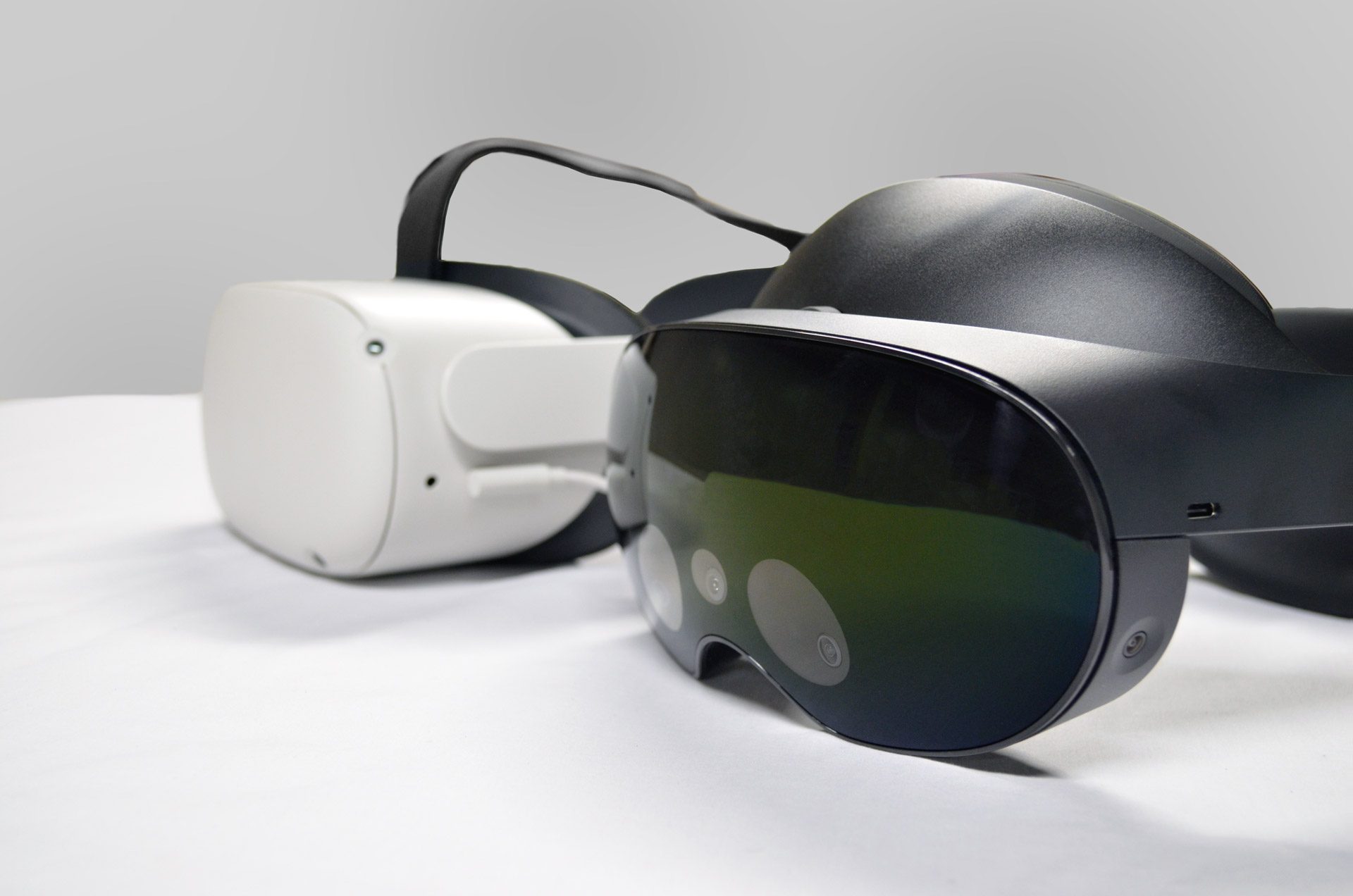
It’s only been three months since Meta launched Quest Pro, pitching its next-gen mixed reality standalone to enterprise and prosumers with the hefty price tag of $1,500. In an unusual move by the company, Meta has quietly slashed the price of Quest Pro for a limited time, putting it more directly in competition with HTC’s recently revealed Vive XR Elite standalone headset.
Update (11AM ET): Sale timing has been revealed; the price drop is in effect for one week only in the US, and two weeks in the UK (dropping to £1,300). We’ve included this in the body of the article below.
Released in late October, Quest Pro essentially set the tone of the next generation of standalone VR hardware. Typically, Meta is consumer-forward, pricing its headsets below (or close to) $500, but Quest Pro represents a pivotal shift in Meta’s strategy.
Starting with Quest Pro, the company is using mixed reality as “a key part of the journey toward full augmented reality devices,” Chief Technology Officer and Reality Labs Chief Andrew Bosworth described in a year-end blogpost.
Quest Pro | Image courtesy Meta
With the sale, it seems the company is quietly gunning to retain its share of the budding MR headset marketplace by knocking the price of Quest Pro to match its largest competitor, Vive XR Elite, which HTC revealed earlier this month, couching it as its long-awaited return to the consumer VR space.
Vive XR Elite | Image courtesy HTC
Now, Meta’s Quest Pro is priced at $1,100, or $400 below its previous MSRP, challenging Vive XR Elite’s unique selling points in the process. According to CNET, the sale is happening for one week only in the US, and two weeks in the UK (dropping to £1,300).
Notably, these aren’t entirely analogous devices; some hardware quirks might act as key differentiators, although the undeniable overlap now puts them squarely in direct competition. Still, it’s pretty close.
Here’s a quick breakdown of the headset specs side-by-side:
Feature
Vive XR Elite
Quest Pro
Inside-out tracking
wide FOV cameras (4), depth sensor (1)
wide FOV cameras (4), no depth sensor
Passthrough
single 16 MP RGB camera
single RGB (MP?) camera
Resolution
1,920 × 1,920 per eye (LCD)
1,800 × 1,920 per eye (LCD)
Display Refresh
90 Hz
90 Hz
Eye-tracking
Additional module required
Onboard eye-tracking
Face-tracking
Additional module required
Onboard face-tracking
Chipset
Qualcomm Snapdragon XR2
Qualcomm Snapdragon XR2+
Storage & Memory
128 GB / 12 GB
256 GB / 12 GB
FOV
up to 110-degrees diagonal
up to 96-degrees diagonal
Optics
Pancake lens
Pancake lens
IPD Adjustment
manual, 54–73 mm range
manual, 55-75 mm
Audio
built-in open-ear audio
built-in open-ear audio, 3.5mm audio port
Weight
625g (including battery), 273g in ‘glasses’ mode
722 g (including battery)
Controllers
6DOF motion controllers (2), hand-tracking
Playtime on battery
~2 hours
~2 hours
Retail Price
$1,099
$1,099 (MSRP $1,499)
A raw spec sheet doesn’t exactly tell the full story, although it’s clear HTC will need to play catchup if it intends on remaining competitive with Meta now that both headsets have achieved price parity, albeit temporarily. Vive XR Elite is still in pre-order, with a late February shipping window, while Quest Pro is available today, direct from Meta.
In Vive XR Elite’s favor is its convertibility: the traditional battery headstrap can be replaced with a glasses arm piece, which allows it to be used with an external powerbank for more casual content viewing, like watching a film in your own private theater whilst on a plane or train.
It’s a unique selling point, although the lack of 3.5mm sours this somewhat, as you’ll need to use Bluetooth headphones to watch anything if you want complete privacy in a public space. Still, the focus on every day, on-the-go use sets it apart from Quest Pro. On the flipside, Quest Pro however features both eye and face-tracking out of the box, something Vive XR Elite will gain in the future with the release of separate modules.
Hardware aside, Meta undoubtedly has a leg up with its content ecosystem, as all games designed for Quest 2 automatically support Quest Pro—that’s a lot of content out of the box in addition to the admittedly smallish drip of mixed reality experiences already on the Quest Store.
Meanwhile, HTC is still amassing games for its growing content library, which currently doesn’t boast any truly notable exclusives that might make you choose one headset over the other. Notably, HTC also openly refutes it will sell personal user data since it’s not a social media company—a clear shot across the bow at Meta’s spotty track record in user privacy and security.
“What’s the cost of your personal data? We’re not a social media company. Our business model doesn’t rely on advertising revenue, so it’s not something we’re doing. We want to build good hardware.” – @shen
The list of differences doesn’t end there. If you want to learn more about Quest Pro and Vive XR Elite, check out our in-depth hands-on articles with both headsets.
This article was originally published on .cult by Luis Minvielle. .cult is a Berlin-based community platform for developers. We write about all things career-related, make original documentaries, and share heaps of other untold developer stories from around the world.
Quiet quitting is a brand-new form of approaching the work-life balance. Contrary to what its name might suggest, quiet quitting doesn’t actually involve an official resignation from your job. It’s merely a transformation in how employees approach their work.
The catalyst behind this movement is simple yet powerful: a generalized, overwhelming desire deep inside the minds of the new wave of employees, predominantly those belonging to Gen Z, to find a counterweight to the long hours spent working at desks and computers, or in front of any other screen.
Gen Z employees are just now entering the workforce and facing the aftermath of the overridden, overworked traditions their predecessors, millennials, endured. These traditions are part of a more extensive belief system ingrained in a culture that values those who dedicate their lives to their job and neglect their personal lives, resulting in a generation of overworked, burdened, burned out, exhausted individuals.
The demand for work-life balance
So, this is where the transformation mentioned above, primarily centred in the tech industries, comes in. It’s essentially the product of going from ‘Above and beyond’ to ‘Acting your wage.’ Under this new model, the typical employee will no longer accept or tolerate excessive office hours and will take control of their lives by giving personal matters precedence over their work duties.
On the surface, this new idea (more and more favored by younger employees and more and more bewailed by corporate veterans) seems to respond to a cursory desire to work less. Still, quiet quitting is a more extensive, more powerful, and comprehensive response to a culture that has so far normalized burnout and exhaustion.
So, quiet quitting is a comforting choice, it’s a growing, forceful revolution changing how the corporate world approaches its relationship with employees and the workers’ mindset. Employers can no longer expect their employees to prioritize their jobs over their personal lives and families.
It’s not only cultural. Many European employment laws protect workers’ rights to have wiggle room. Even Elon Musk, who’s living through a revamped jack-of-all-trades phase, is having trouble firing (instead of laying off) European Twitter employees because of these laws, which prevent employers from contacting staffers outside working hours and also grants them due process before ousting them from their jobs.
Even though quiet quitting took over headlines in 2022, actually quitting has silently (pun intended) become an HR darling. The term ‘Great Resignation’, as executives and consulting firms dubbed it, has also shaken the professional space during the past two years. During the Great Resignation, more and more professionals left their posts and repurposed their careers, giving a further spin to the concept of doing ‘what’s necessary and that’s it.’
Some professionals didn’t change career paths, but instead simply shifted how they interact with their jobs. A Stack Overflow survey observed that many developers veered from full-time arrangements to freelance, independent working systems, all while doing essentially the same, which is punching code in.
Even if these insights should come as motivation to someone struggling with the decision of leaving a job (in the sense of ‘if everyone’s doing it…’), they are not the only truths a struggling worker can leverage for motivation. While job insecurity and a global recession looming ominously can make people reconsider quitting, the market tells a different story.
The tech industry is in high demand for programmers: jobs and pay, as our salary reports detailed, are copious. Actually quitting your job to become a full-time programmer might seem like a scary feat, but, as our research tells us, it can be quickly rewarding, with a good bang-for-buck ratio.
The best part? You don’t need a college degree or years-long education to break into the job market. With a short-term bootcamp, you can make a decent start. As our deep dive into bootcamps revealed, in 2020, 79% of bootcamp attendees got a job 180 days after finishing their course.
Truly quitting and starting anew works
Due to the scarcity of job offers and the incredibly high demand for skilled programmers, combined with the many accessible options to learn how to program, getting a job in coding is a very attainable goal. As the insights of the Great Resignation uncover, it’s an increasingly popular choice.
A 2020 report on coding bootcamps by Course Report found that the average graduate had seven years of experience in an unrelated field, a college degree, and no prior experience as a programmer. Making this career-changing move might seem like a giant leap, but it allows you to liberate yourself from the constraints of the corporate world and start working on your terms.
Quitting your day job might be the most freeing choice you’ll ever make: you’ll have control over your schedule and larger authority over who you want to work for. And hey, you can be on the receiving end of a very competitive paycheck. So, while quiet quitting is definitely the more leisurely, most comforting choice, sometimes letting it all go and starting over under your conditions can be the more liberating choice.
We hope you have a better idea of what quitting might do for you. We absolutely don’t recommend doing it lightheartedly, it’s important to weigh all your choices and do what’s best for you. But hey, if you do make that decision, you can check out our article ‘How to tell your boss you’re quitting‘ to draw inspiration and ideas.
We might think that the conception of robots, AI, and automated machines is a modern phenomenon, but, in fact, the idea had already appeared in Western literature nearly 3,000 years ago. Long before Isaac Asimov conceived the Laws of Robotics (1942) and John McCarthy coined the term “Artificial Intelligence” (1995), Ancient Greeks myths were full of stories about intelligent humanoids.
The fact that these mythical humanoids meet the criteria of modern definitions on robotics and AI is impressive in itself. But what’s even more astonishing is that these old tales can provide us with valuable teachings and insights into our modern discourse on artificial intelligence.
Such stories “perpetuated over millennia, are a testament to the persistence of thinking and talking about what it is to be human and what it means to simulate life,” historian Adrienne Mayor, writes in her book Gods and Robots: Myths, Machines, and Ancient Dreams of Technology.
In other words, the desire to reach beyond humans and create non-biological life by endowing intelligence into machines seems an innate part of our nature. And this is why we can find wisdom to inform contemporary discourse in age-old myths.
Through the dread, hope, and moral dilemmas they express, these stories can provide us with an alternative way to process some of the most pressing questions regarding intelligent machines: how far should we go with AI? And what are the looming moral and practical implications of this technology?
To revisit these questions, we’ll look into three intelligent humanoids in Greek myth: the Golden Maidens, Talos, and Pandora.
The Golden Maidens: the inherent need for labor-saving technology
The Golden Maidens were built by Hephaestus, the god of fire. They’re described as female assistants made of gold who look like living young women, and can anticipate and respond to their maker’s needs.
But most importantly, “they’re endowed with the hallmarks of human beings: consciousness, intelligence, learning, reason, and speech,” Mayor remarks in her book.
Kylix depicting Hephaestus presenting Thetis with armor for her son Achilles. The divine smith holds a hammer in one hand and a helm in the other. The painting illustrates a scene from Homer’s Iliad. Credit: ArchaiOptix via Wikimedia
There’s an immediate parallel we can draw between ancient myth and modern society: one of the main reasons for the creation of intelligent, automated machines is economic, or rather, labor-saving.
The idea that robots and self-acting devices could act as servants (or slaves) was a point also stressed by the famous Greek philosopher, Aristotle. In the first book of his Politics, he contemplates:
If every tool could perform its own work obeying or anticipating the needs of others, […] and if […] shuttles could weave and picks could play the lyre by themselves, then craftsmen wouldn’t need servants and masters wouldn’t need slaves.
The idea, though well ahead of its time, is actually very simple: a society in which people don’t have to do the drudge work, and instead, delegate it to machines. And as much as Greek society depended on the institution of slavery to function, we are now creating a new class of mechanical servants.
Think of the vacuum bot cleaners that may stroll across your floors, the surgical robots that perform complex surgical procedures, or the military bots designed to disarm bombs.
This does raise an interesting question though. While we have personal robots that can help us with small tasks, the real wealth of automation will come when entire industries are destroyed and replaced by free workers. Think of self-driving cars removing truckers from work for instance. But unless the money generated from such moves go to the dispossessed, the privileged and wealthy (i.e. those similar to Hephaestus) will benefit most.
This idea is explored further in the continuing myths.
Talos: intelligent machines in the hands of tyrants
Unlike the Golden Maiden, Talos was created to cause harm (as was Pandora, but more on that later).
Talos was a bronze giant robot, again made by Hephaestus. He was gifted by Zeus to his son Minos, the mythical king of Crete, to guard and protect the island.
The guardian robot would throw huge rocks at foreign ships approaching the island, and enemies managed to get on land, he would hug them and burn them alive thanks to his ability to heat up his bronze body.
Silver stater depicting Talos with wings and rocks on each hand. 5th century B.C. Credit: Museum of Fine Arts Boston
Talos doesn’t seem to possess a human level of intelligence, but he’s able to interact with his environment and perform various tasks.
In fact, some mythological variations of his demise hint significantly at the possibility that he’s conscious of his existence and that he has a kind of agency.
As Mayor notes, ”In these versions, Talos is portrayed as susceptible to human fears and hopes, with a kind of volition and intelligence.”
If one looks at the relevant mythological corpus, they will notice that all such machines used to cause harm belonged to tyrannical rulers; in our example, King Minos of Crete, and Zeus, the father of gods and men, in the case of Pandora.
And there’s a notable moral in these stories: superior technology can help exercise control.
And it’s not just war that AI can serve those in power.
It can also be used by authoritarian regimes to track citizens, influence the flow of information, and marginalize dissident voices, as the example of China shows.
Domination of AI by powerful nations is expected to deepen structural inequalities and contribute to new forms of social and economic imbalance. Similarly, as AI is mostly centralized (meaning that it’s limited to the ownership of a single entity), it will further empower the leading Big Tech companies creating it, enabling them to pursue their own agendas.
But have these consequences been debated enough by the nations’ regulatory bodies or the companies that are currently developing AI?
“I think the Silicon Valley and Big Tech companies and billionaires control the narrative over AI so much that it creates little space for that kind of debate that’s necessary for a technology that grows so massively,” George Zarkadakis, AI engineer, futurist, and writer, told TNW.
Unless controlled, legally regulated, and removed from the individual, AI tools won’t benefit society in the way we envision. And the danger of them falling into the hands of nefarious actors who could use them to assert dominance is highlighted by the following myth where Zeus’ fear of losing his ruling power led to the creation of a perilous weapon: Pandora.
Pandora: surpassing the limits
Pandora was created as an instrument of punishment. After the Titan Prometheus (his name means “foresight”) stole fire from the gods and gave it to mankind to help it create technology, Zeus commanded Hephaestus to fabricate Pandora.
The mythical humanoid was designed to be an evil disguised as a gift, something that would make humankind pay for reaching closer to the divine level, as up until then, fire and technology were unique privileges of the gods.
Hephaestus fabricated Pandora, molding earth and water into the shape of a beautiful woman. She was also endowed with treachery, deceit, and seduction. At the end, Zeus gave her a mysterious jar.
After her completion, Pandora was sent to Prometheus’ brother, Epimetheus (his name meaning “hindsight”), who forgot the warning never to accept a gift from Zeus. Once on Earth, Pandora opened the jar unleashing all kinds of evil that would plague humankind forever. Following Zeus’ instructions, she sealed the jar right before hope could escape, trapping it inside.
Calyx-krater depicting Pandora’s making. On the top row, Pandora stands in the middle facing forward, a stance typically used for non-living creatures. On her left stand Athena and Poseidon, and on her right stands Ares who’s looking back to Hermes. On the bottom row, there is a chorus of Pans. 5th century BC. Credit: The Trustees of the British Museum
“It’s unclear whether Pandora has the ability to learn, choose, or act autonomously,” Mayor notes. “Her only mission is to open the jar of all human misfortune.” In modern terms, “she does what she’s programmed to do.”
There is a pressing question we can explore using this mythological context: are we suffering from a god complex? And, with AI, dealing with elements we simply don’t understand?
An integral element of Greek mythology, which is fully expressed in Pandora’s myth, is the notion of hubris. This refers to an act that violates the natural order by disregarding the divinely fixed limits on human action in the cosmos. Such an act is always followed by god-sent punishment to restore balance, as in the case of Pandora’s jar.
According to Zarkadakis, there’s a lot of hubris in AI as well.
“I think the purpose of God is to remind people that they’re not gods themselves. And you know, in the absence of gods, we have this problem, right? We think we are gods because we don’t need God anymore. So we’re building our own gods that will be our gods in the future,” he explained. And machines that would be almost impossible to discern from a human being could also be infinitely smarter, “they would be like a god,” he added.
Zarkadakis believes that the ancient myths were trying to prevent us from going down that slippery path; but we’re heading there anyway.
This recalls Steven Hawking’s warning over the potential danger of AI. “The development of full artificial intelligence could spell the end of the human race,” he said during an interview with BBC. “It would take off on its own, and re-design itself at an ever increasing rate. Humans, who are limited by slow biological evolution, couldn’t compete, and would be superseded.”
Aryballos (perfume jar) depicting Hope trapped in a jar. 7th century BC. Credit: Museum of Fine Arts Boston
So should we open Pandora’s jar?
Our choice doesn’t differ too much from the one Epimetheus had to make. Much like the ancient humanoid, AI comes with a black box, the Deep Neural Networks (DNN) systems machine learning is based on. This means that while scientists have access to the inputs and outputs AI uses, they don’t know how its decision-making process works.
We don’t know what’s inside the black box, the same way Epimetheus didn’t know what was inside the jar. The moral of the myth is clear: think before you act, or act before you think — and suffer the consequences. And to relate this to our modern debate, unless we seriously consider the possible negative outcomes, it’s dangerous to rush into creating something we don’t fully understand just because we can.
To avoid opening the jar recklessly, Zarkadakis suggests posing a vital question supported by ethical and philosophical considerations: “What’s the end game?” And based on that, “what might be the cost and consequences of the technology?”
“A machine that has full autonomy and is conscious means it’s completely free, it can think in any way, and, thus, that it can be potentially dangerous,” he explained. “The number one risk is extinction, and it’s bad enough in theory to try to build such AI and see what happens.”
Cup depicting Pandora’s making. In the center, Pandora stands en face with Hephaestus on her right holding a hammer. 5th century BC. Credit: The Trustees of the British Museum
Zarkadakis remarked that the reason why we’re fully autonomous is because as biological social beings we are equipped with ethics and morality.
Zarkadakis believes that we don’t actually need conscious AI. “I think what we need as human society is to live a better life and having more free time is a big goal to that,” he added.
“There’s a massive usefulness for artificial intelligence to help us reach that point. What we need for AI is social integration and we should absolutely rethink the autonomy of machines and revise their manifesto.”
With this approach, AI could, in fact, be the inverse of Pandora — a democratic tool that could help make ourselves and the world better. And shouldn’t this be technology’s mission?
From myth to reality
Thousands of years ago, these three myths illuminated the potential of intelligent machines to serve a good purpose (as in the case of the Golden Maidens) or cause harm (as in the case of Talos and Pandora) — a potential we’re already seeing materializing today.
Most notably, though, they bring forth a set of questions that are vital for our pursuit of AI: whose aspirations will it serve, from whom will it learn, what do we want it to be, and how far should we go with it before surpassing the limits?
Ultimately, AI is much like Pandora’s mysterious jar. We don’t know what’s inside and we can assume it contains both good and evil. In the end, it’s all about the role we’ll play: will we be like Prometheus and demonstrate the required foresight, or will we be like Epimetheus and act before examining the consequences?
Ancient Greek myth has told us the dangers of AI, it’s now up to us to listen.
Games are the largest use case for consumer VR and AR. While VR and AR remain a comparatively small segment of the games industry, the industry is taking notice as VR hardware in particular improves. This presents possibilities for new kinds of games but also promises to breathe new life into established franchises.
The GDC’s State of the Game Industry Report for this year is by no means dedicated to VR and AR. However, it does hold insights into how this segment of the industry is growing and changing. This includes insights into larger emerging technology trends like Web3 and the metaverse.
VR and AR in the Larger Games Industry
This GDC survey, the 11th in an annual series, found that “the metaverse has become more than a buzzword.” That doesn’t mean that VR and AR are now the driving force in the games industry.
In terms of which platforms developers are building for, VR headsets land in 10th place with 12% of respondents. AR landed in 14th place with 4% of respondents. When asked which platforms developers are building their next project for, VR headsets remained in 10th place with 12%, but AR moved up to 11th place with 5%.
Source: GDC State of the Game Industry 2023
PC leads the pack, with the intervening platforms consisting of the usual suspects – legacy gaming platforms and mobile. However, this may be changing in the near future.
When asked which platforms developers are most interested in, 23% of respondents said VR, pushing the platform to 6th place, ahead of Android, Mac, and Xbox One. Similarly, 12% responded with AR, placing it in 11th place ahead of PS4 and web browsers.
Source: GDC State of the Game Industry 2023
So, while we might not see a boom period for VR and AR games in the immediate future, it’s increasingly on the radar of game developers. This trend looks like it could be setting up growth in this aspect of the industry within the next few years.
That said, last year’s big metaverse hype may have led to increased expectations for the cycle we’re in now. Last year, 42% of respondents said that they were actively involved in VR and AR game development. Now that number is at 38%, closer to where it was in 2021.
Platform Wars Within VR
So, of the developers that are working in VR and AR gaming, what platforms are they working on?
When asked which platform their next game will release on, 36% responded with Quest meaning Quest 2. An additional 10% responded with “Project Cambria” – the Quest Pro which had not yet been released at the time of the survey. A further 10% responded with Rift, Meta’s now discontinued line of tethered PC VR headsets.
Source: GDC State of the Game Industry 2023
It is worth noting that the percentage of respondents working with Quest has gone up almost 10% since last year. That in itself is not necessarily surprising if not for the fact that the overall number of VR and AR game developers has gone down.
Interestingly, the runner-up is the as-yet-unreleased PlayStation VR 2 with 18%, followed by the HTC VIVE ecosystem at 15%. A further 12% responded with Apple’s ARKit, and another 9% responded with Android’s ARCore. There was also a potentially unexpected write-in entry.
“A handful of respondents shared that they were developing games for Pico, a platform that was not on the survey list,” the report offers. In some geographical markets, the Pico 4, which was announced shortly before the Quest Pro, is a significant potential Quest Pro competitor. However, Pico Interactive does not currently offer consumer support in the US.
Gaming in the Metaverse?
“The concept of the metaverse continues to pick up steam in the game industry, as new and existing companies alike move to secure funding, spin up projects, and develop new technology,” reads the survey. However, like VR and AR gaming, this news comes with a grain of salt and some more sober attitudes since last year.
Nearly half of the respondents didn’t select any of the survey’s platform options. They instead said that “the metaverse concept will never deliver on its promise.” This occurred last year as well when around a third of respondents said that the metaverse will never materialize.
From a VR and AR perspective, it gets worse. More developers said that Fortnite would become the model metaverse platform than Horizon Worlds. This isn’t bad news because Horizon Worlds is better than Fortnite, it’s bad news because Horizon Worlds is VR and Fortnite isn’t. In fact, many of the more popular “metaverse” contenders are flat platforms.
Source: GDC State of the Game Industry 2023
And it gets worse. “Microsoft/Minecraft” came in a distant third place with 7% of respondents choosing them as the model metaverse. This presumably included AltspaceVR. As this article was being written, it was announced that AltspaceVR is coming to an end.
A Note on Blockchain
ARPost is not explicitly interested in blockchain but as a potential pillar of both the metaverse and the future of gaming, it shouldn’t be inappropriate to share some of the survey’s findings in this field. And, if you aren’t explicitly interested in blockchain either, the survey results should please you.
When asked about their interest in blockchain integration in games, 23% of respondents said that they were “very interested” or “somewhat interested”, with 75% saying that they were not interested at all. The remaining 2% are using blockchain in games already, with blockchain being the principal monetization strategy of around 4% of games.
Interest in blockchain is down slightly from last year, but, according to the report, most respondents were against blockchain last year as well and simply haven’t changed their minds.
Source: GDC State of the Game Industry 2023
“Many developers said there could be a valuable place for blockchain technology in video games in the future,” the report explains. “Others said that the risks outweigh the benefits and that existing technologies serve similar purposes that negate the need for blockchain.”
A Maturing Industry
If you thought that the gaming industry was moving a little too fast last year, you were right. Metaverse hype driven by hardware expectations and blockchain buzz may have led to a brief, hard burn in the industry. It now seems that a small correction has taken place but the VR and AR games industry is settling in for longer-term development.
For the full picture of the whole gaming industry, find the complete report here.
Ioanna is a writer at SHIFT. She likes the transition from old to modern, and she’s all about shifting perspectives. Ioanna is a writer at SHIFT. She likes the transition from old to modern, and she’s all about shifting perspectives.
Researchers from the University of Birmingham have developed an innovative method for existing furnaces that could reduce steelmaking’s CO2 emission by nearly 90%.
The iron and steel industry is a major cause of greenhouse gasses, accounting for 9% of global emissions. That’s because of the inherent carbon-intensive nature of steel production in blast furnaces, which currently represent the most-widely used practice.
In blast furnace steel manufacturing, coke (a type of coal) is used to produce metallic iron from ore obtained from mining — which releases large quantities of carbon dioxide in the process. According to Dr Harriet Kildahl, who co-devised the method with Professor Yulong Ding, their technology aims to convert this carbon dioxide into carbon monoxide that can be reused in the iron ore reaction.
This is realised using a thermochemical cycle which performs chemical reactions through changes in temperature. That way, the typically damaging CO2 is turned into a useful part of the reaction, forming “an almost perfect closed carbon loop.” This drastically reduces emission by the amount of coke needed and, subsequently, lowers steelmaking’s emissions by up to 88%.
As per the researchers, if this method was implemented in the remaining two blast furnaces in the UK, it could save £1.28 billion in 5 years, all while reducing the country’s overall emissions by 2.9%.
“Current proposals for decarbonising the steel sector rely on phasing out existing plants and introducing electric arc furnaces powered by renewable electricity. However, an electric arc furnace plant can cost over £1 billion to build, which makes this switch economically unfeasible in the time remaining to meet the Paris Climate Agreement,” Professor Ding said. “The system we are proposing can be retrofitted to existing plants, which reduces the risk of stranded assets, and both the reduction in CO2, and the cost savings, are seen immediately.”
University of Birmingham Enterprise has filed a patent application covering the system and its use in metal production. It’s currently looking for partners to take part in pilot studies and deliver this technology to existing infrastructure, or collaborate on further research to develop the process.
Twitter has fallen out with yet another landlord: King Charles III.
The Crown Estate, which manages the British monarch’s vast property portfolio, has sued Twitter over unpaid rent for office space in London. The complaint was filed last week at the High Court in Britain’s capital.
The case joins a range of wranglings over rent engulfing Twitter. In December, the company had reportedly not paid rent on any of its global offices “for weeks.” Since then, landlords in San Francisco, Seattle, and London have all sued the bird app, while workers at a Twitter office in Singapore were briefly evicted over late payments.
The rent-dodging has been surmised as an attempt to negotiate better terms. In the London building, however, this doesn’t appear to be the plan.
As the space has reportedly been deserted and emptied, it doesn’t seem that Twitter will re-occupy the office. Yet this doesn’t mean that Musk will get off scot-free.
“Twitter will remain liable to pay.
Andrew Conway, senior director and leading property litigator at London firm Lawrence Stephens, told TNW his obligations are tricky to escape.
“Unless the landlord forfeits the lease (that is, taking back the premises, so it can be re-let to other tenants) or agrees to accept a formal surrender of the lease, Twitter will remain liable to pay the rent for the remainder of the term of the lease,” Conway said via email.
If the lease is forfeited or surrendered, the tenant is only liable for payments up to the date that happens. That may well appeal to Musk, but it could be a headache for the Crown Estate.
If the property can’t quickly be re-let, the landlord faces several problems.
“A landlord will be left with empty premises on which it will have to pay business rates after three months,” said Conway. “Moreover, empty premises are more susceptible to occupation by squatters.”
Court proceedings provide a route to recovering rent arrears — and Twitter will have little defense against paying them.
The debt collectors are coming
Musk’s mounting feuds with landlords coincide with growing financial pressures at Twitter.
The first interest payment on the $13 billion of debt used for his takeover could be due by the end of January, according to the Financial Times. Analysts expect the looming bill to be around $300 million.
Revenues at Twitter have also plummeted. Research suggests that ad spending on the platform — the source of roughly 90% of its revenue in 2021 — dropped by 71% in December.
Skipping rent may postpone some costs, but it adds another dent to Musk’s floundering reputation. It’s also a blow to his dream of ending remote working.
At least surviving staff at Twitter’s New York base can still go to the office. Unfortunately, it reeks of poo and has a cockroach problem.
“AR” stands for “augmented reality,” right? Almost always. However, there is another “AR” – assisted reality. The term is almost exclusively used in industry applications, and it isn’t necessarily mutually exclusive of augmented reality. There are usually some subtle differences.
Isn’t Augmented Reality Tricky Enough?
“AR” can already be confusing, particularly given its proximity to “mixed reality.” When ARPost describes something as “mixed reality” it means that digital elements and physical objects and environments can interact with one another.
This includes hand tracking beyond simple menus. If you’re able to pick something up, for example, that counts as mixed reality. In augmented reality, you might be able to do something like position an object on a table, or see a character in your environment, but you can’t realistically interact with them and they can’t realistically interact with anything else.
So, What Is “Assisted Reality?”
Assisted reality involves having a hands-free, heads-up digital display that doesn’t interact with the environment or the environment’s occupants. It might recognize the environment to do things like generate heatmaps, or incorporate data from a digital twin, but the priority is information rather than interaction.
The camera on the outside of an assisted reality device might show the frontline worker’s view to a remote expert. It might also identify information on packaging like barcodes to instruct the frontline worker how to execute an action or where to bring a package. This kind of use case is sometimes called “data snacking” – it provides just enough information exactly when needed.
Sometimes, assisted reality isn’t even that interactive. It might be used to do things like support remote instruction by enabling video calls or displaying workflows.
Part of the objective of these devices is arguably to avoid interaction with digital elements and with the device itself. As it is used in enterprise, wearers often need their hands for completing tasks rather than work an AR device or even gesture with one.
These less technologically ambitious use cases also require a lot less compute power and a significantly smaller display. This means that they can occupy a much smaller form factor than augmented reality or mixed reality glasses. This makes them lighter, more durable, easier to integrate into personal protective equipment, and easier to power for a full shift.
Where It Gets Tricky
One of the most popular uses for augmented reality, both in industry and in current consumer applications, are virtual screens. In consumer applications, these are usually media viewers for doing things like watching videos or even playing games.
However, in enterprise applications, virtual screens might be used for expanding a virtual desktop by displaying email, text documents, and other productivity tools. This is arguably an assisted reality rather than an augmented reality use case because the digital elements are working over the physical environment rather than working with it or in it.
In fact, some people in augmented reality refer to these devices as “viewers” rather than “augmented reality glasses.” This isn’t necessarily fair, as while some devices are primarily used as “viewers,” they also have augmented reality applications and interactions – Nreal Air (review) being a prime example. Still, virtually all assisted reality devices are largely “viewers.”
Jon wearing Nreal Air
Words, Words, Words
All of these terms can feel overwhelming, particularly when the lines between one definition and another aren’t always straight and clear. However, emerging technology has emerging use cases and naturally has an emerging vocabulary. Terms like “assisted reality” might not always be with us, but they can help us stay on the same page in these early days.
Starting today, the VR-supported stealth shooter Hitman 3 will be rebranded under the new umbrella name of Hitman World of Assassination. This not only includes Hitman 1, 2 and 3, but a free upgrade for previous owners of Hitman 3 on all platforms.
IO Interactive says the aim is to simplify the purchase experience for new players, who previously would need to either navigate the various deluxe editions, or buy additional access passes to play Hitman 1 & 2.
“Essentially, these […] changes will mean that all new players and existing HITMAN 3 owners will have the same base content ownership. There will be no more confusion over which edition to buy, what content you own, how to redeem Legacy packs or import locations, etc. We’re done with that,” the studio says in a Steam update.
So now, if you own the standard edition of Hitman 3 on PSVR or Steam for PC VR headsets, you’ll be able to jump into the rest of the trilogy starting today at 7PM CET (local time here).
If you haven’t previously bought Hitman 3, Hitman World of Assassination will get a price bump to $70 over the standard edition of $60.
Released on PSVR in January 2021, Hitman 3 suffered from the lack of motion control support at launch, and also wasn’t nearly as immersive as VR players would have hoped due to the lackluster object interaction. Then, the studio launched the VR-supported game on Steam a year later, giving the game its first taste of proper tracked motion controls.
Although Hitman 3 won Steam’s VR Game of the Year, the debate is still very much alive if Hitman 3 is truly a good enough VR experience to merit such high praise from the community.
Gemba, the corporate VR learning platform, announced it’s closed an $18 million Series A funding round, which the company says will be used to continue expansion into Europe, the Middle East, Africa, and North America.
The latest funding round was led by Parkway Venture Capital, now valuing the UK-based company at $60 million.
In 2017, Gemba grew out of executive training company The Leadership Network, which was founded in 2013 by CEO Nathan Robinson and Chairman Victor Lewis. At the time, The Leadership Network was focused on cross-industry leadership training which, through its executive masterclasses, let senior execs from non-competing companies go hands-on at the state-of-the-art facilities of global giants like Toyota, Tesla, Google, BMW and Amazon.
Now the company is all-in with VR training platform Gemba, which also still holds masterclasses, albeit in virtual reality. The platform also focuses on immersive skill transfer, including things like on-the-job VR skill training, simulated factory walks, and live training events in VR.
Image courtesy Gemba
Gemba has since worked with 4,000 executives from more than 675 companies, including Philips, Pfizer, Nike and Dell.
Its most recent success story involves Aptiv, a leading automotive supplier. Gemba says its VR training enabled Aptiv to increase skill transfer efficiency by 80% when compared to real-world training programs. In the first year of working with Aptiv, the company also saved $2 million on travel expenses alone.
“As an educator, we know that 90% of learning is about engagement,” says Frankie Cavanagh, Gemba’s Chief Technology Officer. “Gemba allows users to learn and train in a whole new way. With higher engagement levels than traditional teaching and the combination of unprecedented levels of realism and a customized learning experience, it’s a revolutionary teaching tool.”
Gemba says its Series A will accelerate the development of the platform, enabling people and companies to access Gemba on a subscription basis. It’s also set to expand its offering of immersive training simulations, tools and learning experiences, all of which are accessible via online app stores.
Ioanna is a writer at SHIFT. She likes the transition from old to modern, and she’s all about shifting perspectives. Ioanna is a writer at SHIFT. She likes the transition from old to modern, and she’s all about shifting perspectives.
French startup Eolink — in collaboration with 15 European energy partners — will install a 5MW floating offshore wind turbine in Bulgaria by 2025. This is part of the EU-backed Black Sea Floating Offshore Wind (BLOW) project, which aims to advance sustainable energy solutions.
BLOW will use Eolink’s patented floating offshore wind turbine design, which the company claims solves existing industry issues by using four steel masts instead of one to spread the turbine’s stresses. This is said to make the overall structure more than 30% lighter. As per the startup, its turbines can produce 10% more energy by reducing aerodynamic interactions thanks to a greater distance between the blades and masts.
The unit will be designed to operate with maximum efficiency in the Black Sea, and this includes fitting it with a larger rotor so it can generate more energy in low-wind areas.
Eolink’s wind turbine. Credit: Eolink
“The World Bank 2021 report indicates there is vast technical potential in South East Europe, with a staggering 166 GW of floating offshore energy in the Black Sea alone, which is the equivalent of five times the electricity consumption of Bulgaria and Romania,” Eolink’s CCO Alain Morry said in the press release. “Through this project we hope to catalyze offshore development across the region, which already has ongoing /fixed-bottom offshore wind projects in Romania”
But although every sustainable energy development sounds like a positive step for the EU, there is a catch: the wind turbine will be used to power an existing gas platform operated by Petroceltic, a Bulgarian oil and gas company. Unfortunately, this isn’t an uncommon practice. Think of Norway’s Hywind Tampen, the world’s largest floating offshore wind farm, which also powers the country’s gas and oil production.
On the one hand, powering fossil fuel production with renewable energy is the lesser evil compared to conventional drilling or burning practices. And developing a new industrial case for offshore wind that other traditional industries is a positive development. One could also argue that the lessons learnt in the process of manufacturing, installing, and operating the wind turbine can benefit larger wind farms in the future.
But on the other hand, it seems like a step backwards for the EU that’s funding a project on green energy in order to harvest the gas and oil that are endangering the planet. And while this might simply represent a transitional stage before we fully depend on renewable energy sources, the bloc should step up its game if it’s to meet its climate targets for carbon neutrality by 2050.
The team behind the VR adaptation of popular party game Among Us announced it’s officially gone platinum, selling over 1 million copies across all platforms.
Recreating viral flatscreen titles in VR seems to be a potent recipe for success, as Among Us VR follows in the footsteps of other meme-able games like Friday Night at Freddy’s and SUPERHOT, both of which boast high-performing VR adaptations.
Developed by Innersloth, Schell Games, and Robot Teddy, Among Us VR replicates the original’s team-based game of betrayal. Complete tasks aboard a starship, but keep an eye out for the ship’s singular impostor, who is always looking to get away with murder.
The viral phenomenon caught fire in the summer of 2020—nearly two years after the flatscreen version was initially released on Steam by Innersloth. Then the VR version was released in November 2022, which seems to be replicating that success, albeit in the proportionally smaller Quest 2 and PC VR platforms.
Released in November, Among Us VR has crossed the one million unit mark in less than ten weeks after launch, releasing simultaneously across Quest 2 and SteamVR headsets priced at $10. A version for the upcoming PSVR 2 is also arriving as a launch day title, releasing February 22nd.
And it isn’t stopping there. Among Us VR has a number of planned updates on the horizon, including new maps, custom lobby settings, and improved accessibility features. The team says in-game reporting and voice chat moderation is also in the works to improve player safety.
In addition to the sales news, the team released a few stats: Among Us VR has been played more than four million times by users across 122 countries. On average, 44,000 matches are held per day. More than 89,100,000 minutes have been dedicated to tasks, sabotages, and betrayal.