Ioanna is a writer at TNW. She covers the full spectrum of the European tech ecosystem, with a particular interest in startups, sustainabili Ioanna is a writer at TNW. She covers the full spectrum of the European tech ecosystem, with a particular interest in startups, sustainability, green tech, AI, and EU policy. With a background in the humanities, she has a soft spot for social impact-enabling technologies.
In March, Italy became the first Western country to temporarily ban access to ChatGPT within its borders. Citing concerns over “unlawful” data collection and the lack of an age verification mechanism for minors, the country’s data protection agency — Garante — blocked the service, requiring OpenAI to meet a series of demands for the suspension to be lifted.
As of April 28, Italian users have regained access to the AI system, after OpenAI implemented the majority of the measures ordered by Garante. These address age verification, transparency, and the rights of users and non-users alike.
First off, the US-based company has introduced a “welcome back” pop-up box, which asks users to confirm they’re above 18 years-old, or that they have obtained parental consent if they’re aged between 13 and 18. They also need to specify their birthday on the sign-up page to gain access.
The pop-up box upon entering ChatGPT using an Italian IP address.
In addition, the pop-up’s text contains links to OpenAI’s new privacy policy and a help center article on how ChatGPT is developed and trained. This information notice is easily visible both on the log-in and the sign-up page.
By clicking on the links, users can get information about what kind of data is being processed for training purposes and under what conditions. OpenAI has now clarified that it’ll continue processing certain types of data on a contractual basis to enable the performance of its services, but for algorithm training data processing will be on the legal basis of legitimate interest.
To enable users and non-users to better exercise their rights, as requested by Garante, the company has further included an opt-out form for the processing of personal data. Users can also obtain erasure for inaccurate information, although, for now, OpenAI claims it’s “technically impossible” to provide rectifications.
While the Italian regulator welcomed OpenAI’s new measures, it called on the company to comply with the extra requests it had ordered as well.
Besides the age gate, OpenAI has to introduce an age verification system that prevents minors from using the service. It also needs to conduct a campaign informing Italians that their personal data may have been used for ChatGPT’s training, while raising awareness of the new information policy and attached data rights.
The Italian agency said that it “acknowledges the steps forward made by OpenAI to reconcile technological advancements with respect for the rights of individuals and hopes that the company will continue in its efforts to comply with European data protection legislation.” Nevertheless, it will continue its investigation into the company’s compliance with GDPR.
While Italy’s ChatGPT ban didn’t last for more than a month, it’s the first attempt in the Western world to regulate a generative AI tool like OpenAI’s model. The company’s compliance may set a precedent for other European countries as well — with several other data protection agencies (including France’s, Ireland’s, and Spain’s) paying close attention to the developments.
Get the TNW newsletter
Get the most important tech news in your inbox each week.
The COVID-19 pandemic was a veritable gold rush for food delivery startups — as the world shut down, people ordered in. These companies promised rapid delivery of groceries from local stores using bikes and scooters, and as demand skyrocketed, investors poured cash into the booming industry.
But now, amid soaring inflation and a post-pandemic downturn, the ‘quick commerce’ market is undergoing rapid consolidation with small companies being swallowed up by a few big players.
Founded in 2020 at the height of the pandemic, German-based grocery delivery startup Flink remains one of Europe’s last remaining independent grocery delivery groups. But that could be about to change: Turkish competitor Getir is in talks to acquire the startup, Financial Times reports.
The talks come just five months since Getir acquired Berlin-based rival Gorillas in a $1.2bn deal that valued the combined group at $10bn, making it Europe’s largest quick commerce company. Getir operates in around 50 cities across seven European countries, including the UK, Germany, France, Italy, Spain, Netherlands, and Portugal.
Parallel to the takeover talks, Flink is looking to raise $100m from existing investors at a valuation of $1bn for the entire company. This is a major departure from mid-2022, when the startup, which is still loss-making, was valued at $5bn.
Despite turbulent economic times and less demand from consumers, the startup’s core German business aims to become profitable by the end of this year. It also has subsidiaries in France and the Netherlands and hopes its overall business will be in the green by the end of 2024.
It is yet unclear how much Getir is willing to pay for Flink. There is no guarantee of an agreement being reached, either, said FT, citing people familiar with the matter. However, an eventual takeover could be streamlined by the fact that Abu Dhabi sovereign wealth fund Mubadala Investment Company holds a stake in both companies.
The merger would further consolidate Europe’s food delivery market, which has seen a number of major acquisitions in recent years. In addition to Getir’s blockbuster buy-out of Gorillas, it also acquired UK’s Weezy and Spain’s Blok in 2021, while US-based Gopuff bought British startups Dija and Fancy in the same year, and Flink acquired French startup Cajoo in 2022.
If the takeover is completed, Getir’s only competition in the European market would be GoPuff, which recently downsized and only operates in the UK and France. This would essentially give Getir a monopoly over rapid grocery delivery on the continent.
While Deliveroo and UberEats also offer grocery delivery, they have a different business model, relying on third-party shops while Getir has its own warehouses or dark stores, which offers a “competitive advantage”, says the company’s CEO. The only other potential competitor is Zapp, but it operates solely in London.
Despite its apparent success, Getir’s place at the top is anything but secure. The company is not yet profitable in Europe, and in May 2022 it has cut 14% of its global workforce, citing soaring inflation. But there is hope that as competition lessens the remaining big players like Getir will be able to cash in on demand for rapid grocery delivery, which still remains relatively high.
Get the TNW newsletter
Get the most important tech news in your inbox each week.
Sandbox VR, known for its location-based VR games, announced today the launch of its newest VR experience. Seekers of the Shard: Dragonfire is the company’s first VR game that features multiple storylines, created by the company’s AAA in-house gaming studio.
VR game “Dragonfire”: A New Immersive Experience Each Time
After a successful partnership with Netflix that will see its hit series Squid Game developed into an immersive VR experience later this year, Sandbox VR continues to explore new ways to develop VR worlds for its customers. Dragonfire’s multiple storylines allow players to experience something different each time they play, even after completing it.
Developed by experts in the VR industry, Dragonfire was helmed by the former lead designer on Assassin’s Creed franchise and Sandbox VR’s VP of Content and Creative Director, Michael Hampden.
The new VR game makes full use of Sandbox VR’s proprietary technology that lets players experience a fully immersive, VR-powered adventure. It’s the first game that features branching storylines, making each experience different from others.
Sandbox VR Develops Unique VR Experiences
For Sandbox VR CEO Steve Zhao, developing Dragonfire is a step toward the company’s goal of providing unique VR experiences. “With each experience we create, our goal is to push ourselves to invent new ways to immerse players in virtual worlds,” he stated in a press release shared with ARPost.
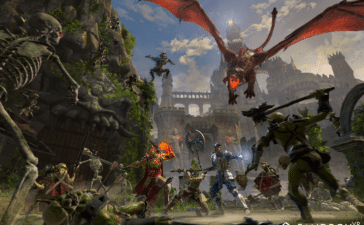
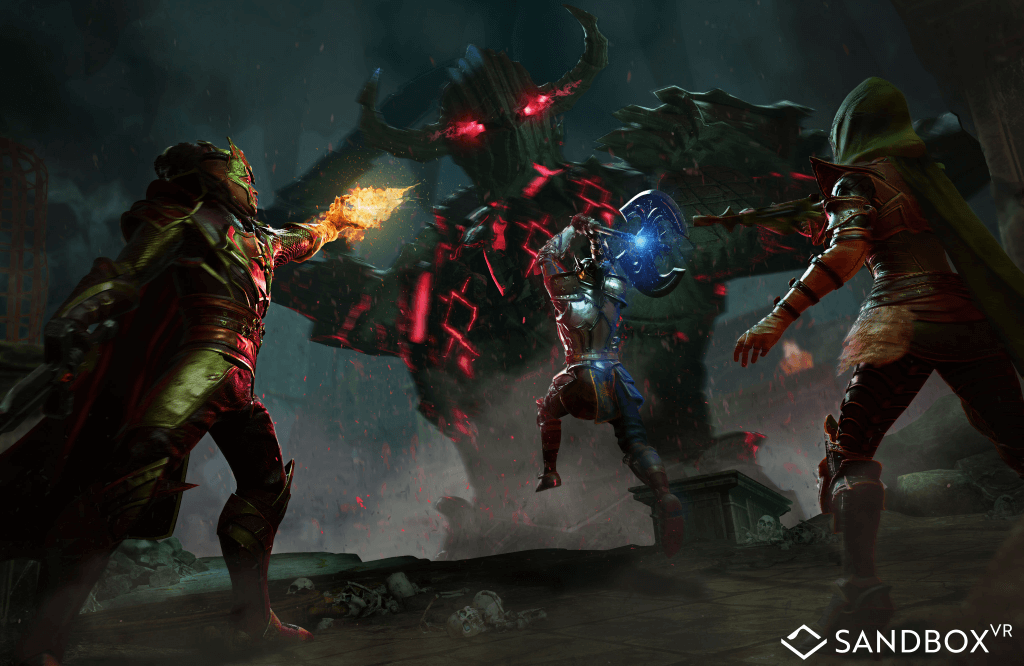
Set in a castle in a fantasy world, VR game Seekers of the Shard: Dragonfire sees players come together as a group of explorers. They encounter a variety of enemies and mysteries and go through several different areas to accomplish their mission.
Because of the branching story arcs within the game, players can choose from many options during gameplay. In essence, players can experience different versions of Dragonfire, depending on their choices. In fact, younger gamers will be able to play an age-appropriate version of the game that does not contain violence.
Consequently, such a complex design posed a big challenge for Sandbox VR in the development of Dragonfire.
“There’s a reason why there isn’t anything like Dragonfire available out there, because so many features have to be designed from the ground up,” Hampden said. “Melee combat, magic weapons and spells, unlockable items, and choosing where to go next are just a few of the new features we have added to make this perhaps the deepest and most replayable location-based VR experience yet.”
Expanding Sandbox VR’s Virtual Worlds
Sandbox VR is a location-based VR startup with over 35 locations around the world. It provides immersive VR experiences to guests, which the company describes as similar to the fictional “holodecks” popularized by the Star Trek franchise. Up to six guests can participate in each experience.
Sandbox VR uses motion capture technology and high-quality haptics to give players a sense of realism while they explore virtual worlds. Each gameplay is designed to be a social experience where friends and family work together to complete game objectives.
Seekers of the Shard: Dragonfire is the seventh exclusive immersive experience developed by Sandbox VR, along with Amber Sky 2088, Star Trek: Discovery, Deadwood Mansion, Deadwood Valley, UFL: Unbound Fighting League, and Curse of Davy Jones. Squid Game, the highly anticipated VR experience in partnership with Netflix, is currently under development, set to launch in late 2023.
Meta announced its third annual Quest Gaming Showcase is arriving next month, coming only a few days before Apple’s rumored XR headset announcement at Worldwide Developers Conference (WWDC).
Meta is livestreaming the Quest Gaming Showcase on June 1st, a bit unusual for the company, as it traditionally holds the annual event in late April.
Calling it their “biggest celebration of the depth and breadth of content across the Meta Quest Platform yet,” Meta is slated to share over 40 minutes of content, including a brand-new pre-show covering game updates and debut trailers, starting 15 minutes before the show begins.
Meta says to expect new game announcements, gameplay first-looks, updates to existing games, and more. There’s also set to be a post-show developer roundtable, which will feature conversation around upcoming games.
There could be at least one clue to what’s in store, as we get a brief glimpse at a horned helmet in the showcase’s promo video, which seems very much like Loki’s helmet from Rift exclusive Asgard’s Wrath (2019). Maybe Meta’s Sanzaru Games has slimmed down the Norse-inspired RPG?
Meanwhile, previous reports maintain Apple is finally set to unveil its long rumored mixed reality headset during the company’s WWDC keynote, taking place on Monday, June 5th.
Provided Apple indeed plans to announce its headset at WWDC, Meta could be looking to generate so called ‘strategic noise’ to better manage market reactions, and potentially offset any negative sentiment prior to Apple’s expected announcement—undoubtedly slated to be a pivotal moment for the entire XR industry.
Meta recently released its Q1 2023 earnings report, showing a consistent investment of around $4 billion per quarter into its XR division Reality Labs. With Apple rumored to be unveiling their own XR headset and a host of apps, reportedly set to include everything from fitness to VR/AR gaming, Meta may want to showcase where some of that investment is going.
Who knows? We may even hear more about Meta’s promised Quest 3 at the gaming showcase, which the company has confirmed will “fire up enthusiasts” when its released at some point this year, notably targeting a higher price point than its Quest 2 headset.
Ioanna is a writer at TNW. She covers the full spectrum of the European tech ecosystem, with a particular interest in startups, sustainabili Ioanna is a writer at TNW. She covers the full spectrum of the European tech ecosystem, with a particular interest in startups, sustainability, green tech, AI, and EU policy. With a background in the humanities, she has a soft spot for social impact-enabling technologies.
A group of over 23 VCs across Europe and the US have joined forces this week to guide startups and their early-stage investors towards net zero, in an effort to decarbonise the global economy and the venture capital industry.
The Venture Climate Alliance (VCA) consists of both generalist and climate-focused firms, and its members manage a combined $62.3 billion in assets, according to Crunchbase figures.
To begin with, participating VCs pledge to inventory their Scope 1-3 emissions and, in turn, reach either net zero or negative emissions for their own operations (such as office energy consumption and employee commuting) by 2030 or earlier.
VCA’s members will also encourage their portfolio startups to align with the net zero goals by 2050 or sooner, and will help founders in setting the right targets for their businesses. For climate-focused companies, this could include support to existing efforts. For non-climate-focused companies, this could entail providing access to additional resources, such as specific tools and methodologies.
Once startups have set their net zero transition goals, the VCA will offer further assistance depending on their needs, such as supporting response mechanisms to climate-related risks, or adapting to regulatory developments.
The alliance’s members will share annual updates on both their own and their portfolio companies’ progress.
“Our goal is to bridge the gap between what’s happening in public markets, where hundreds of companies have made bold forward-looking net zero commitments, and early stage innovation, which has the potential to decarbonise legacy industries through a combination of better products, more efficient processes, and lower costs,” said Alexandra Harbour, founder & chair of the VCA and a principal at Prelude Ventures — one of the alliance’s founding members.
“By harnessing the collective expertise of top venture capitalists from both sides of the Atlantic, the VCA has the potential to significantly influence the funding decisions that shape the future of climate startups and technologies,” added Danijel Višević, Founding Partner at VCA member World Fund.
The Venture Capital Alliance counts 10 founding members: Prelude Ventures, Capricorn Investment Group, DCVC, Energy Impact Partners, Galvanize Climate Solutions, S2G Ventures, Union Square Ventures, Tiger Global, World Fund and 2150.
The following firms are also participating: Obvious Ventures, Congruent Ventures, Valo Ventures, Clean Energy Ventures, Fifth Wall, Overture Ventures, Blackhorn Ventures, Spring Lane Capital, Azolla Ventures, Systemiq Capital, The Westly Group, Innovation Endeavors, and ReGen Ventures.
Operation Money Grab is all systems go. The heist is officially on. Valo Motion has launched the latest addition to its growing game library of multiplayer mixed reality games for ValoArena. This heist-themed game is set to challenge players physically and mentally as they become immersed in a spy adventure that’s almost straight out of a Hollywood movie. To complete all the missions, you’d need to keep your wits and work well with your team.
Grab Your Squad and Pull Off the Greatest Heist in MR
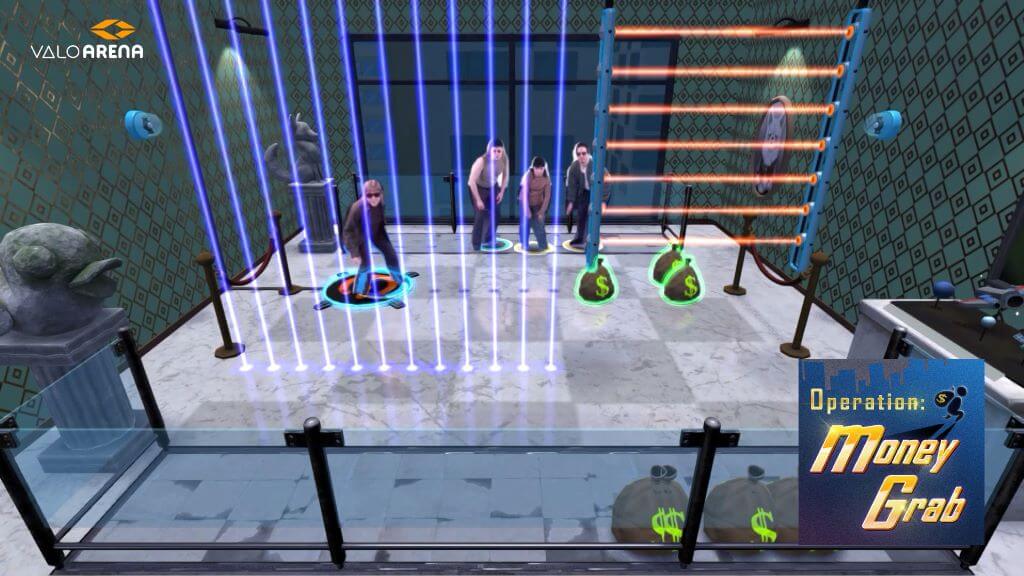
Recruit a team of up to six players and attempt to pull off the greatest heist in ValoArena. Be spies or thieves and grab as much money and valuables as you can while outmaneuvering high-tech security systems and evading capture.
Upon entering the game arena, be transported to the lobby of the Museum of Money. Enter the elevator and brace yourself for a highly interactive and mentally stimulating spy adventure. As the elevator door opens, figure out how to get past the unique security system and snatch valuable items. Work as a team to solve puzzles and go through physical obstacles on every floor of the building. Once all floors are cleared, head to the roof of the building, then board the helicopter on standby for your grand escape.
Throughout the game, references to popular spy and heist movies add humor and make you feel like the lead star in a Hollywood film. Download the Valo Motion app to create shareable play videos and release your “trailer” on social media.
Powered by Valo Motion Technology
Like all other mixed reality games for Valo Arena, Operation Money Grab is powered by the proprietary motion tracking technology of Valo Motion. With full body tracking, players can roam freely around the game arena and play untethered without using any wearables.
Large digital screens, visually stunning graphics, and spatial audio create a hyper-realistic virtual environment that immerses players in the game.
According to Lauri Lehtonen, Lead Developer in Valo Motion, the popularity of the game Groundfall, inspired by The Floor is Lava, made their team think of other playground games they could draw inspiration from. Lehtonen recounts,
“We noticed that quite a few of them are played by moving back and forth in a limited space. This gave rise to the idea of designing a game with a series of different challenges players must go through in the ValoArena play area,” Lehtonen said in a press release shared with ARPost. “That idea eventually developed into the espionage and robbery-themed game Operation Money Grab, where the game challenges vary a lot during one game, and the players are taken on a kind of mini-adventure through a building to be robbed.”
Innovative Games That Keep People Active
Along with Astro Blade, Runway Zero, Toywatch Island, and Groundfall, Operation Money Grab highlights Valo Motion’s aim to encourage people to lead active and healthy lives through interactive experiences. “Valo Motion takes great pride in developing ValoArena experiences that get people on their feet and moving,” said Raine Kajastila, CEO and founder of Valo Motion.
By creating innovative games that are entertaining and highly interactive, Valo Motion hopes to make it easier and much more fun for people to develop and maintain healthy habits. We expect to see its game library grow with more themed games that would pique the different interests of players of all ages.
It is generally assumed that the VR and XR industry managed to weather the pandemic quite well. However, not all virtual reality endeavors benefited equally. For location-based entertainment (also LBE or LBVR for short), the pandemic had devastating effects.
Even with the social distancing measures and disinfection protocols, the idea of sharing headsets inside a busy venue did not seem very appealing, and just like cinemas, most had no choice but to shut down.
The biggest casualty of that time had to be The Void. They were considered pioneers and one of the biggest players in the LBE space, so their closure and subsequent bankruptcy were seen by many as a grim indication of what was to come.
However, just like with cinemas, location-based destinations are back in business. And while The Void is still closed down (with rumors it might reopen sometime soon), most LBEs are already back on their feet, together with a whole cast of new players, big and small, all interested in exploring this new, emerging frontier.
VR Unleashed
It seems location-based venues continue to attract fun-seekers for a variety of reasons. One is that they offer a high-fidelity experience. Users can walk around freely without the need for gamepads or any other artificial locomotion. Experiences are designed with immersion in mind, taking full advantage of VR as a medium in a way that cannot be replicated at home. This can be especially powerful when experienced by newcomers who’ve never encountered VR before.
Another reason is the social aspect of LBEs. Whether it’s a group of friends or a family, it’s all part of a shared adventure, similar to cinemas, arcades, and many other leisure activities. Booking, getting to the venue, gearing up, and having a chat afterward are all part of this ritual.
Given all of this, it makes sense that, despite the pandemic, LBEs have managed to find an audience again.
But enough theory, time to look at LBEs in practice! I had a chance to try three of the more popular venues. They all have a slightly different approach. Here are my impressions.
1. Dreamscape Immersive
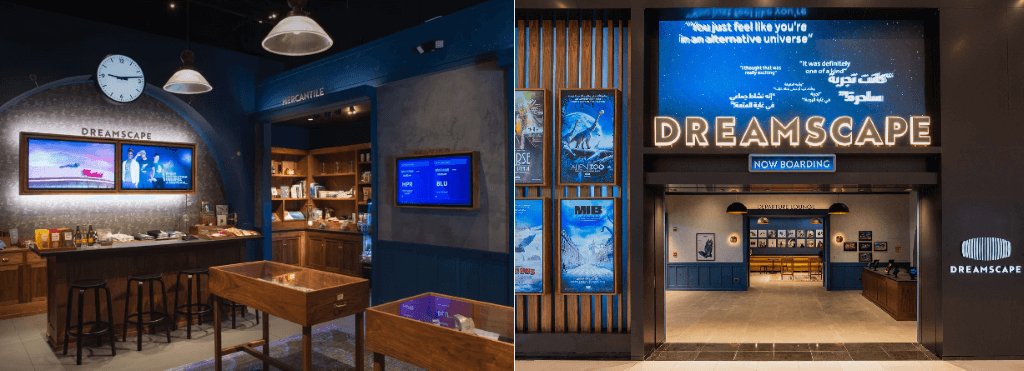
Dreamscape Immersive has currently six centers, three in the United States and the other three in Dubai, Riyadh, and Geneva. Looking at the interior, it’s obvious Dreamscape aims to create a cinema atmosphere. Movie-like posters advertise available experiences, screens inform of the next showings and a sizable cafeteria allows for a place to sit down and relax before the onboarding.
I had the opportunity to participate in the Curse of the Lost Pearl — an Indiana Jones-inspired adventure where you embark on a mission to find an ancient pearl deep in the catacombs of what looked like either a Mayan or Aztec pyramid.
Dreamscape Immersive uses trackers for motion control, one for each hand and one for each foot, as well as laptop backpacks. They also make good use of tracked props. Participants can expect to carry tracked items light torches or the aforementioned lost pearl.
In fact, right from the start, we were asked to push a lever that existed in both the virtual world (as an interactive element) and in the real world (as a feedback prop). This immediately helped blur the distinction. Next, we had to step through the projector, which turned out to be a portal — another clever trick that created a sense of awe as the horizon suddenly expanded miles into the distance.
Dreamscape Immersive scripts feel very engaging and creative. At some point, you might be asked to wave to your pilot. At other points, you’ll get separated. Their venues feature floor which has motorized elements that provided rumbling and trembling during descent. There are also other immersive elements such as wind, heat, or water.
The Curse of the Lost Pearl has no shooting in it. Users can expect scares and traps, but it’s meant to be cinematic first and foremost. It does, however, allow for a bit of flexibility. In my case, for example, at one point, I took a torch from another participant and ended up carrying two. Location-based experiences are always a bit unpredictable as we all react differently, so it’s nice when everything behaves the way you would expect it to, even when things go off script.
Thanks to a technique called “redirected walking”, participants feel like they traverse large distances when, in fact, everyone is walking in circles. Moving platforms, elevators, impossible geometry all of those can be used to make us forget our real-world bearings.
Technically, it would be nice to see higher-fidelity avatars. They all looked a bit lifeless and crude compared to the rest of the experience. Also, our feet didn’t track nearly as well as our hands, resulting in some awkward walking animations, but those were the only real issues I had.
2. Zero Latency VR
Zero Latency VR is a well-known company in the LBE space. They currently have 70 venues in over 26 countries and target intense, gaming-like scenarios.
I had a chance to try two of their adventures. One zombie-themed is aptly called Zombie: Outbreak Origins and the other one is a well-received Far Cry: Dive Into Insanity, which is based on a popular gaming IP. It features arguably the most recognizable character in the entire franchise — Vaas Montenegro.
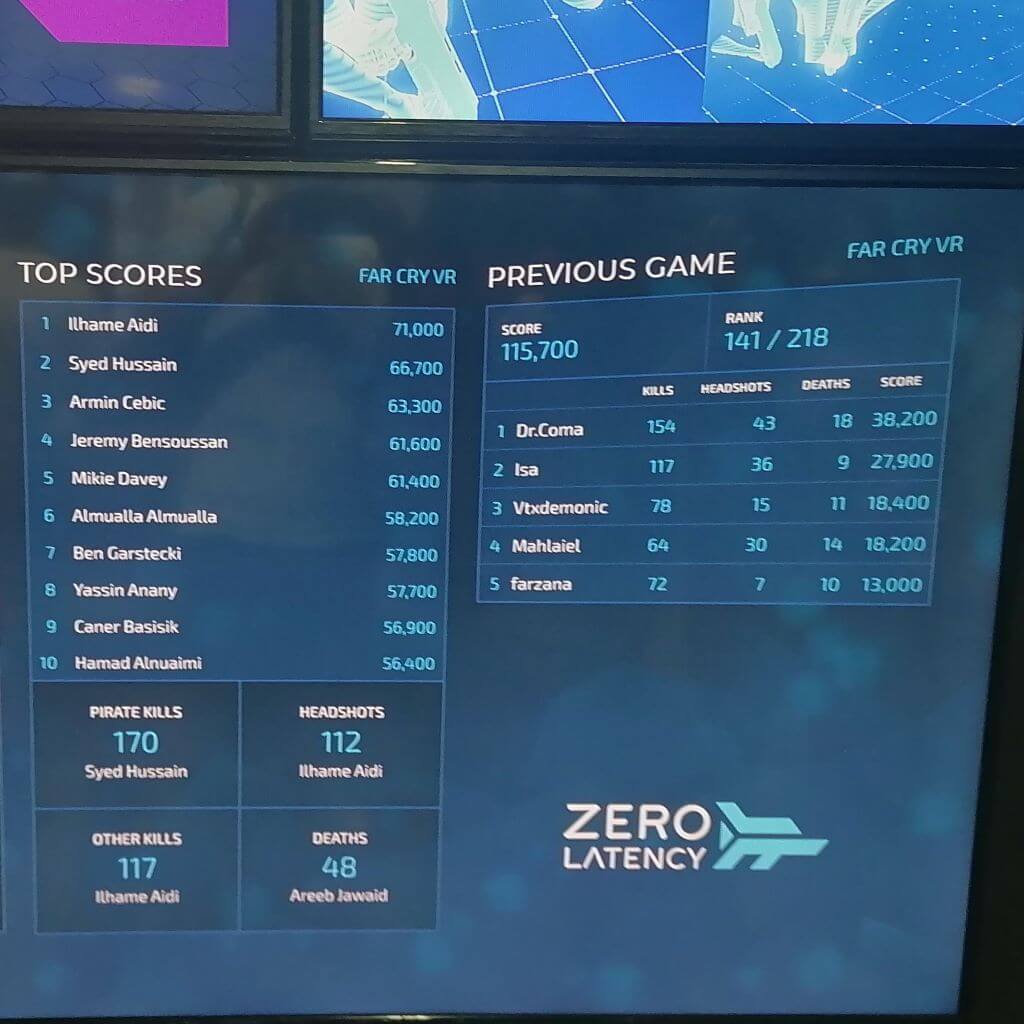
Zero Latency experiences focus primarily on action and shooting. You wear a backpack but throughout the whole game, you will only need to hold one prop: the gun. Same with onboarding, it mostly focuses on how to reload and fire. There are other game-related mechanics as well, such as respawning, points, and leaderboards.
Far Cry VR made us feel like we were doing great, even though we actually scored 141st
Zombie: Outbreak Origins is pretty much a non-stop shootout between you and the undead. Far Cry VR, on the other hand, features storyline elements, where participants end up captured by Vaas and thrown into what looks like a world of hallucinations. The shooting remains the key component, but thanks to these intermissions, it makes the experience much more intriguing and also helps glue all the action scenes together.
Like many other LBEs, Zero Latency takes advantage of redirected walking, making users traverse the large-scale arena in redirected patterns while the action keeps moving onward in VR.
In my case, I found Far Cry VR to be rewarding and even thought-provoking, but Zombie: Outbreak Origins was fun as well, simply because you roam this big virtual world on foot, making the immersion so much more profound.
3. Divr Labs
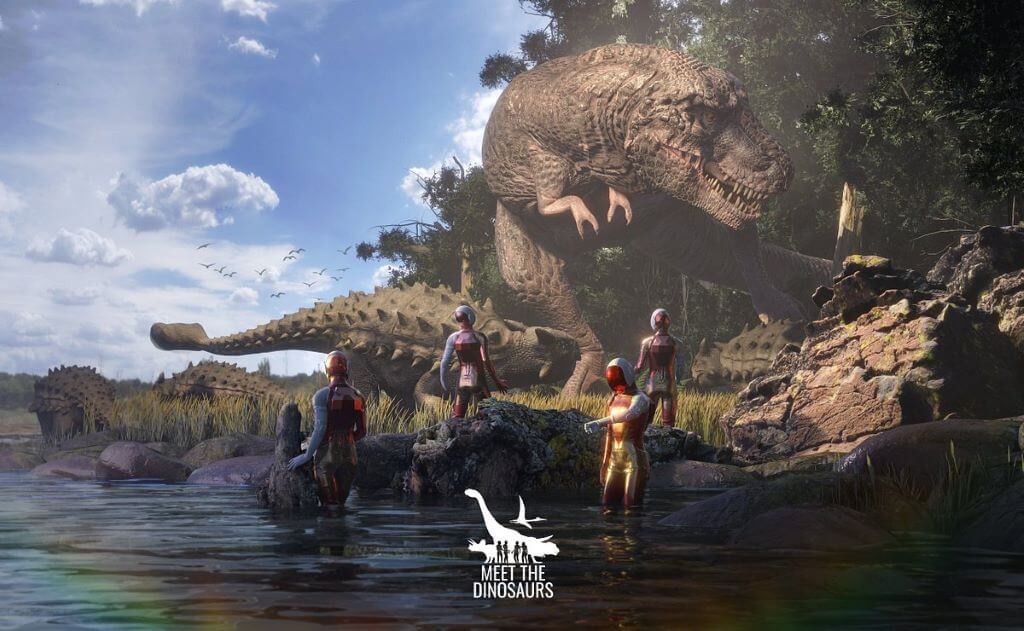
Divr Labs was founded in 2016 and its arenas are currently available in three locations: Prague, London, and Stockholm. I had a chance to try their prehistoric adventure titled Meet the Dinosaurs, where you become a time-traveling scientist on a mission to collect some data from 80 million years ago.
What makes Divr Labs stand out is the graphical fidelity of their experiences. The prehistoric jungle, along with its inhabitants, feels high-quality and very realistic. Divr Labs decided to forgo props or guns, opting instead for hand tracking. As a result, everything feels very intuitive. There is no fighting or shooting and instead, participants are asked to gather as much data as possible in the form of specimens, plants, leaves, eggs, and so on. It’s a bit of a game of hidden items.
The story elements were pretty straightforward and there is no plot, other than you being a scientist from the future. Moreover, all the dinosaurs and environments remain true to our current understanding of the Mesozoic Era which makes the experience somewhat educational.
In my case, I really enjoyed the hand tracking aspect of the experience. I could move my hand past things like grass or leaves and the leaves would waggle accordingly. It felt convincing, even though my hands were not receiving any feedback. Collecting hidden items was done by opening my hand over various specimens, which triggered a download animation around my palm.
Towards the end, I had a face-to-face encounter with a T-Rex, plus a virtual photo as my scientist avatar before it was time to leave VR and off-board. I was also given their personal score based on the amount of data collected, which is a nice touch for those planning to go again.
Unfortunately, my experience wasn’t without hiccups. At some point, my hand tracking stopped working. Instead of focusing on the world around me, I anxiously waited for the issue to get fixed. Despite restarting tracking, the issue persisted, which left me without tasks to do and without any interactive elements. Online, some users complained they had missing audio and encountered other technical problems. These aren’t design issues as such, but suggest focus should be on quality assurance so that every experience is always great.
More to Come
Location-based entertainment is not limited to cinematic and gaming entertainment. There are museums, art exhibitions, and other truly amazing free-roaming LBE venues out there, such as the massive, over 1,150m2 (over 12,000 ft2) Space Explorers: The Infinite where participants get to spend one hour in a full-scale replica of the International Space Station.
In the coming years, LBE venues will continue to offer the most refined and sophisticated VR experiences available. They allow people to try virtual reality without the risk of the so-called ‘well-poisoning’, which is an insider term for when someone’s first experience with virtual reality is so inadequate that it effectively kills their interest forever. That was the argument often leveraged against very cheap cardboard and smartphone headsets.
Location-based entertainment is the opposite of that. You can say it sweetens the well by making people immediately aware of the potential of VR and making them curious about what else virtual reality has to offer. It serves as a great ambassador for the entire industry.
About the Guest Author(s)
Mat Pawluczuk
Mat Pawluczuk is an XR / VR writer and content creator.
First unveiled at CES 2022 early last year, Canon has now taken its first step into consumer VR software with Kokomo, its fledgling social VR platform. Compared to more full-featured collaboration apps, Kokomo isn’t there yet, but it’s a start in a new direction for Canon, which up until now has been mostly focused on XR hardware aimed at enterprise.
The Japanese optics and imaging giant announced that early access to its Kokomo social collaboration software for Quest 2 is now available in beta in the US and Canada.
If you didn’t hear about it at CES 2023 back in January where it had a pretty big outing, here’s how it works: you first use a mobile companion app to scan your face while making several expressions to generate a model of your head. Combined with the camera on your phone, you invite a friend to jump into Kokomo’s social VR environment where your avatar is essentially a mixed reality projection of you, replete with that face scan you did earlier to cover where the Quest 2 would normally obscure your eyes.
Realistically, the app still needs a lot of work. There are only a few virtual environments, which although plush, are simple backgrounds without much utility beyond looking nice. Moreover, the face scanning and projection on the mixed reality avatar feels a little too uncanny to give that face-to-face vibe the Japanese tech giant is going for right now. The fail state of Kokomo’s headset replacement is pretty funny too, as your mug can sometimes end up pasted awkwardly in mid-air.
Kokomo failing to position a face scan correctly | Image courtesy TechCrunch
Granted, it’s still in open beta, so we’re hoping to see some improvements in the near term before considering it over professional collaboration apps like Meta’s Horizon Workrooms, Spatial or Immersed.
And why Canon? The Japan-based company accounts for nearly half of all global camera sales, putting it in a good position to look for ways to integrate its high-quality optics in service of metaverse immersion. For now, it’s far from the most functional social collaboration tool we’ve seen, although the company’s commitment to sidestepping some of the inherent weirdness of avatars today (Zuckerberg has fake legs for you) by using what you already have in your pocket may show some real results with time.
Contrasted with something like Google’s Project Starline, which provides a stereo correct 3D chatting experience thanks to its host of sensors, light-field display, spatial audio, and computer vision—more akin to a telephone booth from the future—Canon’s Kokomo certainly takes accessibility to heart.
On the flipside, Canon has a number of XR devices which are largely focused on the Japanese enterprise market. Its most recent MREAL mixed reality headset is still very expensive—think 10s of thousands of dollars—making Kokomo the first step in an entirely new direction for the company.
We’ll be checking in on Kokomo as it progresses in the coming months. In the meantime, you can try it out for yourself by downloading the free app on Quest’s App Lab, and free companion app for either Android or iOS device.
Ioanna is a writer at TNW. She covers the full spectrum of the European tech ecosystem, with a particular interest in startups, sustainabili Ioanna is a writer at TNW. She covers the full spectrum of the European tech ecosystem, with a particular interest in startups, sustainability, green tech, AI, and EU policy. With a background in the humanities, she has a soft spot for social impact-enabling technologies.
The UK’s competition regulator has blocked Microsoft’s $68.7bn acquisition of Activision Blizzard, the maker of world-renowned games including Call of Duty and World of Warcraft.
The Competition and Markets Authority (CMA) said it’s concerned that the deal would tamper with the future of the rapidly-growing cloud gaming market, resulting in reduced innovation and fewer choices for UK gamers.
According to the CMA, Microsoft, which already accounts for an estimated 60% to 70% of the global cloud gaming market, would further increase its advantage by making some of the world’s most popular games exclusively available on its own platforms.
The regulator also noted that without the merger Activision would start providing games via cloud platforms, which, in turn, would enable gamers to choose how they play without the need to buy expensive gaming consoles, such as Microsoft’s Xbox.
“Microsoft already enjoys a powerful position and head start over other competitors in cloud gaming and this deal would strengthen that advantage giving it the ability to undermine new and innovative competitors,” said Martin Coleman, chair of the independent panel of experts who conducted the deal’s investigation.
“Cloud gaming needs a free, competitive market to drive innovation and choice. That is best achieved by allowing the current competitive dynamics in cloud gaming to continue to do their job,” he added.
In response, Microsoft’s vice-chair and president Brad Smith said that the company remains “fully committed” to the acquisition and plans to appeal.
We remain fully committed to our acquisition with @ATVI_AB and will appeal today’s determination by the CMA. Here’s our statement. pic.twitter.com/ylvDP5RUqQ
In an email to Activision’s employees, CEO Bobby Kotick noted that this is “far from the final word on this deal,” stressing that it would boost the broader UK tech force and players around the world. The company characterised CMA’s decision as “disservice to UK citizens, who face increasingly dire economic prospects”, adding that “the UK is clearly closed for business.”
The CMA is only the first of the three regulators that need to approve the deal for it to go through, but its decision might also impact the following respective bodies in the EU and the US. If the deal fails, Microsoft will have to pay a break fee of $3bn.
Get the TNW newsletter
Get the most important tech news in your inbox each week.
Thomas is a senior reporter at TNW. He covers European tech, with a focus on deeptech, startups, and government policy. Thomas is a senior reporter at TNW. He covers European tech, with a focus on deeptech, startups, and government policy.
The EU’s latest crackdown on big tech is taking shape. The bloc yesterday released a list of companies that must adhere to the strictest rules of the landmark Digital Services Act (DSA).
The 17 platforms and two search engines reach at least 45 million monthly active users. All of them have four months to comply with the full obligations of the DSA.
The services are now mandated to mitigate their systemic risks and establish robust content moderation (this means you, Elon). They range from banning ads that target sensitive user data to special risk assessments for mental health impacts. Violations can be punished with fines of up to 6% of a company’s global turnover.
According to the EU, the new rules are designed to empower and protect people online.
“The whole logic of our rules is to ensure that technology serves people and the societies that we live in — not the other way around,” said Margrethe Vestager, Executive Vice-President for a Europe Fit for the Digital Age.
“The Digital Services Act will bring about meaningful transparency and accountability of platforms and search engines and give consumers more control over their online life. The designations made today are a huge step forward to making that happen.”
Here are the 19 services that have been designated:
The rulings are another milestone in the EU’s mission to lead the world in tech regulation. Still, that doesn’t mean the union is above marking the moment with a cringe pun.
“Today is the D(SA)-Day for digital regulation,” said Thierry Breton, Commissioner for Internal Market. “The countdown is starting for 19 very large online platforms and search engines to fully comply with the special obligations that the Digital Services Act imposes on them.”
Over to you, tech barons.
Get the TNW newsletter
Get the most important tech news in your inbox each week.
Thomas is a senior reporter at TNW. He covers European tech, with a focus on deeptech, startups, and government policy. Thomas is a senior reporter at TNW. He covers European tech, with a focus on deeptech, startups, and government policy.
A startup claims to have launched a world-first AI speech-to-speech translation system.
The tool, called Aivia, was developed by Interprefy, a Zurich-based provider of translation services. The firm focuses on interpreting meetings and events — a market being turbocharged by globalisation.
As interactions spread across borders, they can become harder to understand. Although English is the language of international business, it’s only spoken by an estimated 17% of the world. The remainder is often excluded from the conversation.
Interprefy supplies a way to remove this language barrier — and the demand seems strong. In the eight years since the company was founded, Interprefy says it’s supported over 50,000 meetings. They range from remote press conferences at the Euro 2020 football tournament tointerviews with astronauts at the International Space Station.
Aivia was designed to expand this client base. At the touch of a button, the service translates speech into audio and captions in real time. Interprefy claims it’s the first-ever advanced automated speech translation service for online and live events.
“Many organisations and events lack the budget to book professional interpretation.
Oddmund Braaten, Interprefy’s CEO, has grand ambitions for Aivia. He wants the tool to finally make simultaneous translations mainstream.
“Over the last eight years, our remote interpreting technology has helped democratise access to these services greatly and has seen wide adoption, especially during the Covid era,” Braaten tells TNW.
“But we’ve still seen many organisations and events lacking the budget to book professional interpretation. That’s why we developed a service that provides affordable real-time translation as well as the flexibility and support needed to ensure a seamless multilingual user experience.”
Braaten is bullish about the results. He believes Aivia is the most accurate and flexible AI speech translator on the market.
Braaten was promoted from COO to CEO at Interprefy last year.
Under the hood, Aivia integrates three main AI technologies: automatic speech recognition, machine translation, and synthetic voice generation.
To enhance their outputs, Interprefy built a benchmarking toolkit to evaluate the best AI for every language combination. The company also uses a glossary extraction tool to further customise Aivia for each event. This preps the system with relevant keywords and hard-to-catch names or abbreviations from pertinent content.
According to Braaten, this approach addresses two shortcomings in real-time speech translation: inconsistent results and the needs of event organisers.
“We believe we’ve solved both pain points,” he says. “Because we’ve been supporting events of all shapes and sizes for nearly a decade, we have the expertise to support event organisers hands-on. We’ve also built a solution that can benchmark leading AI solutions to use only the best-performing AI technologies available on the market.”
Initially, Aivia will be available in 24 languages and regional accents. Both in-person audiences and platforms such as Microsoft Teams, Zoom, and ON24 can use the service.
Interprefy plans to add many more languages in the near future — and with good reason. Globally, an estimated 30% of internet users now use online translation tools every week — but real-time speech interpretation remains a challenge. Aivia offers a new solution to the problem.
Aivia arrives amid rapid advances in AI translation. Last year, an Italian interpretation company predicted that machines will surpass the top human translations by the end of the decade.
Naturally, the progress raises concerns about the future prospects for the profession. Braaten argues that AI and humans can play complementary roles.
Only skilled linguists, he says, can translate the subtleties of context, tone, humour, and idioms. Furthermore, they’re the only safe option for sensitive content.
“Interpreters have the unique ability to adapt their translation to every scenario, as well as being able to paraphrase and interpret non-spoken information such as body language and tone of voice,” says Braaten.
“These are qualities that AI simply cannot replicate and are especially important for higher-level communication such as board meetings, legal meetings, or diplomatic conversations.”
AI, meanwhile, is better suited to situations in which nuance is rare and risks are low. In these scenarios, machine translations can provide a more affordable and practical alternative.
Yet for live events and meetings, simultaneous interpretation remains a niche service. Braaten hopes Aivia’s accessibility can change that.
Get the TNW newsletter
Get the most important tech news in your inbox each week.
While one report is not indicative of a trend, job growth, and low unemployment rates are positive indicators of a strong market. To keep up with this growth, businesses must implement solutions that streamline recruitment processes and facilitate faster onboarding.
According to David Chen, CTO and co-founder of a company that makes 3D cameras and depth sensors, Orbbec, VR training is going to be critical to the continued growth of the job market. We talked to him about the role VR training will play in the growing job market and how businesses can leverage this technology to their advantage.
The Role of VR Training in the Growing Job Market
VR training has gained popularity in the business world due to its ability to help new employees acquire skills quickly and efficiently. According to Chen, traditional training methods can be complex with multi-step operations, which are harder to remember and even dangerous in certain industries.
However, VR enables hands-on experiences that are safe and engaging. “VR enables hands-on experiences that risk neither raw materials, equipment nor personnel. Headsets and projectors give trainees real, immersive guidance on what to do, and what not to do,” Chen told us in a written interview. “Unexpected scenarios can be posed at will and because there is no incremental cost for repetition, skills are learned faster.”
In fact, a PwC study found that employee training can be up to four times faster when using VR courses rather than traditional classroom training. What takes two hours in a classroom setting can be learned within 30 minutes using VR.
Chen continues that compared to other emerging training technologies such as augmented reality and gamification, VR training provides a more holistic experience that combines hard and soft skills training. AR training may be more suitable for businesses looking to perform micro-training, focusing on one definable concept, idea, skill, object, or process. On the other hand, VR training puts trainees in a completely digital world, allowing for less repercussion in the physical space while learning a new task.
Honeywell, for instance, has been using VR training for years to train plant operators and field technicians. Its VR training simulator, the Immersive Field Simulator, generated skills retention that is twice as high as previous training methods, leading to a more engaging training program for younger generations of workers. Last year, the simulator was enhanced with new capabilities to meet a broader spectrum of training and development requirements.
Bank of America also launched a VR training program in 2021 to simulate client interactions and practice routine tasks. The pilot program reported that 97% of the employees who went through the simulations felt more comfortable performing their tasks afterward. Now, the VR program is being used by around 50,000 employees in nearly 4,300 financial centers across the country.
These and more examples show that VR training is proving to be a valuable tool in helping businesses train new employees quickly and efficiently while minimizing risk and increasing skills retention.
Challenges Businesses Face in Implementing VR Training
Implementing VR training in businesses is not without its challenges. According to Chen, content creation is one of the primary challenges businesses face when implementing the technology. “Some scenes can be very difficult to recreate in the virtual realm and not everything can be operated with a VR headset controller,” he explained.
Upfront costs can be another obstacle that business leaders have to overcome. One study by PwC shows that VR content initially requires up to 48% greater investment than classroom or e-learning courses.
To address the challenges businesses face when implementing VR training, Chen suggests that businesses consider the long-term benefits of the technology. They should also be aware of the advancements in VR technology, which have made it more affordable than before. By doing so, businesses can improve their training processes, save time and resources, and achieve a higher ROI.
How Businesses Can Implement VR Training
To successfully implement VR training, businesses should consider starting with a pilot program and selecting a platform with features tailored to their specific needs. “Testing VR training in small batches can help determine what jobs can best be improved upon with the use of VR and how these programs may need to be adjusted to fit participants’ specific needs,” Chen said.
As a 3D camera manufacturer, Orbbec offers necessary solutions that support VR training programs.
3D camera technology helps capture the real environment and quickly transfer it into VR content, providing a more realistic training experience without the need for a controller. By using solutions like this, companies can optimize their training processes and provide their employees with a more effective and engaging learning experience.
Indeed, the future of VR training looks promising, with new applications and use cases that are expected to emerge in various industries and continued advancements in processing power, rendering engines, and display technologies.