Author name: Rejus Almole

revitalising-european-democracy:-ai-supported-civic-tech-on-the-rise

Revitalising European democracy: AI-supported civic tech on the rise

Revitalising European democracy: AI-supported civic tech on the rise

Linnea Ahlgren

Story by

Linnea Ahlgren

According to a study by the International Institute for Democracy and Electoral Assistance (IDEA) released late last week, digital technologies will become an increasing factor in European democracy in the coming decade. This is perhaps not entirely surprising; after all, the pandemic shifted much of our lives into the digital realm, why shouldn’t our political participation?

The report, based on interviews with more than 50 government and industry representatives, finds that the market for online participation and deliberation in Europe is expected to grow to €300mn in the next five years, whereas the market for e-voting will grow to €500mn. The respondents also state that there is a “window of opportunity” for European providers of democracy technology to expand beyond Europe.

Authors of the report further believe that digital democracy technology can support outreach to demographics that may otherwise be difficult to reach, such as youth and immigrant communities. This also includes broader populations under difficult circumstances, such as those brought on by the pandemic and Russia’s war of aggression against Ukraine. 

“In case of war, electronic democracy tools have to be even stronger. Because we understand we have to live for the society and give citizens tools,” said Oleg Polovynko, Director of IT at Kyiv Digital, City Council of Kyiv, and one of the speakers at the TNW Conference 2023

Not without controversy

Digital democracy refers to the use of digital technologies and platforms to enhance democratic processes and increase citizens’ participation in government decision-making. This is also referred to as civic tech (not to be confused with govtech, which focuses on technologies that help governments perform their functions more efficiently).

Examples of tools include online petitions, open data portals, and participatory budgeting systems, where citizens come together to discuss community needs and priorities and then allocate public funds accordingly. 

In a best-case scenario, it has the potential to reinvigorate democracy by allowing citizens to participate from anywhere at any time. In a worst-case scenario, it could be used for disinformation or just plain good old online toxic behaviour. 

Furthermore, the discussion of a potential ‘digital divide – who will benefit and who will be excluded due to access or lack thereof to technology – is not one that is easily settled. 

Inviting AI into collective decision making

IDEA states that there are more than 100 vendors in Europe in the online participation, deliberation and voting sector, most of whom are active on a national level. The majority of those operating internationally are startups with between 10 and 60 employees, but expanding quickly.

Many of these democracy technology platforms have already begun taking advantage of the recent step-change developments in artificial intelligence to introduce new features or enhance existing ones. 

“We foresee a future where citizens and AI collaboratively engage with governments to address intricate social issues by merging collective intelligence with artificial intelligence,” Robert Bjarnason, co-founder and President of Citizens.is tells TNW. 

We advocate for a model in which citizens work alongside powerful AI systems to help shape policy, rather than allowing centralised government AI models to exert excessive influence.

Following the collapse of Icelandic banks in 2008, distrust of politicians was at an all-time high in the Nordic island nation. Together with a fellow programmer, Gunnar Grímsson, Bjarnasson created a software platform called Your Priorities that allows citizens to suggest laws and policies that can then be up- or down-voted by other users. 

Just before local elections in 2010, the open-source software was used to set up the Better Reykjavik portal. Five years later, a poll on the site managed to name a street in the Icelandic capital after Darth Vader (well, his Icelandic moniker of Svarthöfði, or Black-cape, which already fitted well with the names of the streets in the area). 

Of course, there have been much ‘weightier’ decisions influenced by the platform, such as crowdsourcing ideas on how to prioritise the City’s educational objectives.

Thus far, over 70,000 of the capital’s inhabitants have engaged with Better Reykjavik. Pretty impressive for a population of 120,000. Furthermore, Your Priorities has been trialled in Malta, Norway, Scotland, and Estonia. 

The Baltic tech-forward nation has adopted several laws suggested through the platform, which features a unique debating system, crowdsourcing of content and prioritisation, a ‘toxicity sensor’ to alert admins about potentially abusive content – and extensive use of AI. In fact, Citizens.is recently entered into collaboration with OpenAI, and has deployed GPT-4 for its AI assistant – in Icelandic. 

GPT-4 now empowers digital democracy and collective intelligence in Iceland 🤖❤️ Thnx to a collaboration btw @OpenAI, the government, and Miðeind, we’re launching our AI assistant in Icelandic. Thanks @sama, @gdb, @vthorsteinsson, @cohere, @langchain, @weaviate_io & @buildWithLit pic.twitter.com/LNxAAFe2nf

— Citizens Foundation (@CitizensFNDN) March 19, 2023

Don’t worry if the language barrier felt a little steep. Citizens.is has been kind enough to provide TNW with a screenshot of the company’s AI assistant in action from a project in Oakland, California. 

Screenshot of OpenAI chatbot conversation
Credit: Citizens.is

Other examples of civic tech focused companies in Europe include Belgium-founded scaleup CitizenLab, which now works with more than 300 local governments and organisations across 18 countries, and Berlin-based non-profit Liquid Democracy. Liquid’s open source deliberation and collaborative decision-making Adhocracy+ software platform also helps facilitate face-to-face meetings throughout the timeline of participation projects. 

Gaining the trust of the citizen

The main product trends identified in the IDEA study are: artificial intelligence, voting, and administration and reporting. Meanwhile, it also found that it is important to address issues around inclusiveness, data usage, accountability and transparency, and to develop security standards for end-to-end verified voting.

One solution proposed is the introduction of a Europe-wide quality trust mark for democracy technologies. 

“If a citizen can trust the banking application to make transactions, then equivalently our service can be trusted to make the citizen’s voice heard,” stated Nicholas Tsounis, CEO of online voting platform Electobox. “We want people to trust this application because we know that it is there for them to protect the right to speak and vote.” 

Get the TNW newsletter

Get the most important tech news in your inbox each week.

Also tagged with


Revitalising European democracy: AI-supported civic tech on the rise Read More »
spanish-island-builds-‘giant-water-battery’-to-boost-energy-security

Spanish island builds ‘giant water battery’ to boost energy security

Spanish island builds ‘giant water battery’ to boost energy security

Siôn Geschwindt

Story by

Siôn Geschwindt

Gran Canaria is perhaps best known for its sandy beaches, eternal sunshine, and volcanic past. But isolated far from the European mainland, the island relies heavily on imported fossil fuels to power its growing economy — 76% of its electricity comes from burning oil. 

In an effort to decarbonise, the government has been investing heavily in renewable energies to harness the island’s abundant wind and solar resources. In 2022, renewables made up 24% of the island’s energy mix, up from just 12% in 2018. But as more renewables come online, the island faces another problem: storage.   

Last year, the government invested €400m in the Canary Islands’ first-ever energy storage scheme, to stabilise the grid when the wind isn’t blowing or the sun isn’t shining. This project won’t build battery packs, however, but convert two existing dams into one giant water battery.

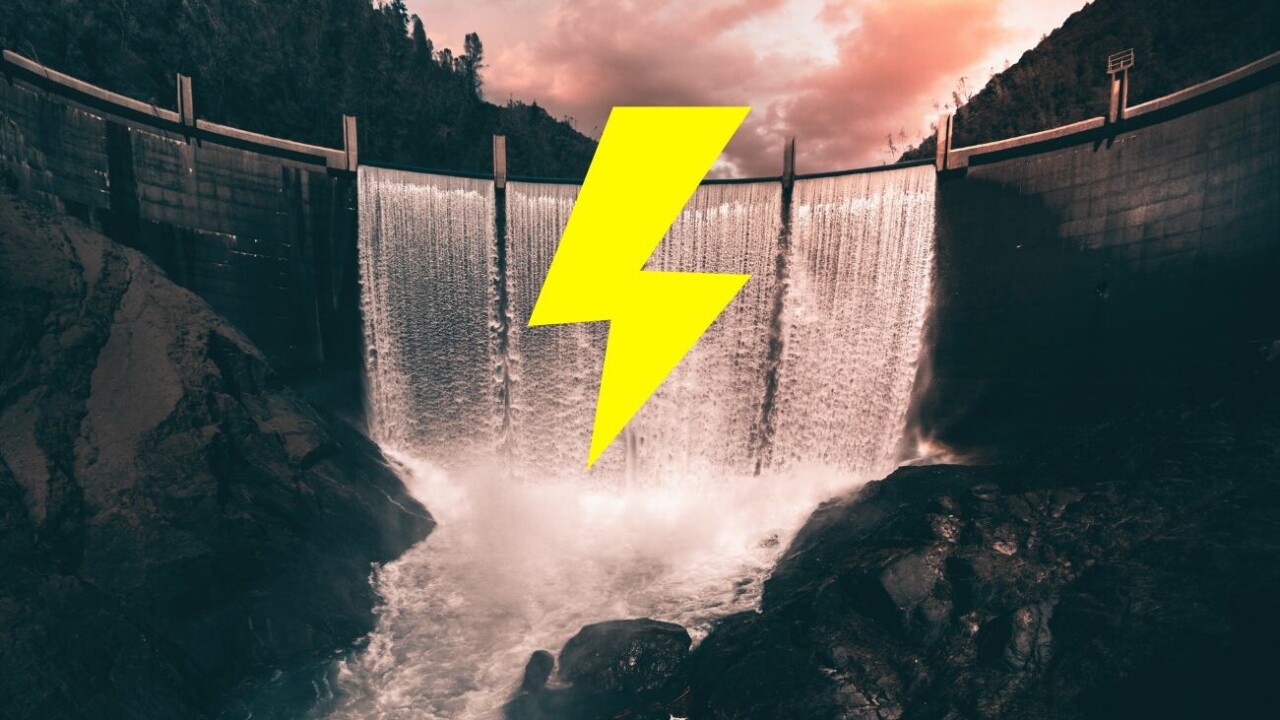
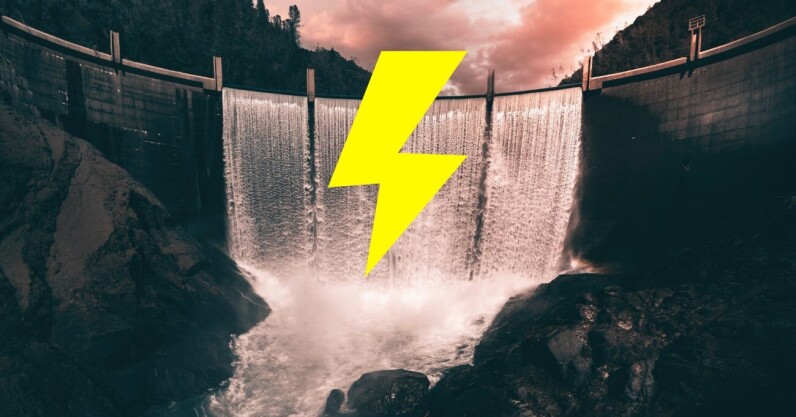
Salto de Chira, as the ‘pumped hydro’ project is known, will pump water from the Soria dam into the Chira dam — which sits at a higher elevation — during periods of low energy demand. During periods of high energy demand, water will be released from Chira, down a tunnel, over a set of turbines, and back into Soria. And the cycle continues.

How pumped hydro works. Credit: MBIE

Pumped hydro is often referred to as a ‘giant water battery’ because it can store and release power on demand. According to the International Energy Agency, it is still the most widely deployed storage technology today, accounting for over 90% of global energy storage capacity. 

When it comes online in 2027, the Salto de Chira project is expected to generate up to 200MW of power at times of high demand, equivalent to more than a third of the island’s needs. Last week, Spain’s grid operator Red Eléctrica selected GE Energy to supply the turbines for the plant, in another step forward for the scheme. 

According to Red Eléctrica,  the project will increase the island’s share of renewables from 24% to 51% and save €122m a year in imported fossil fuel. It is also expected to create more than 4,300 jobs, of which around 3,500 will be on Gran Canaria itself.  

President of the Canary Islands, Ángel Víctor Torres, called the project a “great boost” to the archipelago’s ambitions of fully decarbonising its economy by 2040, ten years ahead of the targets set by the EU. 

“Energy storage is going to be one of the key elements in the energy transition, both for its contribution to electrification and for its capacity to enable enhanced management of renewable energy, which is especially important in non-interconnected systems such as the islands,” he said.  

The Soria dam is the only arch dam built on the Canary Archipelago, and standing at a lofty 132 metres is among the highest dams in Spain.

The Canary Islands has ramped up its decarbonisation efforts significantly in the last five years. The archipelago’s largest renewable energy complex, comprising eight wind farms and 12 solar plants, was inaugurated in 2022 and provides enough energy for around 54,000 households. 

Spain’s government and the European Union also recently announced plans to provide 20m in funding to support the development of 65 new solar projects across the Canary Islands by the end of next year. The archipelago is also exploring alternatives such as wave energy, with the first such pilot project launched in February,led by Danish startup Wavepiston.

Key to the success of all these projects, says one study, will be the deployment of sufficient energy storage solutions to stabilise the grid during peak demand, and the construction of sea cables to connect the islands. Pumped hydro seems to be taking care of the former, while the latter is gaining momentum with the first of many power links now under construction to connect Tenerife and La Gomera. The links are expected to decrease the cost of electricity for taxpayers and improve energy security in the archipelago.  

As European countries decarbonise their energy systems, adopting energy storage solutions to balance the intermittent supply of renewable energy and increase energy security is becoming increasingly urgent. According to the European Association for Storage of Energy (EASE), the EU will need 200GW of energy storage by the end of the decade and 600GW by 2050.  

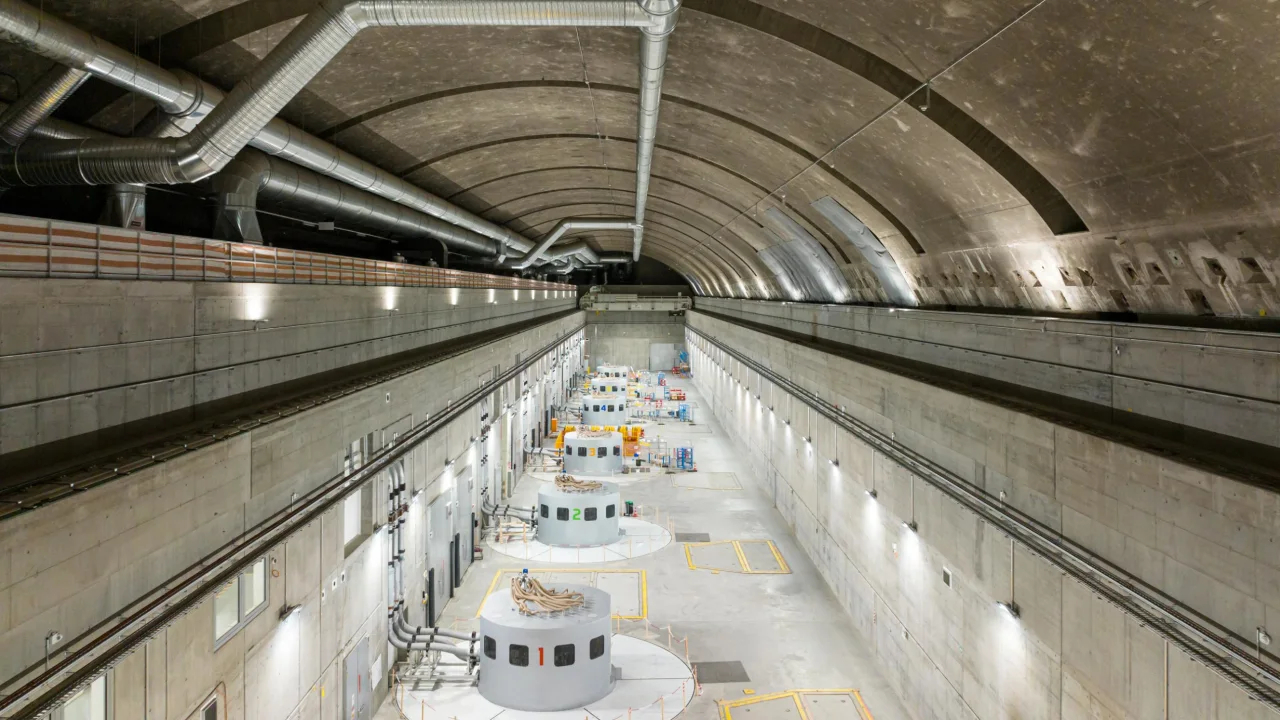
Switzerland is one of Europe’s leaders in pumped hydro technology. This is a view from inside its latest plant, which opened at the end of 2022. The turbines are stored in an underground cavern the length of two football fields. Credit: Nant de Drance/Sébastien Moret

A new industry coalition launched last week aims to promote sustainable energy storage technologies like batteries, hydrogen, and pumped hydro in order to reach these targets. 

“Energy storage is key to building a future-proof, resilient, and decarbonised energy system,” said EU energy chief Kadri Simson at the launch. 

Pumped hydro projects can be controversial, however, particularly when they involve dams on rivers that flood land to create new reservoirs and affect ecosystems. But as highlighted in an article published in The Conversation last year, most pumped hydro projects do not require the building of new dams, but the retrofitting of existing ones, as is the case with the Gran Canaria project.  

Either way, the IEA’s landmark 2021 Net Zero by 2050 report estimates that an additional 1300GW of hydropower is required if we are to meet the climate targets outlined in the Paris Agreement. This is double the current global capacity.

Get the TNW newsletter

Get the most important tech news in your inbox each week.

Also tagged with


Spanish island builds ‘giant water battery’ to boost energy security Read More »

talespin-releases-ai-powered,-web-accessible-no-code-creator-platform

Talespin Releases AI-powered, Web-Accessible No-Code Creator Platform

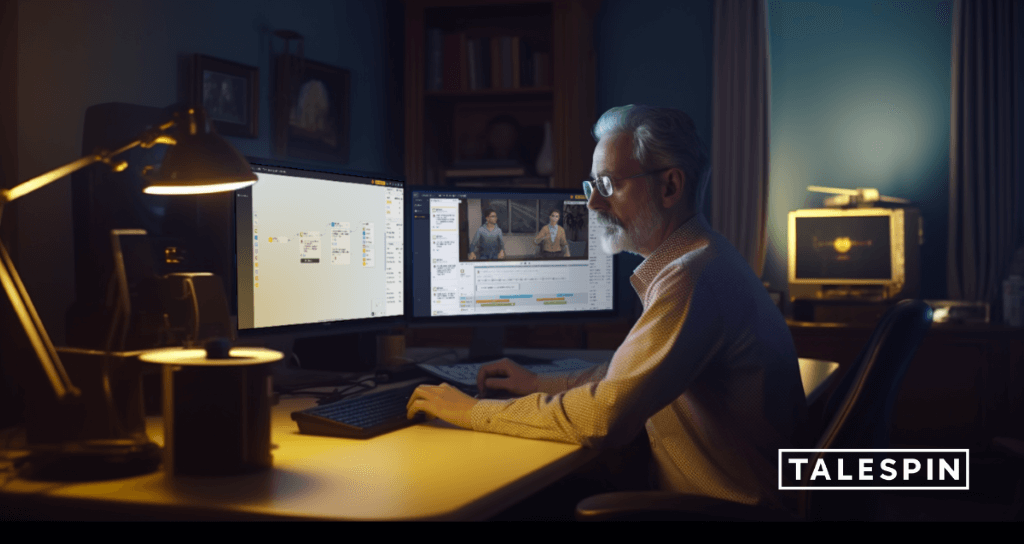
To prepare professionals for tomorrow’s workplace, you need to be able to leverage tomorrow’s technology. Talespin was already doing this with their immersive AI-powered VR simulation and training modules.

Now, they’re taking it a step further by turning over a web-based no-code creator tool. To learn more, we reconnected with Talespin CEO Kyle Jackson to talk about the future of his company and the future of work.

The Road So Far

Talespin has existed as an idea for about ten years. That includes a few years before they started turning out experiences in 2015. In 2019, the company started leveraging AI technology for more nuanced storytelling and more believable virtual characters.

CoPilot Designer 3.0 Talespin

CoPilot Designer, the company’s content creation platform, released in 2021. Since then, it’s gone through big and small updates.

That brings us to the release of CoPilot Designer 3.0 – probably the biggest single change that’s come to the platform so far. This third major version of the tool is accessible on the web rather than as a downloaded app. We’ve already seen what the designer can do, as Talespin has been using it internally, including in its recent intricate story world in partnership with Pearson.

“Our North Star was how do you get the ability to create content into the hands of people who have the knowledge,” Jackson told ARPost this March. “The no-code platform was built in service of that but we decided we had to eat our own dogfood.”

In addition to being completely no-code, CoPilot Designer 3.0 has more AI tools than ever. It also features direct publishing to Quest 2, PC VR headsets, and Mac devices via streaming with support for Lenovo ThinkReality headsets and the Quest Pro coming soon.

Understanding AI in the Designer

The AI that powers CoPilot Designer 3.0 comes in two flavors – the tools that help the creator build the experience, and the tools that help the learner become immersed in the experience.

More generative 3D tools (tools that help the creator build environments and characters) is coming soon. The tools really developing in this iteration of CoPilot Designer are large language models (LLMs) and neural voices.

Talespin CoPilot Designer 3.0

Jackson described LLMs as the context of the content and neural voices as the expression of the content. After all, the average Talespin module could exist as a text-only interaction. But, an experience meant to teach soft skills is a lot more impactful when the situations and characters feel real. That means that the content can’t just be good, it has to be delivered in a moving way.

The Future of Work – and Talespin

While AI develops, Jackson said that the thing that he’s waiting for the most isn’t a new capability of AI. It’s trust.

“Right now, I would say that there’s not much trust in enterprise for this stuff, so we’re working very diligently,” Jackson told ARPost. “Learning and marketing have been two areas that are more flexible … I think that’s going to be where we really see this stuff break out first.”

Right now, that diligence includes maintaining the human component and limiting AI involvement where necessary. Where AI might help creators apply learning material, that learning material is still originally authored by human experts. One day AI might help to write the content too, but that isn’t happening so far.

“If our goal is achieved where we’re actually developing learning on the fly,” said Jackson, “we need to be sure that what it’s producing is good.”

Much of the inspiration behind Talespin in the first place was that as more manual jobs get automated, necessary workplace skills will pivot to soft skills. In short, humans won’t be replaced by machines, but the work that humans do will change.

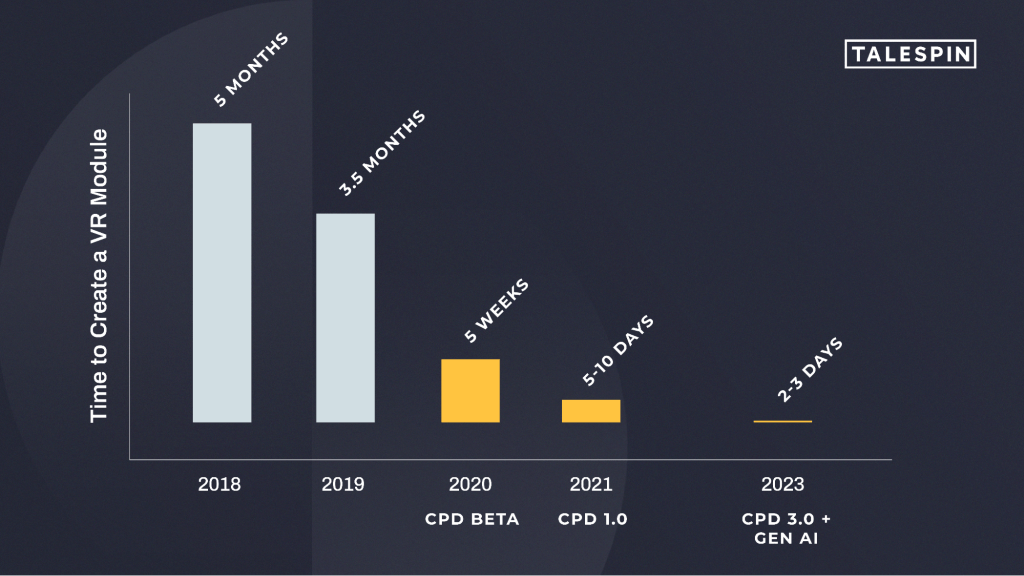
As his own company relies more on AI for content generation, Jackson has already seen this prediction coming true for his team. As they’ve exponentially decreased the time that it takes for them to create content, they’re more able to work with customers and partners as opposed to largely serving as a platform to create and host content that companies made themselves.

Talepsin CoPilot Designer 3.0 - XR Content Creation Time Graph

Solving the Content Problem

To some degree, Talespin being a pioneer in the AI space is a necessary evolution of the company’s having been an XR pioneer. Some aspects of XR’s frontier struggles are already a thing of the past, but others have a lot to gain from leaning on other emerging technologies.

“At least on the enterprise side, there’s really no one doubting the validity of this technology anymore … Now it’s just a question of how we get that content more distributed,” said Jackson. “It feels like there’s a confluence of major events that are driving us along.”

Talespin Releases AI-powered, Web-Accessible No-Code Creator Platform Read More »

an-effort-to-hack-psvr-2-to-support-pc-vr-has-been-put-on-indefinite-hold

An Effort to Hack PSVR 2 to Support PC VR Has Been Put on Indefinite Hold

The creator of a PC VR driver which includes support for the original PSVR 1 headset says it is are stepping away from hacking PSVR 2 to work with PC VR, citing frustrating technical, financial, and social challenges.

Mediator Software, the developer of a PSVR-to-PC SteamVR driver called iVRy, says it is putting efforts to hack PSVR 2 for PC VR compatibility on hold. Just days after saying it had managed to authenticate PSVR 2 on PC, the developer says the project is now on ice.

“I’m walking away from this project for the time being. Between spiralling costs, a never ending set of obstacles put forward by the PSVR2, unrealistic hype in blogs, abusive commenters and accusations of fraud, it has ceased to be fun. I’ll be back. Some time,” reads the announcement.

The creators also shared screenshots showing what kind of social media strife they were facing, apparently with regards to Mediator Software seeking financial support for the project from the community.

Aside from the social challenges, struggling to get PSVR 2 working on SteamVR isn’t surprising. Despite their best efforts, the iVRy developers themselves previously said it was “unlikely” that PSVR 2 would be useable for PC VR “within five years of its release,” if ever.

That’s a shame considering PSVR 2 is one of the market’s best consumer headsets to date, and even has the basic ability to act like a proper display when plugged into a PC.

While we’d love to see PSVR 2 work with PC VR, the reality is that Sony has little incentive to let it happen.


Thanks to our pal Daniel Fearon for the tip!

An Effort to Hack PSVR 2 to Support PC VR Has Been Put on Indefinite Hold Read More »

ea’s-‘f1-23’-racer-coming-to-pc-vr-headsets-next-month,-psvr-2-still-uncertain

EA’s ‘F1 23’ Racer Coming to PC VR Headsets Next Month, PSVR 2 Still Uncertain

Codemasters, the EA-owned developer behind the F1 racing franchise, announced F1 23 is coming to consoles and PC next month, again bringing its high-profile racing game to VR.

F1 23 is coming to PlayStation 4|5, Xbox Series X|S, Xbox One and PC on June 16th, which is confirmed to include VR support on PC.

Codemasters hasn’t said whether it’s also coming to PSVR 2 on PS5, so we’ll just have to wait and see. As it is now, F1 22 only supports PC VR headsets, and not PSVR.

Here’s how the studio describes the upcoming installment:

A new chapter in the thrilling “Braking Point” story mode delivers high-speed drama and heated rivalries. Race wheel-to-wheel at new Las Vegas and Qatar circuits, and earn rewards and upgrades in F1 World. New Red Flags add an authentic strategic element, and the 35% Race Distance feature delivers more action and excitement. Drive updated 2023 cars with the official F1 lineup of your favorite 20 drivers and 10 teams. Create your dream team and race to win in My Team Career Mode, compete in split-screen or in the expanded cross-platform multiplayer, and be more social with new Racenet Leagues.

Preorders are now available, priced at $70 across Steam, Epic Games, and EA Play.

EA’s ‘F1 23’ Racer Coming to PC VR Headsets Next Month, PSVR 2 Still Uncertain Read More »

one-of-vr’s-most-hardcore-apocalyptic-survival-games-is-getting-a-sequel

One of VR’s Most Hardcore Apocalyptic Survival Games is Getting a Sequel

Into the Radius is a cult favorite for a reason, as it offers up some of the most hardcore gameplay in a very Stalker-inspired post-apocalyptic world, making for an absolutely unforgiving experience in the anomaly-ridden wasteland. Now developers CM Games say a sequel is in the works.

In a community update, CM Games says a second chapter to Into the Radius is currently being developed.

“We are in the pre-production phase, and will follow an Early Access development model like before when the time is right,” the studio says. “The original [Into the Radius] is a testament to how much our community has helped us in developing the game, and we want to continue this trend in the sequel.”

The studio says many user suggestions and ideas are currently being considered for the newest installment, although they’re not revealing anything beyond that right now. Into the Radius is currently available on SteamVR and Quest 2. The developers have said in the past that it’s also in development for other headsets, although there’s still no word on whether it’s coming to PSVR 2.

We’ll be following Into the Radius and its upcoming seqeuel via the game’s Discord (invite link), as CM Games is due to publish an FAQ soon that may answer more questions about the next chapter.

One of VR’s Most Hardcore Apocalyptic Survival Games is Getting a Sequel Read More »

‘propagation:-paradise-hotel’-review-–-a-pretty-ok-impression-of-‘resident-evil’

‘Propagation: Paradise Hotel’ Review – A Pretty Ok Impression of ‘Resident Evil’

Propagation: Paradise Hotel offers some patently terrifying moments of horror, but between the ever-lingering danger of zombified attacks and a few giant bosses—making for a very Resident Evil-inspired experience—there’s a bit of clunk that tarnishes what could have been a more memorable and cohesive experience. Still, it’s functionally a pretty solid zombie adventure that makes a clear departure from the franchise’s roots as a static wave shooter.

Propagation: Paradise Hotel Details:

Available On:  SteamVR, Quest

Release Date:  May 4th, 2023

Price: $20

Developer: WanadevStudio

Reviewed On:  Quest 2 via PC Link

Gameplay

It’s the zombie apocalypse, and you’re bumming around the bowels of a non-descript hotel in some non-descript part of the world. You won’t have a lot of time to hang with your fatherly security guard pal though because you have to go and find your sister, who is gone for some reason. Okay, so the setup isn’t spectacular, but at least the zombie kill’n is pretty good, right? I’ll lead with an emphatic “yeah, mostly!”

Rule number one of zombies: shoot them in the head. That’s the ironclad directive you’re probably most familiar with, but there are some caveats in Propagation: Paradise Hotel. Shooting zombies in the head multiple times with a pistol makes them very sleepy. No, really. Shoot a zombie three times in the head and they’ll quietly lay down on the ground for a while. Sometime later, usually when you’ve tripped another lurch forward in the narrative, he’ll pop back up at a patently inopportune time to bother you once again.

As clear of a departure from zombie orthodoxy this is, the effect it had on me was something I can’t say I’ve felt in a zombie shooter before. Instead of worrying about walkers popping out from the ceiling (there are a few) or shambolically oozing out from closed doors or windows, you become much more fixated on every single corpse laying in the hallway, of which there are many. You aren’t roaming through an infinite hellscape either, as you’ll be backtracking, learning the layout of the hotel, and tip-toeing around zombies whilst pointing a gun in their face, lest they reawaken and start harassing you again.

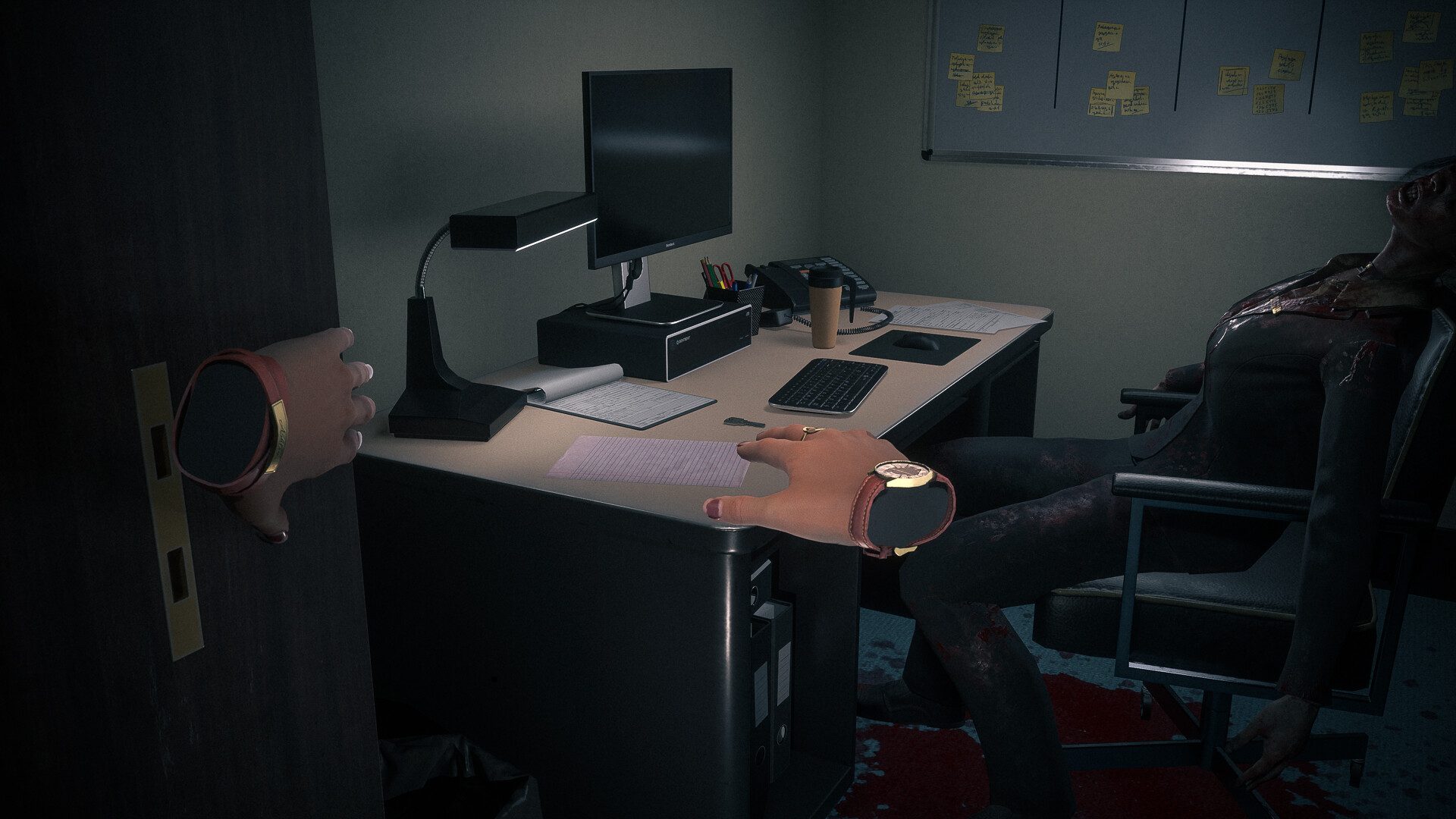
Image courtesy WanadevStudio

In effect, any one of them could be waiting for you to lower your guard, open their eyes and grab onto your ankle. Sadly, a preemptive shot in the head is completely ineffectual, which is a letdown in the Immersion department, but more on that below. Just the same, you’ll be cautious because you can’t discount a single corpse, which is a new type of creepy that really kept me on edge. Knowing this, I would have loved the option to cut off some heads to put an end to the contant revisitations, but that’s just not in the cards.

That’s basically the case until you get a shotgun in the latter half of the game, and then those walkers lay down for good because you’ve effectively stumpified their infected brains (finally). What was previously one-on-one battles ramp up to three-on-one battles, putting the game’s only other gun (and most powerful) to the test. You’ll also start to rush through a few new classes of zombie in addition to some more difficult baddies, which offers some interesting variety in difficulty. Will you run into three walkers? One scorpion-style zombie? A ripped dude that can take a ton of shots to the face?

Image courtesy WanadevStudio

While there are a few difficult and unique zombies, there’s really only one true boss in the game. Full disclosure: I disliked it, and while I won’t spoil anything here, rest assured you’ll probably be frustrated too with how to take him down. He is ultra lame, and you’ll want to mute the game just so you don’t have to hear your character constantly shout ad nauseum “I need to knock him out!”

Ok. No. I will spoil the boss. Skip this paragraph if you want to avoid the spoiler: What does “I need to knock him out” even mean?? Don’t I need to kill this bastard? Do I need to knock him out before I kill him? Is that a hint? Do I need something to do that? Maybe I need to call the elevator and rig up something to knock him out? Maybe I need to escape the lobby and head up the stairs to get something I missed? Maybe I need to explode a fire extinguisher in his face to knock him out? Nope. My hand phases right through those, so it can’t be that. Maybe I need to die a dozen times before I learn he has a specific attack pattern with a singular weak point, hit it three times and meander my way to sequel-bait then the end credits? Yup, that’s it.

Anyway, many of the mechanical bits of Propagation: Paradise Hotel are very functional, and work well. The body-based inventory system isn’t overloaded, so you always have what you need, like a medical spray on your left flank, a flashlight that you can clip to your chest or hold in your hand, your 9mm pistol on your right, or the shogun over your shoulder. It’s all there and easy to grab. This compliments a 2D menu that you can pull up, which as mission-essential items, the map, settings, etc.

It’s not easy changing up a user’s expectation of level design when we all know what to expect more or less in a space as familiar as a hotel. Still, the game throws a few curveballs your way to keep you from mechanically looking through every room in the hotel, which spans seven levels. Still, the story itself didn’t feel like a compelling enough driver to keep you moving forward. The found notes add a little flavor, but don’t do enough to flesh out the background of what’s actually going on, leaving you to mostly just bump your head against each task until its complete so you can move onto the next.

Finally, the game, which took me around 3.5 hours to complete, also includes a few puzzles, although all solutions are published in found notes, so you just have to be thorough in your shelf-opening game.

Immersion

Everything about Propagation looks the part, but very little is actually interactable, making it feel more like a flatscreen game than it probably should. There are a few key items you can pick up and use, but everything else is pure set dressing. I don’t want to underplay just how good the game looks, as it offers a visual acuity and variety that makes each room unique, and not at all the sort of copy-paste experience you’d logically expect from a motif that is basically supposed to look extremely uniform. Still, you can’t grab that fire extinguisher, or even pick up a bottle of detergent. You can only open doors and drawers, and interact with keys, key cards, and important notes.

That already feels pretty gamey enough, but just as things start getting good, you grab for an item and a big achievement pops up to ruin the atmosphere—because apparently you need to be constantly reminded that you just collected nine out of 30 secret items. I’d like my full field of view please, since I’m under constant threat of death and everything.

Image captured by Road to VR

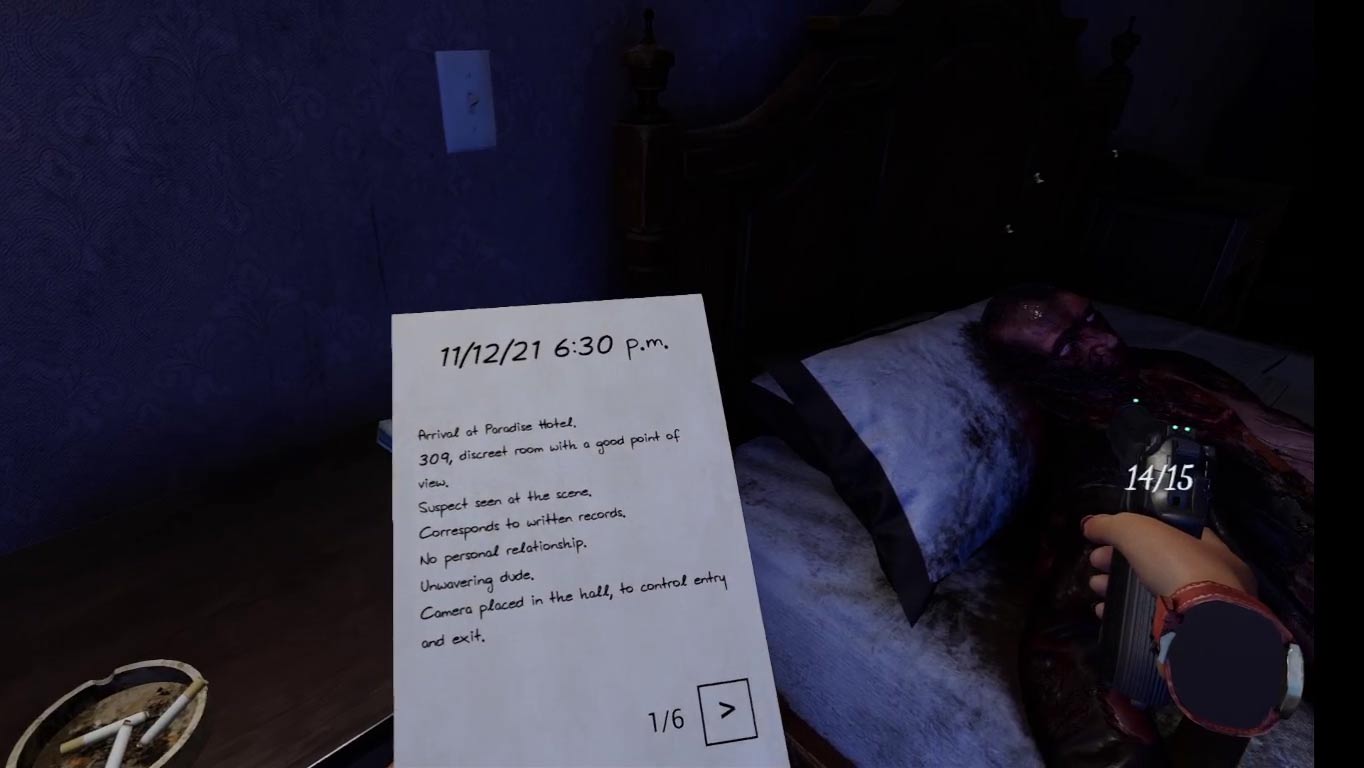
One of the big narrative drivers is the game’s found notes, and I generally like the mechanic for its ability to either drive the narrative or unobtrusively flavor its back story. In VR, they can be especially immersive since you’re handling something that’s more of a physical artifact than just a bunch of text on a screen. This is where Propagation fails somewhat, as all notes feature a physical ‘next’ button at the bottom that you have to click, making it more like interacting with an eReader than something that was actually written by someone who lived, survived, and maybe even died in the hotel.

Maybe the notes could be shorter? Maybe they could have used the back of the paper? Maybe a different font? Whatever the case, interacting with a piece of paper shouldn’t feel this unnatural in a VR game.

Image captured by Road to VR

And the wacky unorthodoxy doesn’t stop there. While reloading weapons is a pretty standard experience, the gun’s ammo counter system is definitely not standard. The number indicated isn’t how many bullets you have in the gun, it’s how many are in the magazine. So, if you have 15 bullets in a fresh mag, as soon as you chamber one, the counter says 14.

That’s all well and good for the pistol, but if you forget it when using the shotgun, you may find yourself in deep dog doo-doo as you unintentionally cycle a live round out of the weapon by mistake. Provided you’ve loaded up the shotgun and chambered a round, you may have 3/4 rounds displayed. Once you’re in a tense battle though, and you’re displaying 0/4, you simply can’t be sure whether that 0/4 means you still have one in the chamber, or you don’t. You’ll load back up, shell by shell, until you’re at 4/4 again, but you don’t have any discernible visual indication whether you still have an empty chamber or not, so you cycle the pump just in case. An unspent shell flies out, lands on the floor, and disappears.

While it’s visually interesting and a mostly serviceable shooter despite those inherent flaws, the cherry on the cake is undoubtedly the game’s voice acting, which was clearly farmed out to native French speakers putting on their best American accents. This ranges from “I went to high school in Ohio for a year and picked up the accent pretty well,” to “How do you do, fellow American?” It’s more of an eccentricity than a knock per se, but it leaves me questioning where the hell I am on planet Earth.

Comfort

As a 100 percent walking-based experience that doesn’t include forced locomotion, like on a rollercoaster or similar vehicle, the game proves to be very comfortable, save a single moment when there is some camera shaking. With a wide range of standard comfort options, most everyone will be able to play Propagation: Paradise Hotel without too much issue.

Propagation: Paradise Hotel’ Comfort Settings – May 8th, 2023

Turning
Artificial turning
Snap-turn
Quick-turn
Smooth-turn
Movement
Artificial movement
Teleport-move
Dash-move
Smooth-move
Blinders
Head-based
Controller-based
Swappable movement hand
Posture
Standing mode
Seated mode
Artificial crouch
Real crouch
Accessibility
Subtitles Yes
Languages

English, Italian, German, French, Spanish, Japanese, Korean, Portuguese, Russian, Simplified Chinese, Polish

Dialogue audio Yes
Languages English
Adjustable difficulty
Two hands required
Real crouch required
Hearing required
Adjustable player height

‘Propagation: Paradise Hotel’ Review – A Pretty Ok Impression of ‘Resident Evil’ Read More »

from-michelangelo-to-robots:-this-startup-is-carving-a-new-era-of-sculpture

From Michelangelo to robots: This startup is carving a new era of sculpture

From Michelangelo to robots: This startup is carving a new era of sculpture

Ioanna Lykiardopoulou

Story by

Ioanna Lykiardopoulou

Ioanna is a writer at TNW. She covers the full spectrum of the European tech ecosystem, with a particular interest in startups, sustainabili Ioanna is a writer at TNW. She covers the full spectrum of the European tech ecosystem, with a particular interest in startups, sustainability, green tech, AI, and EU policy. With a background in the humanities, she has a soft spot for social impact-enabling technologies.

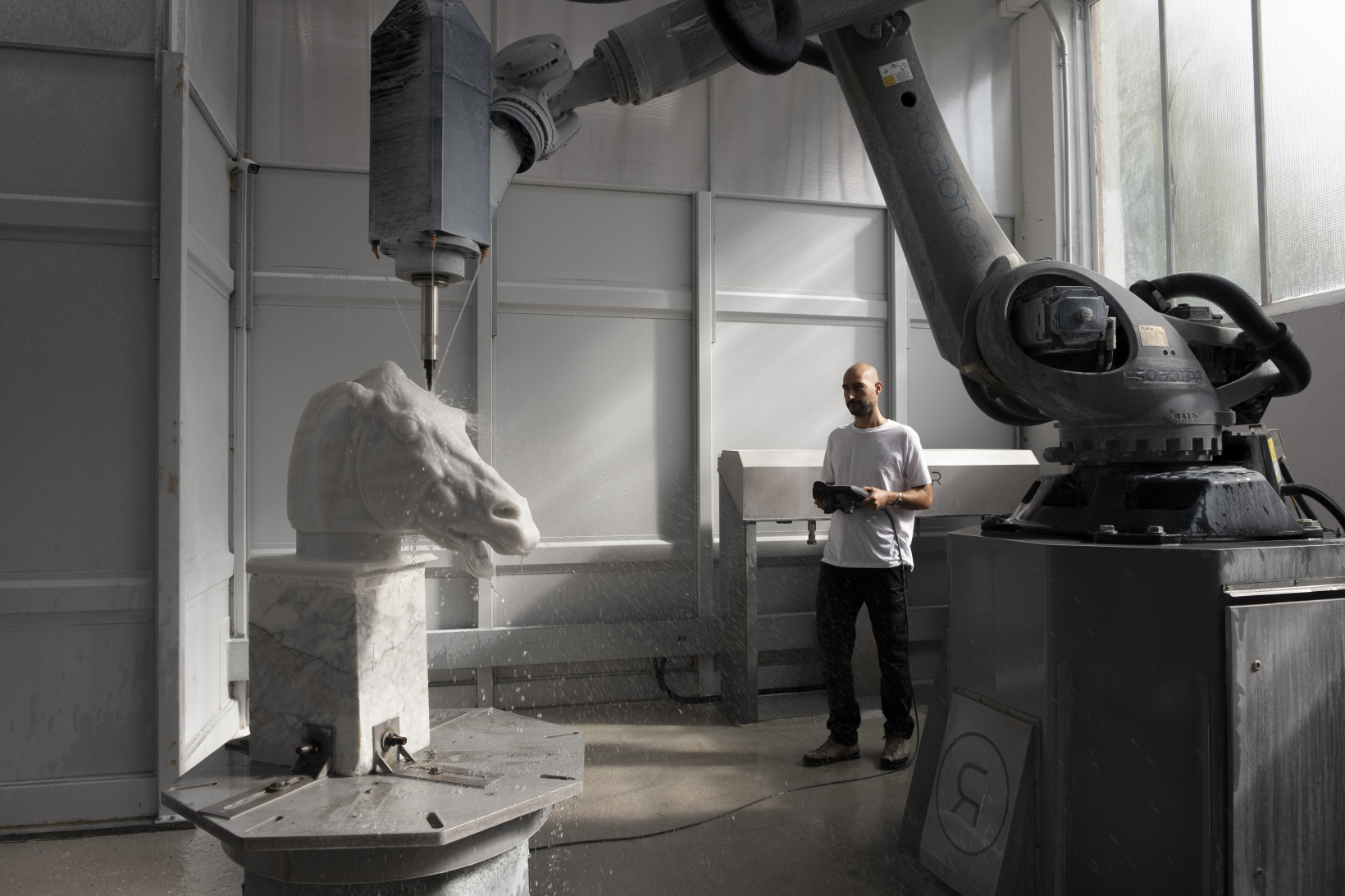
Carrara, the Italian city famous for some of the world’s finest marbles, has given birth to the masterpieces of Renaissance masters, such as Michelangelo and Antonio Canova. Now, right in the heart of the city’s quarry district, a startup aims to carve a new era of sculpture in which robots pick up — or rather become — the chisel.

Founded by Filippo Tincolini and Giacomo Massari, Robotor’s mission is to revolutionise the industry by simplifying the sculpting process with the use of robotics and artificial intelligence. The aim is to make sculpture faster, easier, and more sustainable, while enabling artists to create works that would otherwise be inconceivable.

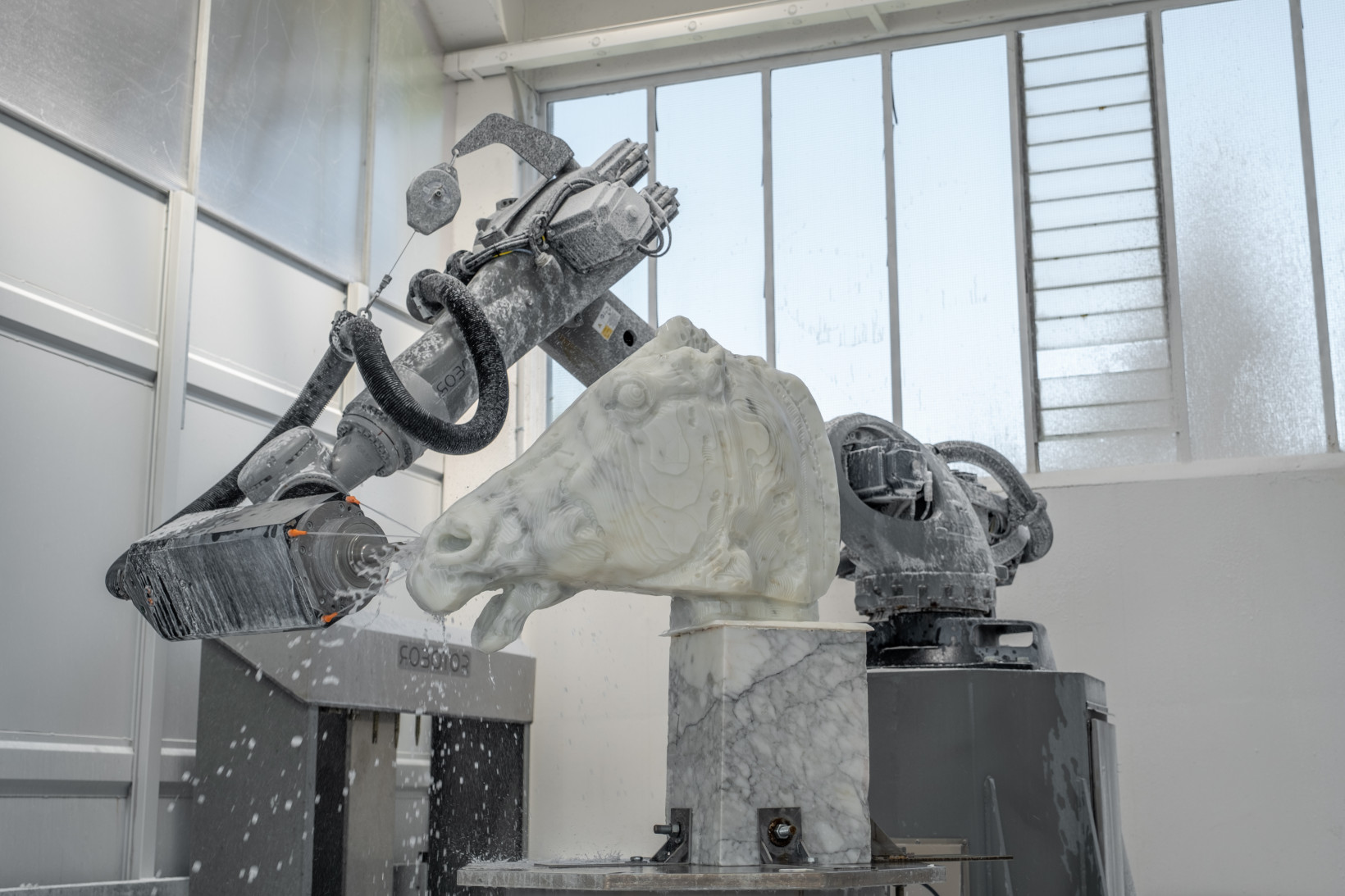
robot creates sculptures of parthenon
Robotor’s machine recreating the Parthenon horse. Credit: Laura Veschi

Drawing from research and the interaction between art, the local area, tradition, and technology, the startup has developed a robot chisel, driven by self-programming software.

It all started in 2004, when Tincolini founded Torart, a company specialising in merging sculpture, contemporary art, and design with the application of new technologies. Torart developed the first robot two years later, and in 2010 Giacomo Massari joined the team as well.

Following increasing orders, the collaboration with world-renowned artists such as Barry X Ball, and the creation of the Arch of Palmyra replica — after the original was destroyed by ISIS in 2015, — the duo founded Robotor in 2019. The size and funding of the company remain undisclosed.

“Our robots are born from sculptors for sculpture,” co-founder Giacomo Massari tells TNW. “They are born from those who perfectly know traditional sculpture in a territory, Carrara, which is the homeland of sculpture.”

Carrara marble
The marble quarries of Carrara. Credit: Laura Veschi

The idea behind their development is “to entrust a robot with tiring work,” Massari adds. “But the entire Robotor project is born from a precise philosophy that is the ‘daughter’ of 18 years of experience in stone processing.”

Putting the robot sculptors to work

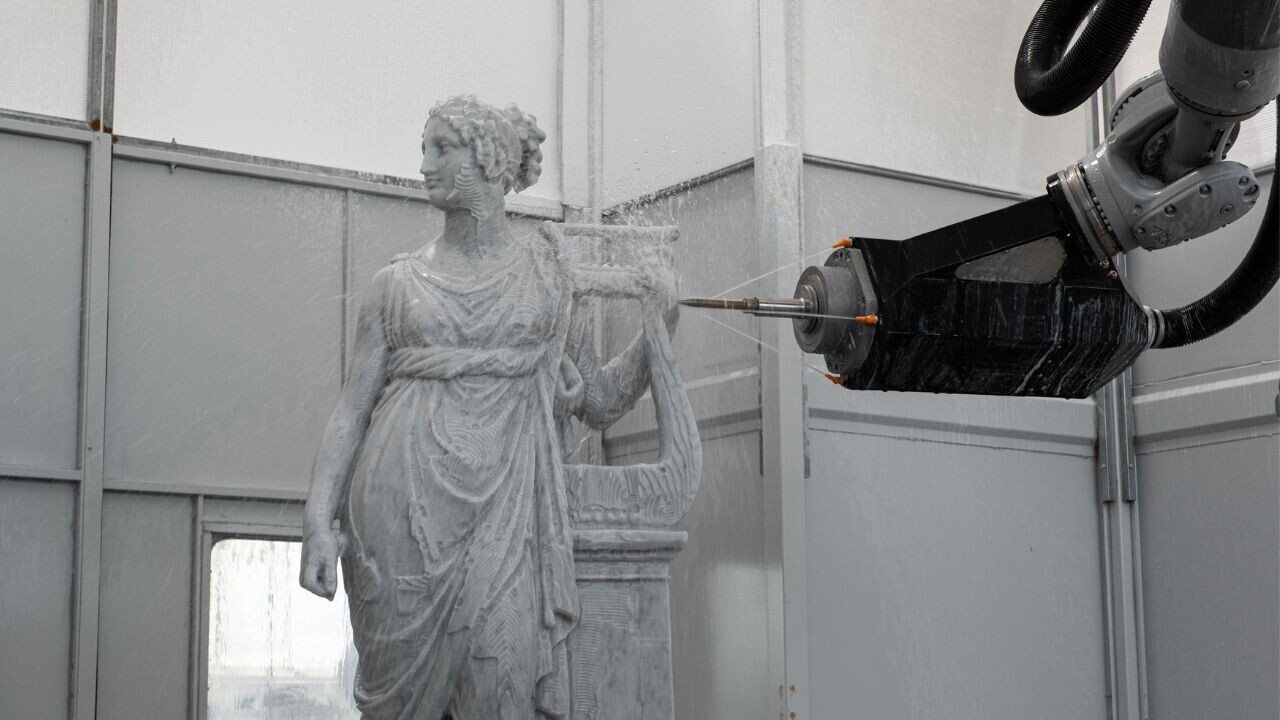
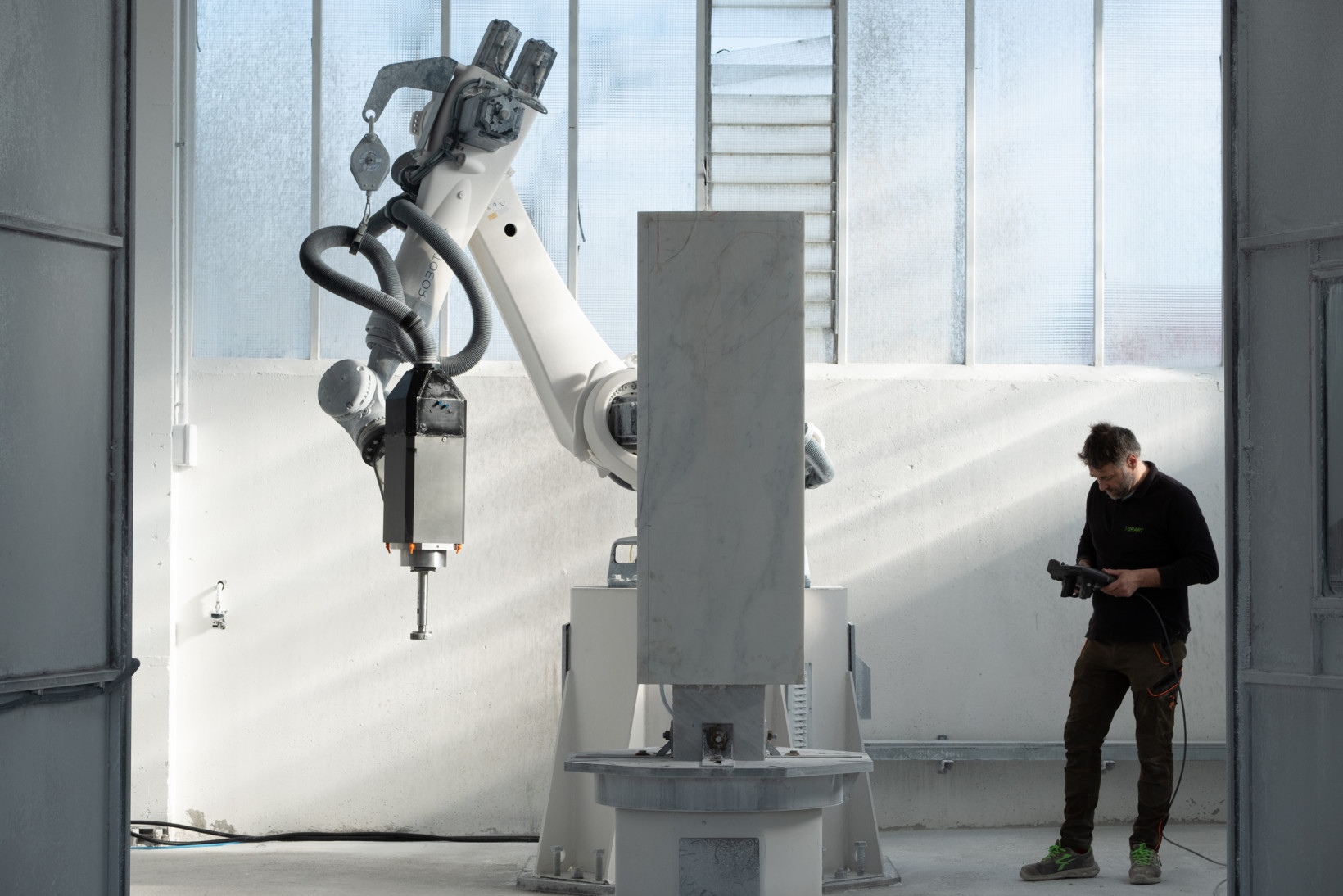
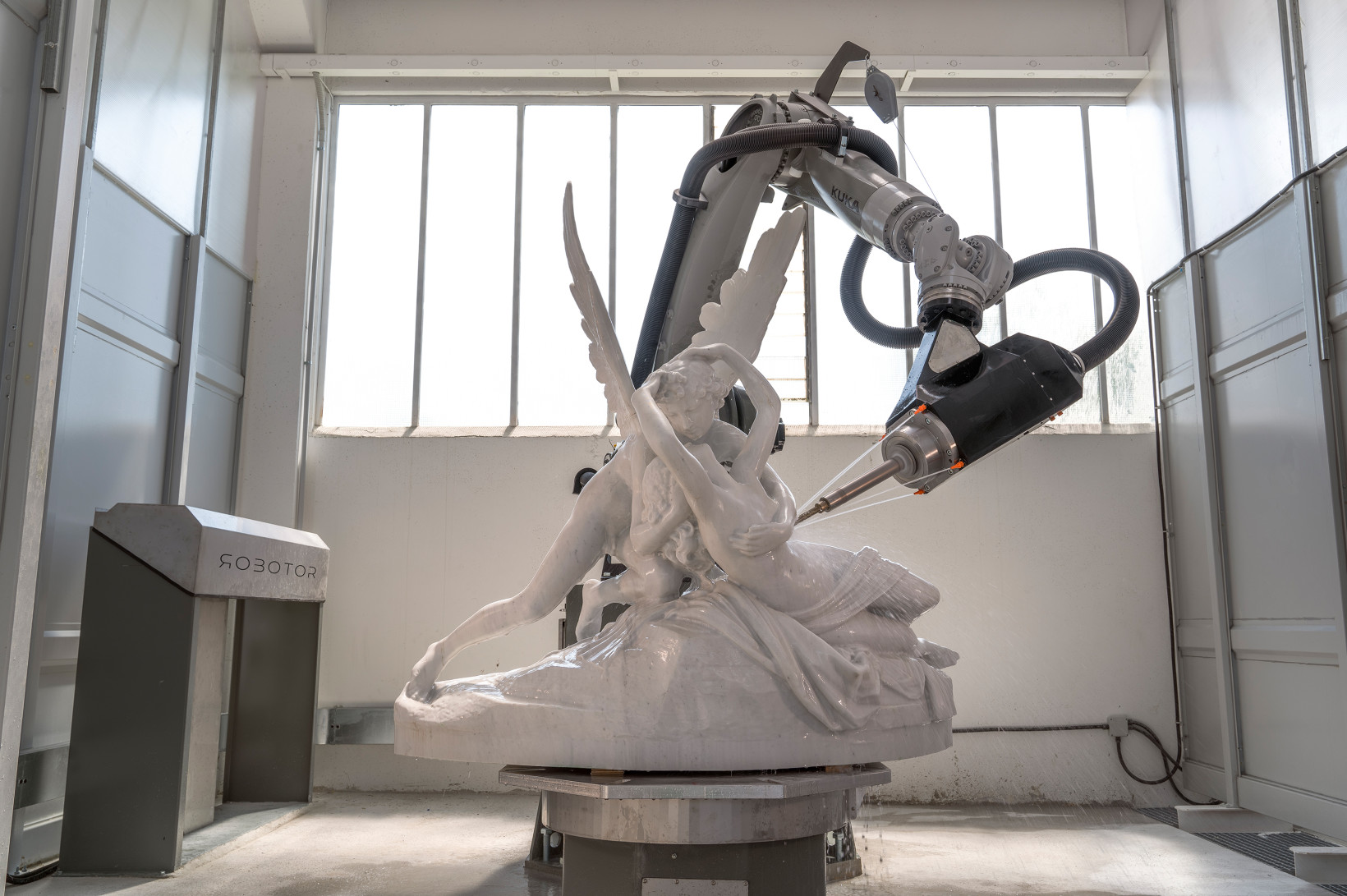
The robotic system consists of a mechanical arm that uses electro-spindles of various sizes and capacities, and features an automatic tool change function.

The arm is mounted on a multifunctional, modular base, which contains the necessary electrical and hydraulic components. It’s also accompanied by a seventh-axis rotary table, where the marble and future sculptures stand. The table rotates in full interpolation with the robot’s movements, making the most of its flexibility, and can support a workload of up to 50 tonnes.

robot creates sculpture
Credit: Laura Veschi

At the heart of Robotor’s system is the company’s proprietary software, called OR-OS — designed either for programming by expert operators, or for fully automated self-programming.

The software takes a 3D model and automatically generates an optimised workflow and tool paths without requiring human intervention. It then simulates the process internally to identify any potential issues before sending the instructions to the robotic chisel.

Based on the selected work path, the OR-OS software prompts the robot to choose which types of products and tools it will use for the different stages of the production process: from sculpting, to polishing and cleaning.

robots create sculptures horse of parthenon
Credit: Laura Veschi

The robot then analyses the stone or material it’s going to work on, and reviews its shape and properties, to identify where and how it can be carved, before moving to production.

Besides the robot’s ability to work fully autonomously, users can also opt for programming it and choose the work path it’s going to follow. They’re also able to control various machine functions in real time, including speed adjustment, and monitor the status of the robot and its components, conveniently receiving alerts in case any anomalies occur.

From the human to the robotic hand: speed, accuracy, and innovation

Robotor’s mechanical sculptors come with an array of intriguing advantages.

First off, the robots are designed to eliminate all the tiring phases of the production process, work in extreme environments that would otherwise be endangering humans, and avoid any human error.

“The use of appropriate tools combined with the optimisation of work paths allow for machine use without interruptions 24/7, responding to the need for precise control of work times and costs,” Massari says. This, according to the co-founder, translates into a significant reduction of execution times and expenses.

While cost savings are difficult to quantify, Massari notes that a work of art can, on average, be created by the robots in one-tenth the time that traditional techniques require — excluding manual finishing.

Despite this fast pace, Robotor’s sculptors boast an impressive level of accuracy.

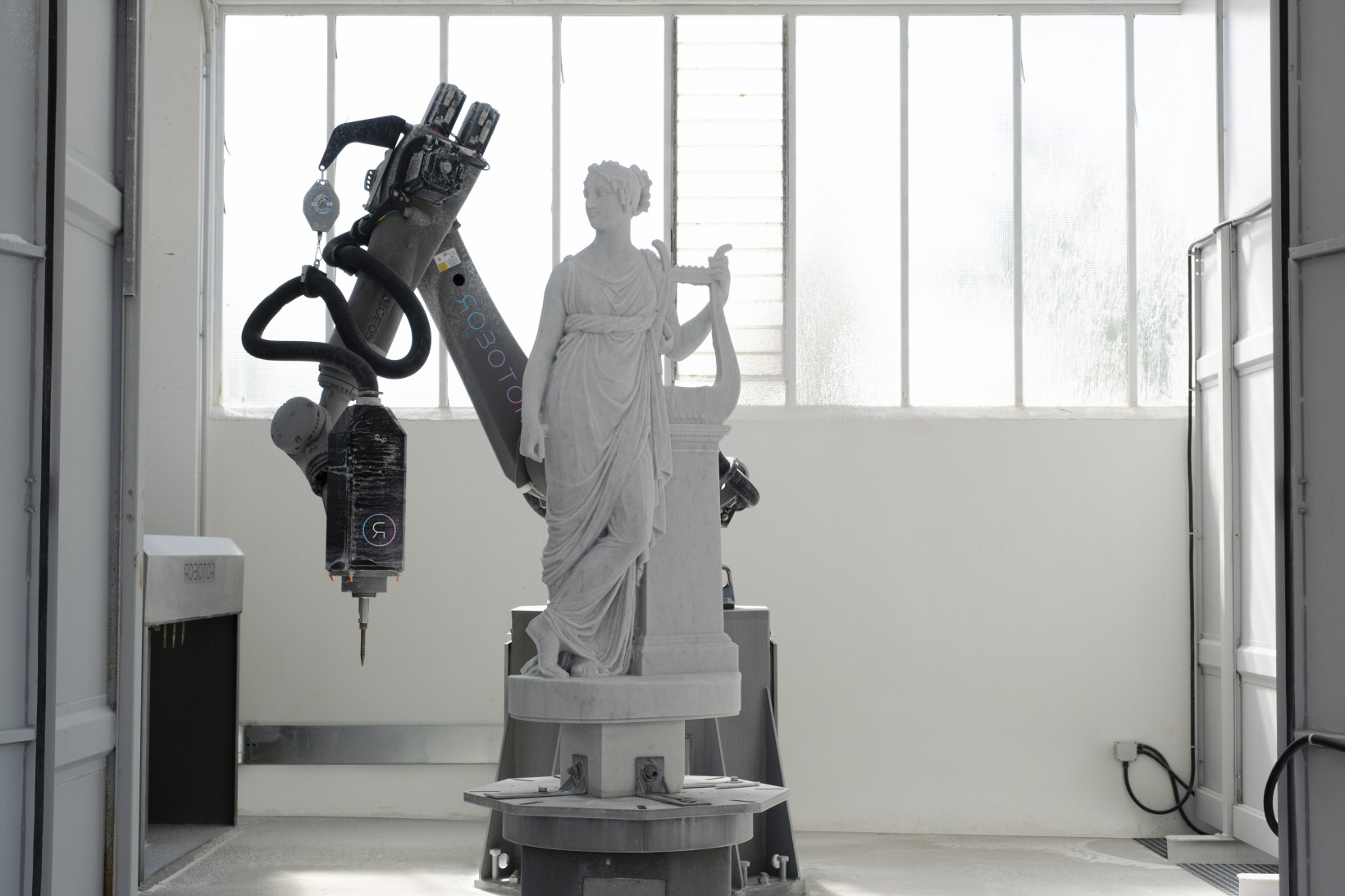
To demonstrate this, Massari mentions the reproduction of The Muse Terpsichore, a famous sculpture completed by Canova in 1811, which was featured in the exhibition “A tempo di danza” at Vetulonia’s Archaeological Civic Museum. The museum opted to display the replica without any hand finishing to avoid confusion between the copy and the original.

Tersicore statue
The Muse of Terpischore, replica by Robotor. Credit: Laura Veschi

Most notably, Massari believes that the robotic chisels can push the boundaries of sculpture, by allowing artists to create works that would have been “inconceivable” before the robots’ facilitation.

“Artists who collaborate with us, such as Quayola and Barry X Ball, present themselves to the public with never-before-seen sculptures designed to be realised with the support of a robotic system, and exploiting its peculiarities,” he says.

“Every work of art is primarily determined by the materials available to the artist and their ability to manipulate them.”

The robots’ diamond-tipped tools that extract material without breaking or splitting it, open new possibilities for material use as well, including conglomerates of stones and earth that can not be processed with traditional methods.

This, according to Massari, is also linked to sustainability, which is accentuated by the software’s 3D model simulation and work path optimisation. That way, the marble block can be excavated with precise knowledge of the final artwork’s dimensions, without any waste.

While suitable for any stone product, Massari says, the robots are mainly targeting three market groups: traditional sculpture workshops aiming to introduce robotics into their production line, artists who wish to manage all creation phases themselves, and designers who produce their own pieces directly. And thanks to their self-programming software, Robotor’s machines are accessible to everyone.

Apart from facilitating the creation of novel artworks, Robotor gains its main satisfaction from the preservation and communication of cultural heritage through the reproduction of great works of the past.

Such an example is the Arch of Palmyra, which was reproduced on a 1:3 scale, based on photographs taken during a documentation campaign of the archaeological site.

Arch of Palmyra replica
The replica of the Arch of Palmyra, displayed in New York. Credit: Laura Veschi

The replica was created in five weeks using 20 tonnes of Egyptian marble, technologically ‘reviving’ the 2,000-year-old monument destroyed by ISIS. In 2016, it was displayed in Trafalgar Square in London, and the City Hall Park in New York.

Another example is Amore e Psyche, one of Canova’s most famous sculptures, completed in 1793 after five years of work, and exhibited at the Louvre Museum.

Eros e psyche Canova Louvre
The original Amore e Psyche by Antonio Canova, displayed at the Louvre Museum. Credit: Louvre Museum.

In 2020, Robotor’s replica was manufactured in just over 10 days, and was featured in the exhibition “Eterna belezza” in Rome, along with 170 other artworks from museums around the world.

Amore e psiche sculpture Robotor
The replica of Amore e Psyche by Robotor. Credit: Laura Veschi

In 2022, the startup made a total of some 400 sculptures. Massari didn’t disclose the price of the machines or the cost for commissioning a sculpture.

Human vs robot: who is the real creator?

Robotor’s mechanical sculptors are fast, accurate, and efficient, and can even rival the works of Renaissance masters. This bids the question: is there enough space for human agency?

Massari’s answer is succinct: the robot will never replace the artist. “It is not a creative, but a mere executor,” he emphasises.

For the co-founder, the robotic chisels are essentially replacing the laborious and time-consuming work that artists would normally entrust to specialised laboratories to execute their vision.

“It is rare to see the artists themselves executing all the phases,” explains Massari, noting that they may intervene in the finishing phase directly, or by giving precise instructions.

“This was how Michelangelo operated, and it is how artists operate today,” he adds.

In fact, he explains that the creative process hasn’t changed at all. Sculptors have used clay or plaster sketches for centuries before moving on to marble work. Today there is one more step: a 3D model that’s created from the sketch, which is essential for the software that controls the robot.

And by replacing the traditional strenuous and time-consuming production process, Robotor aims to actually expand the creative possibilities of artists.

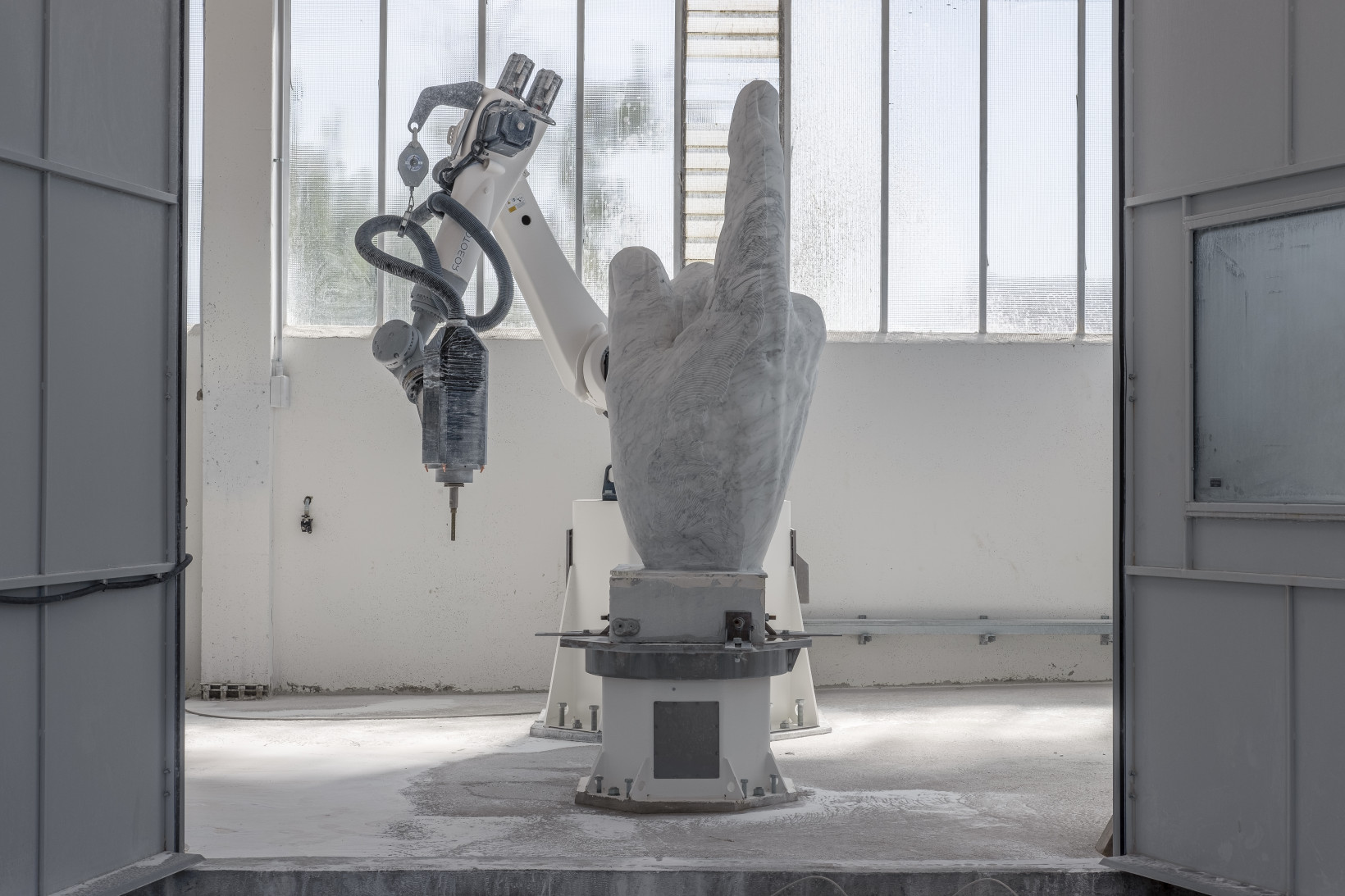
fabio viale sculpture robot
The Dito il Constativo by Fabio Viale. Credit: Laura Veschi

“The history of art is a continuous history of innovations,” says Massari. “Artists have always relied on technological knowledge and ingenuity to find the materials and tools they need to express their dreams, thoughts, visions, or beliefs. And innovation has always had an impact on the way art is made.”

The startup’s ultimate goal is to usher in a new era of sculpture, in which human artists’ expression is supported and expanded through the use of robotics and AI. As the co-founders put it, “this era no longer consists of broken stones, chisels, and dust, but of scanning, point clouds, and design.”

Get the TNW newsletter

Get the most important tech news in your inbox each week.

Also tagged with


From Michelangelo to robots: This startup is carving a new era of sculpture Read More »

ai-that-decodes-what-mice-see-can-enhance-future-bcis,-say-researchers

AI that decodes what mice see can enhance future BCIs, say researchers

AI that decodes what mice see can enhance future BCIs, say researchers

Thomas Macaulay

Story by

Thomas Macaulay

Senior reporter

Thomas is a senior reporter at TNW. He covers European tech, with a focus on deeptech, startups, and government policy. Thomas is a senior reporter at TNW. He covers European tech, with a focus on deeptech, startups, and government policy.

An AI tool that decodes what mice see could enhance future brain-computer interfaces, according to a new study.

Named CEBRA, the system was developed by researchers at EPFL, a university in Switzerland. Their aim? To uncover hidden relationships between the brain and behaviour.

To test CEBRA (pronounced “zebra”), the team tried to decode what a mouse sees when it watches a video.

“Given the brain is the most complex structure in our universe, it’s the ultimate test for CEBRA.

First, the researchers collected open-access neural data on rodents watching movies. Some of the brain activity had been measured with electrode probes in a mouse’s visual cortex. The remainder came via optical probes of genetically modified mice, which were engineered so their neurons glowed green when activated.

All this data was used to train the base algorithm in CEBRA. As a result, the system learned to map brain activity to specific frames in a video.

Next, the team applied the tool to another mouse that had watched the video. After analysing the data,  CEBRA could accurately predict what the mouse had seen from the brain signals alone.

The team then reconstructed the clip from the neural activity. You can see the results for yourself in the video below:

Unsurprisingly, the researchers aren’t solely interested in the movie-viewing habits of rodents.

“The goal of CEBRA is to uncover structure in complex systems. And, given the brain is the most complex structure in our universe, it’s the ultimate test space for CEBRA,” said EFPL’s Mackenzie Mathis, the study’s principal investigator.

“It can also give us insight into how the brain processes information and could be a platform for discovering new principles in neuroscience by combining data across animals, and even species.”

Nor is CERA limited to neuroscience research. According to Mathis, it can also be applied to numerous datasets involving time or joint information, including animal behaviour and gene-expression data. But perhaps the most exciting application is in brain-computer interfaces (BCIs).

As the movie-loving mice showed, even the primary visual cortex — often considered to underlie only fairly basic visual processing — can be used to decode videos in a BCI style. For the researchers, an obvious next step is using CEBRA to enhance neural decoding in BCIs.

“This work is just one step towards the theoretically-backed algorithms that are needed in neurotechnology to enable high-performance BMIs,” said Mathis.

You can read the full study paper in Nature.

Get the TNW newsletter

Get the most important tech news in your inbox each week.

Also tagged with


AI that decodes what mice see can enhance future BCIs, say researchers Read More »
a-new-hope:-hv-capital-raises-record-e710m-to-invest-in-european-startups

A new hope: HV Capital raises record €710M to invest in European startups

A new hope: HV Capital raises record €710M to invest in European startups

Linnea Ahlgren

Story by

Linnea Ahlgren

The first quarter of 2023 was pretty bleak for the European startup ecosystem, to say the least. Funding fell a whopping 57% compared to Q1 of 2022, and fundraising is on pace for the lowest total since 2015. As such, the recent developments being heralded from Berlin might bring particularly welcome succour. 

German VC firm HV Capital announced today it has raised its ninth and largest fund ever, with €710 million for investments across all growth phases – all the way from pre-Seed to Series D and beyond. 

The fund is backed mostly by institutional investors from Europe and the US. HV Capital says it will be divided almost evenly into two vehicles: Fund IX Venture and Fund IX Growth. Ticket sizes will range from €500,000 to €60mn.

While the firm will look extensively at deals inside Germany, it also wants to place about 40% of the fund throughout Europe. Reiner Märkle, General Partner at HV Capital, said the record fund would provide the firm with “new opportunities to invest in the next generation of disruptive ideas.”

Indeed, HV Capital, who was an early backer of German e-commerce company Zalando, has already made four investments from the fund. One of these is in Berlin-based SPREAD, who makes augmented engineering intelligence platforms. Another is in GovTech startup Polyteia, also from Berlin, providing authorities with data infrastructure to help “improve and accelerate decision making.” 

Fund IX has also invested in B2B energy management platform ecoplanet, based in Munich, and female-founded monitoring, reporting and verification (MRV) software developer Agreena in Copenhagen, which supports agriculture with regenerative farming practices and carbon monitoring. 

HV Capital said it had established the fund with a view of “advancing ESG in the venture capital ecosystem,” with commitments made under Article 8 of the EU’s Sustainable Finance Disclosure Regulation, or SFDR. 

By the end of the fund’s lifecycle in a decade, the firm says it is targeting at least one-third of women in executive positions across the portfolio. Furthermore, HV Capital will aim to have at least 30% of the fund allocated to companies aligned with the climate goals of the European Investment Fund (EIF). 

SFDR?

If this is the first time you have come across SFDR, consider yourself acquainted with one of the potentially most impactful principles in whether or not your company will receive funding moving forward. Basically, it is a set of rules laid out by the EU designed to counteract greenwashing, and to help investors make more informed decisions about sustainable investment. 

Obligated firms will need to disclose potentially negative consequences an investment decision may have on sustainability factors (environmental and social), and how they are mitigating the impacts, on an annually recurring basis. While it is up to individual member states to decide on financial consequences, there are other potentially adverse effects of non-compliance, such as reputational penalties and sending poor signals to current and future investors.

Get the TNW newsletter

Get the most important tech news in your inbox each week.

Also tagged with


A new hope: HV Capital raises record €710M to invest in European startups Read More »
uk-competition-watchdog-probes-ai-market-amid-safety-concerns

UK competition watchdog probes AI market amid safety concerns

UK competition watchdog probes AI market amid safety concerns

Siôn Geschwindt

Story by

Siôn Geschwindt

The UK’s competition watchdog has launched a review of the artificial intelligence market, in an effort to weigh up the potential opportunities and risks of a technology Bill Gates dubs as “revolutionary as mobile phones and the Internet.”

The Competition and Markets Authority (CMA) said it would investigate the systems underpinning tools such as ChatGPT in order to evaluate the competition rules and consumer protections that may be required. This, the CMA stated, is to ensure the development and deployment of AI tools is done in a safe, secure, and accountable manner. 

“It’s crucial that the potential benefits of this transformative technology are readily accessible to UK businesses and consumers while people remain protected from issues like false or misleading information,” said CMA chief executive, Sarah Cardell.  

The CMA has set a deadline for views and evidence to be submitted by June 2, with plans to report its findings in September.  

The announcement comes as regulators across the world tighten their grip on the development of generative AI — a technology which can generate text, images, and audio virtually indistinguishable from human output. Hype around this type of AI has been swiftly followed by fears over its impact on jobs, industry, education, privacy — virtually all aspects of daily life.   

In late March, more than 2,000 industry experts and executives in North America — including researchers at DeepMind, computer scientist Yoshua Bengio, and Elon Musk — signed an open letter, calling for a six-month pause in the training of systems more powerful than GPT-4, ChatGPT’s successor. The signatories cautioned that “powerful AI systems should be developed only once we are confident that their effects will be positive and their risks will be manageable.”

Meanwhile, Dr Geoffry Hinton, widely referred to as AI’s “godfather,” quit his job at Google this week to talk about the dangers of the technology he helped develop. Hinton fears that generative AI tools could inundate the internet with fake photos, videos, and texts to the extent that an average person won’t be able to “tell what’s true anymore.”

And yesterday, former UK government chief scientific adviser Sir Patrick Vallance told MPs on the Science, Innovation and Technology Committee that AI could have as big an impact on jobs as the industrial revolution.

Anita Schjøll Abildgaard, CEO and Co-founder of Norwegian startup Iris.ai, is optimistic that the probe will address some of these fears and “uphold consumer protections and safely progress the development of AI,” she told TNW. Abildgaard also hopes the review will help address the “competitive imbalance” and “lack of disclosure” present in Big Tech’s proprietary data and training models.

However, while the CMA and many others are clearly concerned about the impacts of AI tools developed by firms such as OpenAI, Microsoft, and Google, Cardell is adamant that the review would not be targeting any specific companies. Rather, she said that the “fact-finding mission” would engage with “a whole host of different interested stakeholders, [including] businesses, academics, and others, to gather a rich and broad set of information”. 

Cardell is also clear that the CMA doesn’t wish to stifle the growth of the rapidly emerging AI industry, but promote it, albeit with a few safeguards. “It’s a technology that has the potential to transform the way businesses compete as well as drive substantial economic growth,” she said. 

A UK government white paper published in March follows a similar trend, signalling ministers’ preference to avoid setting any bespoke rules (or oversight bodies) to govern the uses of AI at this stage. This differs from the EU which is currently in the later stages of finalising its landmark AI Act — the world’s first AI law by a major regulatory body.

While the EU has been first out the gate, according to a new report by the Centre for Data Innovation, politicians should avoid getting swept up in the “hysteria” and shouldn’t “rush to regulate AI before anyone else does because that likely will bode ill, and lead to missed opportunities, for society.”  

Whatever the case may be, the rapid emergence of generative AI has clearly left governments scrambling to figure out if and how to regulate it.

Get the TNW newsletter

Get the most important tech news in your inbox each week.

Also tagged with


UK competition watchdog probes AI market amid safety concerns Read More »

we’re-closer-than-ever-before-to-creating-a-real-lightsaber

We’re closer than ever before to creating a real lightsaber

Robert Jones

Story by

Robert Jones

Robert Jones is a Post Doctoral Research Associate in the Department of Physics at the Faculty of Natural, Mathematical and Engineering Scie Robert Jones is a Post Doctoral Research Associate in the Department of Physics at the Faculty of Natural, Mathematical and Engineering Sciences of King’s College London. He specialises in theoretical condensed matter physics and its simulation.

Ever dreamed of being a Jedi? Armed with an elegant weapon for a more civilised age, many of us have fantasised about cutting a bright green (or blue) swathe across a galaxy far, far away. Disney even released a patent in 2018 for one such device, although ‘Sword device with retractable, internally illuminated blade,’ doesn’t quite evoke images of cutting through blast doors or droid armour.

That begs the question on this Star Wars Day: is it actually possible to build a lightsaber, and if so, how far away from holding it in our hands and whistling ‘Duel of Fates’ are we? The answer might surprise you —but first, we’ll have to set out exactly what we mean when we say lightsaber and learn some science on the way.

So what would you need to make a lightsaber as we know it?

There are six fundamental boxes a lightsaber must tick: it must light up and glow when in use, it must be able to cut through an object, it must be retractable, it must make a trademark whooshing noise, you must be able to cross them in a fight, and most importantly, it must obey the rule of cool. The bad news is that not all of these are possible at once — yet — but the good news is that all of them are already possible individually — at least, in theory.

Whilst we don’t have access to Kyber Crystals in our galaxy, the laws of physics make more than a fine substitute. The first problem to tackle is the light and cutting edge, and for that, we can utilise the physical principle of laminar flow. This is when all the components in a gas or fluid are moving in the exact same direction without colliding into one another, a little like when you use a shower head. 

This then allows us to use any kind of fluid fuel-oxidiser mix to make a single, high-intensity beam of cutting power. Whilst we may be tempted to use a rocket-grade propellant and fuel, the reality is that something simple like the liquid propane used in BBQs is more than enough. With these ingredients; BBQ fuel, and a laminar flow jet, the task simply becomes one of tuning the fuel mix and valves to get a retractable blade. For the iconic whoosh, it’s a matter of building a circuit with a speaker and accelerometer to make the famed sound of a lightsaber when it’s swung.

Yoda's gorgeous green lightsaber
Yoda’s green plasma blade should only be handled by experts. Credit: JD Hancock

The final touch is the famous colouring of the blade. While Wien’s Displacement law states that the temperature of an object is directly related to its colour, this won’t give us the intense colour we usually associate with this aspect of the Star Wars universe. Instead, by introducing small amounts of specific chemical compounds at the end of the hilt, we can influence the colour. By burning strontium metal for example, we can achieve that iconic Sith red or potassium chloride for the Mace Windu purple. The intense glow of the lightsaber will come from the heat of the plasma generated by the fuel-oxidiser mix.

This still leaves us the issue of being able to cross them in a duel, which necessitates a resistance to temperatures high enough to melt a blast door. At present, the material with the highest melting temperature is the Tantalum hafnium carbide alloy (Ta4HfC5), which melts at a whopping 3990 °C. This unfortunately is the approximate temperature of burning liquid propane. When making something retractable, you also introduce small weaknesses in a metal, which makes fractures and failures more likely. Therefore, even when working with ultra-heat-resistant materials, appropriate care is needed to keep the material from failing due to stress.

This means that any plan to build a lightsaber you can duel with needs to involve not only a heat-resistant material, but a robust one as well. 

How close are we to being able to wield the favoured weapon of the Jedi?

There are two main stumbling blocks to us waving around a screen-accurate lightsaber: the fuel and the duel. Assuming that we’re still following the principle of laminar flow mentioned above, we can achieve a steel-melting, glowing beam by finding a fuel with a high density, and a high burning temperature. The former we want so we can keep the fuel in a nice little rechargeable cylinder, like a battery, and the latter so we can melt through the blast doors of any would-be rebels. 

Acetylene or rocket-grade kerosene could be good candidates, with acetylene being used in plasma cutters and kerosene having put men on the moon in the Apollo programme. Yet, these still don’t quite fit the bill. Acetylene isn’t dense enough to be stored in a battery, and you would need a large tank of it to power a lightsaber for any amount of time. Kerosene on the other hand has a relatively low flame temperature, meaning it would struggle to cut through metal.

Lightsaber colours
Other colours are available. Credit: Remco van der meer

Then comes the issue of being able to cross the blade, as you need a sturdy material which can simultaneously handle the stresses of high temperature and combat with a mortal enemy. My guess for realising this design would be a central core of a high-melting-point material, like Tantalum hafnium carbide alloy, which can be telescopically extended with the high-temperature flame from the propellant and fuel mixture.

The good news is that modern science is making leaps and bounds in this area. Ongoing research into high-density, energy-rich fuels and stress-resilient materials means that we’re now closer than ever to producing a real-life lightsaber. The only question left to ask is, what colour do you want yours in?

Get the TNW newsletter

Get the most important tech news in your inbox each week.

Also tagged with


We’re closer than ever before to creating a real lightsaber Read More »