Author name: Rejus Almole

social-vr-platform-‘vrchat’-to-lose-quest-1-support-next-month

Social VR Platform ‘VRChat’ to Lose Quest 1 Support Next Month

As a part of its big send off, Meta has already deprecated first-party social features on the original 2019 Quest, which includes access to Parties and Meta Horizon Home. If you thought you could keep using Quest 1 with other social VR platforms though, your choices are about to get even more limited, as VRChat is soon dropping support too.

The studio announced it was dropping support in a recent developer update, stating that VRChat will no longer provide support for the Meta Quest 1 headset after June 30th, 2023.

“This is primarily due to Meta’s deprecation of the Quest 1 SDK, which will prevent us from keeping VRChat updated properly on the device,” the studio says. “You can continue to use Quest 1 with Quest Link, Virtual Desktop, ALVR, or other tethering methods to connect your Quest 1 to a Windows PC. Please note that those other applications may also be deprecating the Quest 1, so keep an eye on their announcements and news posts.”

VRChat isn’t the only app losing Quest support. One of the first to go, Meta’s BigBox VR already dropped Quest 1 support for its battle royale shooter Population: One late last year. Then followed Rec Room in early January 2023.

Meta’s Downpour Interactive announced in February its mil-sim shooter Onward will be dropping Quest 1 support on July 31st. Other games seeing upcoming support freezes include Myst, Zenith: The Lost City, and Synth Riders. We expect to see many more in the coming months, as the back catalogue of games is slowly phased or completely dropped.

Social VR Platform ‘VRChat’ to Lose Quest 1 Support Next Month Read More »

sweden-to-pave-world’s-first-permanent-e-road-for-ev-charging-while-driving

Sweden to pave world’s first permanent e-road for EV charging while driving

Sweden to pave world’s first permanent e-road for EV charging while driving

Ioanna Lykiardopoulou

Story by

Ioanna Lykiardopoulou

Ioanna is a writer at TNW. She covers the full spectrum of the European tech ecosystem, with a particular interest in startups, sustainabili Ioanna is a writer at TNW. She covers the full spectrum of the European tech ecosystem, with a particular interest in startups, sustainability, green tech, AI, and EU policy. With a background in the humanities, she has a soft spot for social impact-enabling technologies.

As countries across Europe scale up efforts towards fossil fuel-free mobility, Sweden is working on the world’s first permanent electric road — allowing electric cars and trucks to charge while driving.

The project is led by the Swedish Transport Administration, Trafikverket, which has selected the E20 highway. Specifically, it will build the electric road system (ERS) on the 21km route from Hallsberg to Örebro, located between the country’s two largest cities, Stockholm and Gothenburg.

The e-road is now at the procurement and final planning stage, while Trafikverket expects to complete and introduce it to the public in 2025/2026.

How will it work?

Trafikverket has yet to determine which technology it will use for the ERS. Currently, there are three types available: overhead conductive, ground-based conductive, and ground-based inductive charging.

In the first type of charging, power is transferred from overhead wires to a vehicle through a pantograph — much like how trams operate. This technology, however, is only suitable for heavy-duty vehicles that are high enough to reach the electric lines.

The other two ground-based options work in a similar way. In conductive charging, power is transferred from special rails or tracks placed below or on the road. The vehicles charge with the help of a mechanical arm or stick that touches the rails. In the inductive system, the power transfer takes place between coils embedded in the road and the vehicles.

Sweden’s bet on electric roads

The ambitious electrification of E20 follows a series of successful ERS pilot projects in the country. From 2016 to date, Trafikverket has tested all three road charging technologies in various parts of the country, including Lund, Gotland, and Sandviken.

Most of the focus has been on trucks and buses and for a good reason. Electrifying the road network that connects the country’s biggest cities would reduce emissions of heavy duty vehicles by 1.2m tonnes in 2030, research estimates.

But, in 2018, Sweden began testing road charging for both commercial and passenger EVs as well on a 2km route between Stockholm’s Arlanda airport and a logistics area in Rosenberg.

The government’s plan is to deploy 2,000km of ERS on public roads by 2030 — the same year it has proposed to ban new fossil fuel-powered cars. But whether betting on e-roads constitutes a fruitful strategy remains a controversial topic.

On the one hand, electric road systems will enable longer distances to be traveled between charging station visits, increasing the adoption rate of EVs and, in turn, reducing carbon emissions.

A recent study by the Chalmers University of Technology in Gothenburg has further found that e-roads would also lower the demand on the grid during peak times, working as an alternative to home charging. The team also suggested that combining home (static) and on-the-go (dynamic) charging can reduce the battery size by up to 70%.

“This would reduce the need for raw materials for batteries, and an electric car could also become cheaper for the consumer,” said Sten Karlsson, co-author of the study.

There is, however, an important counterargument: the lofty investment and maintenance costs for a nascent type of infrastructure that, in the long run, may prove obsolete as battery development accelerates.

But according to the study’s findings, the risk doesn’t seem that high. The team estimates that only 25% of the national and European roads would need to be electrified for the system to work.

Sweden is not alone in developing e-roads, with Italy, France, Germany, and the UK testing the technology as well. In fact, Europe’s interconnectivity might indeed give a winning chance to an electric road network.

Get the TNW newsletter

Get the most important tech news in your inbox each week.

Also tagged with


Sweden to pave world’s first permanent e-road for EV charging while driving Read More »

spring-has-sprung-for-niantic-and-8th-wall

Spring Has Sprung for Niantic and 8th Wall

It’s already been a year since Niantic acquired 8th Wall. While acquisitions can be a scary thing in the tech world, both companies are growing and strengthening through their partnership.

Pillars of the Earth

Niantic and 8th Wall are both AR companies that might be bigger and more important than some realize. However, they both come at AR architecture and accessibility from different perspectives. Their coming together was a game changer that’s hard to understate.

Niantic Senior Director of AR Product Marketing, Caitlin Lacey, helps us understand what the companies are doing in their own products and projects as well as how they are helping each other grow and develop.

“I joined Niantic a year ago primarily to focus on Lightship, and one of the things that I was really excited about coming in was the acquisition,” said Lacey. “Having 8th Wall as part of the Niantic family has definitely made it better.”

Niantic

For some readers, Niantic is synonymous with Pokémon Go. If you Ctrl+K “Niantic”, Google Docs suggests the Pokémon Go website as a link option. Other readers will recognize this as a gross misrepresentation. Pokémon Go may have made Niantic a household name, but it only scratches the surface of what the historic and storied company actually does.

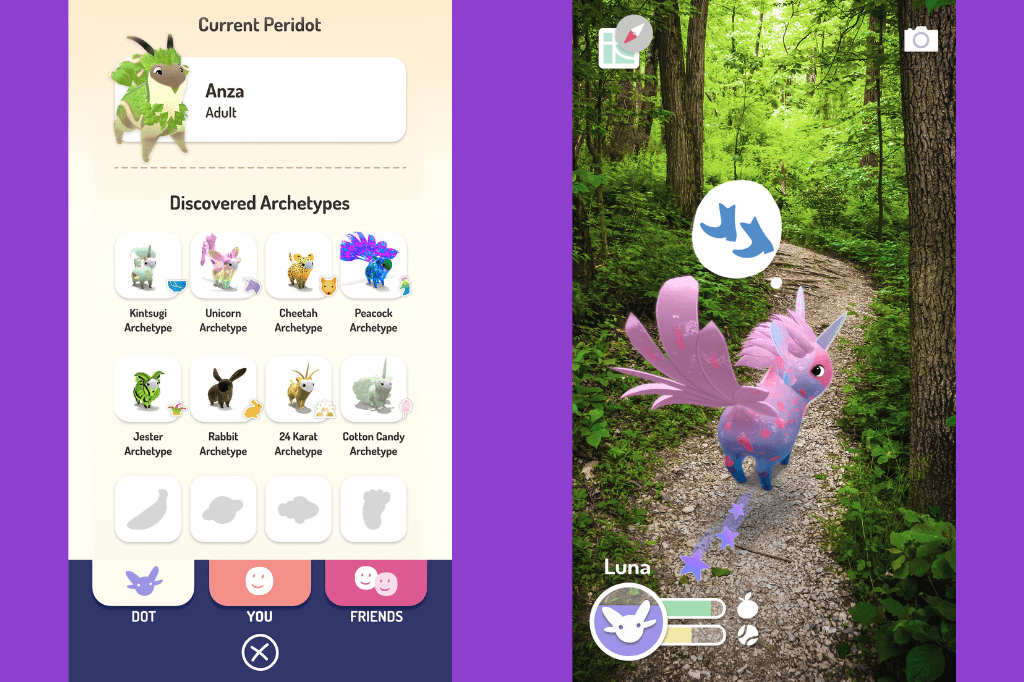
In addition to games (including the just released AR real-world pet game Peridot), Niantic has probably the largest and most detailed working virtual map of the world ever. A few years ago, that was a neat trick. As devices become more powerful and AR gains traction, it’s increasingly becoming something a lot more.
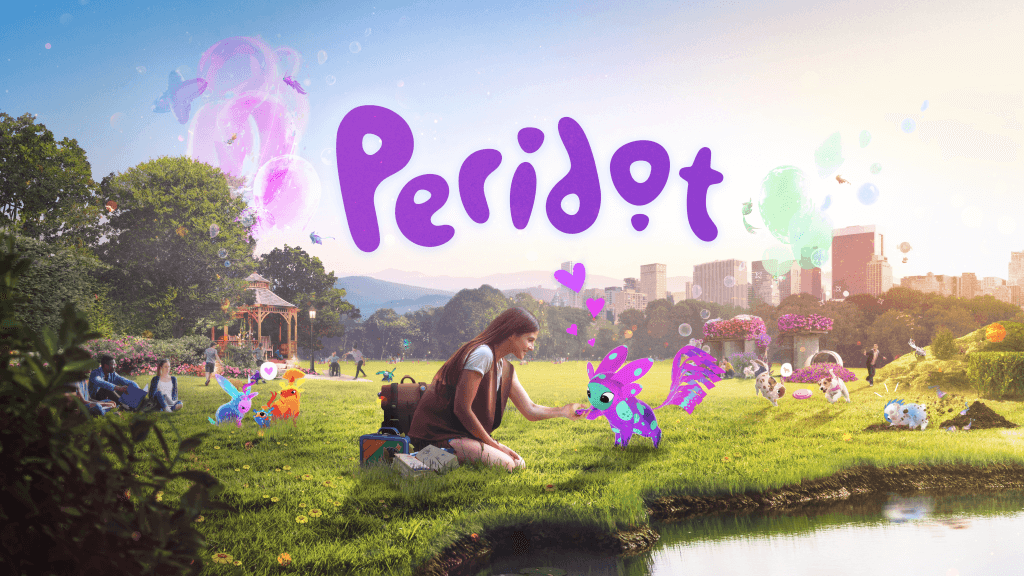
Niantic Peridot AR pet game

Niantic games gather data for this virtual map of the world, but they also have a dedicated platform called Lightship that developers use to fill in the empty spots, add detail, and create their own experiences. Whether you’re building or playing, you’re using an app.

8th Wall

Like its parent company, readers have probably seen the 8th Wall logo on an AR experience but might not realize the magnitude of the operation. Also like its parent company, users can experience 8th Wall both through experiences that they enjoy or through developer tools.

Over the years, 8th Wall has been building out their developer tools and experiences making them easier to use and accessible on more devices. The company has tools for augmenting the world around a user, as well as for augmenting users themselves through lenses and filters.

8th Wall’s experiences and developer tools are web-based. No app installation required, they’re well-positioned to run on pretty much any connected device.

Web and Apps

Apps have a certain gravity bringing obstacles and opportunities. People know how apps work and they know what to expect. Apps can run larger and more in-depth experiences, but they only do one thing at a time. These two necessary strengths are at odds when people expect an experience to do everything and do it well – an unrealistic expectation called “the metaverse.”

“It took a long time to train people how to use apps, but now they’re trained,” said Lacey. However, as she points out, “if you’re thinking about a future where all of these mobile technologies have AR capabilities”, opening and switching apps can become a hassle.

WebAR is getting better all the time, but it’s still limited in terms of the experiences it can run. Thinking about being out and about, this compounds as people are away from stable home networks and relying on burdened public networks or potentially spotty data coverage.

“There are still limitations to experience and file size that the web just can’t handle,” said Lacey. “As computing power continues to grow and get stronger, we’ll see better experiences across platforms.”

In the meantime, both companies are working on leveraging their strengths in app and webAR respectively trying to achieve the best of both worlds in both worlds.

“On the Lightship side, there was tons of tech that was very app-based … we took that and asked, ‘What do you want, and how do we bring it to the web?’” said Lacey. “And then, on the other side, bringing things from the web to Lightship.”

Updates and Releases From Niantic and 8th Wall

In the last few weeks, some exciting changes have come for developers using both developer platforms – including some of those updates that look a lot like a cross-pollination between the two platforms.

Sky and World Effects

First, Sky Effects and World Tracking came to 8th Wall. These are two separate developer tools that allow an AR experience to augment the sky itself, or to help AR elements realistically appear in the physical world. However, when used together, a single experience can bridge the earth and heavens in new and immersive ways.

“With sky and world effects, an object drops from the sky, recognizes the environment, and can interact with that environment,” said Lacey. “We’re seeing that happen across the board and there’s more coming.”

To celebrate the launch, 8th Wall held the “Sky Effects Challenge” which invited developers to use the new technology in interesting and inventive ways. Creators turned the sky into a canvas, mapped the planets, and more.

“We are consistently amazed by what our community builds,” said Lacey.

A Cross-Device Scanning Framework

A new Scanning Framework for Lightship AR Developer’s Kit 2.5 allows users to virtually reconstruct physical spaces and objects without LiDAR. LiDAR is one of two common methods for capturing spatial data on mobile devices, but it’s only available on higher-end iOS devices. Opening the Scanning Framework to other methods greatly increases accessibility.

“We’ve continually heard the feedback, and we’re listening,” said Lacey. “We really want to be a consistent partner to developers in the AR space. We do believe that AR can help make the world more interesting and fun.”

Two New Games

8th Wall doesn’t do so much in the games category – again, games still work better as full apps for now. However, a big theme in this article is that the line between the two companies can be a little foggy these days – at least in terms of user experience. These apps likely benefited from 8th Wall technology and 8th Wall will likely benefit from what the apps learn and earn for Niantic.

Early this year, Niantic launched NBA All World. The app includes basketball mechanics and an NBA partnership, and grows to incorporate elements that make it more than just a game.

“Our version of an NBA basketball game starts with exciting one-on-one gameplay and expands from there to include the major elements of basketball culture, including music, fashion, sneakers, and more, all of which are integrated into real-world locations,” Niantic founder and CEO John Hanke said in a blog post.

If that wasn’t enough, by the time you read this, Peridot will be live. The highly anticipated game encourages players to nurture an AI-powered virtual pet, including feeding it, petting it, and playing with it. Players can also use Niantic’s social platform Campfire to meet with other players and breed new and unique Peridots (or Dots).
Spring Has Sprung for Niantic and 8th Wall

I’m not a huge basketball fan and Pokémon is a chapter of my life that closed a long time ago, but I’ve had my Dot Erin for a few days now. Erin mainly hangs out by my desk eating sandwiches, but was pretty excited to see the spring flowers in my backyard the other day.

Peridot AR pet game Niantic - Jon's Dot Erin

Much More to Come

Lacey advised that a lot more updates to Niantic and 8th Wall will continue to reinforce both platforms for the benefit of developers and end-users alike. There are also some interesting artistic activations coming in the next few weeks. And, of course, we’re excited about Peridot becoming publicly available. There’s definitely a lot more to come from this power pair.

Spring Has Sprung for Niantic and 8th Wall Read More »

swiss-startup-edges-closer-to-first-ever-space-trash-collection

Swiss startup edges closer to first-ever space trash collection

Swiss startup edges closer to first-ever space trash collection

Thomas Macaulay

Story by

Thomas Macaulay

Senior reporter

Thomas is a senior reporter at TNW. He covers European tech, with a focus on deeptech, startups, and government policy. Thomas is a senior reporter at TNW. He covers European tech, with a focus on deeptech, startups, and government policy.

The first active removal of space debris has moved closer to lift-off after a new deal was inked on the landmark mission.

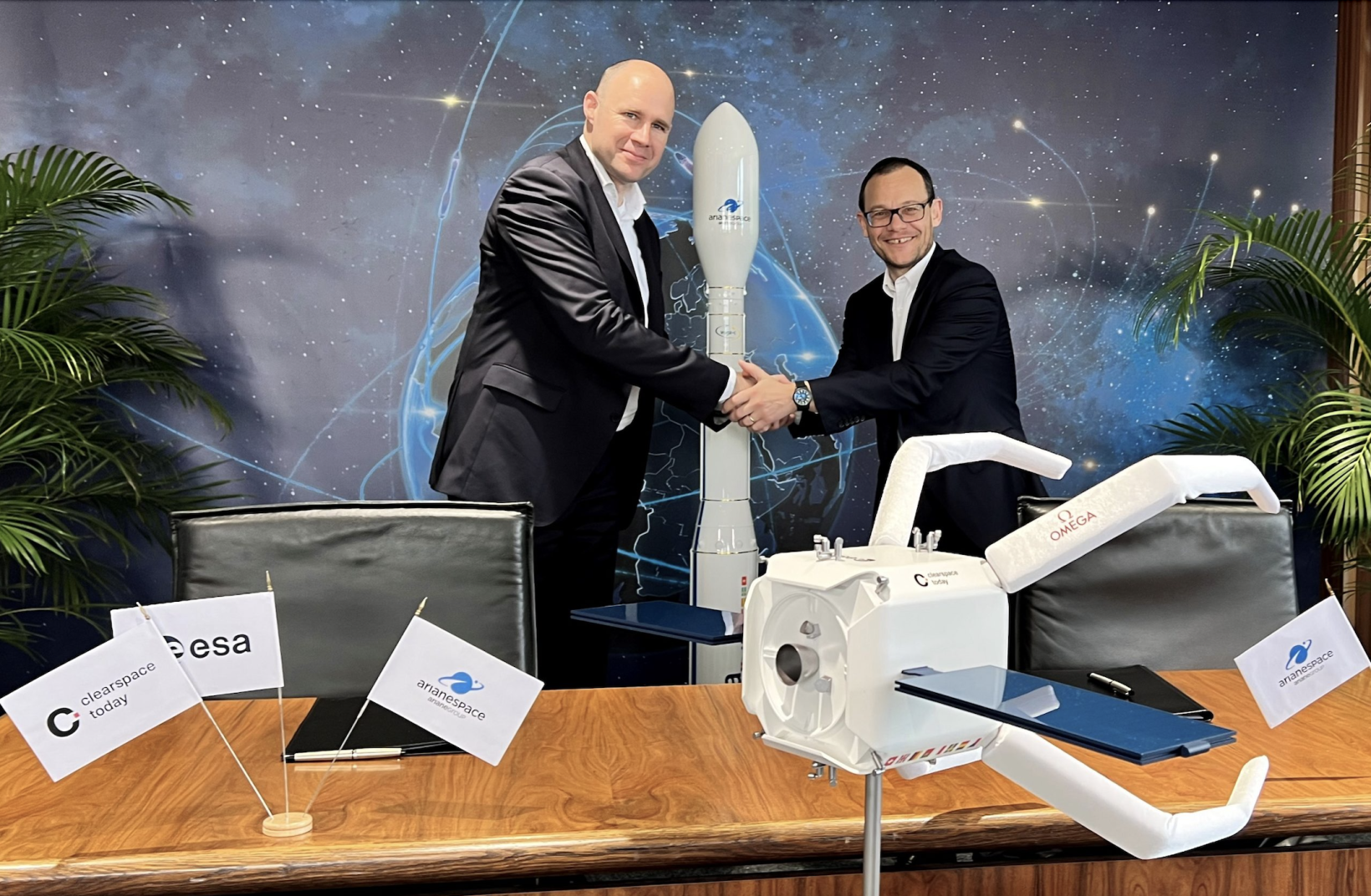
Swiss startup ClearSpace and French rocket giant Arianespace today announced that a launch contract has been signed for the assignment.

The mission, named ClearSpace-1, aims to capture and deorbit a chunk of garbage weighing over 100 kg. To start, the trash-collecting spacecraft will be released into a sun-synchronous orbit by the new European light launcher Vega C.

After commissioning and critical tests, the spacecraft will be raised to the target litter, which will be disposed of through an atmospheric reentry.  

The launch is scheduled for no earlier than the second half of 2026.

Artist's impression of Vega C launching ClearSpace-1
Artist’s impression of Vega C launching ClearSpace-1. Credit: ClearSpace/Arianespace

Luc Piguet, the CEO and co-founder of ClearSpace, hailed the new deal as a crucial step for the project.

“This secures ClearSpace’s access to space for our trailblazing space debris removal mission,” Piguet said in a statement.

“The ClearSpace-1 mission demonstrates a turning point in the space industry as we urgently need to bring solutions to a fundamental problem: we are putting objects into space quicker than they are being removed.”

Luc Piguet, ClearSpace CEO and co-founder, and Stéphane Israël, Arianespace CEO, signing a contract for the launch of the ClearSpace-1 mission, due in 2026. Credit: Arianespace, ClearSpace
Piguet (left) and Stéphane Israël, Arianespace CEO, signed the contract for the launch of ClearSpace-1. Credit: Arianespace/ClearSpace

The deal between two European players also marks another milestone for the continent’s space ambitions. It comes a month after Europe was found to have surpassed the US in private spacetech investment for the first time.

More importantly, the contract brings us closer to solving a growing problem in space. At present, there are over 34,000 pieces of space debris larger than 10 centimetres — as well as about 6,500 operational satellites in orbit, a number expected to exceed 27,000 by the decade’s end.

All these objects are increasing the risk of collisions with satellites or space stations. If the build-up of trash continues at this rate, some regions of space could become unusable. And for those of us on Earth, the litter’s ruining our views of the cosmos.

If all goes to plan, ClearSpace-1 will set a benchmark for making our solar system a cleaner place.

Get the TNW newsletter

Get the most important tech news in your inbox each week.

Also tagged with


Swiss startup edges closer to first-ever space trash collection Read More »

king’s-coronation:-controversial-ai-tech-deployed-alongside-record-setting-5g-network

King’s coronation: Controversial AI tech deployed alongside record-setting 5G network

King’s coronation: Controversial AI tech deployed alongside record-setting 5G network

Siôn Geschwindt

Story by

Siôn Geschwindt

Last week Saturday, over 20 million viewers from across the UK tuned in to watch the coronation of King Charles III, making it the country’s most-watched TV event of the year. Another approximately two million took to the streets of London, under the close watch of AI. 

In the lead-up to the coronation, the Metropolitan Police confirmed that it would deploy live facial recognition technology — which scans faces and matches them against a list of people wanted for alleged crimes — across central London to identify potentially dangerous individuals mingling in the crowds. 

During the event, the software scanned footage from central London’s almost 1 million CCTV cameras and analysed it using an AI algorithm to identify faces that might match those on the Met’s watchlist. The sheer scale of the deployment made it the largest-ever use of live facial recognition technology in public spaces in British history. 

Live facial recognition technology has been a topic of controversy in the UK in recent years due to concerns about privacy, civil liberties, and the potential for the technology to be misused.

One of the main issues is the lack of clear legal regulation around its use. “Live facial recognition is not referenced in a single UK law, has never been debated in parliament, and is one of the most privacy-intrusive technologies ever used in British policing,” said Madeleine Stone, legal and policy officer at British civil liberties campaign group Big Brother Watch.

Critics argue that the use of live facial recognition could lead to false positives, where innocent people are wrongly identified as suspects. There are also concerns that the technology may disproportionately impact certain groups, such as people of colour or those with disabilities, due to the potential for bias in the algorithms used to analyse the images. 

Staying safe over the Coronation weekend – Coronation of Their Majesties The King & Queen Camilla
The UK police resumed the use of live facial recognition last month. Credit: HM Government

As a result of these concerns, there have been calls for a moratorium on the use of live facial recognition technology until clear legal guidelines and ethical standards can be established. While some European countries have limited its use by private companies, they are reluctant to extend these restrictions to public authorities and law enforcement. 

Last month, the UK police resumed the use of live facial recognition technology following  research showing a ‘substantial improvement’ in its accuracy. A report from the National Physical Laboratory found that the chances of a false match were 1 in 6000. This is still far too inaccurate, say campaigners. 

While the tensions around live facial recognition were on full show during the coronation, there was another emerging technology setting records: 5G. 

5G is the latest wireless technology that provides faster and more reliable connectivity than its predecessor 4G and has the potential to revolutionise how we use the internet, especially for data-intensive applications like self-driving cars, gaming, and live media streaming. 

While there has been a significant concern (and misinformation) surrounding 5G — from beliefs that it causes radiation to more outlandish claims that it could spread the coronavirus — unlike live facial recognition, most experts agree it poses little harm. 

‘World’s largest temporary private 5G network’

Of the 20 million plus viewers that tuned into the royal action on Saturday, the majority watched the coverage on the BBC, which broadcast the event live. 

In recent years, news crews have relied on mobile networks to capture footage from hard-to-reach locations that can’t be accessed with satellite trucks or cables. This approach can cause issues during large events as the networks become congested with social media users uploading content and journalists competing to send their images back to news channels.  

To ensure a reliable connection for live broadcasting BBC R&D, the technical research arm of the British news company, deployed the world’s largest temporary private 5G network across The Mall — the 1km grand red road leading from Admiralty Arch to Buckingham Palace, where hundreds of thousands of people gathered for the King’s procession. 

5G-network-coronation
Denmark’s TV2 News going live from outside Buckingham Palace with support from the world’s first temporary private 5G network. Credit: BBC R&D

Streaming large amounts of professional video requires a high uplink capacity, which public networks are not designed for. To handle the traffic, the BBC set up a separate, private network using UK comms regulator Ofcom’s shared access spectrum which secured 80 MHz of radio capacity centred on 3855MHz. Mobile bonding devices such as LiveU’s LU300 with 5G modems and dedicated SIMS moved the video traffic away from the public networks and onto the private network. 

In plain English, this meant that 60 devices could stream large data rate video from any point along The Mall, without interfering with the speed of public mobile networks. 

“The beauty of this system is that for operators and broadcasters, the workflow is pretty much the same as they use every day, but we can be confident that their units will work no matter how busy the public network becomes,” said BBC R&D in a blog post

Unlike live facial recognition, the future of 5G is more certain, with half of all mobile subscriptions predicted to be connected to 5G networks in just four years time. 

Get the TNW newsletter

Get the most important tech news in your inbox each week.

Also tagged with


King’s coronation: Controversial AI tech deployed alongside record-setting 5G network Read More »

8-in-10-german-companies-still-fax,-study-finds-—-but,-umm,-why?

8 in 10 German companies still fax, study finds — but, umm, why?

8 in 10 German companies still fax, study finds — but, umm, why?

Ioanna Lykiardopoulou

Story by

Ioanna Lykiardopoulou

Ioanna is a writer at TNW. She covers the full spectrum of the European tech ecosystem, with a particular interest in startups, sustainabili Ioanna is a writer at TNW. She covers the full spectrum of the European tech ecosystem, with a particular interest in startups, sustainability, green tech, AI, and EU policy. With a background in the humanities, she has a soft spot for social impact-enabling technologies.

In the age of digital communication, fax machines seem as outdated as using a rotary dial phone or a cassette tape. Think about it: if a colleague asked you to fax them a document, you’d probably give them an incredulous look. But in Germany, fax machines haven’t been relegated to the history books just yet, research shows.

Digital advocacy group Bitkom surveyed 505 companies across the country and found that a whopping 82% of them still fax. Notably, one-third of the respondents said their use of the 180-year old technology is “frequent” or “very frequent.”

The intensity of use, however, is gradually declining. Last year, it was at 40%, down from 62% in 2018. Correspondingly, half of the companies now send faxes only rarely or occasionally, while 16% have stopped altogether. According to Bitkom, this data shows that faxing is — slowly but surely — nearing its end in the business world.

To fax or not to fax?

But regardless of the declining trend in use, one question still remains: why use fax machines — well beyond their heyday — instead of simply emailing or cloud sharing?

“What is most valued about the classic fax machine is above all its ability to clearly trace whether something has been sent,” said Nils Britze, Bitkom’s head of digital business processes.

Britze pointed to another factor as well: “Once a channel of communication has been established, it usually takes a while before it is completely replaced — even when much more comfortable and safer means of communication have emerged.”

From a business perspective this translates to the challenge of digitisation. According to Bitkom’s previous research, larger companies find it easier to go fully digital compared to small ones with less than 100 employees. Specifically, 42% of large companies surveyed had digitised their business processes in 2021, while 94% of smaller companies were still using paper.

From a personal perspective, postponing the fax machine replacement refers to what Jonathan Coopersmith, History Professor at Texas A&M University, calls “comfortable inertia.” That is, the people’s tendency to stick to the familiar, and in turn, their reluctance to change technologies.

So it seems that classic ol’ faxing still has some good years before becoming a relic of the past — at least in Germany.

Get the TNW newsletter

Get the most important tech news in your inbox each week.

Also tagged with


8 in 10 German companies still fax, study finds — but, umm, why? Read More »

spotify-cracks-down-on-ai-generated-music-streaming-fraud

Spotify cracks down on AI-generated music streaming fraud

Spotify cracks down on AI-generated music streaming fraud

Linnea Ahlgren

Story by

Linnea Ahlgren

According to Spotify founder Daniel Ek, the value of a company is “the sum of the problems you solve.”

The problem of bot farms playing the same tracks over and over to manipulate streaming data may not be entirely new. However, as generative AI tools become increasingly mainstream, it is taking on a new dimension for the music industry. 

This will require streaming service providers to vigilantly predict and plan ahead not to be left playing a game of reactive whac-a-mole, desperately beating down issues as they arise. Otherwise, apart from dealing with obvious copyright controversies, they may end up paying large sums of money for millions of bot-boosted “fake streams.” 

According to a report in the Financial Times, Universal Music Group (UMG), which controls about a third of the global music market, has been sending takedown requests “left and right.” Stockholm-headquartered Spotify has obliged – at least to some degree. 

Last week, the music streaming giant temporarily ousted hundreds of thousands of songs generated on the AI platform Boomy. The California-based startup’s tool lets users create tracks by picking from a selection of styles, such as Lo-Fi or EDM, and then customise them and either record or add vocals, before uploading them to streaming services. 

However, this is not a case of making Drake rap on your track – the vocals must belong to the user. As such, the tracks were not greyed out because of copyright infringement concerns, but due to the discovery of widespread “suspicious listening activity.” 

Meanwhile, this does not mean that Spotify has completely blocked Boomy users and forbidden them from uploading new tracks. Indeed, the AI platform announced this weekend that “Boomy artists” had their curated delivery to the streaming giant re-enabled.

We are pleased to share that curated delivery to Spotify of new releases by Boomy artists has been re-enabled.

Supporting our artists and creators who use the Boomy platform is our top priority, and we greatly appreciate your patience these past few days.

— Boomy – Create AI Music (@boomy) May 6, 2023

Reportedly, the two sides are still in negotiations over the reinstatement of the rest of Boomy’s catalogue. 

Fake stream farms an industry-wide issue

Spotify’s crackdown is part of an ongoing battle against bot streaming farms. Essentially, this is when a bunch of digital devices are logged in on various platforms, and simply play music 24 hours a day, often playing the same track over and over again. 

Obviously, this impacts the number of listens, directly generating revenue for the owner of the track. Meanwhile, it also affects data driven features such as charts and playlists. 

According to the streaming giant, “Artificial streaming is a longstanding, industry-wide issue that Spotify is working to stamp out across our service.”

Earlier this year, France’s Centre National de la Musique (CNM) released a study on music streaming fraud, in which Spotify participated. However, CNM called out other major streaming platforms Apple, Amazon, and YouTube as “unable or unwilling” to take part in the study.

The first-of-its-kind study established that, in France, in 2021, between one and three billion streams, at least, were false, i.e. between 1% and 3% of total listening. Of course, plenty has happened since.

The CNM says it will launch a new study into the matter in 2024, which may better reveal the implications of the recent revolution in access to generative AI  – and the ability of Spotify to mitigate it.

Grimes stands alone in the pro-AI camp

Over the past few months, the music streaming market has experienced a significant rise in AI-generated tracks. According to Boomy, its users have already “created” more than 14 million songs. 

Services such as those provided by Boomy, Aiva, and Soundful leverage machine learning to allow users to generate unlimited tracks and even monetise their creations on streaming platforms, to the chagrin of artists, producers, distributors, and other industry stakeholders. 

Grimes has launched an AI platform specifically for people to use her voice to make new music, stating that “Copyright sucks. Art is a conversation with everyone that has come before us. Intertwining it with the ego is a modern concept. The music industry has been defined by lawyers, and that strangles creativity.”

Needless to say, she is quite the exception in her pro-generative AI stance in the global artist community. 

Get the TNW newsletter

Get the most important tech news in your inbox each week.

Also tagged with


Spotify cracks down on AI-generated music streaming fraud Read More »

not-ready-for-a-4-day-work-week?-the-nine-day-fortnight-could-be-for-you

Not ready for a 4-day work week? The nine-day fortnight could be for you

Not ready for a 4-day work week? The nine-day fortnight could be for you

Suzie Coen

Story by

Suzie Coen

Suzie Coen is a Dubin-based writer with over 25 years of experience in the media industry. She is widely recognised for her work in the life Suzie Coen is a Dubin-based writer with over 25 years of experience in the media industry. She is widely recognised for her work in the lifestyle pages of prominent national and international publications and a host of luxury retail print and digital magazines.

You’ve heard of the four day week. Now, meet its slightly less fun but still a good time younger brother: the nine-day fortnight. It’s taking workplaces by storm, with leaders lauding this new model as a happy medium between burnout and excessive time off.

Its growing popularity is not surprising. The need for a dynamic approach to the changing landscape of the workplace isn’t just advisable, it’s a necessity.

According to an Economist report, 59% of people say they would consider taking a job with a company that offers better well-being benefits than their current employer. But, if the last few years have taught us anything, it’s that there isn’t a blueprint for flexible working policies.

Companies have experimented and continue to experiment with the models that seem best suited to their individual organisations — from the new nine day fortnight to complete location flexibility; a remote-first policy to offering employees flexibility around when they work.

What is a nine-day fortnight?

The nine-day fortnight working pattern effectively means that across 14 calendar days, nine of them are working days and five are days off.

Every other week, employees get an extra day off, often a Friday. Some companies ask employees to work longer hours on the days they’re working to allow for the extra day off, or to take a small pay cut—typically around 10%. Others say this isn’t important to them as long as their output remains consistent.

What are the benefits?

The idea is that it isn’t only a sweet deal for workers, but for employers too. Many of the benefits are similar to those of the four-day week, according to those who have tested it.

Studies have shown that reduced working hours can actually lead to higher productivity, meaning increased company profits, and improved well being among workers.

It could also help to reduce carbon emissions, improve gender equality in the workplace, help tackle unemployment and lead to a better work-life balance.

Where has it gotten substantial buzz?

Worldwide trials of flexible working models have been in operation post-Covid with mostly positive results. In Australia for instance, many workers moved to the nine-day format and took 10% pay cuts in the recession,

The model is also very common in the UK’s public sector bodies. At London Councils, a 9-day fortnight is based on a compressed working week, and allows staff to work nine working days instead of ten over a two week period—as long as the total number of hours worked meets contractual working hours.

And Public Practice, a company delivering services to support the public sector, has just concluded a six-month 9-day fortnight study where it trialled a number of approaches. These included a 10% reduction of working hours, benefits adjustments and flexibility. Once the body conducts an analysis on the impact of the trial, it will take a decision on whether it will be implemented formally.

Why should companies consider a 9-day fortnight?

Bottom line, it’s going to be hard to attract talent if you’re not offering some flexibility. Even for companies that haven’t considered four-day weeks, nine-day fortnights might work best in the long term anyway.

For some workers, four day weeks can feel quite intense. Alternating four and five-day weeks creates a better balance. With a nine-day fortnight, employees are able to switch between working styles and can adapt to how they work based on how many days their working week has, as well as enjoying quality of life improvements.

Businesses should think creatively about what type of adjusted work week works for them. Too often the options are presented as binary (a five-day or a four-day week), but there are lots of potential routes in between.

If you’re striving for a proper work-life balance this year, it’s time to explore new ambitious career paths that also offer more attractive flexible working opportunities.

Employers offering flexibility

If flexibility is key for you, or indeed new to you, it’s worth checking out roles at progressive companies like Improbable on The House of Talent Job Board.

Flexibility is deeply rooted in this British metaverse technology company’s values and culture and the majority of its workforce is hybrid. Right now it has exciting open positions on offer such as Senior Backend Engineer and a Senior Producer, both of which are entirely remote.

If you’re looking to work for a company that’s particularly focused on a hybrid work model, look no further than the European ecommerce platform Zalando with current openings in Berlin for a Senior MicroStrategy Developer and a Project & Talent Development Manager in Ansbach.

Zalando’s hybrid working model is 60% remote per week, as well as a commitment to flexible working hours. The cherry on the cake here is the opportunity to work from abroad for 30 (working) days per calendar year.

Other leading firms like the German engineer company Bertrandt AG are similarly dedicated to promoting a great work-life balance model. Open roles for Squad Lead Software Development in both Ehningen and in Hamburg come with options for mobile and flexible working hours as a standard, plus an attractive assurance of a high degree of freedom in team construction and leadership.

Head to The House of Talent Job Board where you can browse hundreds of jobs right now.

Get the TNW newsletter

Get the most important tech news in your inbox each week.

Not ready for a 4-day work week? The nine-day fortnight could be for you Read More »

eu-set-to-embrace-open-access-research-and-rein-in-scientific-publishings-‘racket’

EU set to embrace open access research and rein in scientific publishings ‘racket’

EU set to embrace open access research and rein in scientific publishings ‘racket’

Thomas Macaulay

Story by

Thomas Macaulay

Senior reporter

Thomas is a senior reporter at TNW. He covers European tech, with a focus on deeptech, startups, and government policy. Thomas is a senior reporter at TNW. He covers European tech, with a focus on deeptech, startups, and government policy.

The EU is set to rein in the “racket” of scientific publishing by backing open access to publicly-funded research papers.

The proposals, first reported by Research Professional News, emerged in a new document from the Council of the EU.

In draft conclusions due to be adopted later this month, the council called for open access to be the default in scholarly publishing. It also wants to end the controversial practice of charging fees to authors.

“Immediate and unrestricted open access should be the norm in publishing research involving public funds, with transparent pricing commensurate with the publication services and where costs are not covered by individual authors or readers,” reads the text.

The position has been agreed “at technical level,” according to the document. They will now be submitted for approval by research ministers at a 23 May 2023 meeting.

Publicly funded research should be publicly available for free.

The EU’s move could have sweeping implications for a divisive industry. Academic publishers can charge thousands of euros to access single articles — despite the papers being based on taxpayer-funded research. Furthermore, the study author often has to pay the publisher to issue the paper.

The EU’s proposals could upend this staggeringly profitable business model. Unsurprisingly, tech entrepreneurs that harness research have welcomed the move.

“I don’t know why it took so long to rein in the scientific publishings racket, but it looks like the EU is finally making it happen,” tweeted Mikko Alasaarela, a serial startup founder based in Helsinki. “Publicly funded research should be publicly available for free. It is finally becoming a reality!”

Get the TNW newsletter

Get the most important tech news in your inbox each week.

Also tagged with


EU set to embrace open access research and rein in scientific publishings ‘racket’ Read More »

wonderland-engine-is-here-to-make-webxr-development-faster-and-easier

Wonderland Engine Is Here to Make WebXR Development Faster and Easier

WebXR development is increasingly popular. Developers want to create content that users can enjoy without having to install apps or check the compatibility of their devices.

One of the companies working for the advancement of immersive technologies, Wonderland GmbH, based in Cologne, Germany, has recently announced one giant leap forward in this process. They have recently released Wonderland Engine 1.0.0, a WebXR development platform already vouched for by top content creators.

Wonderland Engine 1.0.0 – Bringing Native XR Performance to WebXR Development

What is special about the new engine launched by Wonderland? Its first benefit is the ability to mimic native XR performance. Before its launch, Wonderland Engine 1.0.0 passed the test of content creators.

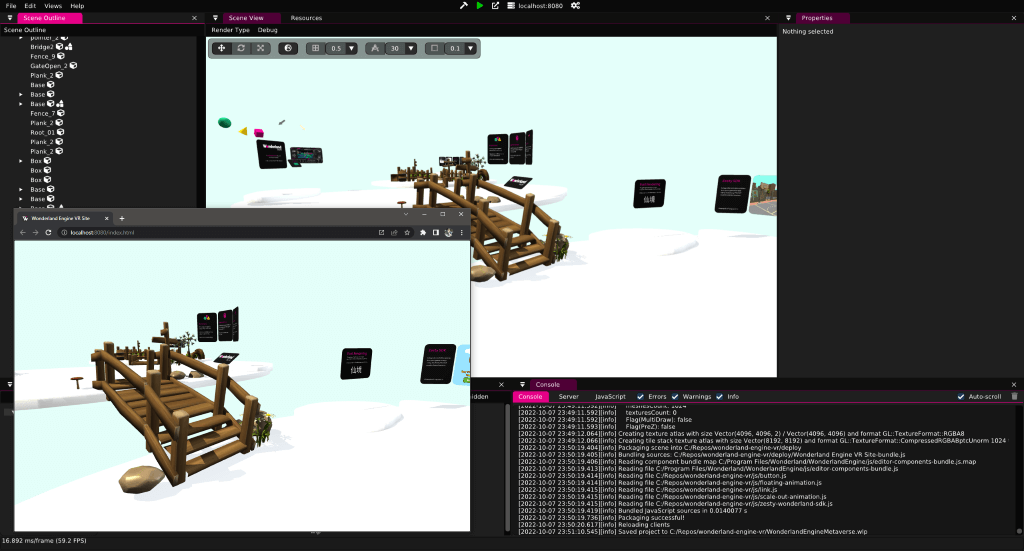
WebXR development platform Wonderland Engine editor vr website with browser

Vhite Rabbit XR and Paradowski Creative, two companies creating XR games, used the engine to develop content. The Escape Artist, an upcoming title by Paradowski Creative, is created with Wonderland Engine 1.0.p0, and its developers say that it matches native games in terms of polish and quality.

“We’re excited to announce this foundational version of Wonderland Engine, as we seek to bridge the gap between native XR app development and WebXR,” said the CEO and founder of Wonderland, Jonathan Hale, in a press release shared with ARPost. “We see a bright future for the WebXR community, for its developers, hardware, support, and content.”

Top Features of Wonderland Engine 1.0.0

The developers who choose Wonderland GmbH’s WebXR development platform to create content will be able to use the following:

  • Full 8th Wall integration – complete integration of 8th Wall AR tracking features such as face tracking, image tracking, SLAM, and VPS;
  • Runtime API rewrite – better code completion, static checks for bugs before running the code, and complete isolation for integration with other libraries;
  • Translation tools – necessary for the localization of WebXR content;
  • Benchmarking framework – to check for content performance on various devices.

Developers can find the complete list of features and bug fixes on the official release page.

According to the company, Wonderland Engine users can launch their first running app into the browser in less than two minutes. With a bit of experience, users can build a multi-user environment that supports VR, AR, and 3D in 10 minutes, as demonstrated in this video.

The XR Development Platform Is Optimized for VR Browsers

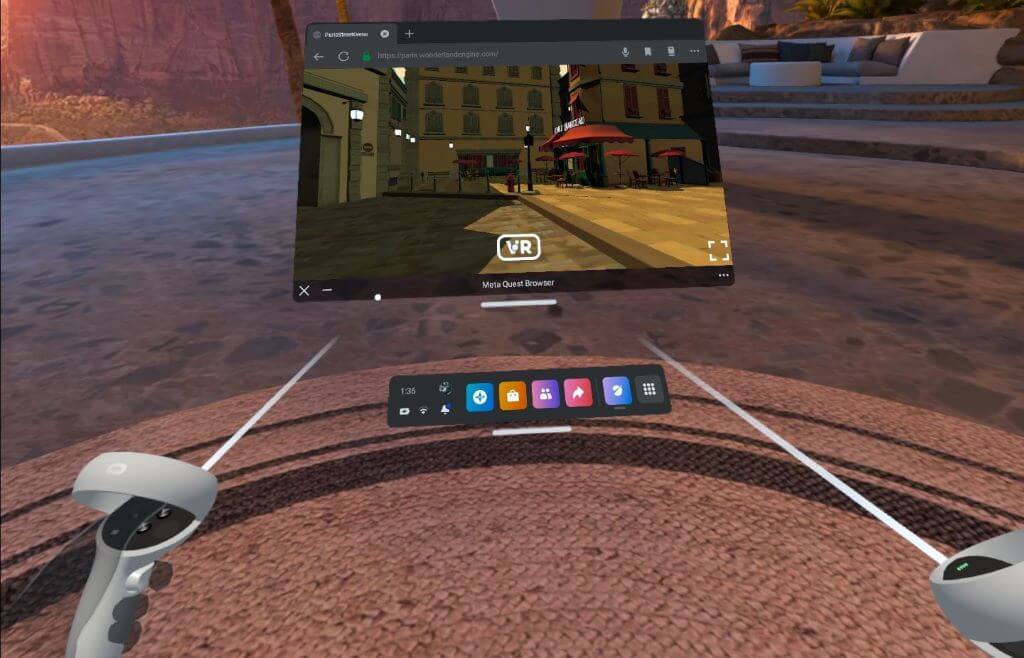
To indicate their commitment to helping content creators, Wonderland GmbH is optimizing their tool specifically for the most popular VR browsers: Meta Quest Browser, Pico Browser, and Wolvic.  

Wonderland Engine WebXR meta browser

Wonderland Engine-based apps support any headset that has a browser available. Also, any headset released in the future will automatically be supported, if it has a browser. Apps created with Wonderland Engine can also run on mobile devices through the browser, as Progressive Web Apps (PWA), which also allows them to run offline.

Apart from the two game development companies mentioned above, the company is also working with various content creators.

“It was crucial to bring the whole ecosystem with us to test and validate the changes we made. This resulted in a highly reliable base to build upon in upcoming versions,” Hale said. “By making it easier to build XR on the web we hope to attract developers and content creators to WebXR. We see WebXR truly being able to rival native apps and offer consumers a rich world of rapidly accessible content to enjoy.”

Meet the Wonderland Team at AWE USA 2023

The creators of Wonderland Engine 1.0.0 will present the WebXR development platform at AWE USA 2023 (use ARPost’s discount code 23ARPOSTD for 20% off your ticket), which is taking place in Santa Clara, CA between May 31 and June 2.

The company is one of the sponsors of the event and will also be present at the event in booth no. 605.

Wonderland Engine Is Here to Make WebXR Development Faster and Easier Read More »

aruvr-releases-no-code-content-creation-platform-for-xr-headsets

ARuVR Releases No-Code Content Creation Platform for XR Headsets

UK-based ARuVR (formerly VRtuoso) enterprise XR training platform has recently announced that it supports no-code content creation, distribution, and management for XR headsets. Thus, companies can now create extended reality training programs for VIVE XR Elite, Meta Quest Pro, and Pico 4 Enterprise without writing a single line of code.

Accessibility of AR/VR Creation Is the Latest Industry Trend

For some time now, creating AR/VR content is no longer conditioned by having coding skills. While developers are still very much in demand for high-end games and applications, there is a movement towards making the creation process accessible for all.

ARuVR puts another important building block to the foundation of this process with its no-code XR platform. Users can rely on the simple drag-and-drop process to create immersive training for employees, which can now also be experienced on extended reality headsets.

Immersive Training Is the New Norm

So far, ARuVR has attracted a roster of top clients, such as PwC, Coca-Cola, BT, and BAE Systems. These companies, and many others, rely on ARuVR’s training platform to create onboarding presentations for employees and ongoing training for staff.

The nature of AR/VR training makes it possible for international companies to create and deploy the same training for teams in various places around the globe. This ensures consistent compliance with the latest policies and best practices. Any other training method is subject to errors, human or otherwise.

With the no-code XR platform, any professional in charge of employee training can create interactive programs, test them and deploy them without a developer’s assistance.

The No-Code XR Platform Is Optimized for Enterprise Headsets

ARuVR is working together with headset producers who supply companies with enterprise-grade devices. Thus, the no-code XR platform is fully compatible with the most popular devices for corporate training, namely: HTC VIVE XR Elite, Meta Quest Pro, and Pico 4 Enterprise.

Speaking about the importance of the new training platform, Nathan Gaydhani, the Enterprise Product Owner EMEA at HTC VIVE said in a press release shared with ARPost:

“XR has the power to change how a business operates, creating and delivering highly realistic experiences to recruit, engage, upskill, or retain its workforce. Combining the great hardware of VIVE XR Elite, and powerful software like ARuVR’s platform means that advanced transformative technology is accessible to any organization.”

The Ultimate Goal: Facilitating Learning

For ARuVR, their new product is one step forward towards the goal of making training and transfer of knowledge faster and more accurate. This will ensure the success of companies, through more consistent training of their employees.

“As the first training platform to add no-code capability to our patented platform for the world’s leading XR headsets, we are ensuring that technical expertise is not a limiting factor to the roll-out of XR training programs,” said the founder and CEO of ARuVR, Frank Furnari. “Now anyone within an organization can easily become a creator of powerful and immersive training and deploy to anyone, anywhere throughout the enterprise.”

ARuVR Releases No-Code Content Creation Platform for XR Headsets Read More »

arcade-boxer-‘creed:-rise-to-glory’-takes-top-spot-in-psvr-2-download-chart

Arcade Boxer ‘Creed: Rise to Glory’ Takes Top Spot in PSVR 2 Download Chart

PlayStation VR 2 is a little over two months old now, and the charts are still very much in flux thanks to a rash of new and upgraded games. Last month, Survios’ high-profile boxing title took the top spot in the US and Canada, and fared pretty well across other regions too.

Creed: Rise to Glory – Championship Edition is an overhauled version of Creed: Rise to Glory (2018) for PSVR 2, bringing new characters and a new location from the Creed III film in addition to new features, quality of life upgrades and PvP cross-platform support.

There’s a ton of movement in the charts, so we’ve included some new symbols to help show just how the games are faring month-to-month.

The chart below is counting PS Store purchases and not bundled or upgraded content, which notably includes big titles such as Horizon Call of the MountainGran Turismo 7, and Resident Evil Village.

PSVR 2 April Top Downloads

US/Canada EU Japan
1 Creed: Rise to Glory – Championship Edition (new) Pavlov (≡)

Kayak VR: Mirage (≡)

2 Pavlov (↓1) Creed: Rise to Glory – Championship Edition (new)

Creed: Rise to Glory – Championship Edition (new)

3 The Walking Dead: Saints & Sinners – Chapter 2: Retribution (↑1) Kayak VR: Mirage (↓1)

Onogoro Monogatari ~The Tale of Onogoro~ (↑4)

4 Job Simulator (↑6) The Walking Dead: Saints & Sinners – Chapter 2: Retribution (↓1)

LES MILLS BODYCOMBAT (↑?)

5 Kayak VR: Mirage (↓2) Job Simulator (↑5)

Horizon Call of the Mountain (↓2)

6 The Dark Pictures: Switchback (↓4) The Dark Pictures: Switchback (↑?)

The Dark Pictures: Switchback VR (↓4)

7 Star Wars: Tales from the Galaxy’s Edge (↓2) Star Wars: Tales from the Galaxy’s Edge (↓3)

After the Fall – Complete Edition (↑?)

8 Synth Riders (↑?) Synth Riders (↓1)

Dyschronia:Chronos Alternate Episode I (↓4)

9 PISTOL WHIP (↓3) Swordsman VR (↓1) Swordsman VR (↑1)
10 Swordsman VR (↓2) PISTOL WHIP (↓4) Drums Rock (↓6)

Arcade Boxer ‘Creed: Rise to Glory’ Takes Top Spot in PSVR 2 Download Chart Read More »