US Copyright Office

in-a-wild-time-for-copyright-law,-the-us-copyright-office-has-no-leader

In a wild time for copyright law, the US Copyright Office has no leader


Rudderless Copyright Office has taken on new prominence during the AI boom.

It’s a tumultuous time for copyright in the United States, with dozens of potentially economy-shaking AI copyright lawsuits winding through the courts. It’s also the most turbulent moment in the US Copyright Office’s history. Described as “sleepy” in the past, the Copyright Office has taken on new prominence during the AI boom, issuing key rulings about AI and copyright. It also hasn’t had a leader in more than a month.

In May, Copyright Register Shira Perlmutter was abruptly fired by email by the White House’s deputy director of personnel. Perlmutter is now suing the Trump administration, alleging that her firing was invalid; the government maintains that the executive branch has the authority to dismiss her. As the legality of the ouster is debated, the reality within the office is this: There’s effectively nobody in charge. And without a leader actually showing up at work, the Copyright Office is not totally business-as-usual; in fact, there’s debate over whether the copyright certificates it’s issuing could be challenged.

The firing followed a pattern. The USCO is part of the Library of Congress; Perlmutter had been appointed to her role by Librarian of Congress Carla Hayden. A few days before Perlmutter’s dismissal, Hayden, who had been in her role since 2016, was also fired by the White House via email. The White House appointed Deputy Attorney General Todd Blanche, who had previously served as President Trump’s defense attorney, as the new acting Librarian of Congress.

Two days after Pelmutter’s firing, Justice Department official Paul Perkins showed up at the Copyright Office, along with his colleague Brian Nieves. According to an affidavit from Perlmutter, they were carrying “printed versions of emails” from Blanche indicating that they had been appointed to new roles within the Copyright Office. Perkins, the email said, was designated as Acting Register of Copyrights. In other words, he was Perlmutter’s replacement.

But was Blanche actually the acting Librarian, and thus able to appoint Perkins as such? Within the Library of Congress, someone else had already assumed the role—Robert Newlen, Hayden’s former second-in-command, who has worked at the LOC since the 1970s. Following Hayden’s ouster, Newlen emailed LOC staff asserting that he was the acting Librarian—never mentioning Blanche—and noting that “Congress is engaged with the White House” on how to proceed.

In her lawsuit, Perlmutter argues that only the Librarian of Congress can fire and appoint a new Register. In a filing on Tuesday, defendants argued that the president does indeed have the authority to fire and appoint the Librarian of Congress and that his appointees then have the ability to choose a new Copyright Register.

Neither the Department of Justice nor the White House responded to requests for comment on this issue; the Library of Congress declined to comment.

Perkins and Nieves did not enter the USCO office or assume the roles they purported to fill the day they showed up. And since they left, sources within the Library of Congress tell WIRED, they have never returned, nor have they assumed any of the duties associated with the roles. These sources say that Congress is in talks with the White House to reach an agreement over these personnel disputes.

A congressional aide familiar with the situation told WIRED that Blanche, Perkins, and Nieves had not shown up for work “because they don’t have jobs to show up to.” The aide continued: “As we’ve always maintained, the President has no authority to appoint them. Robert Newlen has always been the Acting Librarian of Congress.”

If talks are happening, they remain out of public view. But Perlmutter does have some members of Congress openly on her side. “The president has no authority to remove the Register of Copyrights. That power lies solely with the Librarian of Congress. I’m relieved that the situation at the Library and Copyright Office has stabilized following the administration’s unconstitutional attempt to seize control for the executive branch. I look forward to quickly resolving this matter in a bipartisan way,” Senator Alex Padilla tells WIRED in a statement.

In the meantime, the Copyright Office is in the odd position of attempting to carry on as though it wasn’t missing its head. Immediately after Perlmutter’s dismissal, the Copyright Office paused issuing registration certificates “out of an abundance of caution,” according to USCO spokesperson Lisa Berardi Marflak, who says the pause impacted around 20,000 registrations. It resumed activities on May 29 but is now sending out registration certificates with a blank spot where Perlmutter’s signature would ordinarily be.

This unusual change has prompted discussion amongst copyright experts as to whether the registrations are now more vulnerable to legal challenges. The Copyright Office maintains that they are valid: “There is no requirement that the Register’s signature must appear on registration certificates,” says Berardi Marflak.

In a motion related to Perlmutter’s lawsuit, though, she alleges that sending out the registrations without a signature opens them up to “challenges in litigation,” something outside copyright experts have also pointed out. “It’s true the law doesn’t explicitly require a signature,” IP lawyer Rachael Dickson says. “However, the law really explicitly says that it’s the Register of Copyright determining whether the material submitted for the application is copyrightable subject matter.”

Without anyone acting as Register, Dickson thinks it would be reasonable to argue that the statutory requirements are not being met. “If you take them completely out of the equation, you have a really big problem,” she says. “Litigators who are trying to challenge a copyright registration’s validity will jump on this.”

Perlmutter’s lawyers have argued that leaving the Copyright Office without an active boss will cause dysfunction beyond the registration certificate issue, as the Register performs a variety of tasks, from advising Congress on copyright to recertifying organizations like the Mechanical Licensing Collective, the nonprofit in charge of administering royalties for streaming and download music in the United States. Since the MLC’s certification is up right now, Perlmutter would ordinarily be moving forward with recertifying the organization; as her lawsuit notes, right now, the recertification process is not moving forward.

The MLC may not be as impacted by Perlmutter’s absence as the complaint suggests. A source close to the MLC told WIRED that the organization does indeed need to be recertified but that the law doesn’t require the recertification process to be completed within a specific time frame, so it will be able to continue operating as usual.

Still, there are other ways that the lack of a boss is a clear liability. The Copyright Claims Board, a three-person tribunal that resolves some copyright disputes, needs to replace one of its members this year, as a current board member, who did not reply to a request for comment, is leaving. The job posting is already live and says applications are being reviewed, but as the position is supposed to be appointed by the Librarian of Congress with the guidance of the Copyright Register, it’s unclear how exactly it will be filled. A source familiar at the Library of Congress tells WIRED that Newlen could make the appointment if necessary, but they “expect there to be some kind of greater resolution by then.”

As they wait for the resolution, it remains an especially inopportune time for a headless Copyright Office. Perlmutter was fired just days after the office released a hotly contested report on generative AI training and fair use. That report has already been heavily cited in a new class action lawsuit against AI tools Suno and Udio, even though it was technically a “prepublication” version and not finalized. But everyone looking to see what a final report will say—or what guidance the office will issue next—can only keep waiting.

This story originally appeared on wired.com.

Photo of WIRED

Wired.com is your essential daily guide to what’s next, delivering the most original and complete take you’ll find anywhere on innovation’s impact on technology, science, business and culture.

In a wild time for copyright law, the US Copyright Office has no leader Read More »
copyright-office-head-fired-after-reporting-ai-training-isn’t-always-fair-use

Copyright Office head fired after reporting AI training isn’t always fair use


Cops scuffle with Trump picks at Copyright Office after AI report stuns tech industry.

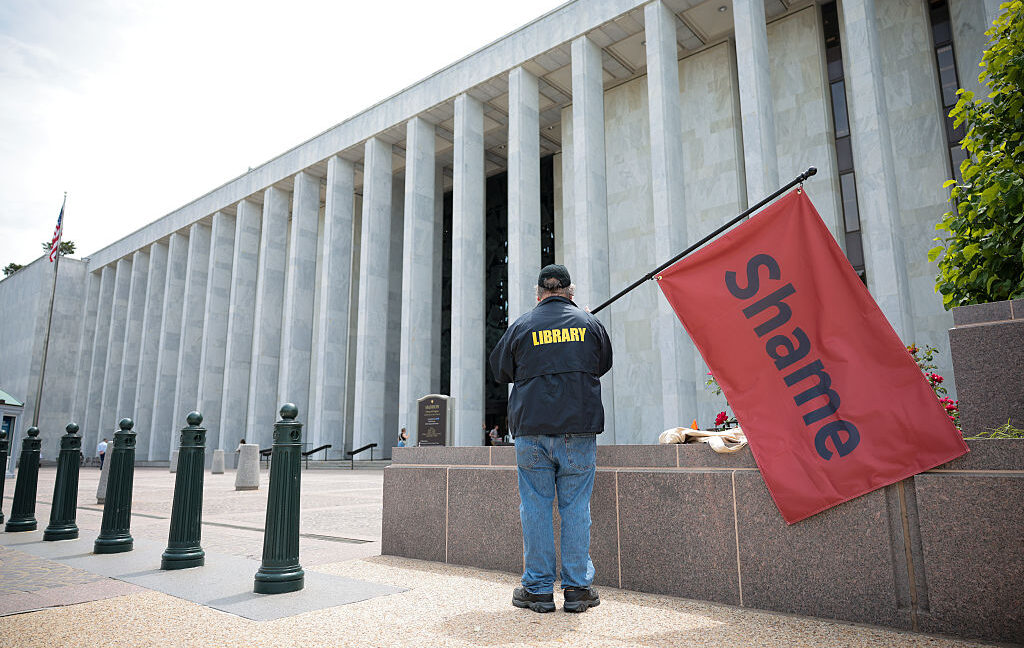
A man holds a flag that reads “Shame” outside the Library of Congress on May 12, 2025 in Washington, DC. On May 8th, President Donald Trump fired Carla Hayden, the head of the Library of Congress, and Shira Perlmutter, the head of the US Copyright Office, just days after. Credit: Kayla Bartkowski / Staff | Getty Images News

A day after the US Copyright Office dropped a bombshell pre-publication report challenging artificial intelligence firms’ argument that all AI training should be considered fair use, the Trump administration fired the head of the Copyright Office, Shira Perlmutter—sparking speculation that the controversial report hastened her removal.

Tensions have apparently only escalated since. Now, as industry advocates decry the report as overstepping the office’s authority, social media posts on Monday described an apparent standoff at the Copyright Office between Capitol Police and men rumored to be with Elon Musk’s Department of Government Efficiency (DOGE).

A source familiar with the matter told Wired that the men were actually “Brian Nieves, who claimed he was the new deputy librarian, and Paul Perkins, who said he was the new acting director of the Copyright Office, as well as acting Registrar,” but it remains “unclear whether the men accurately identified themselves.” A spokesperson for the Capitol Police told Wired that no one was escorted off the premises or denied entry to the office.

Perlmutter’s firing followed Donald Trump’s removal of Librarian of Congress Carla Hayden, who, NPR noted, was the first African American to hold the post. Responding to public backlash, White House Press Secretary Karoline Leavitt claimed that the firing was due to “quite concerning things that she had done at the Library of Congress in the pursuit of DEI and putting inappropriate books in the library for children.”

The Library of Congress houses the Copyright Office, and critics suggested Trump’s firings were unacceptable intrusions into cultural institutions that are supposed to operate independently of the executive branch. In a statement, Rep. Joe Morelle (D.-N.Y.) condemned Perlmutter’s removal as “a brazen, unprecedented power grab with no legal basis.”

Accusing Trump of trampling Congress’ authority, he suggested that Musk and other tech leaders racing to dominate the AI industry stood to directly benefit from Trump’s meddling at the Copyright Office. Likely most threatening to tech firms, the guidance from Perlmutter’s Office not only suggested that AI training on copyrighted works may not be fair use when outputs threaten to disrupt creative markets—as publishers and authors have argued in several lawsuits aimed at the biggest AI firms—but also encouraged more licensing to compensate creators.

“It is surely no coincidence [Trump] acted less than a day after she refused to rubber-stamp Elon Musk’s efforts to mine troves of copyrighted works to train AI models,” Morelle said, seemingly referencing Musk’s xAI chatbot, Grok.

Agreeing with Morelle, Courtney Radsch—the director of the Center for Journalism & Liberty at the left-leaning think tank the Open Markets Institute—said in a statement provided to Ars that Perlmutter’s firing “appears directly linked to her office’s new AI report questioning unlimited harvesting of copyrighted materials.”

“This unprecedented executive intrusion into the Library of Congress comes directly after Perlmutter released a copyright report challenging the tech elite’s fundamental claim: unlimited access to creators’ work without permission or compensation,” Radsch said. And it comes “after months of lobbying by the corporate billionaires” who “donated” millions to Trump’s inauguration and “have lapped up the largess of government subsidies as they pursue AI dominance.”

What the Copyright Office says about fair use

The report that the Copyright Office released on Friday is not finalized but is not expected to change radically, unless Trump’s new acting head potentially intervenes to overhaul the guidance.

It comes after the Copyright Office parsed more than 10,000 comments debating whether creators should and could feasibly be compensated for the use of their works in AI training.

“The stakes are high,” the office acknowledged, but ultimately, there must be an effective balance struck between the public interests in “maintaining a thriving creative community” and “allowing technological innovation to flourish.” Notably, the office concluded that the first and fourth factors of fair use—which assess the character of the use (and whether it is transformative) and how that use affects the market—are likely to hold the most weight in court.

According to Radsch, the report “raised crucial points that the tech elite don’t want acknowledged.” First, the Copyright Office acknowledged that it’s an open question how much data an AI developer needs to build an effective model. Then, they noted that there’s a need for a consent framework beyond putting the onus on creators to opt their works out of AI training, and perhaps most alarmingly, they concluded that “AI trained on copyrighted works could replace original creators in the marketplace.”

“Commenters painted a dire picture of what unlicensed training would mean for artists’ livelihoods,” the Copyright Office said, while industry advocates argued that giving artists the power to hamper or “kill” AI development could result in “far less competition, far less innovation, and very likely the loss of the United States’ position as the leader in global AI development.”

To prevent both harms, the Copyright Office expects that some AI training will be deemed fair use, such as training viewed as transformative, because resulting models don’t compete with creative works. Those uses threaten no market harm but rather solve a societal need, such as language models translating texts, moderating content, or correcting grammar. Or in the case of audio models, technology that helps producers clean up unwanted distortion might be fair use, where models that generate songs in the style of popular artists might not, the office opined.

But while “training a generative AI foundation model on a large and diverse dataset will often be transformative,” the office said that “not every transformative use is a fair one,” especially if the AI model’s function performs the same purpose as the copyrighted works they were trained on. Consider an example like chatbots regurgitating news articles, as is alleged in The New York Times’ dispute with OpenAI over ChatGPT.

“In such cases, unless the original work itself is being targeted for comment or parody, it is hard to see the use as transformative,” the Copyright Office said. One possible solution for AI firms hoping to preserve utility of their chatbots could be effective filters that “prevent the generation of infringing content,” though.

Tech industry accuses Copyright Office of overreach

Only courts can effectively weigh the balance of fair use, the Copyright Office said. Perhaps importantly, however, the thinking of one of the first judges to weigh the question—in a case challenging Meta’s torrenting of a pirated books dataset to train its AI models—seemed to align with the Copyright Office guidance at a recent hearing. Mulling whether Meta infringed on book authors’ rights, US District Judge Vince Chhabria explained why he doesn’t immediately “understand how that can be fair use.”

“You have companies using copyright-protected material to create a product that is capable of producing an infinite number of competing products,” Chhabria said. “You are dramatically changing, you might even say obliterating, the market for that person’s work, and you’re saying that you don’t even have to pay a license to that person.”

Some AI critics think the courts have already indicated which way they are leaning. In a statement to Ars, a New York Times spokesperson suggested that “both the Copyright Office and courts have recognized what should be obvious: when generative AI products give users outputs that compete with the original works on which they were trained, that unprecedented theft of millions of copyrighted works by developers for their own commercial benefit is not fair use.”

The NYT spokesperson further praised the Copyright Office for agreeing that using Retrieval-Augmented Generation (RAG) AI to surface copyrighted content “is less likely to be transformative where the purpose is to generate outputs that summarize or provide abridged versions of retrieved copyrighted works, such as news articles, as opposed to hyperlinks.” If courts agreed on the RAG finding, that could potentially disrupt AI search models from every major tech company.

The backlash from industry stakeholders was immediate.

The president and CEO of a trade association called the Computer & Communications Industry Association, Matt Schruers, said the report raised several concerns, particularly by endorsing “an expansive theory of market harm for fair use purposes that would allow rightsholders to block any use that might have a general effect on the market for copyrighted works, even if it doesn’t impact the rightsholder themself.”

Similarly, the tech industry policy coalition Chamber of Progress warned that “the report does not go far enough to support innovation and unnecessarily muddies the waters on what should be clear cases of transformative use with copyrighted works.” Both groups celebrated the fact that the final decision on fair use would rest with courts.

The Copyright Office agreed that “it is not possible to prejudge the result in any particular case” but said that precedent supports some “general observations.” Those included suggesting that licensing deals may be appropriate where uses are not considered fair without disrupting “American leadership” in AI, as some AI firms have claimed.

“These groundbreaking technologies should benefit both the innovators who design them and the creators whose content fuels them, as well as the general public,” the report said, ending with the office promising to continue working with Congress to inform AI laws.

Copyright Office seemingly opposes Meta’s torrenting

Also among those “general observations,” the Copyright Office wrote that “making commercial use of vast troves of copyrighted works to produce expressive content that competes with them in existing markets, especially where this is accomplished through illegal access, goes beyond established fair use boundaries.”

The report seemed to suggest that courts and the Copyright Office may also be aligned on AI firms’ use of pirated or illegally accessed paywalled content for AI training.

Judge Chhabria only considered Meta’s torrenting in the book authors’ case to be “kind of messed up,” prioritizing the fair use question, and the Copyright Office similarly only recommended that “the knowing use of a dataset that consists of pirated or illegally accessed works should weigh against fair use without being determinative.”

However, torrenting should be a black mark, the Copyright Office suggested. “Gaining unlawful access” does bear “on the character of the use,” the office noted, arguing that “training on pirated or illegally accessed material goes a step further” than simply using copyrighted works “despite the owners’ denial of permission.” Perhaps if authors can prove that AI models trained on pirated works led to lost sales, the office suggested that a fair use defense might not fly.

“The use of pirated collections of copyrighted works to build a training library, or the distribution of such a library to the public, would harm the market for access to those Works,” the office wrote. “And where training enables a model to output verbatim or substantially similar copies of the works trained on, and those copies are readily accessible by end users, they can substitute for sales of those works.”

Likely frustrating Meta—which is currently fighting to keep leeching evidence out of the book authors’ case—the Copyright Office suggested that “the copying of expressive works from pirate sources in order to generate unrestricted content that competes in the marketplace, when licensing is reasonably available, is unlikely to qualify as fair use.”

Photo of Ashley Belanger

Ashley is a senior policy reporter for Ars Technica, dedicated to tracking social impacts of emerging policies and new technologies. She is a Chicago-based journalist with 20 years of experience.

Copyright Office head fired after reporting AI training isn’t always fair use Read More »

us-lawmaker-proposes-a-public-database-of-all-ai-training-material

US lawmaker proposes a public database of all AI training material

Who’s got the receipts? —

Proposed law would require more transparency from AI companies.

US lawmaker proposes a public database of all AI training material

Amid a flurry of lawsuits over AI models’ training data, US Representative Adam Schiff (D-Calif.) has introduced a bill that would require AI companies to disclose exactly which copyrighted works are included in datasets training AI systems.

The Generative AI Disclosure Act “would require a notice to be submitted to the Register of Copyrights prior to the release of a new generative AI system with regard to all copyrighted works used in building or altering the training dataset for that system,” Schiff said in a press release.

The bill is retroactive and would apply to all AI systems available today, as well as to all AI systems to come. It would take effect 180 days after it’s enacted, requiring anyone who creates or alters a training set not only to list works referenced by the dataset, but also to provide a URL to the dataset within 30 days before the AI system is released to the public. That URL would presumably give creators a way to double-check if their materials have been used and seek any credit or compensation available before the AI tools are in use.

All notices would be kept in a publicly available online database.

Schiff described the act as championing “innovation while safeguarding the rights and contributions of creators, ensuring they are aware when their work contributes to AI training datasets.”

“This is about respecting creativity in the age of AI and marrying technological progress with fairness,” Schiff said.

Currently, creators who don’t have access to training datasets rely on AI models’ outputs to figure out if their copyrighted works may have been included in training various AI systems. The New York Times, for example, prompted ChatGPT to spit out excerpts of its articles, relying on a tactic to identify training data by asking ChatGPT to produce lines from specific articles, which OpenAI has curiously described as “hacking.”

Under Schiff’s law, The New York Times would need to consult the database to ID all articles used to train ChatGPT or any other AI system.

Any AI maker who violates the act would risk a “civil penalty in an amount not less than $5,000,” the proposed bill said.

At a hearing on artificial intelligence and intellectual property, Rep. Darrell Issa (R-Calif.)—who chairs the House Judiciary Subcommittee on Courts, Intellectual Property, and the Internet—told Schiff that his subcommittee would consider the “thoughtful” bill.

Schiff told the subcommittee that the bill is “only a first step” toward “ensuring that at a minimum” creators are “aware of when their work contributes to AI training datasets,” saying that he would “welcome the opportunity to work with members of the subcommittee” on advancing the bill.

“The rapid development of generative AI technologies has outpaced existing copyright laws, which has led to widespread use of creative content to train generative AI models without consent or compensation,” Schiff warned at the hearing.

In Schiff’s press release, Meredith Stiehm, president of the Writers Guild of America West, joined leaders from other creative groups celebrating the bill as an “important first step” for rightsholders.

“Greater transparency and guardrails around AI are necessary to protect writers and other creators” and address “the unprecedented and unauthorized use of copyrighted materials to train generative AI systems,” Stiehm said.

Until the thorniest AI copyright questions are settled, Ken Doroshow, a chief legal officer for the Recording Industry Association of America, suggested that Schiff’s bill filled an important gap by introducing “comprehensive and transparent recordkeeping” that would provide “one of the most fundamental building blocks of effective enforcement of creators’ rights.”

A senior adviser for the Human Artistry Campaign, Moiya McTier, went further, celebrating the bill as stopping AI companies from “exploiting” artists and creators.

“AI companies should stop hiding the ball when they copy creative works into AI systems and embrace clear rules of the road for recordkeeping that create a level and transparent playing field for the development and licensing of genuinely innovative applications and tools,” McTier said.

AI copyright guidance coming soon

While courts weigh copyright questions raised by artists, book authors, and newspapers, the US Copyright Office announced in March that it would be issuing guidance later this year, but the office does not seem to be prioritizing questions on AI training.

Instead, the Copyright Office will focus first on issuing guidance on deepfakes and AI outputs. This spring, the office will release a report “analyzing the impact of AI on copyright” of “digital replicas, or the use of AI to digitally replicate individuals’ appearances, voices, or other aspects of their identities.” Over the summer, another report will focus on “the copyrightability of works incorporating AI-generated material.”

Regarding “the topic of training AI models on copyrighted works as well as any licensing considerations and liability issues,” the Copyright Office did not provide a timeline for releasing guidance, only confirming that their “goal is to finalize the entire report by the end of the fiscal year.”

Once guidance is available, it could sway court opinions, although courts do not necessarily have to apply Copyright Office guidance when weighing cases.

The Copyright Office’s aspirational timeline does seem to be ahead of when at least some courts can be expected to decide on some of the biggest copyright questions for some creators. The class-action lawsuit raised by book authors against OpenAI, for example, is not expected to be resolved until February 2025, and the New York Times’ lawsuit is likely on a similar timeline. However, artists suing Stability AI face a hearing on that AI company’s motion to dismiss this May.

US lawmaker proposes a public database of all AI training material Read More »