Upgrade

the-analogue-3d-is-the-modern-n64-fans-have-been-waiting-for

The Analogue 3D is the modern N64 fans have been waiting for


Excellent design and display filters, but the lack of OpenFPGA support rankles.
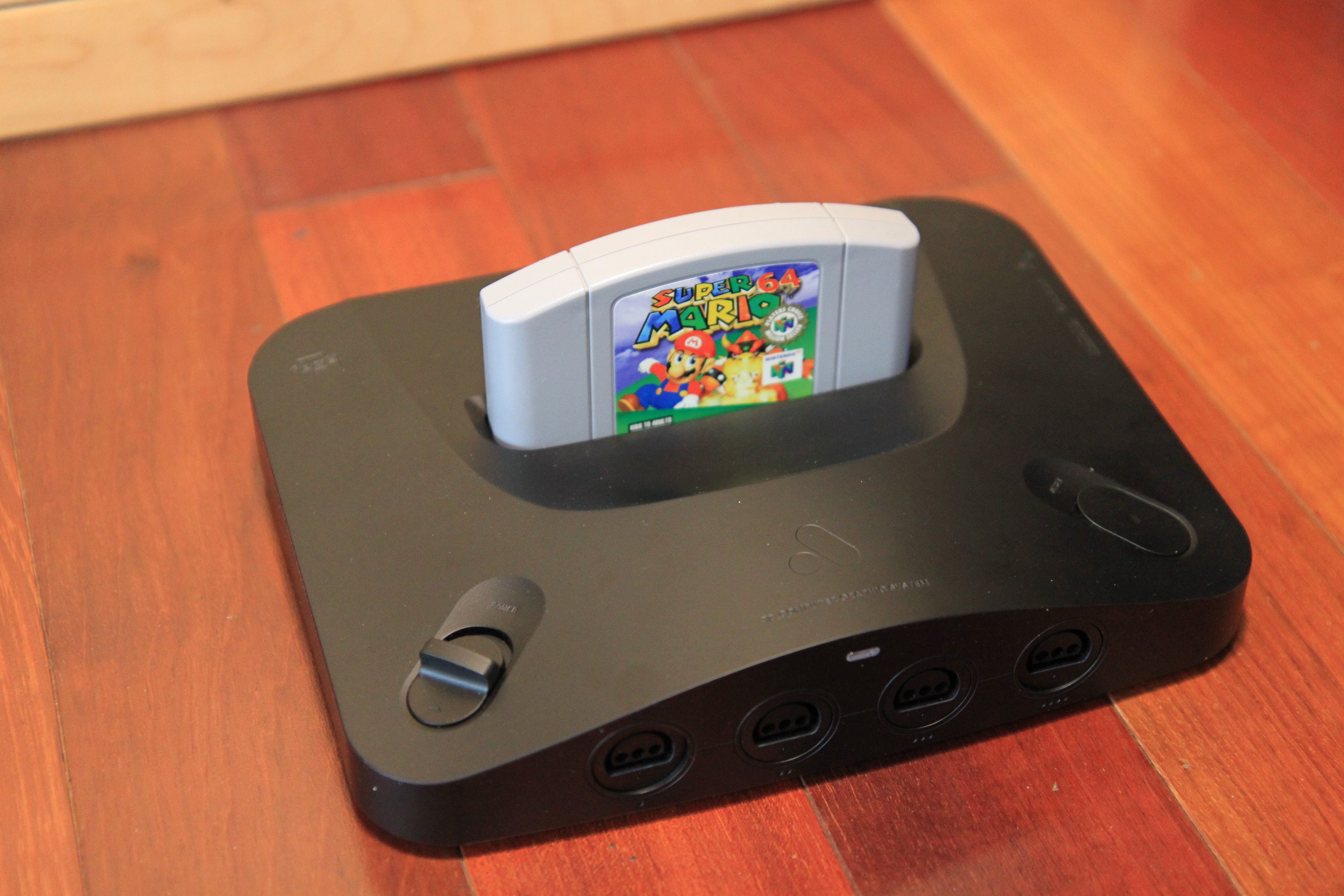
Your Super Mario 64 cartridge has a new home. Credit: Kyle Orland

Your Super Mario 64 cartridge has a new home. Credit: Kyle Orland

If you’ve ever tried to hook an old Nintendo 64 up to a modern HDTV, you know the results can be less than ideal. Assuming your original hardware still works and your flatscreen even has the requisite R/F and/or composite inputs to allow for the connection, the N64’s output will probably look like a blurry mess on a flatscreen that wasn’t designed with those old video signals as a priority.

The Analogue 3D solves this very specific problem very well, with a powerful FPGA core that accurately replicates a Nintendo 64 and well-made display filters that do a good job of approximating that cathode-ray tube glow you remember from decades ago. But the lack of easy expandability limits the appeal of this $250 device to all but the most die-hard fans of original N64 hardware.

A beauty to behold

As a piece of physical design, the Analogue 3D is a work of art. The gentle curves of its sleek black shell evoke the original N64 design without copying it, coming in at a slightly smaller footprint and height. Plus, there’s no ugly power brick.

3D COMPUTER GRAPHICS SYSTEM. Kyle Orland

This is a solidly built device, with a nice grippy underside and springy, elegant power and reset buttons. The shell has a lot of small, thoughtful touches, too, like a front power indicator that doubles as a Bluetooth sync button and lights on each controller port to indicate when a wireless controller is connected to that slot (the Hall Effect joysticks on 8bitdo’s wireless “64” controller are a joy compared to the crunchy mechanical sticks on your old N64 controller).

The one downside to this design is that the hardware can get slightly hot after running for a while, and it emits some noticeable fan noise when stressed. The welcome screen when you first boot the system recommends you give the vents adequate space to breathe, so be careful if you plan to place it directly on the carpet or something.

I saw the TV glow

The Analogue 3D’s custom 3DOS software automatically detects the game cartridge you’ve placed into its top-loading slot and displays basic info like player count, developer/publisher, and release date on-screen (you can also load your own custom cartridge images onto an included SD card). The system maintains this info in a scrollable list of every cartridge you’ve ever inserted, allowing for a quick way to browse through your library without the need to dig out your actual cartridges. You do have to plug in the cartridges to actually play the games, though, which limits the usefulness of the on-screen library more than a little bit.

Before you launch a game, you can also configure the Display Mode between five preset options (these can also be swapped during gameplay using controller hotkeys for an on-screen menu). Of these, you’ll generally want to stay away from the “Clean” option, which upscales the N64’s 320×240 image by simply blowing up each individual pixel to fit the display. The result is an incredibly blocky image with lots of jagged edges and blobs of color that refuse to blend well with nearby elements. It’s a look that’s especially unsuited to the low-resolution textures on most N64 games, which exploited the gentle blur of a CRT to create some vivid effects.

Switching over to the “Scanlines” display option helps a bit in rounding out those jagged N64 polygons, but things really start to look better if you activate one of the system’s three different CRT emulation modes. With these, 3DOS does its best to recreate the look of an electron beam actually scanning across the phosphors on an old tube TV. These filters do an admirable job of softening the hard edges of polygons and sprites while subtly and accurately blending the colors on those low-res textures.

A scene from Starfox 64, upscaled with the Analogue 3D’s “Clean” filter (direct capture). Nintendo / Analogue

The Analogue 3D has three tube TV emulation modes, each representing consumer CRTs and the kind of Pro/Broadcast Video Monitors you’d usually only find in TV station control rooms. You can go into the menus for each mode and tinker with settings like “beam convergence” and “edge hardness,” and you can toggle N64 hardware effects like anti-aliasing and de-blurring (you can also stretch the 4:3 image to fill a 16:9 display if you’re a specific kind of monster).

In general, though, I didn’t see much upside in this kind of settings tinkering. Using the system’s default “CRT” settings created a visual experience that was surprisingly authentic to the actual CRT sitting in my home office. The only thing really missing is an option to simulate the curve of a classic CRT; the hard square edges of the Analogue 3D output are a bit lacking on that score. But that’s a minor complaint for a filter that does such a good job mimicking an old TV on new display technology.

Paper Mario with the Analogue 3D’s “Clean” filter (direct capture). Nintendo / Analogue

Open and shut

Like previous Analogue hardware, the Analogue 3D uses FPGA to accurately recreate the inner workings of an N64 at the level of individual logic gates. This time, the Analogue 3D’s Altera Cyclone FPGA sports a whopping 220,000 logic elements. That’s a big step up from the two FPGAs on 2021’s Analogue Pocket, which have just 49,000 and 15,000, respectively.

That powerful FPGA allows for perfectly accurate and lag-free N64 emulation in all of our tests with original cartridges (Analogue’s Christopher Taber warns us that “flash carts and unofficial 3rd party products can be a bit of a wild card”). But players hoping to emulate other gaming systems with that powerful hardware may run into some problems. That’s because the Analogue 3D doesn’t support the OpenFPGA standard that Analogue itself rolled out in 2022 as “the future of video game preservation.”

That standard has allowed a vibrant community of OpenFPGA developers to create dozens of free “cores” that can recreate everything from classic arcade games to 16-bit consoles with amazing fidelity. Currently, though, those cores will only work on the Analogue Pocket and not subsequent hardware like the Analogue 3D or 2023’s Analogue Duo.

That’s a shame because the OpenFPGA community would certainly be happy to get their hands on the new, larger FPGA in the Analogue 3D to build out core support for even more classic gaming consoles. And we’re sure Analogue 3D owners would be happy to use their purchase to play existing OpenFPGA cores on the big screen, complete with 3DOS’ great display options.

The beginning of Goldeneye as seen through Analogue’s CRT filter (photo of the HDTV screen).

“If we wanted to offer Analogue 3D with OpenFPGA (which is not the purpose or focus of the product), it would require not only a second FPGA, but an even more powerful base FPGA, therefore increasing the price to a price that doesn’t suit our goals,” Analogue founder Christopher Taber told Ars when the system was first announced back in 2023.

It seems likely that hackers and tinkerers will be able to expand the Analogue 3D’s emulation capabilities in the future. As it stands, though, it’s hard to recommend the hardware when options like Android-based, emulation-focused handhelds, Raspberry Pi-based emulation consoles, and even (more expensive) MiSTer FPGA boxes offer able support for much more than just N64 games.

If you’re looking for a simple, plug-and-play way to use your original N64 cartridges and accessories on a modern display, the Analogue 3D offers pretty much everything you could hope for. If you want a single device that can handle more, though, you should look elsewhere.

Photo of Kyle Orland

Kyle Orland has been the Senior Gaming Editor at Ars Technica since 2012, writing primarily about the business, tech, and culture behind video games. He has journalism and computer science degrees from University of Maryland. He once wrote a whole book about Minesweeper.

The Analogue 3D is the modern N64 fans have been waiting for Read More »
gpt-4.1-is-a-mini-upgrade

GPT-4.1 Is a Mini Upgrade

Yesterday’s news alert, nevertheless: The verdict is in. GPT-4.1-Mini in particular is an excellent practical model, offering strong performance at a good price. The full GPT-4.1 is an upgrade to OpenAI’s more expensive API offerings, it is modestly better but costs 5x as much. Both are worth considering for coding and various other API uses. If you have an agent or other app, it’s at least worth trying plugging these in and seeing how they do.

This post does not cover OpenAI’s new reasoning models. That was today’s announcement, which will be covered in full in a few days, once we know more.

That’s right, 4.1.

Here is their livestream, in case you aren’t like me and want to watch it.

On the one hand, I love that they might finally use a real version number with 4.1.

On the other hand, we would now have a GPT-4.1 that is being released after they previously released a GPT-4.5. The whole point of version numbers is to go in order.

The new cheat sheet for when to use GPT-4.1:

Will Brown: it’s simple, really. GPT-4.1 is o3 without reasoning, and GPT-4.1-mini is o4-mini without reasoning. o4-mini-low is GPT-4.1-mini with just a little bit of reasoning. o1 is 4o with reasoning, o1-mini is 4o-mini with a little bit of reasoning, o3-mini is 4o-mini with reasoning that’s like better but not necessarily more, and o4 is GPT-4.5 with reasoning.

if you asked an openai employee about this, they’d say something like “that’s wrong and an oversimplification but maybe a reasonable way to think about it”

I mean, I think that’s wrong, but I’m not confident I have the right version of it.

They are not putting GPT-4.1 in ChatGPT, only in the API. I don’t understand why.

Sam Altman: GPT-4.1 (and -mini and -nano) are now available in the API!

These models are great at coding, instruction following, and long context (1 million tokens). Benchmarks are strong, but we focused on real-world utility, and developers seem very happy.

GPT-4.1 family is API-only.

Greg Brockman: New model in our API — GPT-4.1. It’s great at coding, long context (1 million tokens), and instruction following.

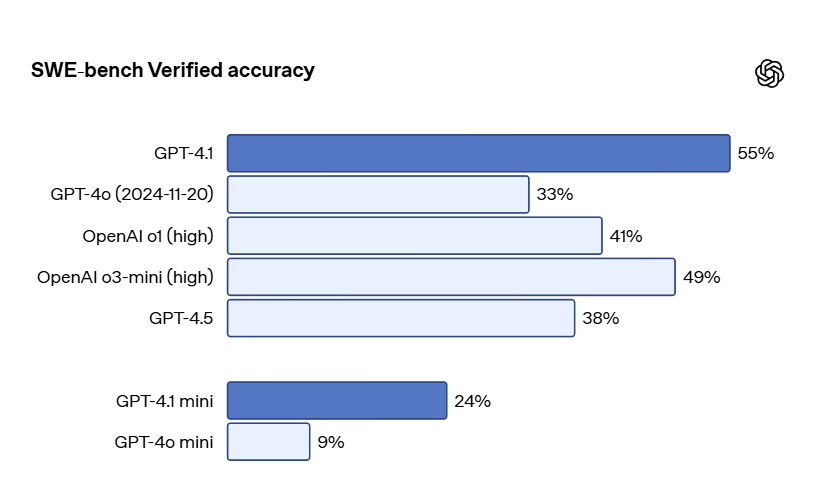
Noam Brown: Our latest @OpenAI model, GPT-4.1, achieves 55% on SWE-Bench Verified *without being a reasoning model*. @michpokrass and team did an amazing job on this! (New reasoning models coming soon too.)

The best news is, Our Price Cheap, combined with the 1M token context window and max output of 32k tokens.

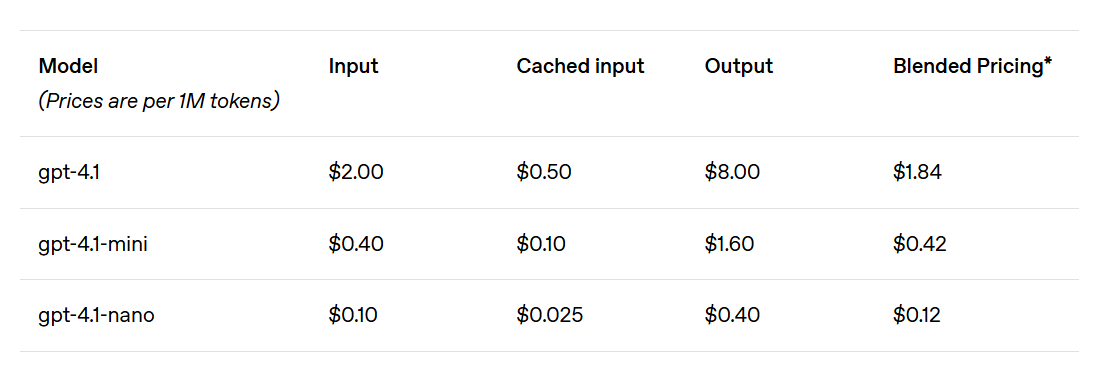
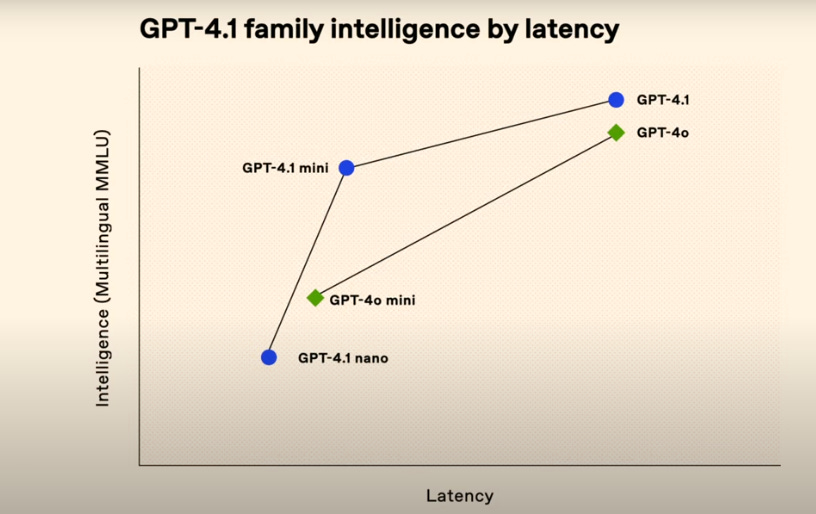
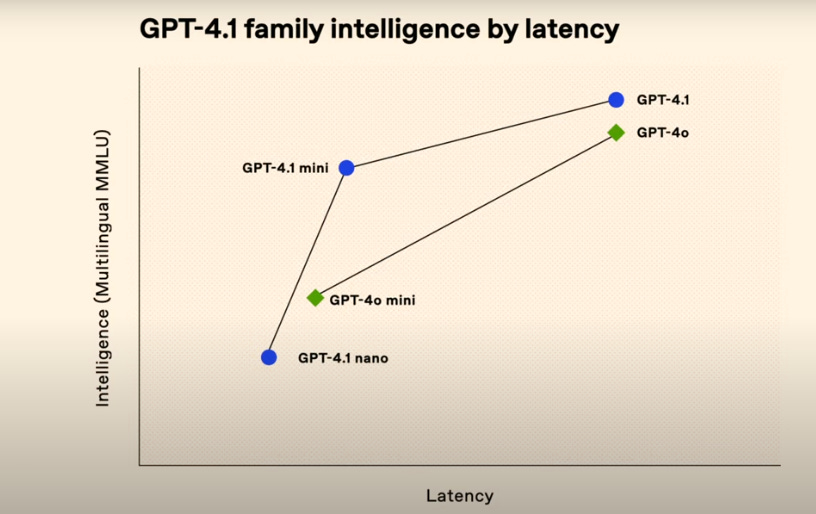
Based on the benchmarks and the reports elsewhere, the real release here is GPT-4.1-mini. Mini is 20% of the cost for most of the value. The full GPT-4.1 looks to be in a weird spot, where you probably want to either go big or go small. Nano might have its uses too, but involves real tradeoffs.

We start with the official ones.

They lead with coding, SWE-bench in particular.

I almost admire them saying no, we don’t acknowledge that other labs exist.

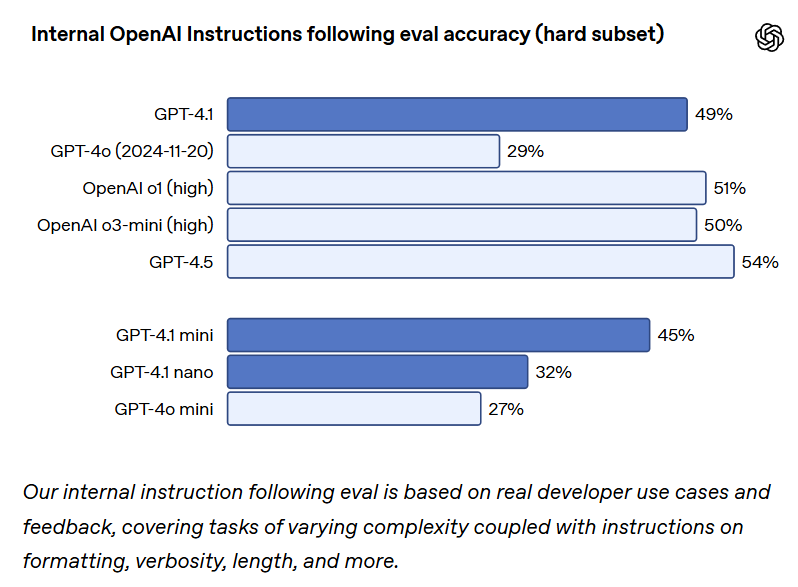
They have an internal ‘instruction following’ eval. Here the full GPT-4.1 is only okay, but mini and nano are upgrades within the OpenAI ecosystem. It’s their benchmark, so it’s impossible to know if these scores are good or not.

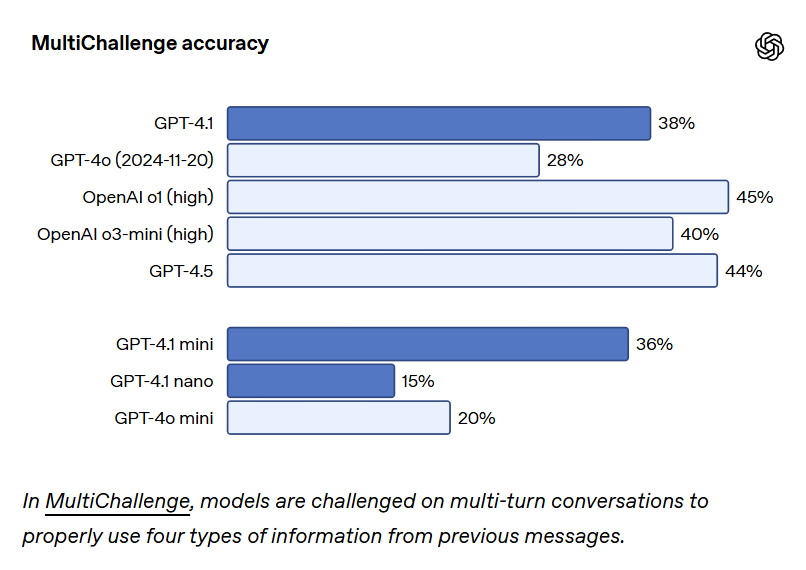
Next up is MultiChallenge.

This is an outside benchmark, so we can see that these results are mid. Gemini 2.5 Pro leads the way with 51.9, followed by Claude 3.7 Thinking. GPT-4.5 is the best non-thinking model, with various Sonnets close behind.

They check IFEval and get 87%, which is okay probably, o3-mini-high is 94%. The mini version gets 84%, so the pattern of ‘4.1 does okay but 4.1-mini only does slightly worse’ continues.

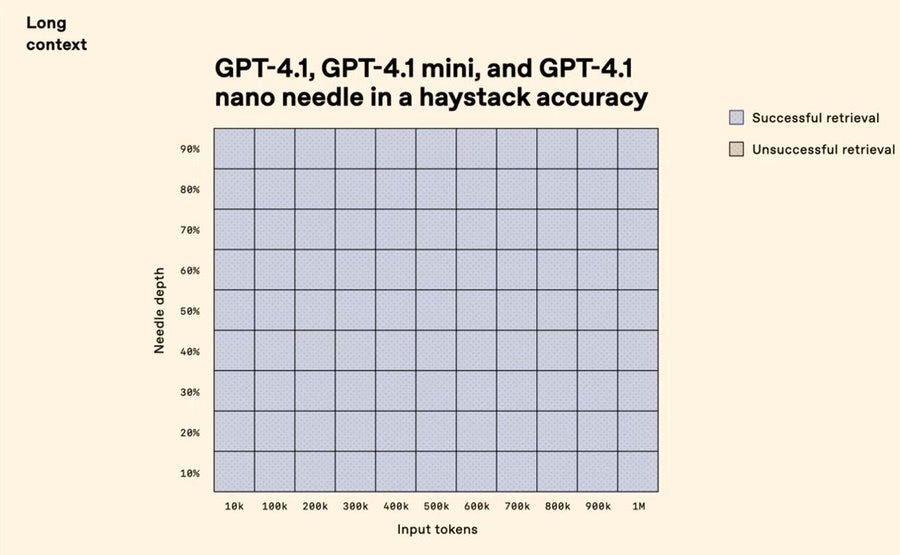
All three model sizes have mastered needle-in-a-haystack all the way to 1M tokens. That’s great, but doesn’t tell you if they’re actually good in practice in long context.

Then they check something called Graphwalks, then MMMU, MathVista, CharXiv-Reasoning and Video long context.

Their charts are super helpful, check ‘em out:

Near: openai launch today. very informative chart.

Kesku: this one speaks to me

Mostly things have been quiet, but for those results we have it is clear that GPT-4.1 is a very good value, and a clear improvement for most API use over previous OpenAI models.

Where we do have reports, we continue to see the pattern that OpenAI’s official statistics report. Not only does GPT-4.1-mini not sacrifice much performance versus GPT-4.1, in some cases the mini version is actively better.

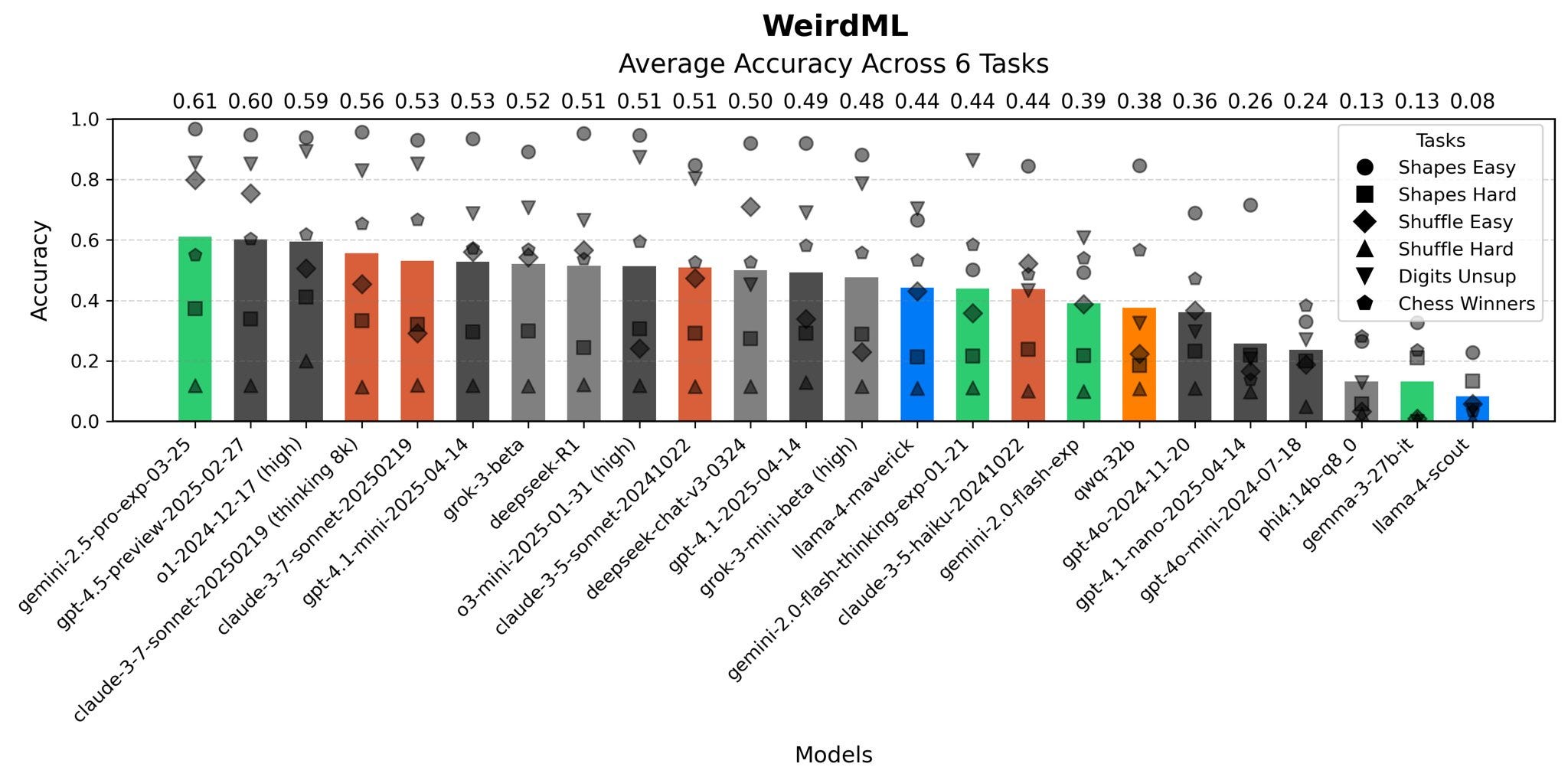
We see this for EpochAI’s tests, and also for WeirdML.

Harvard Ihle: GPT-4.1 clearly beats 4o on WeirdML. The focus on coding and instruction following should be a good combo for these tasks, and 4.1-mini does very well for its cost, landing on the same score (53%) as sonnet-3.7 (no thinking), will be interesting to compare it to flash-2.5.

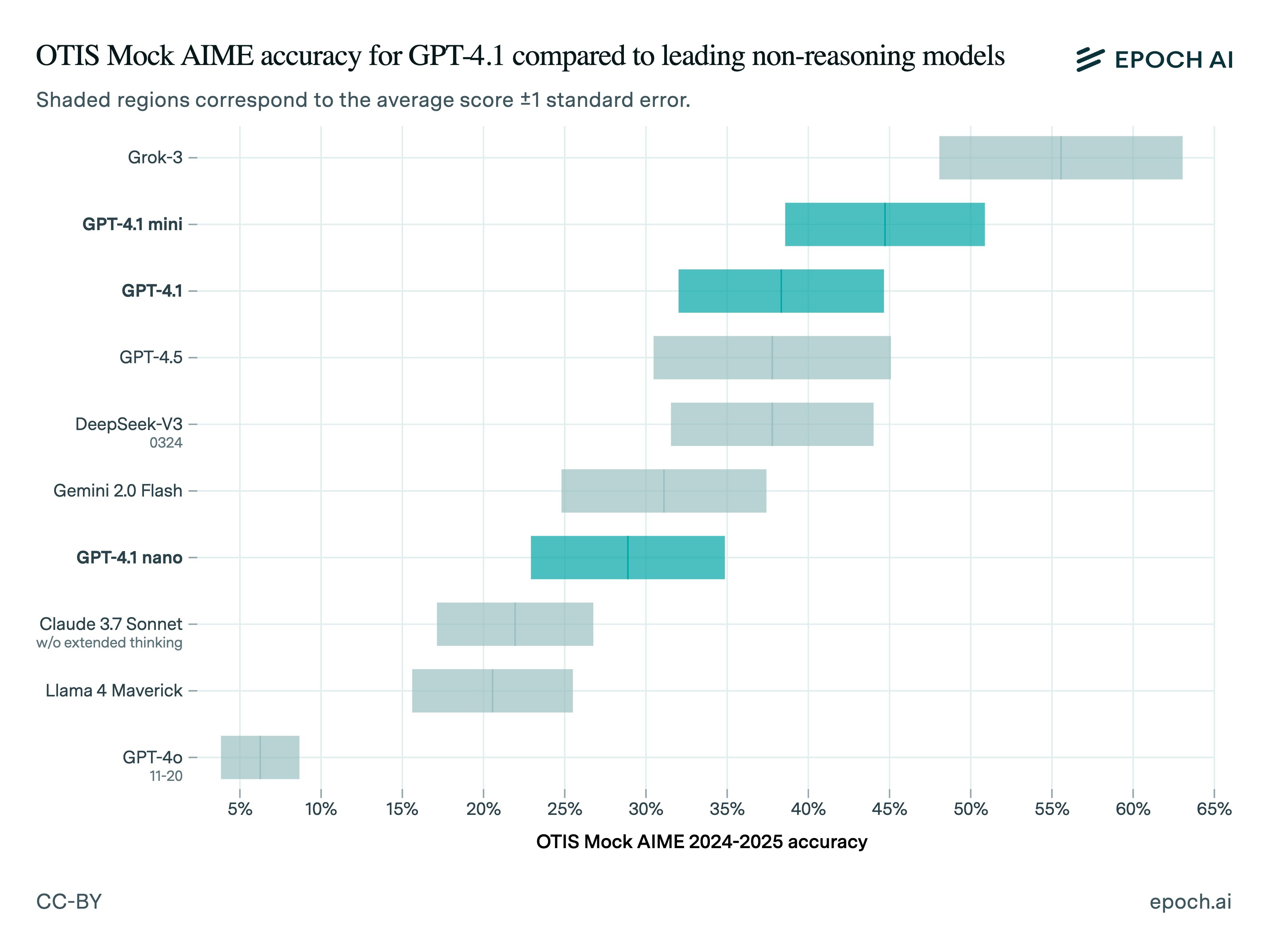
EpochAI: Yesterday, OpenAI launched a new family of models, GPT-4.1, intended to be more cost-effective than previous GPT models. GPT-4.1 models come in multiple sizes and are not extended thinking / reasoning models. We ran our own independent evaluations of GPT-4.1.

On GPQA Diamond, a set of Ph.D.-level multiple choice science questions, GPT-4.1 scores 67% (±3%), competitive with leading non-reasoning models, and GPT-4.1 mini is very close at 66% (±3%). These match OpenAI’s reported scores of 66% and 65%.

Nano gets 49% (±2%), above GPT-4o.

On FrontierMath, our benchmark of original, expert-level math questions, GPT-4.1 and GPT-4.1 mini lead non-reasoning models at 5.5% and 4.5% (±1%).

Note that the top reasoning model, o3-mini high, got 11% (±2%). OpenAI has exclusive access to FrontierMath besides a holdout set.

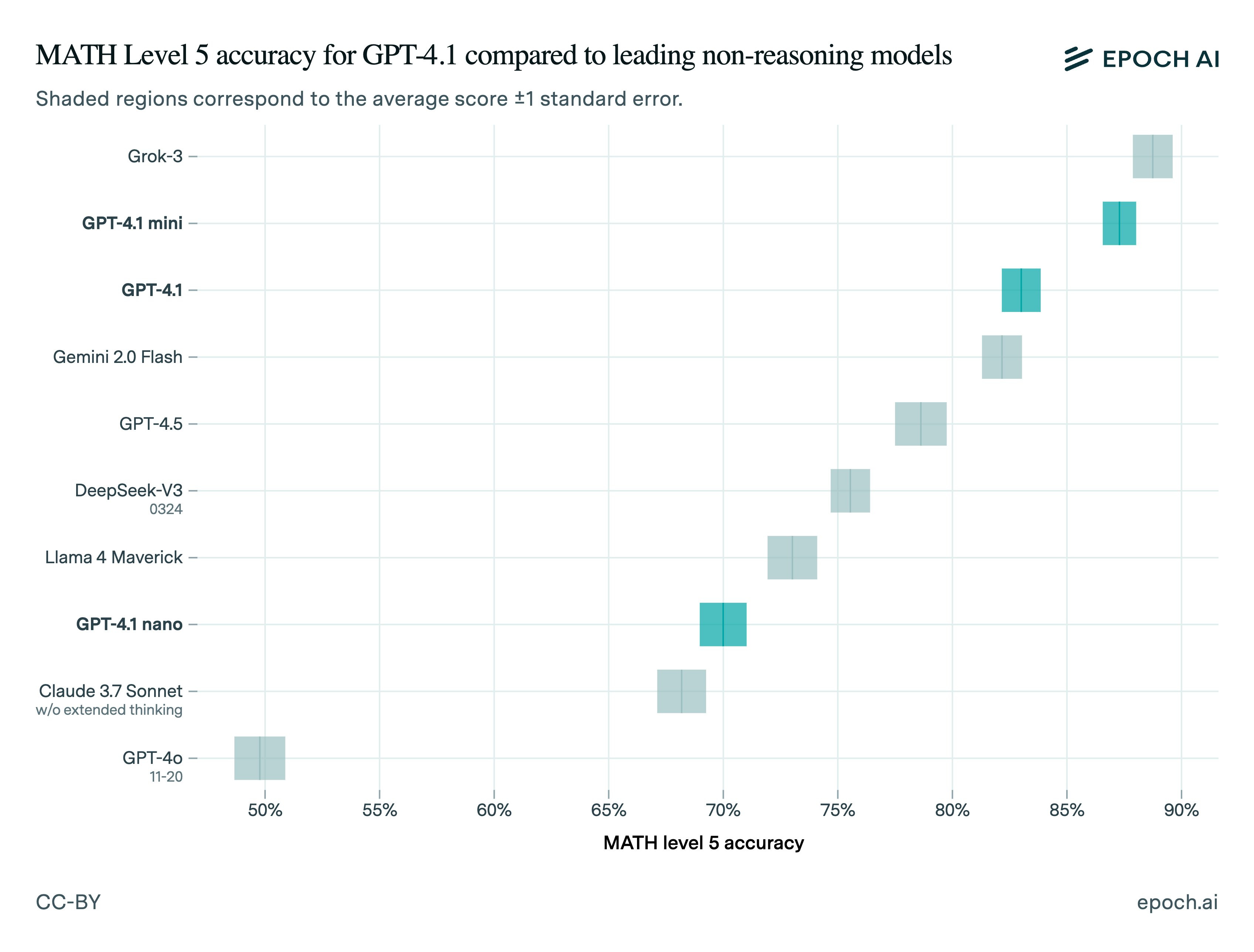
On two competition math benchmarks, OTIS Mock AIME and MATH Level 5, GPT-4.1 and 4.1 mini are near the top among non-reasoning models. Mini does better than the full GPT-4.1, and both outperform the larger GPT-4.5!

GPT-4.1 nano is further behind, but still beats GPT-4o.

Huh, I hadn’t previously seen these strong math results for Grok 3.

EpochAI: GPT-4.1 appears cost-effective, with strong benchmarks, fairly low per-token costs (GPT-4.1 is 20% cheaper than 4o) and no extended thinking.

However, Gemini 2.0 Flash is priced similarly to Nano while approaching GPT-4.1 (mini) in scores, so there is still strong competition.

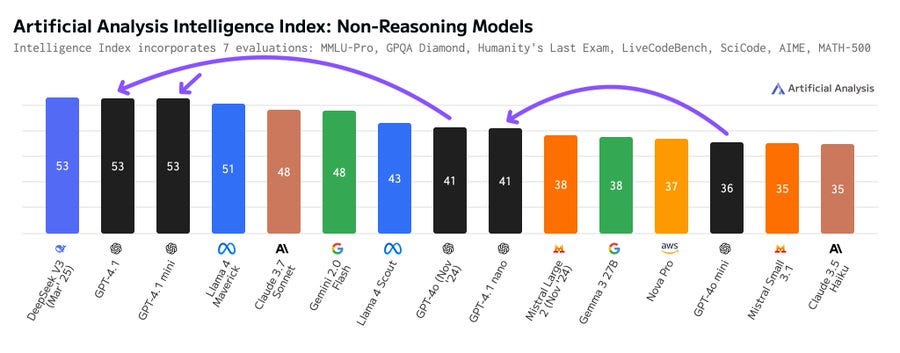
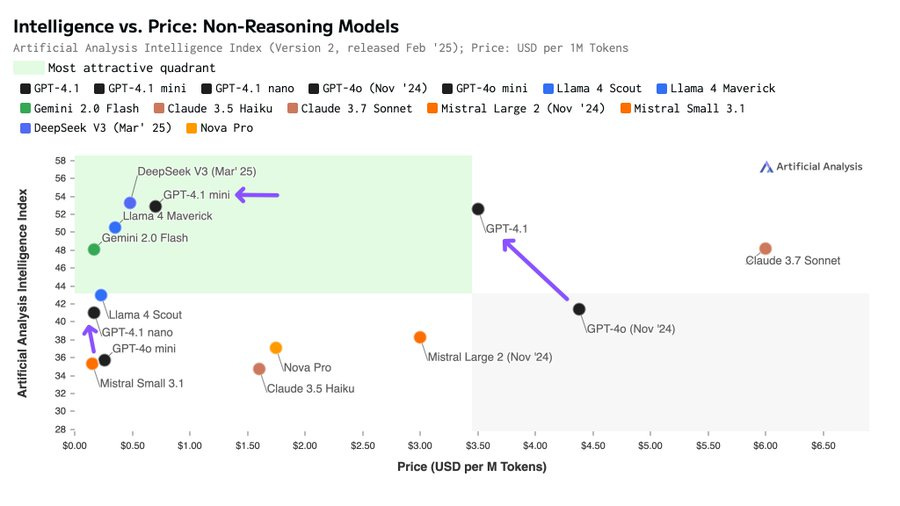
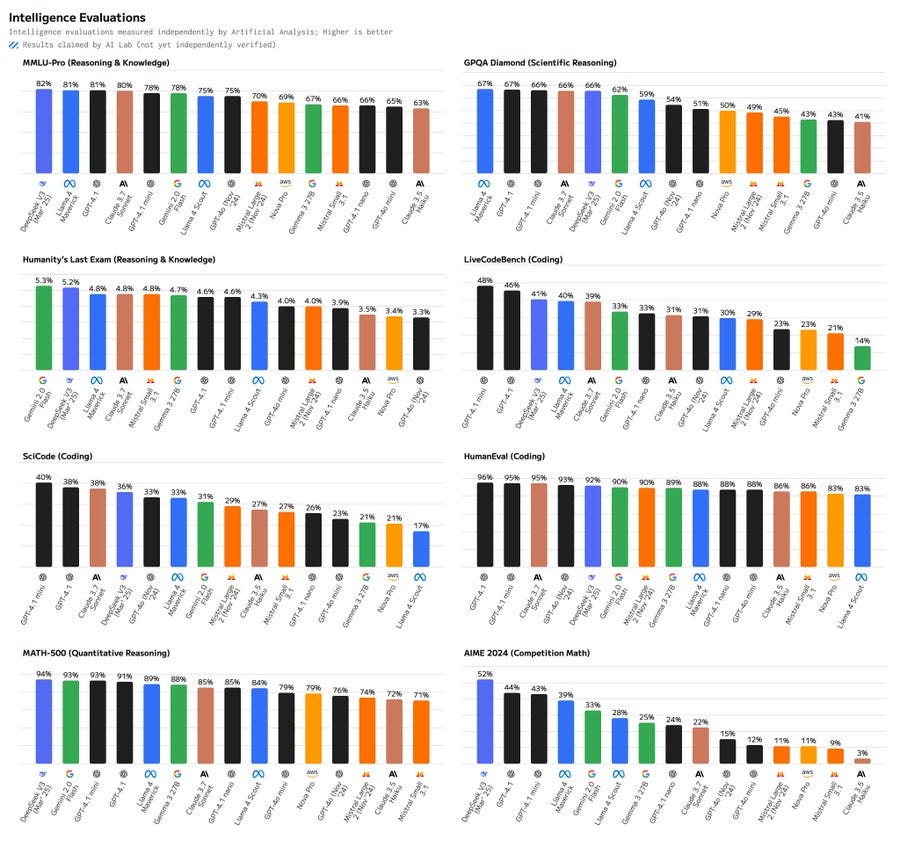
Artificial Analysis confirms OpenAI’s claims with its ‘intelligence index’ and other measures (their website is here, the quotes are from their thread):

Artificial Analysis: OpenAI’s GPT-4.1 series is a solid upgrade: smarter and cheaper across the board than the GPT-4o series.

@OpenAI

‘s GPT-4.1 family includes three models: GPT-4.1, GPT-4.1-mini and GPT-4.1 nano. We have independently benchmarked these with our Artificial Analysis Intelligence Index and the results are impressive:

➤ GPT-4.1 scores 53 – beating out Llama 4 Maverick, Claude 3.7 and GPT-4o to score identically to DeepSeek V3 0324.

➤ GPT-4.1 mini, likely a smaller model, actually matches GPT-4.1’s Intelligence Index score while being faster and cheaper. Across our benchmarking, we found that GPT-4.1 mini performs marginally better than GPT-4.1 across coding tasks (scoring equivalent highest on SciCode and matching leading reasoning models).

➤ GPT-4.1 nano scores 41 on Intelligence Index, approximately in line with Llama 3.3 70B and Llama 4 Scout. This release represents a material upgrade over GPT 4o-mini which scores 36.

Developers using GPT-4o and GPT-4o mini should consider immediately upgrading to get the benefits of greater intelligence at lower prices.

There are obvious reasons to be skeptical of this index, I mean Gemini Flash 2.0 is not as smart as Claude 3.7 Sonnet, but it’s measuring something real. It illustrates that GPT-4.1 is kind of expensive for what you get, whereas GPT-4.1-mini is where it is at.

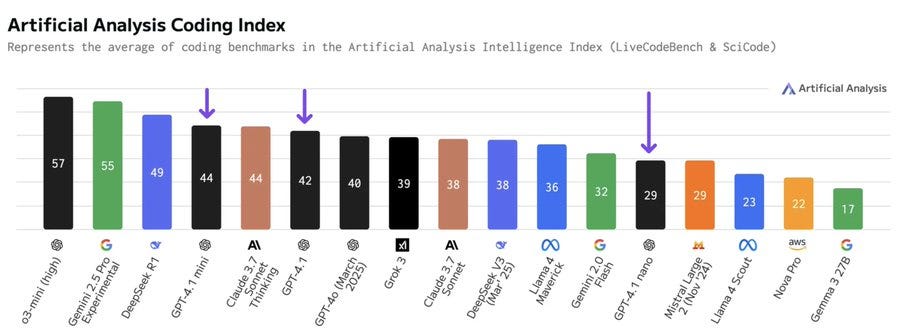
A∴A∴: Our benchmarking results appear to support OpenAI’s claim that the GPT-4.1 series represents significant progress for coding use cases. This chart shows GPT-4.1 models competing well in coding even compared to reasoning models, implying that they may be extremely effective in agentic coding use cases.

GPT-4.1 Nano and Mini are both delivering >200 tokens/s output speeds – these models are fast. Our full set of independent evaluation results shows no clear weakness areas for the GPT-4.1 series.

This is the kind of thing people who try to keep up say these days:

Hasan Can: I can see GPT-4.1 replacing Sonnet 3.6 and implementing the changes I planned with Gemini 2.5 Pro. It’s quite good at this. It’s fast and cheap, and does exactly what is needed, nothing more, nothing less. It doesn’t have the overkill of Sonnet 3.7, slowness of Gemini 2.5 Pro or the shortcomings of DeepSeek 03-24.

Then you have the normal sounding responses, also positive.

Reply All Guy: reactions are sleeping on 4.1 mini. This model of a beast for the price. And lots of analysis missing the point that 4.1 itself is much cheaper than reasoning models. never use price per token; always use price per query.

4o < 3.5 sonnet < 4.1 < 3.7 sonnet

haiku <<< 4.1 mini

Clive Chan: 4.1 has basically replaced o3-mini for me in all my workflows (cursor, etc.) – highly recommend

also lol at nano just hanging out there being 2x better than latest 4o at math.

Dominik Lukes: Welcome to the model points race. 2.5, 3.7, 4.1 – this is a (welcome) sign of the incremental times. Finally catching up on context window. Not as great at wow as Claude 3.7 Sonnet on one shot code generation but over time it actually makes things better.

Pat Anon: Some use cases for GPT-4.1-mini and nano, otherwise its worse than Sonnet 3.7 at coding and worse than Gemini-2.5-pro at everything at roughly the same cost.

Nick Farina: It has a good personality. I’m using it in Cursor and am having a long and very coherent back and forth, talking through ideas, implementing things here and there. It doesn’t charge forward like Claude, which I really like. And it’s very very fast which is actually huge.

Daniel Parker: One quirk I noticed is that it seems to like summarizing its results in tables without any prompt telling it to do so.

Adam Steele: Used it today on the same project i used Claude 3.7 for the last few days. I’d say it a bit worse in output quality but OTOH got something right Claude didn’t. It was faster.

Oli: feels very good almost like 4.5 but way cheaper and faster and even better than 4.5 in some things

I think mostly doing unprompted tables is good.

Here is a bold but biased claim.

Aidan McLaughlin (OpenAI): heard from some startup engineers that they lost several work hours gawking, stupefied, after they plugged 4.1 mini/nano into every previously-expensive part of their stack

you can just do gpt-4o-quality things 25 × cheaper now.

And here’s a bold censorship claim and a counterclaim, the only words I’ve heard on the subject. For coding and similar purposes no one seems to be having similar issues.

Senex: Vastly increased moderation. It won’t even help write a story if a character has a wart.

Christian Fieldhouse: Switched my smart camera to 4.1 from 4o, less refusals and I think better at spotting small details in pictures.

Jan Betley: Much better than 4o at getting emergently misaligned.

OpenAI has announced the scheduled deprecation of API access for GPT-4.5. So GPT-4.5 will be ChatGPT only, and GPT-4.1 will be API only.

When I heard it was a full deprecation of GPT-4.5 I was very sad. Now that I know it is staying in ChatGPT, I think this is reasonable. GPT-4.5 is too expensive to scale API use while GPUs are melting, except if a rival is trying to distill its outputs. Why help them do that?

xlr8harder: OpenAI announcing the scheduled deprecation of GPT-4.5 less than 2 months after its initial release in favor of smaller models is not a great look for the scaling hypothesis.

Gwern: No, it’s a great look, because back then I explicitly highlighted the ability to distill/prune large models down into cheap models as one of several major justifications for the scaling hypothesis in scaling to expensive models you don’t intend to serve.

Morgan: i feel gwern’s point too, but bracketing that, it wasn’t entirely obvious but 4.5 stays in chatgpt (which is likely where it belongs)

xl8harder: this actually supports @gwern’s point more, then: if they don’t want the competition distilling off 4.5, that would explain the hurry to shut down api access.

This space intentionally left blank.

As in, I could find zero mention of OpenAI discussing any safety concerns whatsoever related to GPT-4.1, in any way, shape or form. It’s simply, hey, here’s a model, use it.

For GPT-4.1 in particular, for all practical purposes, This Is Fine. There’s very little marginal risk in this room given what else has already been released. Everyone doing safety testing is presumably and understandably scrambling to look at o3 and o4-mini.

I assume. But, I don’t know.

Improved speed and cost can cause what are effectively new risks, by tipping actions into the practical or profitable zone. Quantity can have a quality all its own. Also, we don’t know that the safeguards OpenAI applied to its other models have also been applied successfully to GPT-4.1, or that it is hitting their previous standards on this.

I mean, again, I assume. But, I don’t know.

I also hate the precedent this sets. That they did not even see fit to give us a one sentence update that ‘we have run all our safety tests and procedures, and find GPT-4.1 performs well on all safety metrics and poses no marginal risks.’

We used to have this principle where, when OpenAI or other frontier labs release plausibly frontier models, we get a model card and a full report on what precautions have been taken. Also, we used to have a principle that they took real and actually costly precautions.

Those days seem to be over. Shame. Also, ut oh.

Discussion about this post

GPT-4.1 Is a Mini Upgrade Read More »