Trump’s election win spells bad news for the auto industry
so we’re really doing this again, huh?
As a candidate, Donald Trump had no love for EVs or foreign imports.
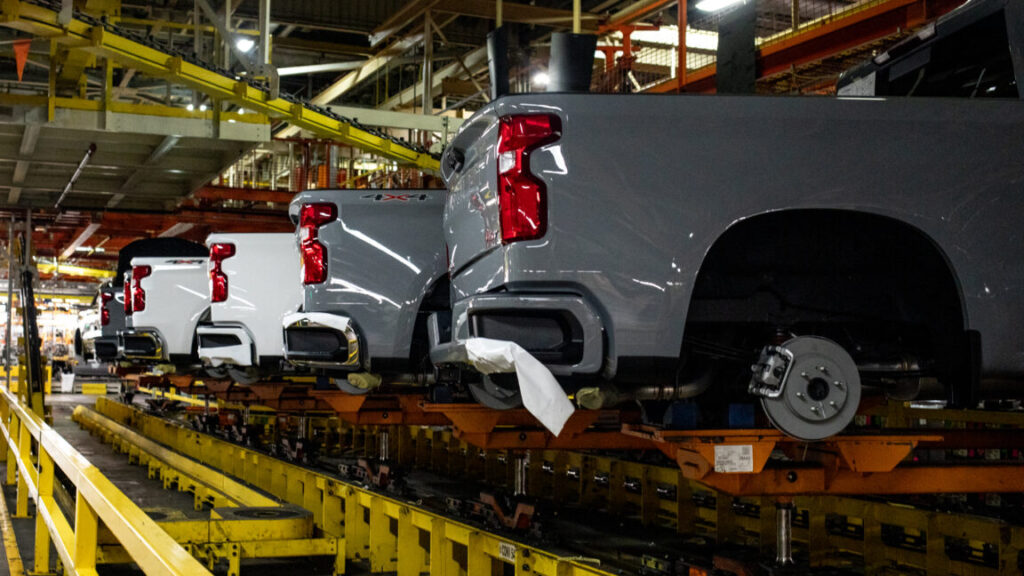
Expect bigger and less efficient trucks in the coming years. Credit: Emily Elconin/Bloomberg via Getty Images
Yesterday, Donald Trump won a second presidential term from American voters. His first term was marked, among other things, by attempts to water down environmental laws and regulations aimed at the auto industry. And as a candidate in 2024, Trump has promised plenty of disruption to the sector through both trade policy and an abrogation of the government’s commitment to fight climate change. Here are some of the more significant changes we think are coming.
Electric vehicle adoption
The Inflation Reduction Act of 2022 was one of President Joe Biden’s signature policy achievements, part of a $450 billion climate package. One of its many sections revised the way we incentivize consumers to buy electric vehicles, with an update to the clean vehicle tax credit that requires final assembly in North America, as well as ever-increasing amounts of US-sourced battery components and minerals to be eligible.
But such policies are not loved by the Republican Party. During his first term, Trump repeatedly criticized EVs, saying that “all-electric is not going to work,” and he vociferously attacked EVs during his campaign, telling supporters at his party’s national convention in July that “I will end the electric vehicle mandate on day one,” referring to a current White House goal to reach 50 percent EV adoption by 2030, and calling the most significant climate legislation ever “the new green scam.”
The Project 2025 policy document, developed by the Heritage Foundation in lieu of an official Republican Party manifesto, contains little affection for EVs. It says we should “respect the right of Americans to buy and drive cars of their own choosing rather than trying to force them into electric vehicles and eventually out of the driver’s seat altogether in favor of self-driving robots” and that the waiver given to the California Air Resource Board should only apply to that state and not the other 16 states and the District of Columbia, which currently abide by CARB’s emissions rules.
Indeed, the Trump campaign press secretary told journalists that California’s waiver would be “immediately revoked” if Trump returned to office.
As such, fuel efficiency rules set forth by the US Department of Energy and the US Environmental Protection Agency, which are meant to go into effect in two years, are almost certainly toast at this point. As we know, the previous Trump administration took an unorthodox approach to undermining existing fuel economy standards, sidelining the EPA in the process.
Given these facts, the future for electric vehicle adoption in the US now appears questionable, and it’s likely that OEMs—the American ones in particular—will return to their 2016–2020 playbook, which involved lots of supersized gas-guzzling SUVs and pickup trucks, with less emphasis on the safety of pedestrians. As an example, Ford has been candid that its EV division is losing billions of dollars a year, and a second Trump administration may well empower shareholders to demand a more profitable allocation of those resources from the automakers in which they are invested.
For companies like Toyota and Stellantis, which lag behind European and Korean rivals when it comes to EVs, Trump’s election will no doubt give their product planners a small measure of relief.
The EV industry says it is ready to work with the incoming government “and all groups that want to ensure our nation’s innovation and economic competitiveness remain the best in the world. The next four years are critical to ensuring that these technologies are developed and deployed by American workers in American factories for generations—a goal that unites every state regardless of their electoral college votes,” said the Zero Emission Transportation Association (ZETA).
“We encourage members of both parties to support policies that provide business and trade certainty so that EV manufacturers up and down the supply chain can unleash the next chapter of American automotive dominance. The United States’ global competitiveness depends on it,” ZETA said to Ars in a statement.
Tesla off the hook?
Tesla, however, should be placed to do better under the next Trump administration. Its CEO Elon Musk has taken a hard right turn politically over the past couple of years, funding republican political causes to the tune of tens of millions of dollars before contributing more than $150 million to Trump’s reelection—a far cry from the Musk of the early 2010s who claimed that climate change was the most pressing issue facing humanity.
As it stands, the future looks very bright for Musk and Tesla. In recent years, the Texas-based automaker has been the subject of at least 14 safety defect investigations by the National Highway Traffic Safety Administration, and many Tesla watchers believed that NHTSA has been getting ready to order a costly hardware recall due to the dangerous nature of Tesla’s “Full Self Driving” and “Autopilot” driver assistance systems.
But a position for Musk in Trump’s cabinet is well within the bounds of possibility—as a candidate, Trump more than once has suggested making Musk a key adviser or giving him control of one or more government departments. With the keys to the Department of Transportation (and thereby NHTSA) in his pocket, any meaningful regulation of Tesla would be very unlikely.
Perhaps a Musk cabinet position would safeguard the National Electric Vehicle Infrastructure program, however. This $7.5 billion program is building out fast chargers along highway corridors and in underserved communities, and the disbursement of funds by the state DOTs (which administer it) has been glacial, making it a potentially ripe target for cancellation. But Tesla has been a recipient of NEVI funding and stands to benefit further in the future if the program survives.
But not every Tesla watcher thinks this would be entirely positive for the company. Musk already splits his time as CEO between several companies, and some investors think a cabinet position would mean even more time away from Tesla’s helm. “Musk getting a cabinet seat in a Trump win would be a complicated decision that would take time away from Tesla and is not what shareholders want to see,” said longtime Tesla bull and analyst Dan Ives to Investors Business Daily.
Big import tariffs on imported cars and parts
Under the Biden administration, there has already been broad bipartisan support to protect US auto manufacturing from cheap Chinese imports, supported by both automakers and unions. In addition to tying clean vehicle tax credits to North American manufacturing, the Biden administration recently levied a 100 percent import tariff on Chinese-made EVs.
Many industry watchers think this will only escalate under the new administration after Trump repeatedly suggested abolishing many federal taxes—including income tax—and replacing them with import tariffs that would significantly drive up the cost of imported goods to US consumers. German automakers that depend on the US market are already seeing their stocks slide today, even though companies like Mercedes-Benz and BMW already have US manufacturing sites. “There’s some natural cover-up against possible tariffs,” BMW CEO Oliver Zipse told Automotive News.

Jonathan is the Automotive Editor at Ars Technica. He has a BSc and PhD in Pharmacology. In 2014 he decided to indulge his lifelong passion for the car by leaving the National Human Genome Research Institute and launching Ars Technica’s automotive coverage. He lives in Washington, DC.
Trump’s election win spells bad news for the auto industry Read More »