solar panels

in-the-southwest,-solar-panels-can-help-both-photovoltaics-and-crops

In the Southwest, solar panels can help both photovoltaics and crops


Cultivation in a harsh climate

Solar arrays can shade crops from sun while moisture cools the panels to increase their productivity.

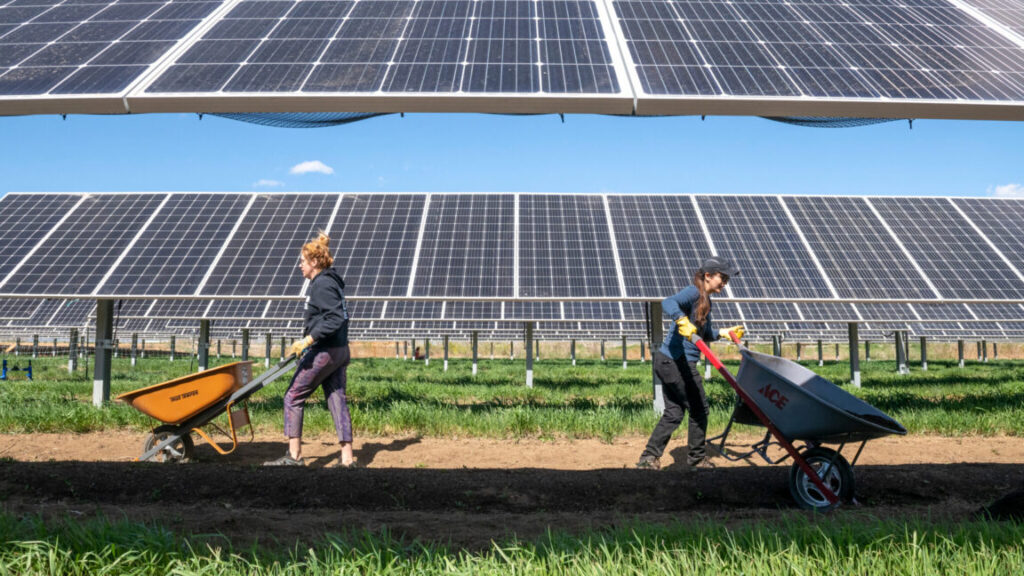
Volunteers with the National Renewable Energy Laboratory work at Jack’s Solar Garden in Longmont, Colorado. Credit: Bryan Bechtold/NREL

This article originally appeared on Inside Climate News, a nonprofit, non-partisan news organization that covers climate, energy, and the environment. Sign up for their newsletter here.

“We were getting basil leaves the size of your palm,” University of Arizona researcher Greg Barron-Gafford said, describing some of the benefits he and his team have seen farming under solar panels in the Tucson desert.

For 12 years, Barron-Gafford has been investigating agrivoltaics, the integration of solar arrays into working farmland. This practice involves growing crops or other vegetation, such as pollinator-friendly plants, under solar panels, and sometimes grazing livestock in this greenery. Though a relatively new concept, at least 604 agrivoltaic sites have popped up across the United States, according to OpenEI.

Researchers like Barron-Gafford think that, in addition to generating carbon-free electricity, agrivoltaics could offer a ray of hope for agriculture in an increasingly hotter and drier Southwest, as the shade created by these systems has been found to decrease irrigation needs and eliminate heat stress on crops. Plus, the cooling effects of growing plants under solar arrays can actually make the panels work better.

But challenges remain, including some farmers’ attitudes about the practice and funding difficulties.

Overcoming a climate conundrum

While renewable electricity from sources like solar panels is one of the most frequently touted energy solutions to help reduce the carbon pollution that’s driving climate change, the warming climate itself is making it harder for solar arrays to do their job, Barron-Gafford said. An optimal functioning temperature for panels is around 75° Fahrenheit, he explained. Beyond that, any temperature increase reduces the photovoltaic cells’ efficiency.

“You can quickly see how this solution for our changing climate of switching to more renewable energy is itself sensitive to the changing climate,” he said.

This problem is especially pertinent in the Southwest, where historically hot temperatures are steadily increasing. Tucson, for instance, saw a record-breaking 112 days of triple-digit heat in 2024, according to National Weather Service Data, and the US Environmental Protection Agency reports that every part of the Southwest experienced higher average temperatures between 2000 and 2023 compared to the long-term average from 1895 to 2023.

However, planting vegetation under solar panels—as opposed to the more traditional method of siting solar arrays on somewhat barren land—can help cool them. In one set of experiments, Barron-Gafford’s team found that planting cilantro, tomatoes and peppers under solar arrays reduced the panels’ surface temperature by around 18 degrees Fahrenheit. That’s because plants release moisture into the air during their respiration process, in which they exchange oxygen for carbon dioxide.

“This invisible power of water coming out of plants was actually cooling down the solar panels,” Barron-Gafford said.

Throwing shade

While Barron-Gafford said some laughed him off when he first proposed the idea of growing crops in the shade of solar panels, this added sun shield can actually help them grow better, especially in the Southwest, where many backyard gardeners already employ shade cloths to protect their gardens from the blazing heat.

“Many people don’t understand that in Colorado and much of the West, most plants get far too much sunlight,” said Byron Kominek, owner/manager of Jack’s Solar Garden in Boulder County, Colorado, which began implementing agrivoltaics in 2020. “Having some shade is a benefit to them.”

Jack’s Solar Garden has integrated 3,276 solar panels over about four acres of farmland, growing crops like greens and tomatoes. Meg Caley with Sprout City Farms, a nonprofit that helps with farming duties at Jack’s Solar Garden, said they’ve been able to produce Swiss chard “the size of your torso.”

“The greens just get huge,” she said. “You have to chop them up to fit them in your refrigerator.”

She added that the shade seems to improve the flavor of the vegetables and prevents them from bolting, when plants prematurely produce flowers and seeds, diverting energy away from leaf or root growth.

“Plants when they’re stressed out can have more of a bitter flavor,” she explained. “So the arugula that we grow is not as bitter or spicy. It’s sweeter. The spinach is sweeter too.”

Barron-Gafford and his team are seeing the same thing in Arizona, where they grow a variety of produce like beans, artichokes, potatoes, kale, and basil.

“We’ve grown 30-plus different types of things across different wet winters and dry winters and exceptionally hot summers, dry summers, average or close to average summers,” he said of the solar-shaded crops. “And across everything we’ve done, we’ve seen equal or greater production down here in the Southwest, the dry land environments, where it really benefits to get some shade.”

As in Colorado, some of those crops are growing to epic proportions.

“We’ve made bok choy the size of a toddler,” Barron-Gafford said.

All that shade provides another important benefit in a drought-stricken Southwest—lower water requirements for crops. Because less direct sunlight is hitting the ground, it decreases the evaporation rate, which means water stays in the soil longer after irrigation. Barron-Gafford and his team have been running experiments for the last seven or so years to see how this plays out with different crops in an agrivoltaic setting.

“What is the evaporation rate under something that’s big and bushy like a bean or potato plant versus something thinner above ground, like a carrot?” is one of the questions Barron-Gafford said they have tried to answer. “For the most part, I would say that we are able to cut back our irrigation by more than half.”

They are partnering with Jack’s Solar Farm on water research in Colorado and have so far found similar results there.

This shade has another benefit in a warming world—respite for farmworkers. Heat-related illnesses are a growing concern for people who work outside, and one recent study predicted climate change will quadruple U.S. outdoor workers’ exposure to extreme heat conditions by 2065.

But with solar arrays in the fields, “if you really carefully plan out your day, you can work in the shade,” a factor that can help increase worker safety on hot days, Caley said.

The AgriSolar Clearinghouse performed skin temperature readings under solar panels and full sun at a number of sites across the United States, finding a skin temperature decrease of 15.3° in Boulder and 20.8° in Phoenix.

“I don’t know what the future holds”

Despite the benefits of agrivoltaics, the up-front cost of purchasing a solar array remains a barrier to farmers.

“Once people see the potential of agrivoltaics, you run into the next challenge, which is how do you fund someone getting into this on their site?” Barron-Gafford said. “And depending on the amount of capital or access to capital that a farmer has, you’re going to get a wildly different answer.”

While expenses are dependent on the size of the installation, a 25-kilowatt system would require an upfront cost of around $67,750, according to AgriSolar Clearinghouse. For comparison, the median size of a residential solar array in 2018 was around 6 kW, the organization stated, which would cost around $16,260 to install.

Kominek said the total initial cost of implementing a 1.2 megawatt capacity agrivoltaics setup on his farm in Colorado was around $2 million, but that the investment has paid off. In addition to the revenue he earns from farming, all of the energy produced by the arrays is sold to clients in the community through a local utility company, earning the farm money.

The Rural Energy for America program has been one resource for farmers interested in agrivoltaics, offering loans and grants to help install solar. However, it’s unclear how this program will move forward amid current federal spending cuts.

Meanwhile, some of the federal grant programs that Barron-Gafford has relied on have suddenly come to a halt, he said, putting his research in danger. But, as federal support dries up, some states are charging on with their own funding opportunities to develop farm field solar projects. For instance, Colorado’s Agrivoltaics Research and Demonstration Grant offers money for demonstrations of agrivoltaics, research projects, and outreach campaigns.

There are other challenges as well. Caley, for instance, said farming around solar panels is akin to working in an “obstacle course.” She and her team, who mostly work manually, have found ways to work around them by being aware of their surroundings so that they don’t accidentally collide with the panels or strike them with their tools. This job is also made easier since Kominek invested between $80,000 and $100,000 to elevate his farm’s panels, which better allows animals, taller crops and farming equipment to operate beneath.

Still, a 2025 University of Arizona study that interviewed farmers and government officials in Pinal County, Arizona, found that a number of them questioned agrivoltaics’ compatibility with large-scale agriculture.

“I think it’s a great idea, but the only thing … it wouldn’t be cost-efficient … everything now with labor and cost of everything, fuel, tractors, it almost has to be super big … to do as much with as least amount of people as possible,” one farmer stated.

Many farmers are also leery of solar, worrying that agrivoltaics could take working farmland out of use, affect their current operations or deteriorate soils.

Those fears have been amplified by larger utility-scale initiatives, like Ohio’s planned Oak Run Solar Project, an 800 megawatt project that will include 300 megawatts of battery storage, 4,000 acres of crops and 1,000 grazing sheep in what will be the country’s largest agrivoltaics endeavor to date. Opponents of the project worry about its visual impacts and the potential loss of farmland.

An American Farmland Trust survey found that Colorado farmers would prefer that utility-scale solar projects be sited on less productive or underutilized farmland rather than on highly productive or actively farmed land. They also expressed concern for the potential negative impact that solar projects could have on farm productivity and the health of the land, including soil quality.

Some farmers also worry that the solar panels could leach metals into the ground, contaminating their crops, Barron-Gafford said. But while agrivoltaic systems are put together in a way that makes that highly unlikely, there’s no reason not to add soil sampling studies into the work they’re doing to reassure farmers, he added.

And agrivoltaics advocates say that the practice could actually improve soil health by reducing erosion, increasing the amount of organic matter and enhancing soil biology with cooler, moister conditions.

“I wish more people spent time listening to the folks on the ground and the folks experiencing these transitions,” Barron-Gafford added. “Because you understand more that way in terms of what their motivations or concerns actually are.”

“We don’t have to choose”

While Caley understands farmers’ concerns, she sees agrivoltaics as a way for them to keep agricultural land in production while also benefiting from solar electricity.

“The tension in a lot of communities seems to be that people don’t want to see agricultural land taken out of production in order to bring a solar farm in,” she said. “The idea here is that we don’t have to choose. We can have both.”

Kominek encourages people to envision what our landscapes and climate will look like in the next 20 to 30 years, adding that in his part of Colorado, it only stands to get hotter and drier, making agrivoltaics a smart solution for farming and clean energy production.

“Communities around the world need to figure out what changes they need to make now to help people adapt to what our climates and landscapes will be in the future,” he said. “Agrivoltaics is a climate adaptation tool that will benefit any community where such systems are built as the decades pass.”

Photo of Inside Climate News

In the Southwest, solar panels can help both photovoltaics and crops Read More »
for-climate-and-livelihoods,-africa-bets-big-on-solar-mini-grids

For climate and livelihoods, Africa bets big on solar mini-grids


Nigeria is pioneering the development of small, off-grid solar panel installations.

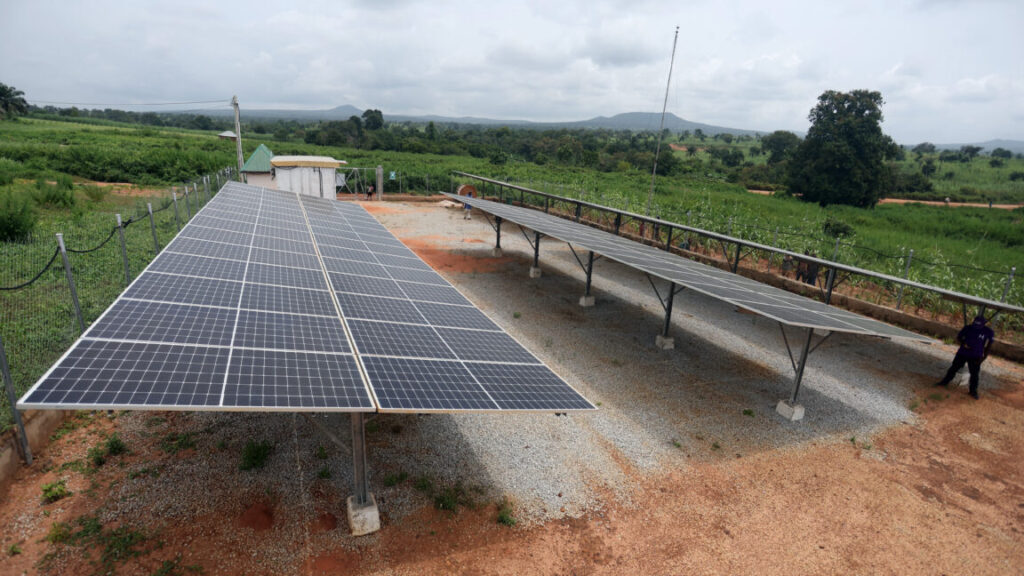
A general view of a hybrid minigrids station in Doma Town which is mainly powered by solar energy in Doma, Nassarawa State, Nigeria on October 16, 2023. Credit: Kola Sulaimon/AFP via Getty Images

To the people of Mbiabet Esieyere and Mbiabet Udouba in Nigeria’s deep south, sundown would mean children doing their homework by the glow of kerosene lamps, and the faint thrum of generators emanating from homes that could afford to run them. Like many rural communities, these two villages of fishermen and farmers in the community of Mbiabet, tucked away in clearings within a dense palm forest, had never been connected to the country’s national electricity grid.

Most of the residents had never heard of solar power either. When, in 2021, a renewable-energy company proposed installing a solar “mini-grid” in their community, the villagers scoffed at the idea of the sun powering their homes. “We didn’t imagine that something [like this] can exist,” says Solomon Andrew Obot, a resident in his early 30s.

The small installation of solar panels, batteries and transmission lines proposed by the company Prado Power would service 180 households in Mbiabet Esieyere and Mbiabet Udouba, giving them significantly more reliable electricity for a fraction of the cost of diesel generators. Village leaders agreed to the installation, though many residents remained skeptical. But when the panels were set up in 2022, lights blinked on in the brightly painted two-room homes and tan mud huts dotted sparsely through the community. At a village meeting in September, locals erupted into laughter as they recalled walking from house to house, turning on lights and plugging in phone chargers. “I [was] shocked,” Andrew Obot says.

Like many African nations, Nigeria has lagged behind Global North countries in shifting away from planet-warming fossil fuels and toward renewable energy. Solar power contributes just around 3 percent of the total electricity generated in Africa—though it is the world’s sunniest continent—compared to nearly 12 percent in Germany and 6 percent in the United States.

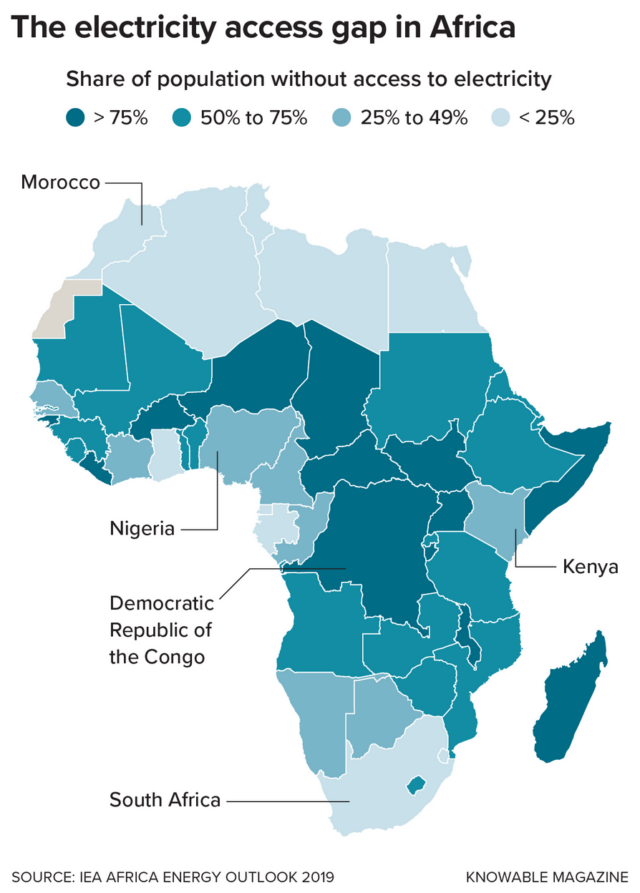
At the same time, in many African countries, solar power now stands to offer much more than environmental benefits. About 600 million Africans lack reliable access to electricity; in Nigeria specifically, almost half of the 230 million people have no access to electricity grids. Today, solar has become cheap and versatile enough to help bring affordable, reliable power to millions—creating a win-win for lives and livelihoods as well as the climate.

That’s why Nigeria is placing its bets on solar mini-grids—small installations that produce up to 10 megawatts of electricity, enough to power over 1,700 American homes—that can be set up anywhere. Crucially, the country has pioneered mini-grid development through smart policies to attract investment, setting an example for other African nations.

Nearly 120 mini-grids are now installed, powering roughly 50,000 households and reaching about 250,000 people. “Nigeria is actually like a poster child for mini-grid development across Africa,” says energy expert Rolake Akinkugbe-Filani, managing director of EnergyInc Advisors, an energy infrastructure consulting firm.

Though it will take more work—and funding—to expand mini-grids across the continent, Nigeria’s experience demonstrates that they could play a key role in weaning African communities off fossil-fuel-based power. But the people who live there are more concerned with another, immediate benefit: improving livelihoods. Affordable, reliable power from Mbiabet’s mini-grid has already supercharged local businesses, as it has in many places where nonprofits like Clean Technology Hub have supported mini-grid development, says Ifeoma Malo, the organization’s founder. “We’ve seen how that has completely transformed those communities.”

The African energy transition takes shape

Together, Africa’s countries account for less than 5 percent of global carbon dioxide emissions, and many experts, like Malo, take issue with the idea that they need to rapidly phase out fossil fuels; that task should be more urgent for the United States, China, India, the European countries and Russia, which create the bulk of emissions. Nevertheless, many African countries have set ambitious phase-out goals. Some have already turned to locally abundant renewable energy sources, like geothermal power from the Earth’s crust, which supplies nearly half of the electricity produced in Kenya, and hydropower, which creates more than 80 percent of the electricity in the Democratic Republic of Congo, Ethiopia and Uganda.

But hydropower and geothermal work only where those resources naturally exist. And development of more geographically versatile power sources, like solar and wind, has progressed more slowly in Africa. Though solar is cheaper than fossil-fuel-derived electricity in the long term, upfront construction costs are often higher than they are for building new fossil-fuel power plants.

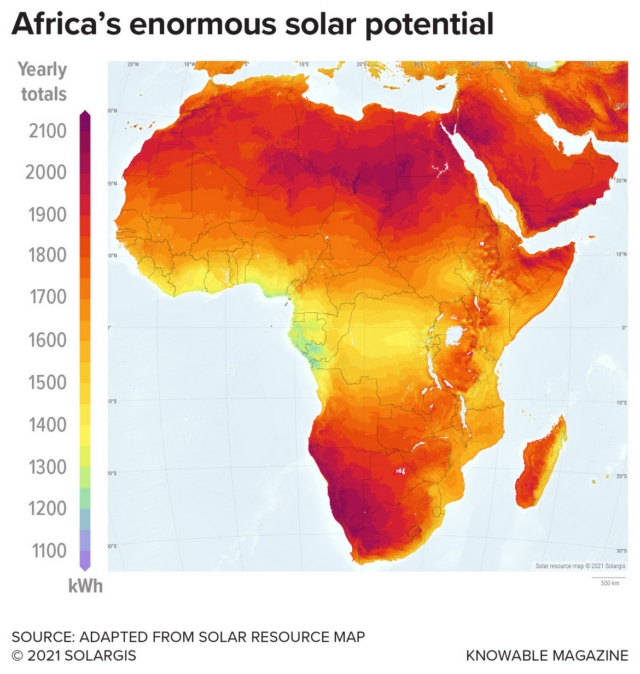
Thanks to its sunny, equatorial position, the African continent has an immense potential for solar power, shown here in kilowatt-hours. However, solar power contributes less than 3 percent of the electricity generated in Africa. Credit: Knowable Magazine

Getting loans to finance big-ticket energy projects is especially hard in Africa, too. Compared to Europe or the United States, interest rates for loans can be two to three times higher due to perceived risks—for instance, that cash-strapped utility companies, already struggling to collect bills from customers, won’t be able to pay back the loans. Rapid political shifts and currency fluctuations add to the uncertainty. To boot, some Western African nations such as Nigeria charge high tariffs on importing technologies such as solar panels. “There are challenges that are definitely hindering the pace at which renewable energy development could be scaling in the region,” says renewable energy expert Tim Reber of the Colorado-based US National Renewable Energy Laboratory.

Some African countries are beginning to overcome these barriers and spur renewable energy development, notes Bruno Merven, an expert in energy systems modeling at the University of Cape Town in South Africa, coauthor of a look at renewable energy development in the Annual Review of Resource Economics. Super-sunny Morocco, for example, has phased out subsidies for gasoline and industrial fuel. South Africa is agreeing to buy power from new, renewable infrastructure that is replacing many coal plants that are now being retired.

Nigeria, where only about a quarter of the national grid generates electricity and where many turn to generators for power, is leaning on mini-grids—since expanding the national grid to its remote communities, scattered across an area 1.3 times the size of Texas, would cost a prohibitive amount in the tens of billions of dollars. Many other countries are in the same boat. “The only way by which we can help to electrify the entire continent is to invest heavily in renewable energy mini-grids,” says Stephen Kansuk, the United Nations Development Program’s regional technical advisor for Africa on climate change mitigation and energy issues.

Experts praise the steps Nigeria has taken to spur such development. In 2016, the country’s Electricity Regulatory Commission provided legal guidelines on how developers, electricity distribution companies, regulators and communities can work together to develop the small grids. This was accompanied by a program through which organizations like the World Bank, the Global Energy Alliance for People and Planet, Bezos Earth Fund and the Rockefeller Foundation could contribute funds, making mini-grid investments less financially risky for developers.

Solar power was also made more attractive by a recent decision by Nigerian President Bola Ahmed Tinubu to remove a long-standing government subsidy on petroleum products. Fossil-fuel costs have been soaring since, for vehicles as well as the generators that many communities rely on. Nigeria has historically been Africa’s largest crude oil producer, but fuel is now largely unaffordable for the average Nigerian, including those living in rural areas, who often live on less than $2 a day. In the crude-oil-rich state of Akwa Ibom, where the Mbiabet villages are located, gasoline was 1,500 naira per liter (around $1) at the time of publishing. “Now that subsidies have come off petrol,” says Akinkugbe-Filani, “we’re seeing a lot more people transition to alternative sources of energy.”

Mini-grids take off

To plan a mini-grid in Nigeria, developers often work with government agencies that have mapped out ideal sites: sunny places where there are no plans to extend the national grid, ensuring that there’s a real power need.

More than 500 million Africans lack access to electricity, and where there is electricity, much of it comes from fossil fuels. Countries are taking different approaches to bring more renewable energy into the mix. Nigeria is focusing on mini-grids, which are especially useful in areas that lack national electricity grids. Morocco and South Africa are building large-scale solar power installations, while Kenya and the Democratic Republic of the Congo are making use of local renewable energy sources like geothermal and hydropower, respectively. Credit: Knowable Magazine

The next step is getting communities on board, which can take months. Malo recalls a remote Indigenous village in the hills of Adamawa state in Nigeria’s northeast, where locals have preserved their way of life for hundreds of years and are wary of outsiders. Her team had almost given up trying to liaise with reluctant male community leaders and decided to try reaching out to the women. The women, it turned out, were fascinated by the technology and how it could help them, especially at night — to fetch water from streams, to use the bathroom and to keep their children safe from snakes. “We find that if we convince them, they’re able to go and convince their husbands,” Malo says.

The Mbiabet community took less convincing. Residents were drawn to the promise of cheap, reliable electricity and its potential to boost local businesses.

Like many other mini-grids, the one in Mbiabet benefited from a small grant, this one from the Rocky Mountain Institute, a US-based nonprofit focused on renewable energy adoption. The funds allowed residents to retain 20 percent ownership of the mini-grid and reduced upfront costs for Prado Power, which built the panels with the help of local laborers.

On a day in late September, it’s a sunny afternoon, though downpours from the days before have made their imprint on the ground. There are no paved roads and today, the dirt road leading through the tropical forest into the cluster of villages is unnavigable by car. At one point, we build an impromptu bridge of grass and vegetation across a sludgy impasse; the last stretch of the journey is made on foot. It would be costly and labor-intensive to extend the national grid here.

Palm trees give way to tin roofs propped up by wooden poles, and Andrew Obot is waiting at the meeting point. He was Mbiabet’s vice youth president when Prado Power first contacted the community; now he’s the site manager. He steers his okada—a local motorbike—up the bumpy red dirt road to go see the solar panels.

Along the way, we see transmission lines threading through thick foliage. “That’s the solar power,” shouts Andrew Obot over the drone of the okada engine. All the lines were built by Prado Power to supply households in the two villages.

We enter a grassy clearing where three rows of solar panels sit behind wire gates. Collectively, the 39 panels have a capacity of over 20 kilowatts—enough to power just one large, energy-intensive American household but more than enough for the lightbulbs, cooker plates and fans in the 180 households in Mbiabet Esieyere and Mbiabet Udouba.

Whereas before, electricity was more conservatively used, now it is everywhere. An Afrobeats tune blares from a small barbershop on the main road winding through Mbiabet Esieyere. Inside, surrounded by walls plastered with shiny posters of trending hairstyles — including a headshot of popular musician Davido with the tagline “BBC—Big Boyz Cutz”—two young girls sit on a bench near a humming fan, waiting for their heads to be shaved.

The salon owner, Christian Aniefiok Asuquo, started his business two years ago when he was 16, just before the panels were installed. Back then, his appliances were powered by a diesel generator, which he would fill with 2,000 naira worth (around $1.20) of fuel daily. This would last around an hour. Now, he spends just 2,000 naira a month on electricity. “I feel so good,” he says, and his customers, too, are happy. He used to charge 500 naira ($0.30) per haircut, but now charges 300 naira ($0.18) and still makes a profit. He has more customers these days.

For many Mbiabet residents, “it’s an overall boost in their economic development,” says Suleiman Babamanu, the Rocky Mountain Institute’s program director in Nigeria. Also helping to encourage residents to take full advantage of their newly available power is the installation of an “agro-processing hub,” equipped with crop-processing machines and a community freezer to store products like fish. Provided by the company Farm Warehouse in partnership with Prado Power, the hub is leased out to locals. It includes a grinder and fryer to process cassava—the community’s primary crop—into garri, a local food staple, which many of the village women sell to neighboring communities and at local markets.

The women are charged around 200 naira ($0.12) to process a small basin of garri from beginning to end. Sarah Eyakndue Monday, a 24-year-old cassava farmer, used to spend three to four hours processing cassava each day; it now takes her less than an hour. “It’s very easy,” she says with a laugh. She produces enough garri during that time to earn up to 50,000 naira ($30.25) a week—almost five times what she was earning before.

Prado Power also installed a battery system to save some power for nighttime (there’s a backup diesel generator should batteries become depleted during multiple overcast days). That has proved especially valuable to women in Mbiabet Esieyere and Mbiabet Udouba, who now feel safer. “Everywhere is … brighter than before,” says Eyakndue Monday.

Other African communities have experienced similar benefits, according to Renewvia Energy, a US-based solar company. In a recent company-funded survey, 2,658 Nigerian and Kenyan households and business owners were interviewed before and after they got access to Renewvia’s mini-grids. Remarkably, the median income of Kenyan households had quadrupled. Instead of spending hours each day walking kilometers to collect drinking water, many communities were able to install electricity-powered wells or pumps, along with water purifiers.

“With all of that extra time, women in the community were able to either start their own businesses or just participate in businesses that already exist,” says Renewvia engineer Nicholas Selby, “and, with that, gain some income for themselves.”

Navigating mini-grid challenges

Solar systems require regular maintenance—replacing retired batteries, cleaning, and repairing and addressing technical glitches over the 20- to 25-year lifetime of a panel. Unless plans for care are built into a project, they risk failure. In some parts of India, for example, thousands of mini-grids installed by the government in recent decades have fallen into disrepair, according to a report provided to The Washington Post. Typically, state agencies have little long-term incentive to maintain solar infrastructure, Kansuk says.

Kansuk says this is less likely in situations where private companies that make money off the grids help to fund them, encouraging them to install high-quality devices and maintain them. It also helps to train locals with engineering skills so they can maintain the panels themselves—companies like Renewvia have done this at their sites. Although Prado Power hasn’t been able to provide such training to locals in Mbiabet or their other sites, they recruit locals like Andrew Obot to work as security guards, site managers and construction workers.

Over the longer term, demographic shifts may also leave some mini-grids in isolated areas abandoned—as in northern Nigeria, for instance, where banditry and kidnapping are forcing rural populations toward more urban settings. “That’s become a huge issue,” Malo says. Partly for this reason, some developers are focusing on building mini-grids in regions that are less prone to violence and have higher economic activity—often constructing interconnected mini-grids that supply multiple communities.

Eventually, those close enough to the national grid will likely be connected to the larger system, says Chibuikem Agbaegbu, a Nigeria-based climate and energy expert of the Africa Policy Research Institute. They can send their excess solar-sourced electricity into the main grid, thus making a region’s overall energy system greener and more reliable.

The biggest challenge for mini-grids, however, is cost. Although they tend to offer cheaper, more reliable electricity compared to fossil-fuel-powered generators, it is still quite expensive for many people — and often much more costly than power from national grids, which is frequently subsidized by African governments. Costs can be even higher when communities sprawl across large areas that are expensive to connect.

Mini-grid companies have to charge relatively high rates in order to break even, and many communities may not be buying enough power to make a mini-grid worthwhile for the developers — for instance, Kansuk says, if residents want electricity only for lighting and to run small household appliances.

Kansuk adds that this is why developers like Prado Power still rely on grants or other funding sources to subsidize construction costs so they can charge locals affordable prices for electricity. Another solution, as evidenced in Mbiabet, is to introduce industrial machinery and equipment in tandem with mini-grids to increase local incomes so that people can afford the electricity tariffs.

“For you to be able to really transform lives in rural communities, you need to be able to improve the business viability—both for the mini-grid and for the community,” says Babamanu. The Rocky Mountain Institute is part of an initiative that identifies suitable electrical products, from cold storage to rice mills to electric vehicle chargers, and supports their installation in communities with the mini-grids.

Spreading mini-grids across the continent

Energy experts believe that these kinds of solutions will be key for expanding mini-grids across Africa. Around 60 million people in the continent gained access to electricity through mini-grids between 2009 and 2019, in countries such as Kenya, Tanzania and Senegal, and the United Nations Development Program is working with a total of 21 African countries, Kansuk says, including Mali, Niger and Somalia, to incentivize private companies to develop mini-grids there.

But it takes more than robust policies to help mini-grids thrive. Malo says it would help if Western African countries removed import tariffs for solar panels, as many governments in Eastern Africa have done. And though Agbaegbu estimates that Nigeria has seen over $900 million in solar investments since 2018—and the nation recently announced $750 million more through a multinationally funded program that aims to provide over 17.5 million Nigerians with electricity access—it needs more. “If you look at what is required versus what is available,” says Agbaegbu, “you find that there’s still a significant gap.”

Many in the field argue that such money should come from more industrialized, carbon-emitting countries to help pay for energy development in Global South countries in ways that don’t add to the climate problem; some also argue for funds to compensate for damages caused by climate impacts, which hit these countries hardest. At the 2024 COP29 climate change conference, wealthy nations set a target of $300 billion in annual funding for climate initiatives in other countries by 2035—three times more than what they had previously pledged. But African countries alone need an estimated $200 billion per year by 2030 to meet their energy goals, according to the International Energy Agency.

Meanwhile, Malo adds, it’s important that local banks in countries like Nigeria also invest in mini-grid development, to lessen dependence on foreign financing. That’s especially the case in light of current freezes in USAID funding, she says, which has resulted in a loss of money for solar projects in Nigeria and other nations.

With enough support, Reber says, mini-grids—along with rooftop and larger solar projects—could make a sizable contribution to lowering carbon emissions in Africa. Those who already have the mini-grids seem convinced they’re on the path toward a better, economically richer future, and Babamanu knows of communities that have written letters to policymakers to express their interest.

Eyakndue Monday, the cassava farmer from Mbiabet, doesn’t keep her community’s news a secret. Those she has told now come to her village to charge their phones and watch television. “I told a lot of my friends that our village is … better because of the light,” she says. “They were just happy.”

This story was originally published by Knowable Magazine.

Photo of Knowable Magazine

Knowable Magazine explores the real-world significance of scholarly work through a journalistic lens.

For climate and livelihoods, Africa bets big on solar mini-grids Read More »

can-the-solar-industry-keep-the-lights-on?

Can the solar industry keep the lights on?

Image of solar panels on a green grassy field, with blue sky in the background.

Founded in Dresden in the early 1990s, Germany’s Solarwatt quickly became an emblem of Europe’s renewable energy ambitions and bold plan to build a solar power industry.

Its opening of a new solar panel plant in Dresden in late 2021 was hailed as a small victory in the battle to wrestle market share from the Chinese groups that have historically supplied the bulk of panels used in Europe.

Now, Solarwatt is preparing to halt production at the plant and shift that work to China.

“It is a big pity for our employees, but from an economic point of view we could not do otherwise,” said Peter Bachmann, the company’s chief product officer.

Solarwatt is not alone. A global supply glut has pummelled solar panel prices over the past two years, leaving swaths of Europe’s manufacturers unprofitable, threatening US President Joe Biden’s ambition to turn America into a renewable energy force and even ricocheting back on the Chinese companies that dominate the global market.

“We are in a crisis,” said Johan Lindahl, secretary-general of the European Solar Manufacturing Council, the European industry’s trade body.

Yet as companies in Europe, the US, and China cut jobs, delay projects, and mothball facilities, an abundance of cheap solar panels has delivered one significant upside—consumers and businesses are installing them in ever greater numbers.

Electricity generated from solar power is expected to surpass that of wind and nuclear by 2028, according to the International Energy Agency.

The picture underlines the quandary confronting governments that have pledged to decarbonise their economies, but will find doing so harder unless the historic shift from fossil fuels is both affordable for the public and creates new jobs.

Governments face a “delicate and difficult balancing act,” said Michael Parr, director of trade group Ultra Low Carbon Solar Alliance. They must “maximize renewables deployment and carbon reductions, bolster domestic manufacturing sectors, keep energy prices low, and ensure energy security.”

The industry, which spans wafer, cell, and panel manufacturers, as well as companies that install panels, employed more than 800,000 people in Europe at the end of last year, according to SolarPower Europe. In the US almost 265,000 work in the sector, figures from the Interstate Renewable Energy Council show.

“There is overcapacity in every segment, starting with polysilicon and finishing with the module,” said Yana Hryshko, head of global solar supply chain research at the consultancy Wood Mackenzie.

According to BloombergNEF, panel prices have plunged more than 60 percent since July 2022. The scale of the damage inflicted has sparked calls for Brussels to protect European companies from what the industry says are state-subsidized Chinese products.

Europe’s solar panel manufacturing capacity has collapsed by about half to 3 gigawatts since November as companies have failed, mothballed facilities, or shifted production abroad, the European Solar Manufacturing Council estimates. In rough terms, a gigawatt can potentially supply electricity for 1mn homes.

The hollowing out comes as the EU is banking on solar power playing a major role in the bloc meeting its target of generating 45 percent of its energy from renewable sources by 2030. In the US, the Biden administration has set a target of achieving a 100 percent carbon pollution-free electricity grid by 2035.

Climate change is a global challenge, but executives said the solar industry’s predicament exposed how attempts to address it can quickly fracture along national and regional lines.

“There’s trade policy and then there’s climate policy, and they aren’t in sync,” said Andres Gluski, chief executive of AES, one of the world’s biggest developers of clean energy. “That’s a problem.”

Brussels has so far resisted demands to impose tariffs. It first levied them in 2012 but reversed that in 2018, partly in what proved a successful attempt to quicken the uptake of solar. Chinese imports now account for the lion’s share of Europe’s solar panels.

In May, the European Commission introduced the Net Zero Industry Act, legislation aimed at bolstering the bloc’s clean energy industries by cutting red tape and promoting a regional supply chain.

But Gunter Erfurt, chief executive of Switzerland-based Meyer Burger, the country’s largest solar panel maker, is skeptical it will be enough.

“You need to create a level playing field,” he said. Meyer Burger would benefit if the EU imposed tariffs because it has operations in Germany.

Can the solar industry keep the lights on? Read More »