
satellite

directv-screensavers-will-show-ai-generated-ads-with-your-face-in-2026

DirecTV screensavers will show AI-generated ads with your face in 2026

According to a March blog post from Glance’s VP of AI, Ian Anderson, Glance’s avatars “analyze customer behavior, preferences, and browsing history to provide tailor-made product recommendations, enhancing engagement and conversion rates.”

In a statement today, Naveen Tewari, Glance’s CEO and founder, said the screensavers will allow people to “instantly select a brand and reimagine themselves in the brand catalog right from their living-room TV itself.”

The DirecTV screensavers will also allow people to make 30-second-long AI-generated videos featuring their avatar, The Verge reported.

In addition to providing an “AI-commerce experience,” DirecTV expects the screensavers to help with “content discovery” and “personalization,” Vikash Sharm, SVP of product marketing at DirecTV, said in a statement.

The screensavers will also be able to show real-time weather and sports scores, Glance said.

A natural progression

Turning to ad-centric screensavers may frustrate customers who didn’t expect ads when they bought into Gemini devices for their streaming capabilities.

However, DirecTV has an expanding advertising business that has included experimenting with ad types, such as ads that show when people hit pause. As far as offensive ads go, screensaver ads can be considered less intrusive, since they typically show only when someone isn’t actively viewing their TV. Gemini screensavers can also be disabled.

It has become increasingly important for DirecTV to diversify revenue beyond satellite and Internet subscriptions. DirecTV had over 20 million subscribers in 2015; in 2024, streaming business publication Next TV, citing an anonymous source “close to the company,” reported that the AT&T-owned firm was down to about 11 million subscribers.

Simultaneously, the streaming industry—including streaming services and streaming software—has been increasingly relying on advertising to boost revenue. For some streaming service providers, increasing revenue through ads is starting to eclipse the pressure to do so through subscriber counts. Considering DirecTV’s declining viewership and growing interest in streaming, finding more ways to sell ads seems like a natural progression.

With legacy pay TV providers already dealing with dwindling subscriptions, introducing new types of ads risks making DirecTV less appealing as well.

And it’s likely that things won’t end there.

“This, we can integrate across different places within the television,” Glance COO Mansi Jain told The Verge. “We are starting with the screensaver, but tomorrow… we can integrate it in the launcher of the TV.”

DirecTV screensavers will show AI-generated ads with your face in 2026 Read More »
satellite-firm-bucks-miniaturization-trend,-aims-to-build-big-for-big-rockets

Satellite firm bucks miniaturization trend, aims to build big for big rockets

Although the price of this satellite bus is proprietary, various estimates place the cost at between $100 million and $150 million. One reason for the expense is that Lockheed Martin buys most of the satellite’s elements, such as its reaction wheels, from suppliers.

“Lockheed is amazing at doing those missions with really complex requirements,” Kunjur said. “But they just have not changed the way they build these larger, more complex spacecraft in the last 15 or 20 years.”

Vertical integration is the way?

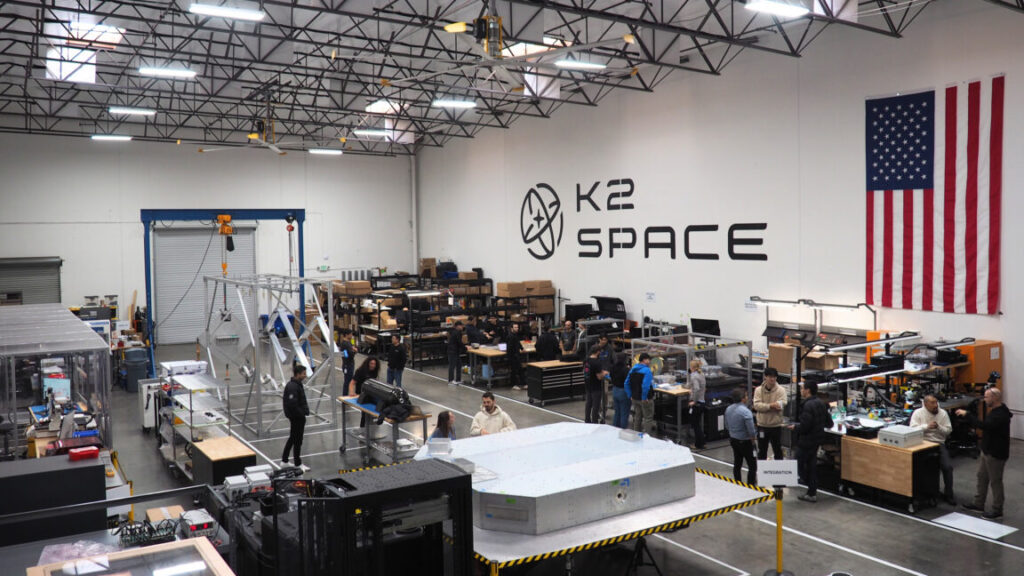
K2 aims to disrupt this ecosystem. For example, the reaction wheels that Honeywell Aerospace sells to Lockheed cost approximately $500,000 to $1 million apiece. K2 is now on its fourth iteration of an internally built reaction wheel and has driven the cost down to $35,000. Kunjur said about 80 percent of K2’s satellite production is vertically integrated.

The company is now building its first “Mega Class” satellite bus, intended to have similar capabilities to Lockheed’s LM2100: 20 kW of power, 1,000 kg of payload capacity, and propulsion to move between orbits. But it’s also stackable: Ten will fit within a Falcon 9 payload fairing and about 50 within Starship’s fairing. The biggest difference is cost. K2 aims to sell its satellite bus for $15 million.

The US government is definitely interested in this capability. About a month ago, K2 announced that it had signed a contract with the US Space Force to launch its first Mega Class satellite in early 2026. The $60 million contract for the “Gravitas” mission will demonstrate the ability of K2’s satellite bus to host several experiments and successfully maneuver from low-Earth orbit to middle-Earth orbit (several thousand km above the surface of Earth).

Although the Mega Class satellite is attractive to government and commercial customers—its lower cost could allow for larger constellations in middle- and geostationary orbits—Kunjur said he and his brother, Neel Kunjur, founded K2 to enable more frequent science missions to other planets in the Solar System.

“We looked at the decadal studies and saw all the mission concept studies that were done,” Kunjur said. “There were maybe 50 studies over a 10-year period. And we realized that if NASA funding remains level, we’ll be able to do one or maybe two of these. So we decided to go after one of the big problems.”

So, if we’re moving into an era of launch abundance, K2 might just solve the problem of affordable science satellites to launch on all these rockets—if it all works, of course.

Satellite firm bucks miniaturization trend, aims to build big for big rockets Read More »