Pompeii

switching-water-sources-improved-hygiene-of-pompeii’s-public-baths

Switching water sources improved hygiene of Pompeii’s public baths

From well to aqueduct

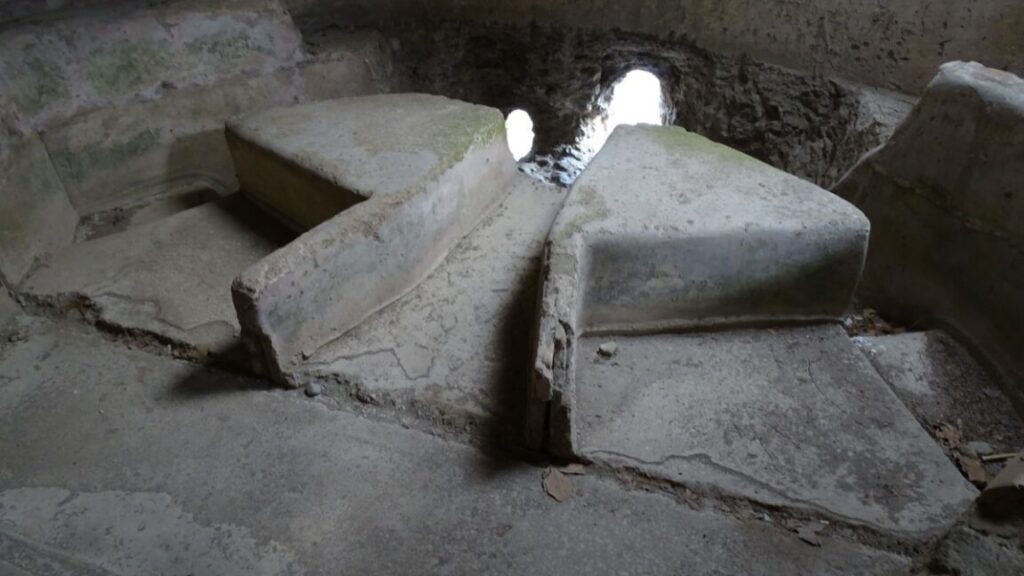
The specific sites studied included the Stabian baths and related structures, which were built after 130 BCE and remained active until the aforementioned eruption; the Republican baths, built around the same period but abandoned around 30 BCE; the Forum baths, built after 80 BCE; and the aqueduct and its 14 water towers, constructed during the Augustan period.

There were variations in the chemical composition of the deposits, indicating the replacement of boilers for heating water and a renewal of water pipes in the infrastructure of Pompeii, particularly during the time period when modifications were being made to the Republican baths. The results for the Republican baths’ heated pools, for instance, showed clear contamination from human activity, specifically human waste (sweat, sebum, urine, or bathing oil), which suggests the water wasn’t changed regularly.

That is consistent with the limitations of supplying water at the time; the water-lifting machines could really only refresh the water about once a day. After the well shaft was enlarged, the carbonate deposits were much thinner, evidence of technological improvements that reduced sloshing as the water was raised. Once the aqueduct had been built, the bathing facilities were expanded with a likely corresponding improvement in hygiene.

On the whole, the aqueduct was a net good for Pompeii. “The changes in the water supply system of Pompeii revealed by carbonate deposits show an evolution from well-based to aqueduct-based supply with an increase in available water volume and in the scale of the bathing facilities, and likely an increase in hygiene,” the authors concluded. Granted, there was evidence of lead contamination in the water, particularly that supplied by the aqueduct, but carbonate deposits in the lead pipes seem to have reduced those levels over time.

The results may also help resolve a scientific debate about the origins of the aqueduct water: Was it water from the town of Avella that connected to the Aqua Augusta aqueduct or from the wells of Pompeii/springs of Vesuvius? Per the authors, the stable isotope composition of carbonate in the aqueduct is inconsistent with carbonate from volcanic rock sources, thus supporting the Avella source hypothesis.

PNAS, 2025. DOI: 10.1073/pnas.2517276122 (About DOIs).

Switching water sources improved hygiene of Pompeii’s public baths Read More »
pompeii-construction-site-confirms-recipe-for-roman-concrete

Pompeii construction site confirms recipe for Roman concrete

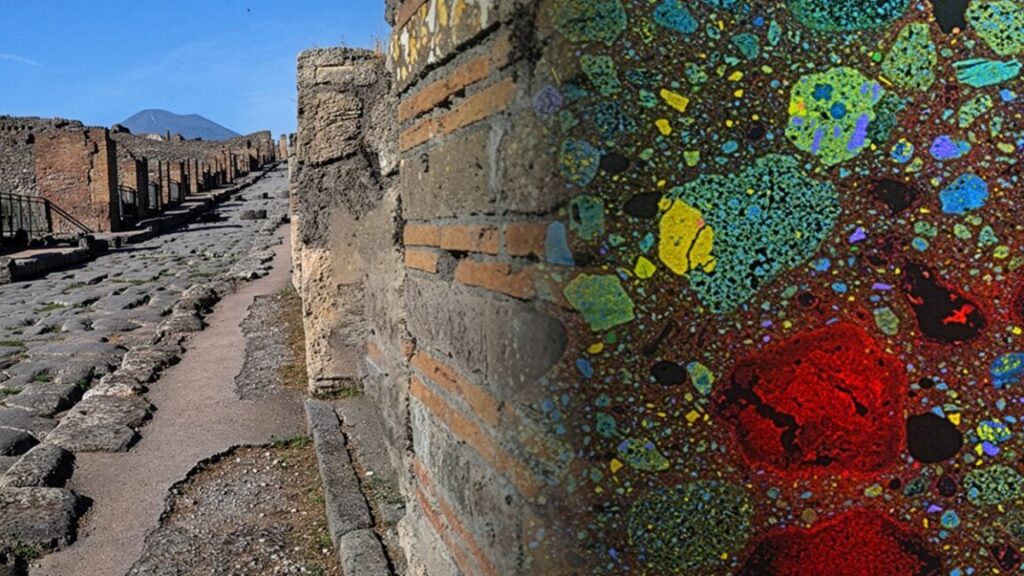
Back in 2023, we reported on MIT scientists’ conclusion that the ancient Romans employed “hot mixing” with quicklime, among other strategies, to make their famous concrete, giving the material self-healing functionality. The only snag was that this didn’t match the recipe as described in historical texts. Now the same team is back with a fresh analysis of samples collected from a recently discovered site that confirms the Romans did indeed use hot mixing, according to a new paper published in the journal Nature Communications.

As we’ve reported previously, like today’s Portland cement (a basic ingredient of modern concrete), ancient Roman concrete was basically a mix of a semi-liquid mortar and aggregate. Portland cement is typically made by heating limestone and clay (as well as sandstone, ash, chalk, and iron) in a kiln. The resulting clinker is then ground into a fine powder with just a touch of added gypsum to achieve a smooth, flat surface. But the aggregate used to make Roman concrete was made up of fist-sized pieces of stone or bricks.

In his treatise De architectura (circa 30 CE), the Roman architect and engineer Vitruvius wrote about how to build concrete walls for funerary structures that could endure for a long time without falling into ruin. He recommended the walls be at least two feet thick, made of either “squared red stone or of brick or lava laid in courses.” The brick or volcanic rock aggregate should be bound with mortar composed of hydrated lime and porous fragments of glass and crystals from volcanic eruptions (known as volcanic tephra).

Admir Masic, an environmental engineer at MIT, has studied ancient Roman concrete for several years. For instance, in 2019, Masic helped pioneer a new set of tools for analyzing Roman concrete samples from Privernum at multiple length scales—notably, Raman spectroscopy for chemical profiling and multi-detector energy dispersive spectroscopy (EDS) for phase mapping the material. Masic was also a co-author of a 2021 study analyzing samples of the ancient concrete used to build a 2,000-year-old mausoleum along the Appian Way in Rome known as the Tomb of Caecilia Metella, a noblewoman who lived in the first century CE.

And in 2023, Masic’s group analyzed samples taken from the concrete walls of the Privernum, focusing on strange white mineral chunks known as “lime clasts,” which others had largely dismissed as resulting from subpar raw materials or poor mixing. Masic et al. concluded that was not the case. Rather, the Romans deliberately employed “hot mixing” with quicklime that gave the material self-healing functionality. When cracks begin to form in the concrete, they are more likely to move through the lime clasts. The clasts can then react with water, producing a solution saturated with calcium. That solution can either recrystallize as calcium carbonate to fill the cracks or react with the pozzolanic components to strengthen the composite material.

Pompeii construction site confirms recipe for Roman concrete Read More »

dna-shows-pompeii’s-dead-aren’t-who-we-thought-they-were

DNA shows Pompeii’s dead aren’t who we thought they were

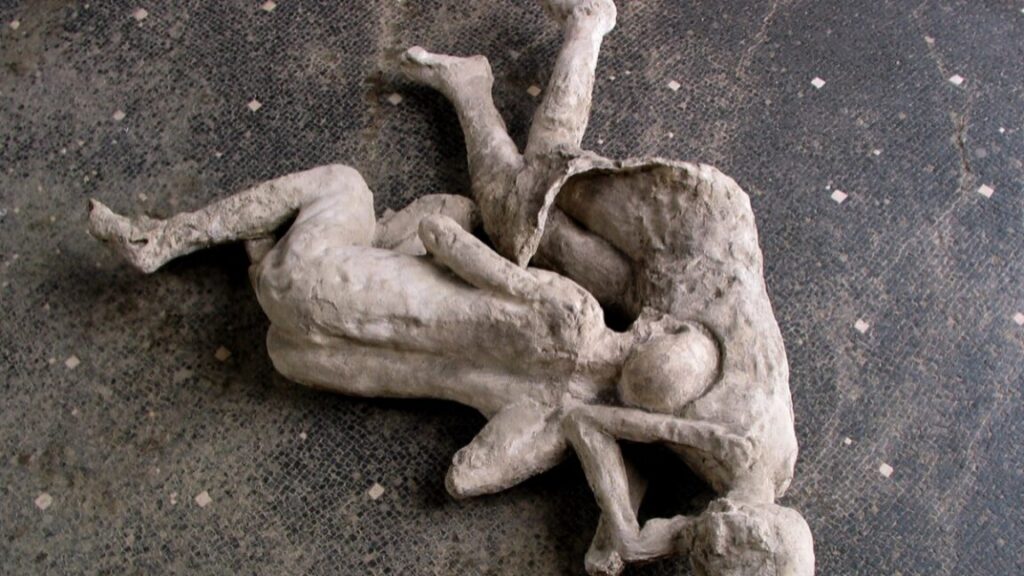
People have long been fascinated by the haunting plaster casts of the bodies of people who died in Pompeii when Mount Vesuvius erupted in 79 CE. Archaeologists have presented certain popular narratives about who these people might have been and how they might have been related. But ancient DNA analysis has revealed that those preferred narratives were not entirely accurate and may reflect certain cultural biases, according to a new paper published in the journal Current Biology. The results also corroborate prior research suggesting that the people of ancient Pompeii were the descendants of immigrants from the Eastern Mediterranean.

As previously reported, the eruption of Mount Vesuvius released thermal energy roughly equivalent to 100,000 times the atomic bombs dropped on Hiroshima and Nagasaki at the end of World War II, spewing molten rock, pumice, and hot ash over the cities of Pompeii and Herculaneum in particular. The vast majority of people in Pompeii and Herculaneum—the cities hardest hit—perished from asphyxiation, choking on the thick clouds of noxious gas and ash. But at least some of the Vesuvian victims probably died instantaneously from the intense heat of fast-moving lava flows, with temperatures high enough to boil brains and explode skulls.

In the first phase, immediately after the eruption, a long column of ash and pumice blanketed the surrounding towns, most notably Pompeii and Herculaneum. By late night or early morning, pyroclastic flows (fast-moving hot ash, lava fragments, and gases) swept through and obliterated what remained, leaving the bodies of the victims frozen in seeming suspended action.

In the 19th century, an archaeologist named Giuseppe Fiorelli figured out how to make casts of those frozen bodies by pouring liquid plaster into the voids where the soft tissue had been. Some 1,000 bodies have been discovered in the ruins, and 104 plaster casts have been preserved. Restoration efforts of 86 of those casts began about 10 years ago, during which researchers took CT scans and X-rays to see if there were complete skeletons inside. Those images revealed that there had been a great deal of manipulation of the casts, depending on the aesthetics of the era in which they were made, including altering some features of the bodies’ shapes or adding metal rods to stabilize the cast, as well as frequently removing bones before casting.

DNA shows Pompeii’s dead aren’t who we thought they were Read More »