Nissan

50-mpg-in-a-nissan-crossover?-testing-the-new-e-power-hybrid-system.

50 mpg in a Nissan crossover? Testing the new E-Power hybrid system.

I noticed the engine running just twice. One was at wide-open throttle, and the other was when the engine was likely operating at higher rpms to help charge the battery. That latter instance was also when I noticed the most harshness from the engine, although it’s one of the smoothest gasoline-supported powertrains I’ve driven.
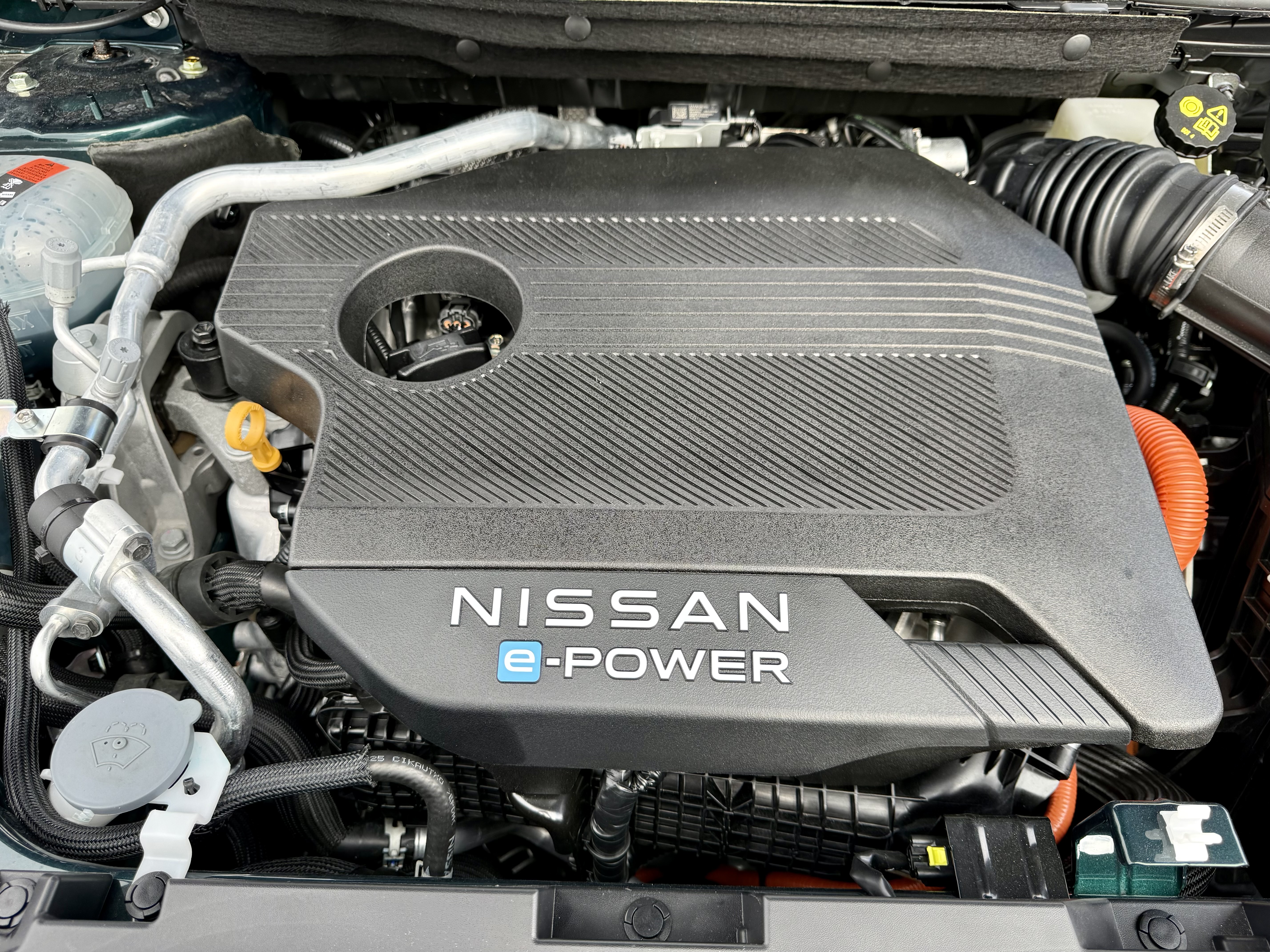
A look under the Qashqai’s hood.

Credit: Chad Kirchner

A look under the Qashqai’s hood. Credit: Chad Kirchner

The E-Power system will operate in full-EV mode at the press of a button, but at full throttle, the engine will still kick in.

What needs work?

Since an electric motor powers the wheels, I would prefer the system to be more responsive when you put your foot down. Electric motors respond nearly instantly. In a gas car, there’s usually a delay with a downshift and engine spin-up. This E-Power Qashqai behaves more like a gas car than an EV, even in the sport setting. I think this powertrain is a great opportunity to show new customers what electrification can do, and a little bit more snappiness would go a long way into articulating that E-Power can be sporty if the driver wants it to be.

The Qashqai had no problems getting up to highway speeds, and acceleration at higher speeds—in an overtake situation, for example—remained consistent. Again, it’s not a sports car or rocket ship, but it can get out of its own way easily enough.

During my loop, the computer indicated 47.7 mpg (4.93 L/100km) in mixed driving. Being left-hand-drive cars, that means they weren’t British imperial gallons. That’s a pretty great fuel efficiency number. In warmer conditions, it should easily exceed 50 mpg (4.7 L/100 km) in many driving scenarios.

Is that directly translatable to the upcoming Rogue E-Power? Somewhat. While the powertrain will be the same, the Rogue will be a little larger and heavier. Speccing all-wheel drive will further increase weight and add losses to the drivetrain. So a 50 mpg Rogue might be a stretch.

If Nissan prices the Rogue E-Power well, and the car delivers on the increase in economy that I’ve seen here, it could be a very compelling product in Nissan’s showrooms for buyers who haven’t had a great hybrid offering from the company before.

As long as Nissan sorts out the brake calibration.

50 mpg in a Nissan crossover? Testing the new E-Power hybrid system. Read More »
how-nissan-leveraged-its-driver-assist-to-cut-traffic-jams

How Nissan leveraged its driver assist to cut traffic jams

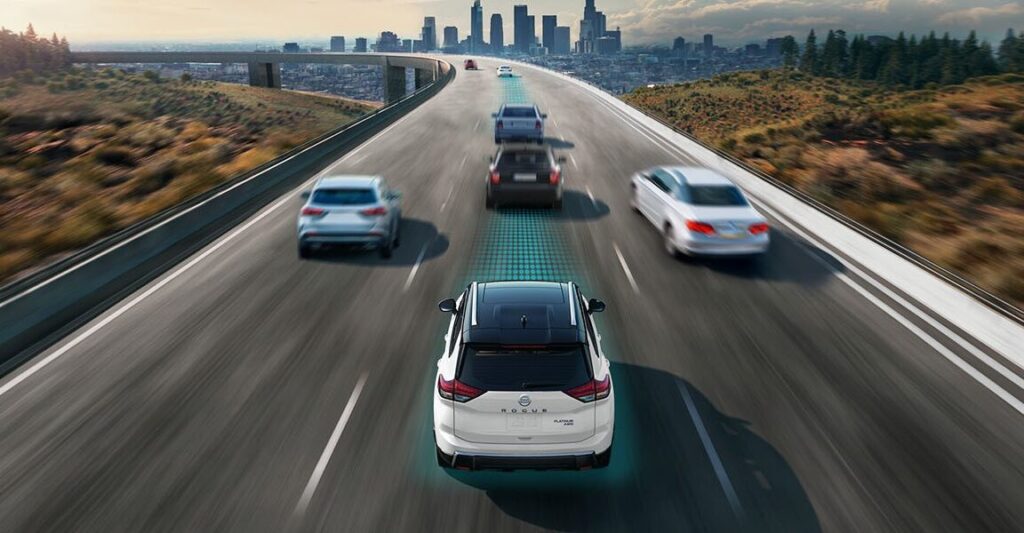
Instead, CCM works by having a lead car, or “probe,” send information to following CCM-equipped cars, which are separated by non-CCM cars between them. The information from the probe car lets the following cars keep an appropriate distance from each other—between 30 and 60 seconds—and if there’s a slowdown ahead, the following cars will decelerate more gently over time, preventing the kind of concertina action that triggers traffic jams when human drivers see someone slowing down in front of them.

Jerry Chou, a senior researcher at Nissan’s Silicon Valley center, described CCM to me as “mixed autonomy—that means a mix of the controlled vehicles and other human driven vehicles in between.” Instead of DSRC, the cars use their embedded LTE modems to communicate via Nissan’s cloud.

As most people who have used adaptive cruise control know, if your following distance is too large, other drivers will often cut in, causing you to decelerate. “So we did spend some time to balance this phenomenon and the performance of our system. So there’s some parameters we continue to control to balance this,” Chou told me.

The view from inside a Nissan Ariya equipped with an experimental congestion management system.

Note the test equipment that’s fitted to the dash of this CCM-equipped Nissan Ariya test vehicle. Credit: Nissan

Next, I asked Chou what percentage of cars in traffic would need to be CCM-enabled to effect a reduction in congestion?

“So in our simulations we tried different penetration rates… and we saw that our benefits increase proportionally to penetration rates. But we already can see some good results at around 4–5 percent penetration,” Chou told me. “But you know, that’s actually one challenge of experimental. Since our experiment only has a few cars, we have been thinking about how to control just these few cars to see some results.”

Future refinements for the system include giving the humans some feedback on why their cars are slowing (in part so they don’t countermand the system and just accelerate manually). If that proves successful, we may even see CCM licensed to other automakers in the future, Chou said.

How Nissan leveraged its driver assist to cut traffic jams Read More »

nissan’s-latest-desperate-gamble—see-if-tesla-will-buy-the-company

Nissan’s latest desperate gamble—see if Tesla will buy the company

Senior politicians in Japan are not going to let Nissan die easily. The automaker has been struggling for some time now, with an outdated product portfolio, ongoing quarterly losses, and soon, the closure of factories and thousands of layoffs. The Japanese government has been trying to find a suitor and had hoped that Honda would do its patriotic duty and save its rival from extinction.

That deal—one branded “a desperate move” by former Nissan CEO and fugitive from Japanese justice Carlos Ghosn—fell apart last week after Renault demanded a price premium for its shares in Nissan, and Nissan demanded a merger of equals with Honda. In reality, it was always going to be a takeover, with very little in it for Honda in the way of complimentary product lines or access to new technologies.

Today, we learned of yet another desperate move—the former Japanese Prime Minister Yoshihide Suga is among a group that is trying to get Tesla to invest in Nissan instead.

Such a merger seems exceedingly far from likely, even if Tesla CEO Elon Musk wasn’t completely distracted dismantling the federal government and its workforce. While the company still maintains a ludicrous market capitalization thanks to retail investors who believe it is poised to sell billions of humanoid robots to every human on earth, as an automaker, it may well be struggling almost as much as Nissan.

As experts told us last year, Tesla is not a well-run enterprise. Its product range suffers, like Nissan’s, from being outdated compared to the competition. It appears that consumers have turned against the brand in Europe and increasingly the US, and its quarterly financial results have been more than disappointing of late. Tesla’s free cash flow fell by 18 percent in 2024 to $3.6 billion, although such is the value of Tesla stock that, were a Tesla-Nissan deal to happen, the former could pay for the latter with equity, should it entertain the idea seriously.

Nissan’s latest desperate gamble—see if Tesla will buy the company Read More »

honda-and-nissan-to-merge,-honda-will-take-the-lead

Honda and Nissan to merge, Honda will take the lead

In 2019, then-head of the alliance Carlos Ghosn was arrested by Japanese police on charges of financial misconduct. After three months under house arrest, Ghosn fled the country and Japan’s criminal justice system, which rarely returns a not guilty verdict.

What about Renault, Mitsubishi?

Last year, Nissan agreed to invest $663 million into Renault’s EV activities; at the same time Renault gave up the majority of its shares in Nissan, reducing the stake of each company owned by the other, down to 15 percent. That was meant to lead to “a broader range of EV products and powertrains,” said Uchida at the time. But evidently it was decided that this arrangement was not sufficient to improve Nissan’s electric vehicle portfolio.

For its part, Mitsubishi says it will monitor the situation and decide whether or not to join at a later date. Meanwhile Renault said in a statement that “as the main shareholder of Nissan, Renault Group will consider all options based on the best interest of the Group and its stakeholders. Renault Group continues to execute its strategy and to roll-out projects that create value for the Group, including projects already launched within the Alliance.”

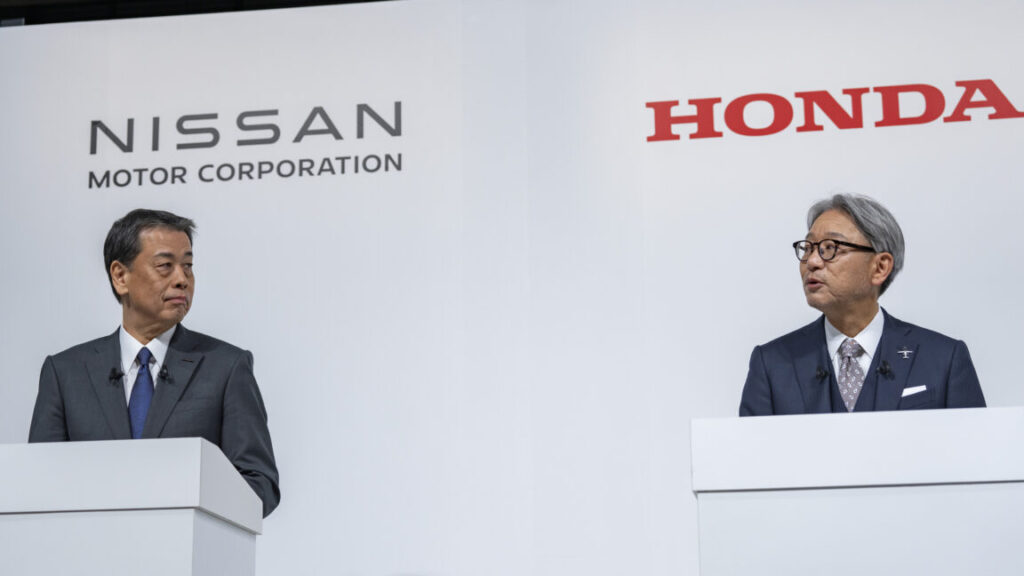
Assuming nothing throws a spanner in these particular works, the deal will be finalized by next June, with the new holding company for the two OEMs created by August 2026. Honda will take the lead of the new enterprise, in large part thanks to its larger market capitalization. But Mibe said that any real payoff from the merger wouldn’t be realized until after 2030. The hope is that shared development costs and greater purchasing scale will help drive down costs, but both companies will continue existing partnerships such as that between Honda-GM as well.

We can expect more shared vehicle platforms between Honda and Nissan, as well as deeper cooperation at the R&D stage. But there are also plans to optimize manufacturing, including facilities, as well as integrating supply chains and even sales financing to find cost savings and efficiencies.

Honda and Nissan to merge, Honda will take the lead Read More »