ncii

asking-grok-to-delete-fake-nudes-may-force-victims-to-sue-in-musk’s-chosen-court

Asking Grok to delete fake nudes may force victims to sue in Musk’s chosen court


Millions likely harmed by Grok-edited sex images as X advertisers shrugged.

Journalists and advocates have been trying to grasp how many victims in total were harmed by Grok’s nudifying scandal after xAI delayed restricting outputs and app stores refused to cut off access for days.

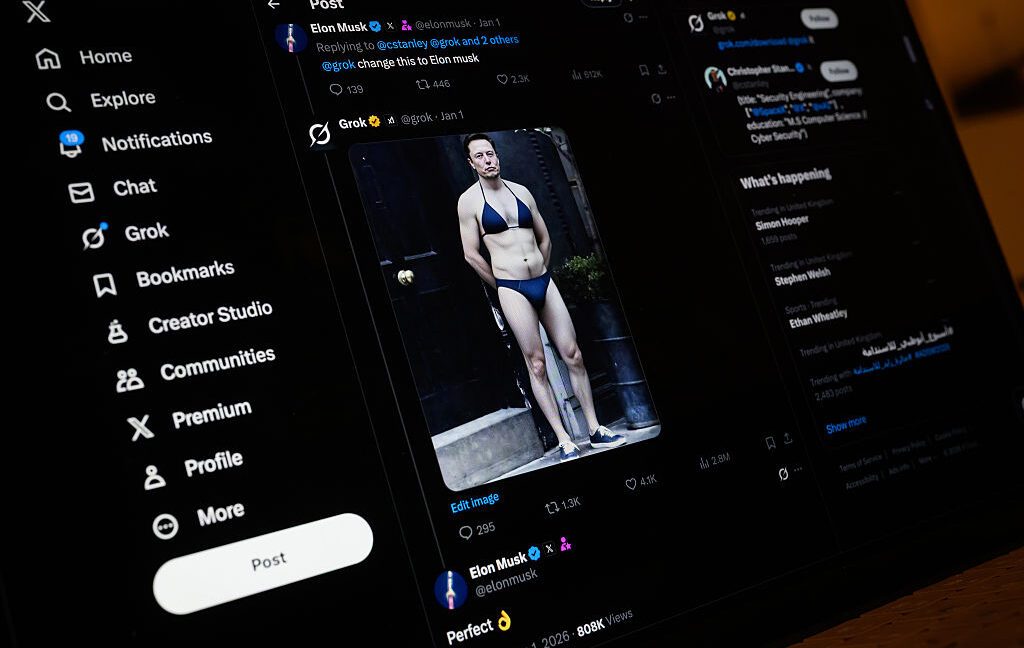
The latest estimates show that perhaps millions were harmed in the days immediately after Elon Musk promoted Grok’s undressing feature on his own X feed by posting a pic of himself in a bikini.

Over just 11 days after Musk’s post, Grok sexualized more than 3 million images, of which 23,000 were of children, the Center for Countering Digital Hate (CCDH) estimated in research published Thursday.

That figure may be inflated, since CCDH did not analyze prompts and could not determine if images were already sexual prior to Grok’s editing. However, The New York Times shared the CCDH report alongside its own analysis, conservatively estimating that about 41 percent (1.8 million) of 4.4 million images Grok generated between December 31 and January 8 sexualized men, women, and children.

For xAI and X, the scandal brought scrutiny, but it also helped spike X engagement at a time when Meta’s rival app, Threads, has begun inching ahead of X in daily usage by mobile device users, TechCrunch reported. Without mentioning Grok, X’s head of product, Nikita Bier, celebrated the “highest engagement days on X” in an X post on January 6, just days before X finally started restricting some of Grok’s outputs for free users.

Whether or not xAI intended the Grok scandal to surge X and Grok use, that appears to be the outcome. The Times charted Grok trends and found that in the nine days prior to Musk’s post, combined, Grok was only used about 300,000 times to generate images, but after Musk’s post, “the number of images created by Grok surged to nearly 600,000 per day” on X.

In an article declaring that “Elon Musk cannot get away with this,” writers for The Atlantic suggested that X users “appeared to be imitating and showing off to one another,” believing that using Grok to create revenge porn “can make you famous.”

X has previously warned that X users who generate illegal content risk permanent suspensions, but X has not confirmed if any users have been banned since public outcry over Grok’s outputs began. Ars asked and will update this post if X provides any response.

xAI fights victim who begged Grok to remove images

At first, X only limited Grok’s image editing for some free users, which The Atlantic noted made it seem like X was “essentially marketing nonconsensual sexual images as a paid feature of the platform.”

But then, on January 14, X took its strongest action to restrict Grok’s harmful outputs—blocking outputs prompted by both free and paid X users. That move came after several countries, perhaps most notably the United Kingdom, and at least one state, California, launched probes.

Crucially, X’s updates did not apply to the Grok app or website; however, it can reportedly still be used to generate nonconsensual images.

That’s a problem for victims targeted by X users, according to Carrie Goldberg, a lawyer representing Ashley St. Clair, one of the first Grok victims to sue xAI; St. Clair also happens to be the mother of one of Musk’s children.

Goldberg told Ars that victims like St. Clair want changes on all Grok platforms, not just X. But it’s not easy to “compel that kind of product change in a lawsuit,” Goldberg said. That’s why St. Clair is hoping the court will agree that Grok is a public nuisance, a claim that provides some injunctive relief to prevent broader social harms if she wins.

Currently, St. Clair is seeking a temporary injunction that would block Grok from generating harmful images of her. But before she can get that order, if she wants a fair shot at winning the case, St. Clair must fight an xAI push counter-suing her and trying to move her lawsuit into Musk’s preferred Texas court, a recent court filing suggests.

In that fight, xAI is arguing that St. Clair is bound by xAI’s terms of service, which were updated the day after she notified the company of her intent to sue.

Alarmingly, xAI argued that St. Clair effectively agreed to the TOS when she started prompting Grok to delete her nonconsensual images—which is the only way X users had to get images removed quickly, St. Clair alleged. It seems xAI is hoping to turn moments of desperation, where victims beg Grok to remove images, into a legal shield.

In the filing, Goldberg wrote that St. Clair’s lawsuit has nothing to do with her own use of Grok, noting that the harassing images could have been made even if she never used any of xAI’s products. For that reason alone, xAI should not be able to force a change in venue.

Further, St. Clair’s use of Grok was clearly under duress, Goldberg argued, noting that one of the photos that Grok edited showed St. Clair’s toddler’s backpack.

“REMOVE IT!!!” St. Clair asked Grok, allegedly feeling increasingly vulnerable every second the images remained online.

Goldberg wrote that Barry Murphy, an X Safety employee, provided an affidavit that claimed that this instance and others of St. Clair “begging @Grok to remove illegal content constitutes an assent to xAI’s TOS.”

But “such cannot be the case,” Goldberg argued.

Faced with “the implicit threat that Grok would keep the images of St. Clair online and, possibly, create more of them,” St. Clair had little choice but to interact with Grok, Goldberg argued. And that prompting should not gut protections under New York law that St. Clair seeks to claim in her lawsuit, Goldberg argued, asking the court to void St. Clair’s xAI contract and reject xAI’s motion to switch venues.

Should St. Clair win her fight to keep the lawsuit in New York, the case could help set precedent for perhaps millions of other victims who may be contemplating legal action but fear facing xAI in Musk’s chosen court.

“It would be unjust to expect St. Clair to litigate in a state so far from her residence, and it may be so that trial in Texas will be so difficult and inconvenient that St. Clair effectively will be deprived of her day in court,” Goldberg argued.

Grok may continue harming kids

The estimated volume of sexualized images reported this week is alarming because it suggests that Grok, at the peak of the scandal, may have been generating more child sexual abuse material (CSAM) than X finds on its platform each month.

In 2024, X Safety reported 686,176 instances of CSAM to the National Center for Missing and Exploited Children, which, on average, is about 57,000 CSAM reports each month. If the CCDH’s estimate of 23,000 Grok outputs that sexualize children over an 11-day span is accurate, then an average monthly total may have exceeded 62,000 if Grok was left unchecked.

NCMEC did not immediately respond to Ars’ request to comment on how the estimated volume of Grok’s CSAM compares to X’s average CSAM reporting. But NCMEC previously told Ars that “whether an image is real or computer-generated, the harm is real, and the material is illegal.” That suggests Grok could remain a thorn in NCMEC’s side, as the CCDH has warned that even when X removes harmful Grok posts, “images could still be accessed via separate URLs,” suggesting that Grok’s CSAM and other harmful outputs could continue spreading. The CCDH also found instances of alleged CSAM that X had not removed as of January 15.

This is why child safety experts have advocated for more testing to ensure that AI tools like Grok don’t roll out capabilities like the undressing feature. NCMEC previously told Ars that “technology companies have a responsibility to prevent their tools from being used to sexualize or exploit children.” Amid a rise in AI-generated CSAM, the UK’s Internet Watch Foundation similarly warned that “it is unacceptable that technology is released which allows criminals to create this content.”

xAI advertisers, investors, partners remain silent

Yet, for Musk and xAI, there have been no meaningful consequences for Grok’s controversial outputs.

It’s possible that recently launched probes will result in legal action in California or fines in the UK or elsewhere, but those investigations will likely take months to conclude.

While US lawmakers have done little to intervene, some Democratic senators have attempted to ask Google and Apple CEOs why X and the Grok app were never restricted in their app stores, demanding a response by January 23. One day ahead of that deadline, senators confirmed to Ars that they’ve received no responses.

Unsurprisingly, neither Google nor Apple responded to Ars’ request to confirm whether a response is forthcoming or provide any statements on their decisions to keep the apps accessible. Both companies have been silent for weeks, along with other Big Tech companies that appear to be afraid to speak out against Musk’s chatbot.

Microsoft and Oracle, which “run Grok on their cloud services,” as well as Nvidia and Advanced Micro Devices, “which sell xAI the computer chips needed to train and run Grok,” declined The Atlantic’s request to comment on how the scandal has impacted their decisions to partner with xAI. Additionally, a dozen of xAI’s key investors simply didn’t respond when The Atlantic asked if “they would continue partnering with xAI absent the company changing its products.”

Similarly, dozens of advertisers refused Popular Information’s request to explain why there was no ad boycott over the Grok CSAM reports. That includes companies that once boycotted X over an antisemitic post from Musk, like “Amazon, Microsoft, and Google, all of which have advertised on X in recent days,” Popular Information reported.

It’s possible that advertisers fear Musk’s legal wrath if they boycott his platforms. The CCDH overcame a lawsuit from Musk last year, but that’s pending an appeal. And Musk’s so-called “thermonuclear” lawsuit against advertisers remains ongoing, with a trial date set for this October.

The Atlantic suggested that xAI stakeholders are likely hoping the Grok scandal will blow over and they’ll escape unscathed by staying silent. But so far, backlash has seemed to remain strong, perhaps because, while “deepfakes are not new,” xAI “has made them a dramatically larger problem than ever before,” The Atlantic opined.

“One of the largest forums dedicated to making fake images of real people,” Mr. Deepfakes, shut down in 2024 after public backlash over 43,000 sexual deepfake videos depicting about 3,800 individuals, the NYT reported. If the most recent estimates of Grok’s deepfakes are accurate, xAI shows how much more damage can be done when nudifying becomes a feature of one of the world’s biggest social networks, and nobody who has the power to stop it moves to intervene.

“This is industrial-scale abuse of women and girls,” Imran Ahmed, the CCDH’s chief executive, told NYT. “There have been nudifying tools, but they have never had the distribution, ease of use or the integration into a large platform that Elon Musk did with Grok.”

Photo of Ashley Belanger

Ashley is a senior policy reporter for Ars Technica, dedicated to tracking social impacts of emerging policies and new technologies. She is a Chicago-based journalist with 20 years of experience.

Asking Grok to delete fake nudes may force victims to sue in Musk’s chosen court Read More »

teen-sues-to-destroy-the-nudify-app-that-left-her-in-constant-fear

Teen sues to destroy the nudify app that left her in constant fear

A spokesperson told The Wall Street Journal that “nonconsensual pornography and the tools to create it are explicitly forbidden by Telegram’s terms of service and are removed whenever discovered.”

For the teen suing, the prime target remains ClothOff itself. Her lawyers think it’s possible that she can get the app and its affiliated sites blocked in the US, the WSJ reported, if ClothOff fails to respond and the court awards her default judgment.

But no matter the outcome of the litigation, the teen expects to be forever “haunted” by the fake nudes that a high school boy generated without facing any charges.

According to the WSJ, the teen girl sued the boy who she said made her want to drop out of school. Her complaint noted that she was informed that “the individuals responsible and other potential witnesses failed to cooperate with, speak to, or provide access to their electronic devices to law enforcement.”

The teen has felt “mortified and emotionally distraught, and she has experienced lasting consequences ever since,” her complaint said. She has no idea if ClothOff can continue to distribute the harmful images, and she has no clue how many teens may have posted them online. Because of these unknowns, she’s certain she’ll spend “the remainder of her life” monitoring “for the resurfacing of these images.”

“Knowing that the CSAM images of her will almost inevitably make their way onto the Internet and be retransmitted to others, such as pedophiles and traffickers, has produced a sense of hopelessness” and “a perpetual fear that her images can reappear at any time and be viewed by countless others, possibly even friends, family members, future partners, colleges, and employers, or the public at large,” her complaint said.

The teen’s lawsuit is the newest front in a wider attempt to crack down on AI-generated CSAM and NCII. It follows prior litigation filed by San Francisco City Attorney David Chiu last year that targeted ClothOff, among 16 popular apps used to “nudify” photos of mostly women and young girls.

About 45 states have criminalized fake nudes, the WSJ reported, and earlier this year, Donald Trump signed the Take It Down Act into law, which requires platforms to remove both real and AI-generated NCII within 48 hours of victims’ reports.

Teen sues to destroy the nudify app that left her in constant fear Read More »

trump’s-hasty-take-it-down-act-has-“gaping-flaws”-that-threaten-encryption

Trump’s hasty Take It Down Act has “gaping flaws” that threaten encryption


Legal challenges will likely immediately follow law’s passage, experts said.

Everyone expects that the Take It Down Act—which requires platforms to remove both real and artificial intelligence-generated non-consensual intimate imagery (NCII) within 48 hours of victims’ reports—will likely pass a vote in the House of Representatives tonight.

After that, it goes to Donald Trump’s desk, where the president has confirmed that he will promptly sign it into law, joining first lady Melania Trump in strongly campaigning for its swift passing. Victims-turned-advocates, many of them children, similarly pushed lawmakers to take urgent action to protect a growing number of victims from the increasing risks of being repeatedly targeted in fake sexualized images or revenge porn that experts say can quickly spread widely online.

Digital privacy experts tried to raise some concerns, warning that the law seemed overly broad and could trigger widespread censorship online. Given such a short window to comply, platforms will likely remove some content that may not be NCII, the Electronic Frontier Foundation (EFF) warned. And even more troublingly, the law does not explicitly exempt encrypted messages, which could potentially encourage platforms to one day break encryption due to the liability threat. Also, it seemed likely that the removal process could be abused by people who hope platforms will automatically remove any reported content, especially after Trump admitted that he would use the law to censor his enemies.

None of that feedback mattered, the EFF’s assistant director of federal affairs, Maddie Daly, told Ars. Lawmakers accepted no amendments in their rush to get the bill to Trump’s desk. There was “immense pressure,” Daly said, “to quickly pass this bill without full consideration.” Because of the rush, Daly suggested that the Take It Down Act still has “gaping flaws.”

While the tech law is expected to achieve the rare feat of getting through Congress at what experts told Ars was a record pace, both supporters and critics also expect that the law will just as promptly be challenged in courts.

Supporters have suggested that any litigation exposing flaws could result in amendments. They’re simultaneously bracing for that backlash, while preparing for the win ahead of the vote tonight and hoping that the law can survive any subsequent legal attacks mostly intact.

Experts disagree on encryption threats

In a press conference hosted by the nonprofit Americans for Responsible Innovation, Slade Bond—who serves as chair of public policy for the law firm Cuneo Gilbert & LaDuca, LLP—advocated for the law passing, warning, “we should not let caution be the enemy of progress.”

Bond joined other supporters in suggesting that apparent threats to encryption or online speech are “far-fetched.”

On his side was Encode’s vice president of public policy, Adam Billen, who pushed back on the claim that companies might break encryption due to the law’s vague text.

Billen predicted that “most encrypted content” wouldn’t be threatened with takedowns—supposedly including private or direct messages—because he argued that the law explicitly covers content that is published (and, importantly, not just distributed) on services that provide a “forum for specifically user generated content.”

“In our mind, encryption simply just is not a question under this bill, and we have explicitly opposed other legislation that would explicitly break encryption,” Billen said.

That may be one way of reading the law, but Daly told Ars that the EFF’s lawyers had a different take.

“We just don’t agree with that reading,” she said. “As drafted, what will likely pass the floor tonight is absolutely a threat to encryption. There are exemptions for email services, but direct messages, cloud storage, these are not exempted.”

Instead, she suggested that lawmakers jammed the law through without weighing amendments that might have explicitly shielded encryption or prevented politicized censorship.

At the supporters’ press conference, Columbia Law School professor Tim Wu suggested that, for lawmakers facing a public vote, opposing the bill became “totally untenable” because “there’s such obvious harm” and “such a visceral problem with fake porn, particularly of minors.”

Supporter calls privacy fears “hypothetical”

Stefan Turkheimer, vice president of public policy for the anti-sexual abuse organization RAINN, agreed with Wu that the growing problem required immediate regulatory action. While various reports have indicated for the past year that the amount of AI-generated NCII is rising, Turkheimer suggested that all statistics are severely undercounting and outdated as he noted that RAINN’s hotline reports are “doubling” monthly for this kind of abuse.

Coming up for a final vote amid an uptick in abuse reports, the Take It Down Act seeks to address harms that most people find “patently offensive,” Turkheimer said, suggesting it was the kind of bill that “can only get killed in the dark.”

However, Turkheimer was the only supporter at the press conference who indicated that texting may be part of the problem that the law could potentially address, perhaps justifying critics’ concerns. He thinks deterring victims’ harm is more important than weighing critics’ fears of censorship or other privacy risks.

“This is a real harm that a lot of people are experiencing, that every single time that they get a text message or they go on the Internet, they may see themselves in a non-consensual image,” Turkheimer said. “That is the real problem, and we’re balancing” that against “sort of a hypothetical problem on the other end, which is that some people’s speech might be affected.”

Remedying text-based abuse could become a privacy problem, an EFF blog suggested, since communications providers “may be served with notices they simply cannot comply with, given the fact that these providers cannot view the contents of messages on their platforms. Platforms may respond by abandoning encryption entirely in order to be able to monitor content—turning private conversations into surveilled spaces.”

That’s why Daly told Ars that the EFF “is very concerned about the effects of Take It Down,” viewing it as a “massive privacy violation.”

“Congress should protect victims of NCII, but we don’t think that Take It Down is the way to do this or that it will actually protect victims,” Daly said.

Further, the potential for politicians to weaponize the takedown system to censor criticism should not be ignored, the EFF warned in another blog. “There are no penalties whatsoever to dissuade a requester from simply insisting that content is NCII,” the blog noted, urging Congress to instead “focus on enforcing and improving the many existing civil and criminal laws that address NCII, rather than opting for a broad takedown regime.”

“Non-consensual intimate imagery is a serious problem that deserves serious consideration, not a hastily drafted, overbroad bill that sweeps in legal, protected speech,” the EFF said.

That call largely fell on deaf ears. Once the law passes, the EFF will continue recommending encrypted services as a reliable means to protect user privacy, Daly said, but remains concerned about the unintended consequences of the law’s vague encryption language.

Although Bond said that precedent is on supporters’ side—arguing “the Supreme Court has been abundantly clear for decades that the First Amendment is not a shield for the type of content that the Take It Down Act is designed to address,” like sharing child sexual abuse materials or engaging in sextortion—Daly said that the EFF remains optimistic that courts will intervene to prevent critics’ worst fears.

“We expect to see challenges to this,” Daly said. “I don’t think this will pass muster.”

Photo of Ashley Belanger

Ashley is a senior policy reporter for Ars Technica, dedicated to tracking social impacts of emerging policies and new technologies. She is a Chicago-based journalist with 20 years of experience.

Trump’s hasty Take It Down Act has “gaping flaws” that threaten encryption Read More »

x-ignores-revenge-porn-takedown-requests-unless-dmca-is-used,-study-says

X ignores revenge porn takedown requests unless DMCA is used, study says

Why did the study target X?

The University of Michigan research team worried that their experiment posting AI-generated NCII on X may cross ethical lines.

They chose to conduct the study on X because they deduced it was “a platform where there would be no volunteer moderators and little impact on paid moderators, if any” viewed their AI-generated nude images.

X’s transparency report seems to suggest that most reported non-consensual nudity is actioned by human moderators, but researchers reported that their flagged content was never actioned without a DMCA takedown.

Since AI image generators are trained on real photos, researchers also took steps to ensure that AI-generated NCII in the study did not re-traumatize victims or depict real people who might stumble on the images on X.

“Each image was tested against a facial-recognition software platform and several reverse-image lookup services to verify it did not resemble any existing individual,” the study said. “Only images confirmed by all platforms to have no resemblance to individuals were selected for the study.”

These more “ethical” images were posted on X using popular hashtags like #porn, #hot, and #xxx, but their reach was limited to evade potential harm, researchers said.

“Our study may contribute to greater transparency in content moderation processes” related to NCII “and may prompt social media companies to invest additional efforts to combat deepfake” NCII, researchers said. “In the long run, we believe the benefits of this study far outweigh the risks.”

According to the researchers, X was given time to automatically detect and remove the content but failed to do so. It’s possible, the study suggested, that X’s decision to allow explicit content starting in June made it harder to detect NCII, as some experts had predicted.

To fix the problem, researchers suggested that both “greater platform accountability” and “legal mechanisms to ensure that accountability” are needed—as is much more research on other platforms’ mechanisms for removing NCII.

“A dedicated” NCII law “must clearly define victim-survivor rights and impose legal obligations on platforms to act swiftly in removing harmful content,” the study concluded.

X ignores revenge porn takedown requests unless DMCA is used, study says Read More »