MCP

perplexity-announces-“computer,”-an-ai-agent-that-assigns-work-to-other-ai-agents

Perplexity announces “Computer,” an AI agent that assigns work to other AI agents

Given the right permissions and with the proper plugins, it could create, modify, or delete the user’s files and otherwise change things far beyond what most users could achieve with existing models and MCP (Model Context Protocol). Users would use files like USER.MD, MEMORY.MD, SOUL.MD, or HEARTBEAT.MD to give the tool context about its goals and how to work toward them independently, sometimes running for long stretches without direct user input.

On one hand, that meant it could do impressive things—the first glimpses of the sort of knowledge work that AI boosters have been saying agentic AI would ultimately do. On the other hand, it was prone to serious errors and vulnerable to prompt injection and other security problems, in part due to a Wild West of unverified plugins.

The same toolkit that was used to create a viral Reddit clone populated by AI agents was also, at least in one case, responsible for deleting a user’s emails against her will.

Stay in your lane

Perplexity Computer aims to address those concerns in a few ways. First, its core process occurs in the cloud, not on the user’s local machine. Second, it lives within a walled garden with a curated list of integrations, in contrast to OpenClaw’s unregulated frontier.

This is, of course, an imperfect analogy, but you could say that if OpenClaw were the open web of AI agent tools, then Computer is Apple’s App Store. While you’re more limited in what you can do, you’re not trusting packages from unverified sources with access to your system.

There could still be risks, though. For one thing, LLMs make mistakes, and those could be consequential if Computer is working with data you don’t have backed up elsewhere or if you’re not verifying the outputs, for example.

Perplexity Computer aims to button up, refine, and contain the wild power of the viral OpenClaw agentic AI tool—competing with the likes of Claude Cowork—by optimizing subtasks by selecting models best suited to them.

It surely won’t be the last existing AI player to try and do this sort of thing. After all, OpenAI hired OpenClaw’s developer, with CEO Sam Altman suggesting that some of what we saw in OpenClaw will be essential to the company’s product vision moving forward.

Perplexity announces “Computer,” an AI agent that assigns work to other AI agents Read More »
xcode-26.3-adds-support-for-claude,-codex,-and-other-agentic-tools-via-mcp

Xcode 26.3 adds support for Claude, Codex, and other agentic tools via MCP

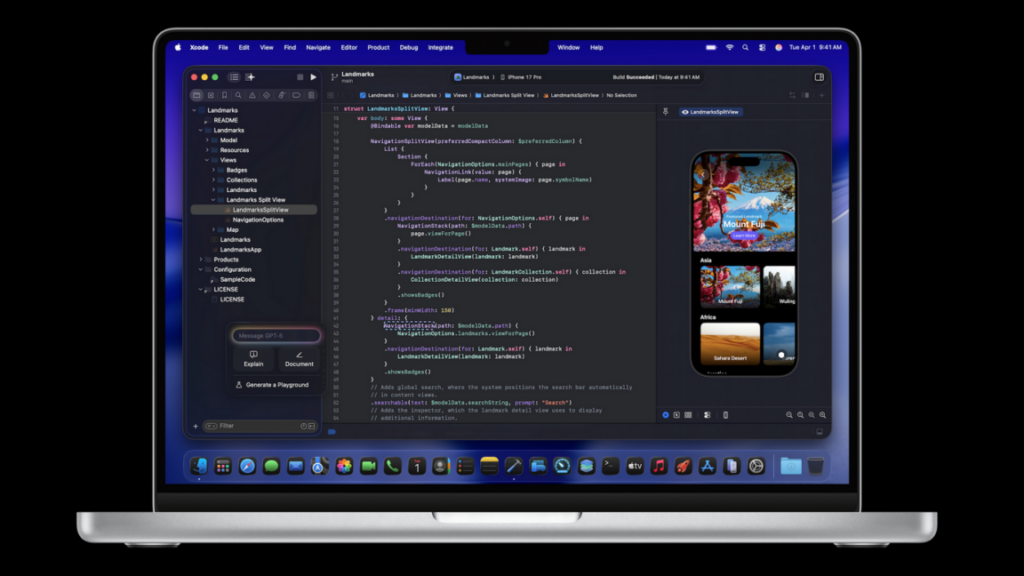
Apple has announced a new version of Xcode, the latest version of its integrated development environment (IDE) for building software for its own platforms, like the iPhone and Mac. The key feature of 26.3 is support for full-fledged agentic coding tools, like OpenAI’s Codex or Claude Agent, with a side panel interface for assigning tasks to agents with prompts and tracking their progress and changes.

This is achieved via Model Context Protocol (MCP), an open protocol that lets AI agents work with external tools and structured resources. Xcode acts as an MCP endpoint that exposes a bunch of machine-invocable interfaces and gives AI tools like Codex or Claude Agent access to a wide range of IDE primitives like file graph, docs search, project settings, and so on. While AI chat and workflows were supported in Xcode before, this release gives them much deeper access to the features and capabilities of Xcode.

This approach is notable because it means that even though OpenAI and Anthropic’s model integrations are privileged with a dedicated spot in Xcode’s settings, it’s possible to connect other tooling that supports MCP, which also allows doing some of this with models running locally.

Apple began its big AI features push with the release of Xcode 26, expanding on code completion using a local model trained by Apple that was introduced in the previous major release, and fully supporting a chat interface for talking with OpenAI’s ChatGPT and Anthropic’s Claude. Users who wanted more agent-like behavior and capabilities had to use third-party tools, which sometimes had limitations due to a lack of deep IDE access.

Xcode 26.3’s release candidate (the final beta, essentially) rolls out imminently, with the final release coming a little further down the line.

Xcode 26.3 adds support for Claude, Codex, and other agentic tools via MCP Read More »

big-tech-joins-forces-with-linux-foundation-to-standardize-ai-agents

Big Tech joins forces with Linux Foundation to standardize AI agents

Big Tech has spent the past year telling us we’re living in the era of AI agents, but most of what we’ve been promised is still theoretical. As companies race to turn fantasy into reality, they’ve developed a collection of tools to guide the development of generative AI. A cadre of major players in the AI race, including Anthropic, Block, and OpenAI, has come together to promote interoperability with the newly formed Agentic AI Foundation (AAIF). This move elevates a handful of popular technologies and could make them a de facto standard for AI development going forward.

The development path for agentic AI models is cloudy to say the least, but companies have invested so heavily in creating these systems that some tools have percolated to the surface. The AAIF, which is part of the nonprofit Linux Foundation, has been launched to govern the development of three key AI technologies: Model Context Protocol (MCP), goose, and AGENTS.md.

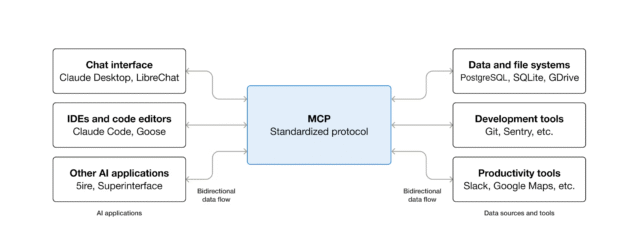
MCP is probably the most well-known of the trio, having been open-sourced by Anthropic a year ago. The goal of MCP is to link AI agents to data sources in a standardized way—Anthropic (and now the AAIF) is fond of calling MCP a “USB-C port for AI.” Rather than creating custom integrations for every different database or cloud storage platform, MCP allows developers to quickly and easily connect to any MCP-compliant server.

Since its release, MCP has been widely used across the AI industry. Google announced at I/O 2025 that it was adding support for MCP in its dev tools, and many of its products have since added MCP servers to make data more accessible to agents. OpenAI also adopted MCP just a few months after it was released.

mcp simple diagram

Credit: Anthropic

Expanding use of MCP might help users customize their AI experience. For instance, the new Pebble Index 01 ring uses a local LLM that can act on your voice notes, and it supports MCP for user customization.

Local AI models have to make some sacrifices compared to bigger cloud-based models, but MCP can fill in the functionality gaps. “A lot of tasks on productivity and content are fully doable on the edge,” Qualcomm head of AI products, Vinesh Sukumar, tells Ars. “With MCP, you have a handshake with multiple cloud service providers for any kind of complex task to be completed.”

Big Tech joins forces with Linux Foundation to standardize AI agents Read More »