DOJ released Epstein files with dozens of nudes and victims’ names, reports say
DOJ reportedly failed to redact nearly 40 nude photos and 43 victims’ names.
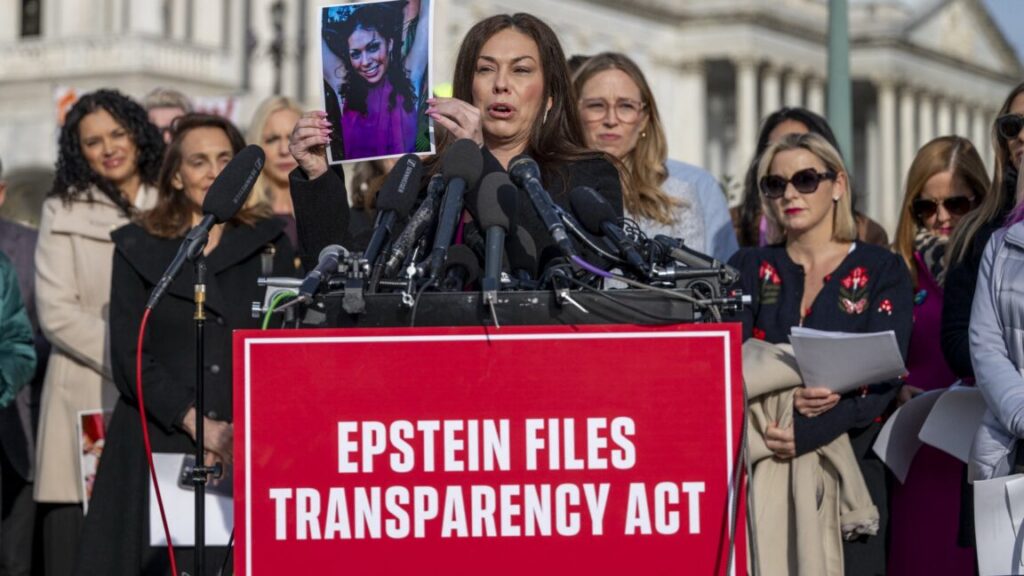
Epstein survivor Haley Robson holds up a photo of her younger self during a news conference on the Epstein Files Transparency Act at the US Capitol in Washington, DC, on November 18, 2025. Credit: Getty Images | Daniel Heuer/AFP
The Epstein files released by the Department of Justice on Friday included at least a few dozen unredacted nude photos and names of at least 43 victims, according to news reports.
The DOJ missed a December 19 deadline set by the Epstein Files Transparency Act by more than a month, but still released the files without fully redacting nude photos and names of Jeffrey Epstein’s victims. The New York Times reported yesterday that it found “nearly 40 unredacted images that appeared to be part of a personal photo collection, showing both nude bodies and the faces of the people portrayed.”
While the people in the photos were young, “it was unclear whether they were minors,” the article said. “Some of the images seemed to show Mr. Epstein’s private island, including a beach. Others were taken in bedrooms and other private spaces.” The photos “appeared to show at least seven different people,” the article said.
The Times said it notified government officials of the nude images and that the pictures have since been “largely removed or redacted” from the files available on the DOJ website. The DOJ told the Times and other media outlets that it is making “additional redactions of personally identifiable information” and redactions of “images of a sexual nature. Once proper redactions have been made, any responsive documents will repopulate online.”
A DOJ spokesperson told Ars today that the department “takes victim protection very seriously and has redacted thousands of victims’ names in the millions of published pages to protect the innocent. The Department had 500 reviewers looking at millions of pages for this very reason, to meet the requirements of the act while protecting victims. When a victim’s name is alleged to be unredacted, our team is working around the clock to fix the issue and republish appropriately redacted pages as soon as possible. To date, 0.1 percent of released pages have been found to have victim identifying information unredacted.”
The 0.1 percent figure is apparently an increase since yesterday, presumably because of more reports of incomplete redactions in the past day. Deputy Attorney General Todd Blanche told ABC News yesterday that “every time we hear from a victim or their lawyer that they believe that their name was not properly redacted, we immediately rectify that. And the numbers we’re talking about, just so the American people understand, we’re talking about .001 percent of all the materials.”
Images “stayed online for at least another full day”
404 Media reported that it sent the DOJ links to nude images from the DOJ’s website and that the “files stayed online for at least another full day, until Sunday evening, when they disappeared.”
Separately, The Wall Street Journal reported yesterday that the files included full names of victims, “including many who haven’t shared their identities publicly or were minors when they were abused by the notorious sex offender. A review of 47 victims’ full names on Sunday found that 43 of them were left unredacted in files that were made public by the government on Friday… Several women’s full names appeared more than 100 times in the files.”
The Journal said its review found that over two dozen names of minor victims were exposed. “Their full names were available Sunday afternoon in the Justice Department’s keyword search, along with personally identifying details that make them readily traceable, including home addresses,” the article said.
Anouska de Georgiou, an Epstein victim who testified against Ghislaine Maxwell, “said she contacted the Justice Department this weekend after learning that her personal information was made public in the release, including a picture of her driver’s license,” the Journal wrote.
DOJ said it made “all reasonable efforts”
Brad Edwards, an attorney for Epstein victims, told ABC News that “we are getting constant calls for victims because their names, despite them never coming forward, being completely unknown to the public, have all just been released for public consumption… It’s literally thousands of mistakes.” Edwards said the government should “take the thing down for now” instead of trying to fix the problems piecemeal.
The DOJ said Friday that the release includes more than 3 million pages, including over 2,000 videos and 180,000 images. The agency said it used “an additional review protocol” to comply with a court order requiring that no victim-identifying information be included unredacted in the public release.
“These files were collected from five primary sources including the Florida and New York cases against Epstein, the New York case against Maxwell, the New York cases investigating Epstein’s death, the Florida case investigating a former butler of Epstein, multiple FBI investigations, and the Office of Inspector General investigation into Epstein’s death,” the DOJ said.
The DOJ’s Epstein files webpage carries a disclaimer on the potential release of images or names that should have been redacted. “In view of the Congressional deadline, all reasonable efforts have been made to review and redact personal information pertaining to victims, other private individuals, and protect sensitive materials from disclosure. That said, because of the volume of information involved, this website may nevertheless contain information that inadvertently includes non-public personally identifiable information or other sensitive content, to include matters of a sexual nature,” it says.
The DOJ’s Epstein webpage advised that members of the public can email [email protected] to report materials that should not have been included.
Lawyer: DOJ put onus on victims to review files
Annie Farmer, who testified that she was 16 years old when Epstein and Maxwell abused her in 1996, told the Times that “it’s hard to imagine a more egregious way of not protecting victims than having full nude images of them available for the world to download.” Farmer is now a psychologist.
The DOJ told ABC News in a statement that it “coordinated closely with victims and their lawyers to ensure that the production of documents includes necessary redactions,” and wants to “immediately correct any redaction errors that our team may have made.”
Edwards and Brittany Henderson, who are partners at the same law firm, “said they provided a list of 350 victims to the Justice Department on Dec. 4 to ensure that the names would be redacted ahead of the release,” according to The Wall Street Journal. “They said Sunday that they are alarmed that the government didn’t perform a basic keyword search of victim names to verify the success of its redaction process.”
Edwards said he contacted Justice Department officials on Friday. “We notified them of the problem within an hour of the release,” Edwards was quoted as saying. “It’s been acknowledged as a grave error; there is no excuse for failing to immediately remedy it unless it was done intentionally.”
Edwards said the DOJ is putting the onus on victims to comb through millions of files and submit redaction requests. “In some cases, he said individuals have had to locate and submit more than 100 links to the DOJ to request that their names be redacted,” the Journal wrote.

Jon is a Senior IT Reporter for Ars Technica. He covers the telecom industry, Federal Communications Commission rulemakings, broadband consumer affairs, court cases, and government regulation of the tech industry.
DOJ released Epstein files with dozens of nudes and victims’ names, reports say Read More »