Claude Sonnet

anthropic’s-claude-haiku-4.5-matches-may’s-frontier-model-at-fraction-of-cost

Anthropic’s Claude Haiku 4.5 matches May’s frontier model at fraction of cost

And speaking of cost, Haiku 4.5 is included for subscribers of the Claude web and app plans. Through the API (for developers), the small model is priced at $1 per million input tokens and $5 per million output tokens. That compares to Sonnet 4.5 at $3 per million input and $15 per million output tokens, and Opus 4.1 at $15 per million input and $75 per million output tokens.

The model serves as a cheaper drop-in replacement for two older models, Haiku 3.5 and Sonnet 4. “Users who rely on AI for real-time, low-latency tasks like chat assistants, customer service agents, or pair programming will appreciate Haiku 4.5’s combination of high intelligence and remarkable speed,” Anthropic writes.
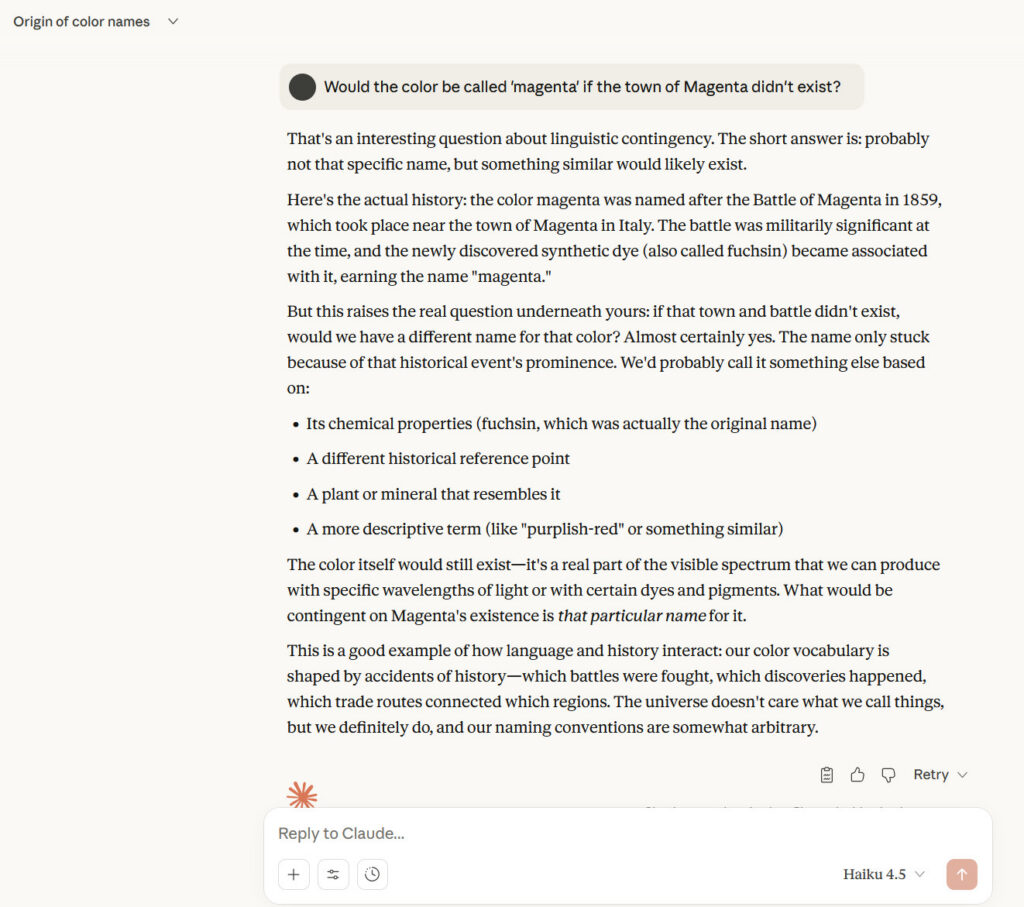
Claude 4.5 Haiku answers the classic Ars Technica AI question,

Claude 4.5 Haiku answers the classic Ars Technica AI question, “Would the color be called ‘magenta’ if the town of Magenta didn’t exist?”

On SWE-bench Verified, a test that measures performance on coding tasks, Haiku 4.5 scored 73.3 percent compared to Sonnet 4’s similar performance level (72.7 percent). The model also reportedly surpasses Sonnet 4 at certain tasks like using computers, according to Anthropic’s benchmarks. Claude Sonnet 4.5, released in late September, remains Anthropic’s frontier model and what the company calls “the best coding model available.”

Haiku 4.5 also surprisingly edges up close to what OpenAI’s GPT-5 can achieve in this particular set of benchmarks (as seen in the chart above), although since the results are self-reported and potentially cherry-picked to match a model’s strengths, one should always take them with a grain of salt.

Still, making a small, capable coding model may have unexpected advantages for agentic coding setups like Claude Code. Anthropic designed Haiku 4.5 to work alongside Sonnet 4.5 in multi-model workflows. In such a configuration, Anthropic says, Sonnet 4.5 could break down complex problems into multi-step plans, then coordinate multiple Haiku 4.5 instances to complete subtasks in parallel, like spinning off workers to get things done faster.

For more details on the new model, Anthropic released a system card and documentation for developers.

Anthropic’s Claude Haiku 4.5 matches May’s frontier model at fraction of cost Read More »

anthropic-introduces-claude-3.5-sonnet,-matching-gpt-4o-on-benchmarks

Anthropic introduces Claude 3.5 Sonnet, matching GPT-4o on benchmarks

The Anthropic Claude 3 logo, jazzed up by Benj Edwards.

Anthropic / Benj Edwards

On Thursday, Anthropic announced Claude 3.5 Sonnet, its latest AI language model and the first in a new series of “3.5” models that build upon Claude 3, launched in March. Claude 3.5 can compose text, analyze data, and write code. It features a 200,000 token context window and is available now on the Claude website and through an API. Anthropic also introduced Artifacts, a new feature in the Claude interface that shows related work documents in a dedicated window.

So far, people outside of Anthropic seem impressed. “This model is really, really good,” wrote independent AI researcher Simon Willison on X. “I think this is the new best overall model (and both faster and half the price of Opus, similar to the GPT-4 Turbo to GPT-4o jump).”

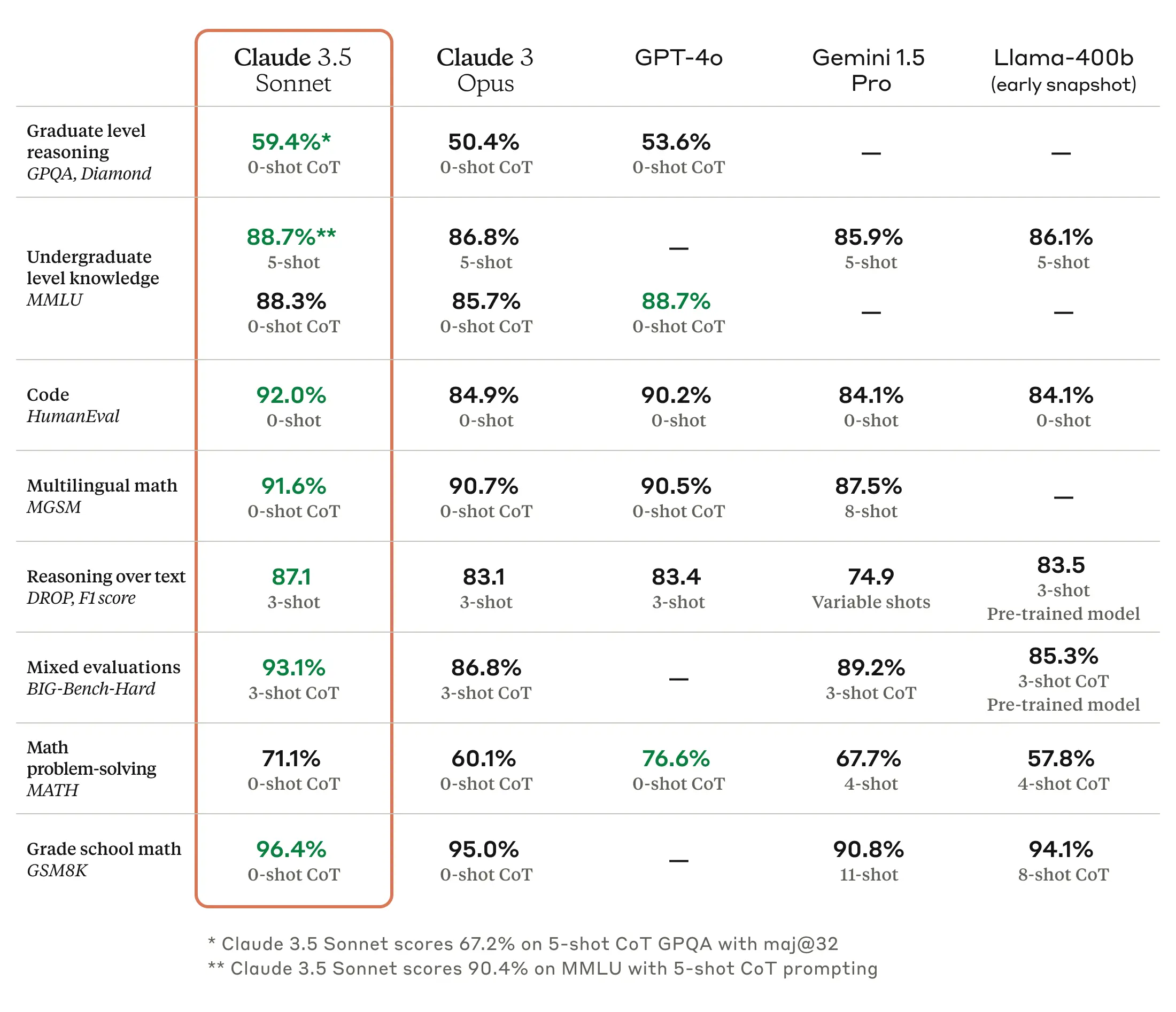
As we’ve written before, benchmarks for large language models (LLMs) are troublesome because they can be cherry-picked and often do not capture the feel and nuance of using a machine to generate outputs on almost any conceivable topic. But according to Anthropic, Claude 3.5 Sonnet matches or outperforms competitor models like GPT-4o and Gemini 1.5 Pro on certain benchmarks like MMLU (undergraduate level knowledge), GSM8K (grade school math), and HumanEval (coding).

Claude 3.5 Sonnet benchmarks provided by Anthropic.

Enlarge / Claude 3.5 Sonnet benchmarks provided by Anthropic.

If all that makes your eyes glaze over, that’s OK; it’s meaningful to researchers but mostly marketing to everyone else. A more useful performance metric comes from what we might call “vibemarks” (coined here first!) which are subjective, non-rigorous aggregate feelings measured by competitive usage on sites like LMSYS’s Chatbot Arena. The Claude 3.5 Sonnet model is currently under evaluation there, and it’s too soon to say how well it will fare.

Claude 3.5 Sonnet also outperforms Anthropic’s previous-best model (Claude 3 Opus) on benchmarks measuring “reasoning,” math skills, general knowledge, and coding abilities. For example, the model demonstrated strong performance in an internal coding evaluation, solving 64 percent of problems compared to 38 percent for Claude 3 Opus.

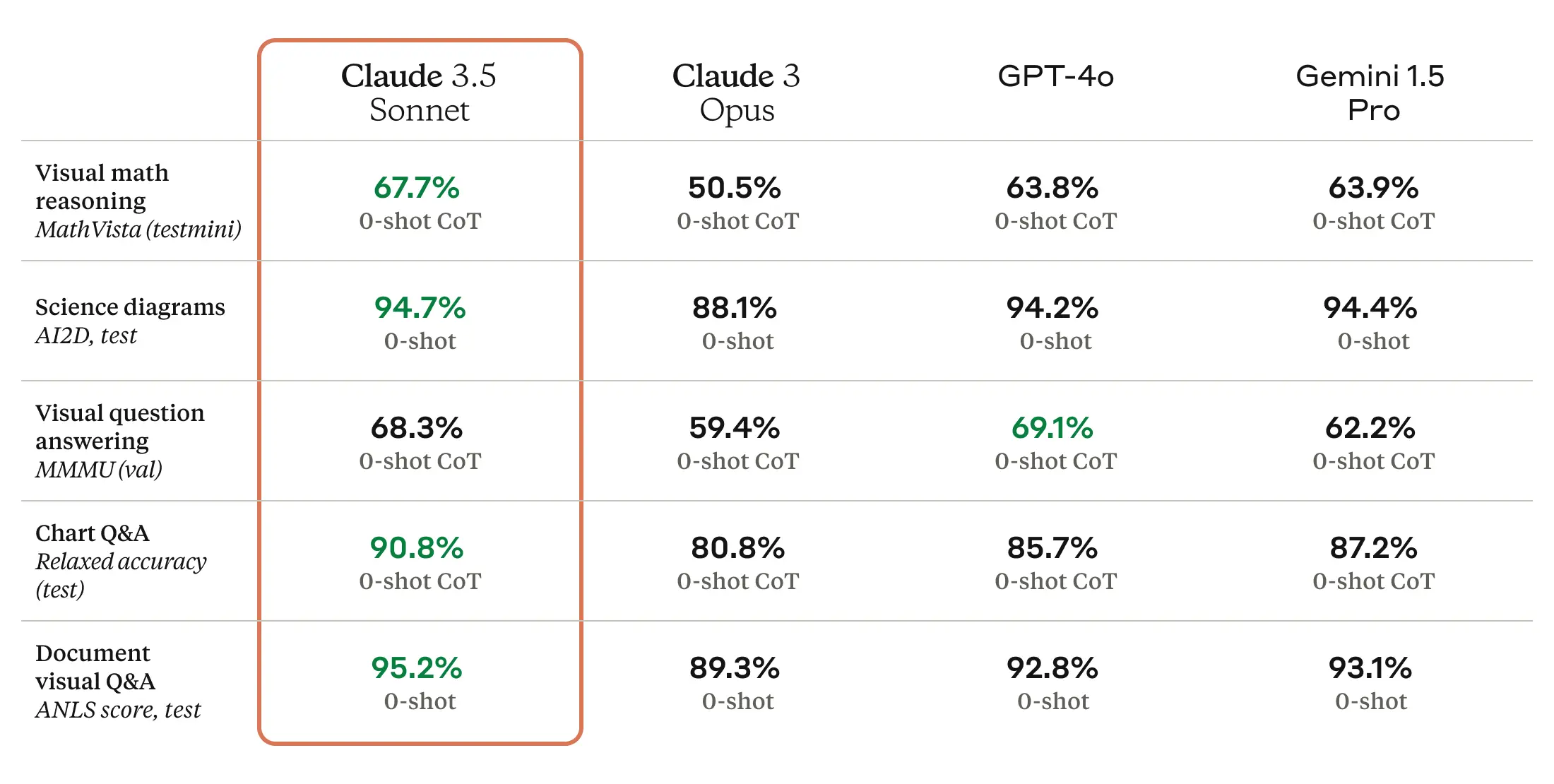
Claude 3.5 Sonnet is also a multimodal AI model that accepts visual input in the form of images, and the new model is reportedly excellent at a battery of visual comprehension tests.

Claude 3.5 Sonnet benchmarks provided by Anthropic.

Enlarge / Claude 3.5 Sonnet benchmarks provided by Anthropic.

Roughly speaking, the visual benchmarks mean that 3.5 Sonnet is better at pulling information from images than previous models. For example, you can show it a picture of a rabbit wearing a football helmet, and the model knows it’s a rabbit wearing a football helmet and can talk about it. That’s fun for tech demos, but the tech is still not accurate enough for applications of the tech where reliability is mission critical.

Anthropic introduces Claude 3.5 Sonnet, matching GPT-4o on benchmarks Read More »