

Claude Haiku

anthropic’s-claude-haiku-4.5-matches-may’s-frontier-model-at-fraction-of-cost

Anthropic’s Claude Haiku 4.5 matches May’s frontier model at fraction of cost

And speaking of cost, Haiku 4.5 is included for subscribers of the Claude web and app plans. Through the API (for developers), the small model is priced at $1 per million input tokens and $5 per million output tokens. That compares to Sonnet 4.5 at $3 per million input and $15 per million output tokens, and Opus 4.1 at $15 per million input and $75 per million output tokens.

The model serves as a cheaper drop-in replacement for two older models, Haiku 3.5 and Sonnet 4. “Users who rely on AI for real-time, low-latency tasks like chat assistants, customer service agents, or pair programming will appreciate Haiku 4.5’s combination of high intelligence and remarkable speed,” Anthropic writes.
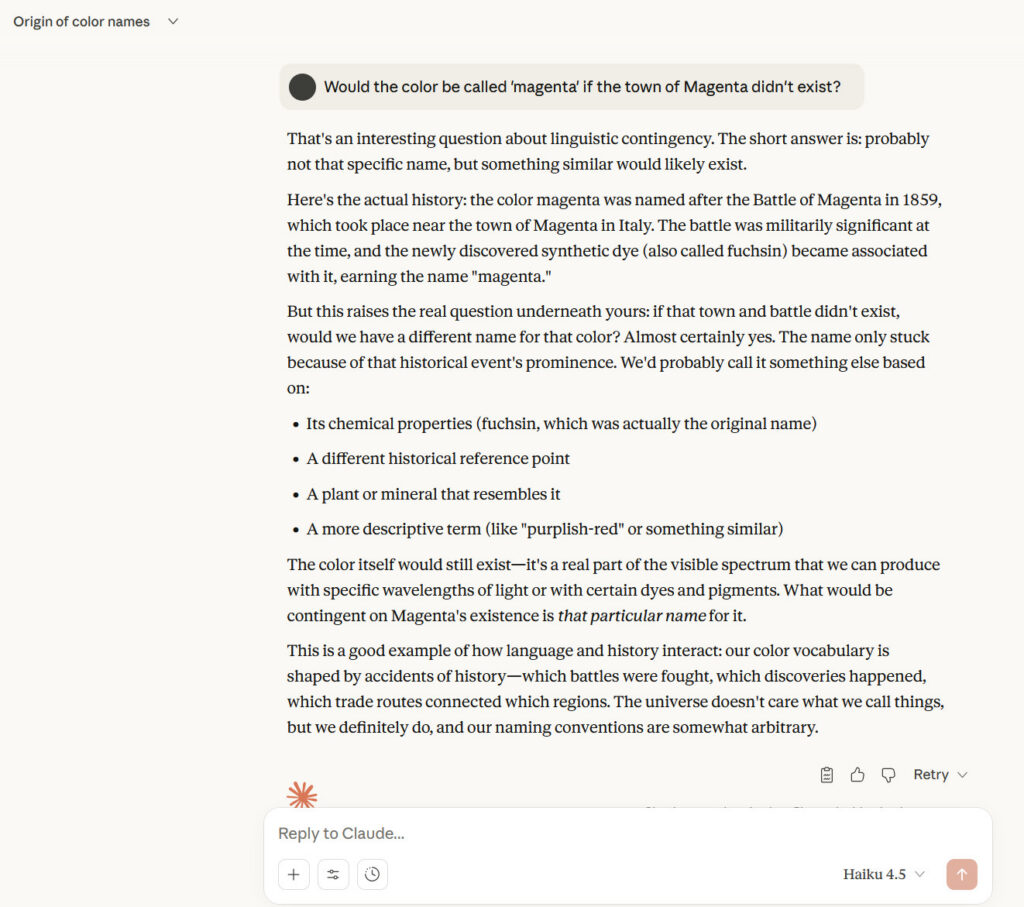
Claude 4.5 Haiku answers the classic Ars Technica AI question,

Claude 4.5 Haiku answers the classic Ars Technica AI question, “Would the color be called ‘magenta’ if the town of Magenta didn’t exist?”

On SWE-bench Verified, a test that measures performance on coding tasks, Haiku 4.5 scored 73.3 percent compared to Sonnet 4’s similar performance level (72.7 percent). The model also reportedly surpasses Sonnet 4 at certain tasks like using computers, according to Anthropic’s benchmarks. Claude Sonnet 4.5, released in late September, remains Anthropic’s frontier model and what the company calls “the best coding model available.”

Haiku 4.5 also surprisingly edges up close to what OpenAI’s GPT-5 can achieve in this particular set of benchmarks (as seen in the chart above), although since the results are self-reported and potentially cherry-picked to match a model’s strengths, one should always take them with a grain of salt.

Still, making a small, capable coding model may have unexpected advantages for agentic coding setups like Claude Code. Anthropic designed Haiku 4.5 to work alongside Sonnet 4.5 in multi-model workflows. In such a configuration, Anthropic says, Sonnet 4.5 could break down complex problems into multi-step plans, then coordinate multiple Haiku 4.5 instances to complete subtasks in parallel, like spinning off workers to get things done faster.

For more details on the new model, Anthropic released a system card and documentation for developers.

Anthropic’s Claude Haiku 4.5 matches May’s frontier model at fraction of cost Read More »

anthropic’s-haiku-3.5-surprises-experts-with-an-“intelligence”-price-increase

Anthropic’s Haiku 3.5 surprises experts with an “intelligence” price increase

Speaking of Opus, Claude 3.5 Opus is nowhere to be seen, as AI researcher Simon Willison noted to Ars Technica in an interview. “All references to 3.5 Opus have vanished without a trace, and the price of 3.5 Haiku was increased the day it was released,” he said. “Claude 3.5 Haiku is significantly more expensive than both Gemini 1.5 Flash and GPT-4o mini—the excellent low-cost models from Anthropic’s competitors.”

Cheaper over time?

So far in the AI industry, newer versions of AI language models typically maintain similar or cheaper pricing to their predecessors. The company had initially indicated Claude 3.5 Haiku would cost the same as the previous version before announcing the higher rates.

“I was expecting this to be a complete replacement for their existing Claude 3 Haiku model, in the same way that Claude 3.5 Sonnet eclipsed the existing Claude 3 Sonnet while maintaining the same pricing,” Willison wrote on his blog. “Given that Anthropic claim that their new Haiku out-performs their older Claude 3 Opus, this price isn’t disappointing, but it’s a small surprise nonetheless.”

Claude 3.5 Haiku arrives with some trade-offs. While the model produces longer text outputs and contains more recent training data, it cannot analyze images like its predecessor. Alex Albert, who leads developer relations at Anthropic, wrote on X that the earlier version, Claude 3 Haiku, will remain available for users who need image processing capabilities and lower costs.

The new model is not yet available in the Claude.ai web interface or app. Instead, it runs on Anthropic’s API and third-party platforms, including AWS Bedrock. Anthropic markets the model for tasks like coding suggestions, data extraction and labeling, and content moderation, though, like any LLM, it can easily make stuff up confidently.

“Is it good enough to justify the extra spend? It’s going to be difficult to figure that out,” Willison told Ars. “Teams with robust automated evals against their use-cases will be in a good place to answer that question, but those remain rare.”

Anthropic’s Haiku 3.5 surprises experts with an “intelligence” price increase Read More »