Author name: Paul Patrick

emtech-digital-2024:-a-thoughtful-look-at-ai’s-pros-and-cons-with-minimal-hype

EmTech Digital 2024: A thoughtful look at AI’s pros and cons with minimal hype

Massachusetts Institute of Sobriety —

At MIT conference, experts explore AI’s potential for “human flourishing” and the need for regulation.

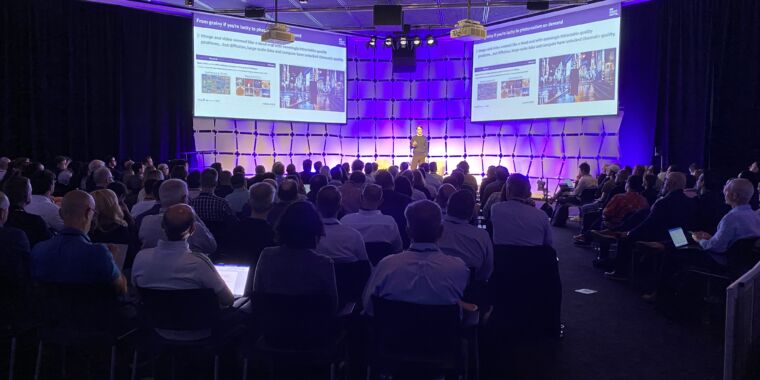
Nathan Benaich of Air Street capital delivers the opening presentation on the state of AI at EmTech Digital 2024 on May 22, 2024.

Enlarge / Nathan Benaich of Air Street Capital delivers the opening presentation on the state of AI at EmTech Digital 2024 on May 22, 2024.

Benj Edwards

CAMBRIDGE, Massachusetts—On Wednesday, AI enthusiasts and experts gathered to hear a series of presentations about the state of AI at EmTech Digital 2024 on the Massachusetts Institute of Technology’s campus. The event was hosted by the publication MIT Technology Review. The overall consensus is that generative AI is still in its very early stages—with policy, regulations, and social norms still being established—and its growth is likely to continue into the future.

I was there to check the event out. MIT is the birthplace of many tech innovations—including the first action-oriented computer video game—among others, so it felt fitting to hear talks about the latest tech craze in the same building that hosts MIT’s Media Lab on its sprawling and lush campus.

EmTech’s speakers included AI researchers, policy experts, critics, and company spokespeople. A corporate feel pervaded the event due to strategic sponsorships, but it was handled in a low-key way that matches the level-headed tech coverage coming out of MIT Technology Review. After each presentation, MIT Technology Review staff—such as Editor-in-Chief Mat Honan and Senior Reporter Melissa Heikkilä—did a brief sit-down interview with the speaker, pushing back on some points and emphasizing others. Then the speaker took a few audience questions if time allowed.
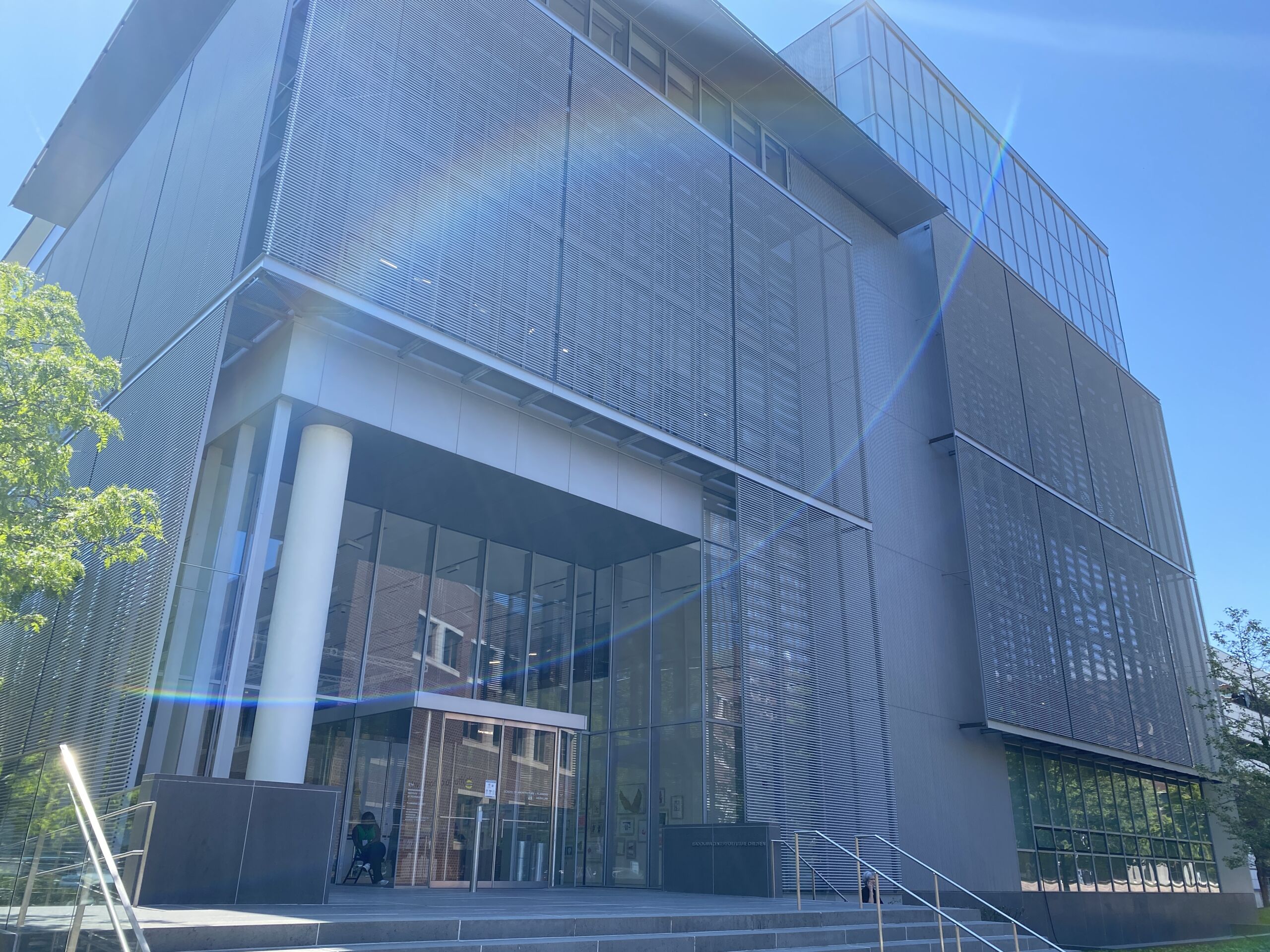
EmTech Digital 2024 took place in building E14 on MIT's Campus in Cambridge, MA.

Enlarge / EmTech Digital 2024 took place in building E14 on MIT’s Campus in Cambridge, MA.

Benj Edwards

The conference kicked off with an overview of the state of AI by Nathan Benaich, founder and general partner of Air Street Capital, who rounded up news headlines about AI and several times expressed a favorable view toward defense spending on AI, making a few people visibly shift in their seats. Next up, Asu Ozdaglar, deputy dean of Academics at MIT’s Schwarzman College of Computing, spoke about the potential for “human flourishing” through AI-human symbiosis and the importance of AI regulation.

Kari Ann Briski, VP of AI Models, Software, and Services at Nvidia, highlighted the exponential growth of AI model complexity. She shared a prediction from consulting firm Gartner research that by 2026, 50 percent of customer service organizations will have customer-facing AI agents. Of course, Nvidia’s job is to drive demand for its chips, so in her presentation, Briski painted the AI space as an unqualified rosy situation, assuming that all LLMs are (and will be) useful and reliable, despite what we know about their tendencies to make things up.

The conference also addressed the legal and policy aspects of AI. Christabel Randolph from the Center for AI and Digital Policy—an organization that spearheaded a complaint about ChatGPT to the FTC last year—gave a compelling presentation about the need for AI systems to be human-centered and aligned, warning about the potential for anthropomorphic models to manipulate human behavior. She emphasized the importance of demanding accountability from those designing and deploying AI systems.

  • Asu Ozdaglar, deputy dean of Academics at MIT’s Schwarzman College of Computing, spoke about the potential for “human flourishing” through AI-human symbiosis at EmTech Digital on May 22, 2024.

    Benj Edwards

  • Asu Ozdaglar, deputy dean of Academics at MIT’s Schwarzman College of Computing spoke with MIT Technology Review Editor-in-Chief Mat Honan at EmTech Digital on May 22, 2024.

    Benj Edwards

  • Kari Ann Briski, VP of AI Models, Software, and Services at NVIDIA, highlighted the exponential growth of AI model complexity at EmTech Digital on May 22, 2024.

    Benj Edwards

  • MIT Technology Review Senior Reporter Melissa Heikkilä introduces a speaker at EmTech Digital on May 22, 2024.

    Benj Edwards

  • After her presentation, Christabel Randolph from the Center for AI and Digital Policy sat with MIT Technology Review Senior Reporter Melissa Heikkilä at EmTech Digital on May 22, 2024.

    Benj Edwards

  • Lawyer Amir Ghavi provided an overview of the current legal landscape surrounding AI at EmTech Digital on May 22, 2024.

    Benj Edwards

  • Lawyer Amir Ghavi provided an overview of the current legal landscape surrounding AI at EmTech Digital on May 22, 2024.

    Benj Edwards

Amir Ghavi, an AI, Tech, Transactions, and IP partner at Fried Frank LLP, who has defended AI companies like Stability AI in court, provided an overview of the current legal landscape surrounding AI, noting that there have been 24 lawsuits related to AI so far in 2024. He predicted that IP lawsuits would eventually diminish, and he claimed that legal scholars believe that using training data constitutes fair use. He also talked about legal precedents with photocopiers and VCRs, which were both technologies demonized by IP holders until courts decided they constituted fair use. He pointed out that the entertainment industry’s loss on the VCR case ended up benefiting it by opening up the VHS and DVD markets, providing a brand new revenue channel that was valuable to those same companies.

In one of the higher-profile discussions, Meta President of Global Affairs Nick Clegg sat down with MIT Technology Review Executive Editor Amy Nordrum to discuss the role of social media in elections and the spread of misinformation, arguing that research suggests social media’s influence on elections is not as significant as many believe. He acknowledged the “whack-a-mole” nature of banning extremist groups on Facebook and emphasized the changes Meta has undergone since 2016, increasing fact-checkers and removing bad actors.

EmTech Digital 2024: A thoughtful look at AI’s pros and cons with minimal hype Read More »

here’s-what’s-really-going-on-inside-an-llm’s-neural-network

Here’s what’s really going on inside an LLM’s neural network

Artificial brain surgery —

Anthropic’s conceptual mapping helps explain why LLMs behave the way they do.

Here’s what’s really going on inside an LLM’s neural network

Aurich Lawson | Getty Images

With most computer programs—even complex ones—you can meticulously trace through the code and memory usage to figure out why that program generates any specific behavior or output. That’s generally not true in the field of generative AI, where the non-interpretable neural networks underlying these models make it hard for even experts to figure out precisely why they often confabulate information, for instance.

Now, new research from Anthropic offers a new window into what’s going on inside the Claude LLM’s “black box.” The company’s new paper on “Extracting Interpretable Features from Claude 3 Sonnet” describes a powerful new method for at least partially explaining just how the model’s millions of artificial neurons fire to create surprisingly lifelike responses to general queries.

Opening the hood

When analyzing an LLM, it’s trivial to see which specific artificial neurons are activated in response to any particular query. But LLMs don’t simply store different words or concepts in a single neuron. Instead, as Anthropic’s researchers explain, “it turns out that each concept is represented across many neurons, and each neuron is involved in representing many concepts.”

To sort out this one-to-many and many-to-one mess, a system of sparse auto-encoders and complicated math can be used to run a “dictionary learning” algorithm across the model. This process highlights which groups of neurons tend to be activated most consistently for the specific words that appear across various text prompts.

The same internal LLM

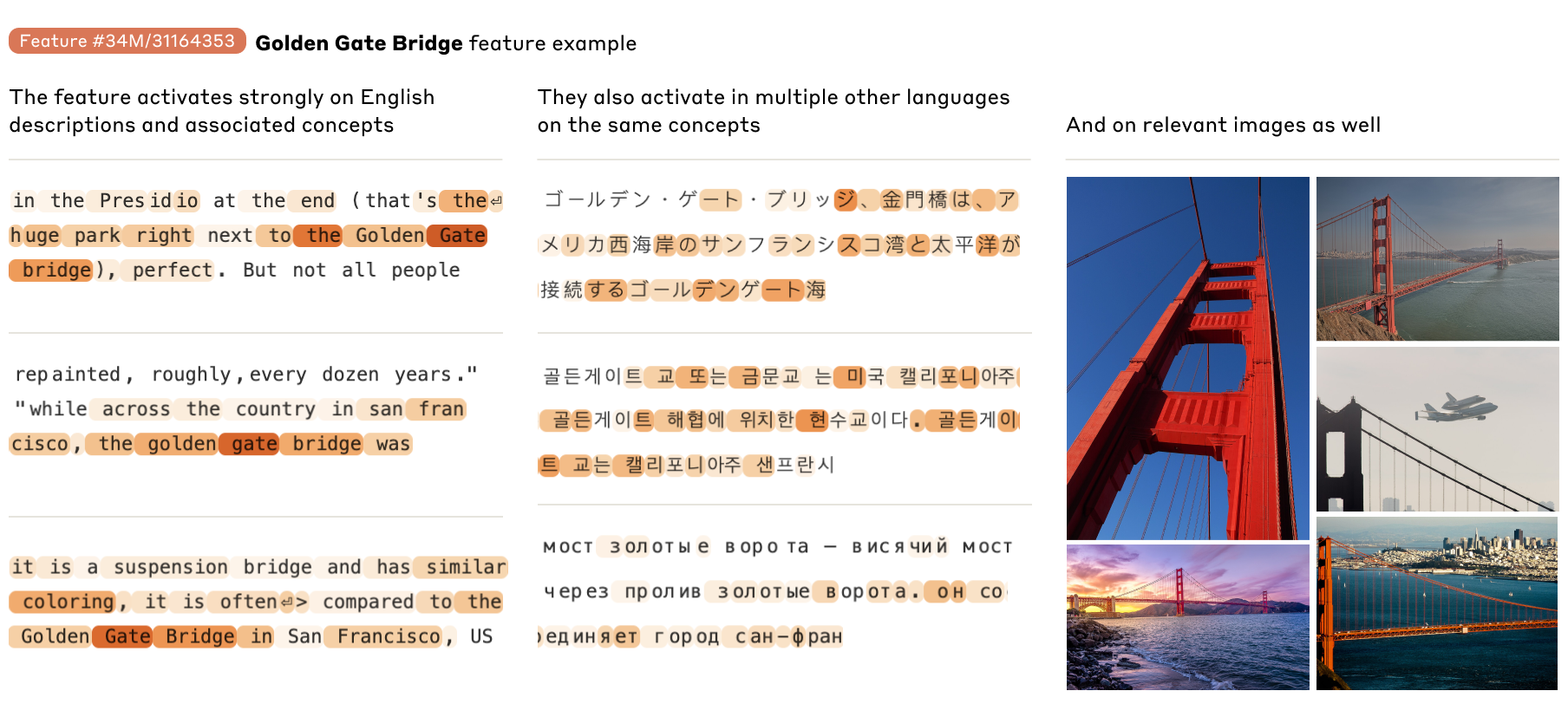
Enlarge / The same internal LLM “feature” describes the Golden Gate Bridge in multiple languages and modes.

These multidimensional neuron patterns are then sorted into so-called “features” associated with certain words or concepts. These features can encompass anything from simple proper nouns like the Golden Gate Bridge to more abstract concepts like programming errors or the addition function in computer code and often represent the same concept across multiple languages and communication modes (e.g., text and images).

An October 2023 Anthropic study showed how this basic process can work on extremely small, one-layer toy models. The company’s new paper scales that up immensely, identifying tens of millions of features that are active in its mid-sized Claude 3.0 Sonnet model. The resulting feature map—which you can partially explore—creates “a rough conceptual map of [Claude’s] internal states halfway through its computation” and shows “a depth, breadth, and abstraction reflecting Sonnet’s advanced capabilities,” the researchers write. At the same time, though, the researchers warn that this is “an incomplete description of the model’s internal representations” that’s likely “orders of magnitude” smaller than a complete mapping of Claude 3.

A simplified map shows some of the concepts that are

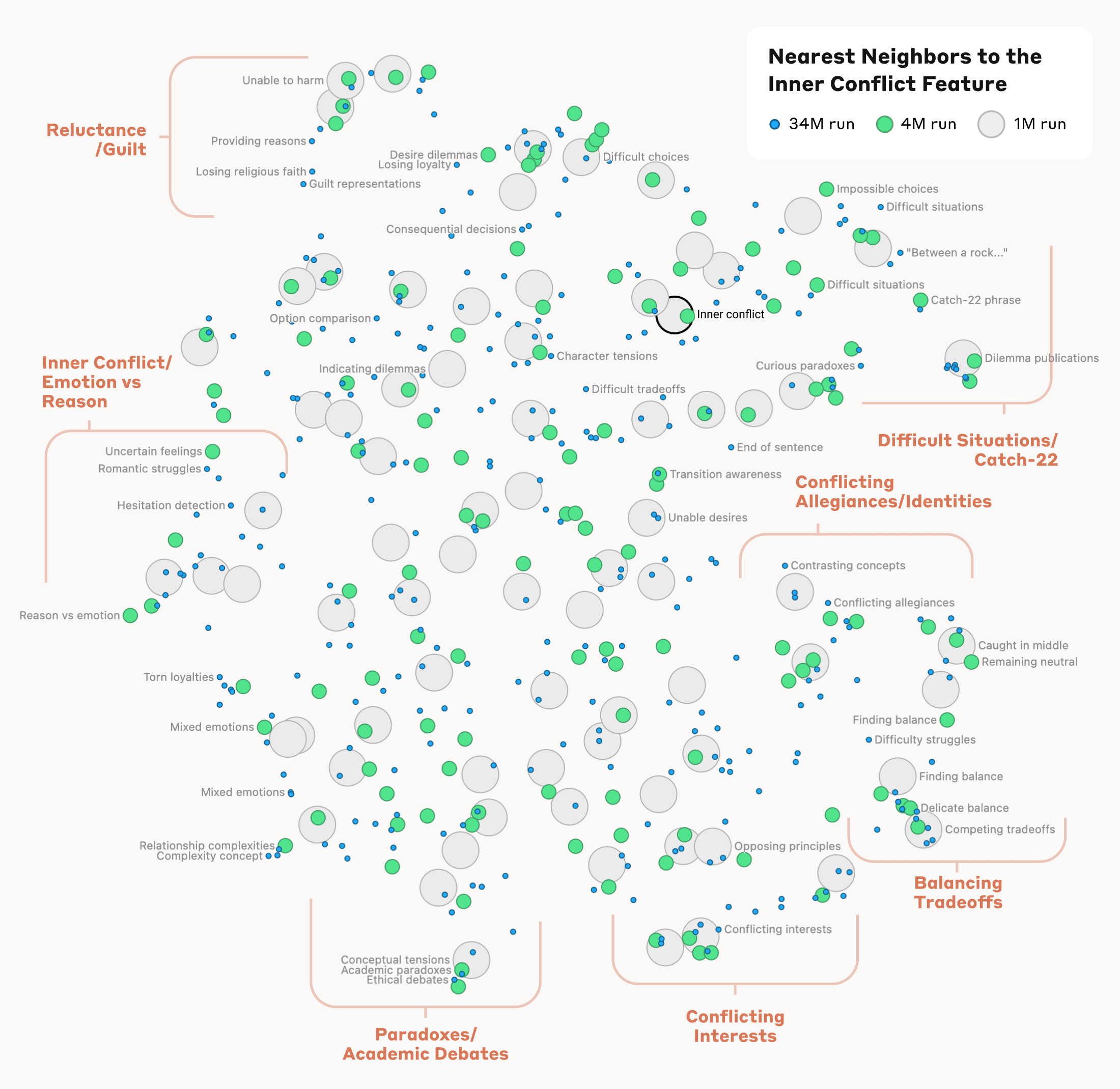
Enlarge / A simplified map shows some of the concepts that are “near” the “inner conflict” feature in Anthropic’s Claude model.

Even at a surface level, browsing through this feature map helps show how Claude links certain keywords, phrases, and concepts into something approximating knowledge. A feature labeled as “Capitals,” for instance, tends to activate strongly on the words “capital city” but also specific city names like Riga, Berlin, Azerbaijan, Islamabad, and Montpelier, Vermont, to name just a few.

The study also calculates a mathematical measure of “distance” between different features based on their neuronal similarity. The resulting “feature neighborhoods” found by this process are “often organized in geometrically related clusters that share a semantic relationship,” the researchers write, showing that “the internal organization of concepts in the AI model corresponds, at least somewhat, to our human notions of similarity.” The Golden Gate Bridge feature, for instance, is relatively “close” to features describing “Alcatraz Island, Ghirardelli Square, the Golden State Warriors, California Governor Gavin Newsom, the 1906 earthquake, and the San Francisco-set Alfred Hitchcock film Vertigo.”

Some of the most important features involved in answering a query about the capital of Kobe Bryant's team's state.

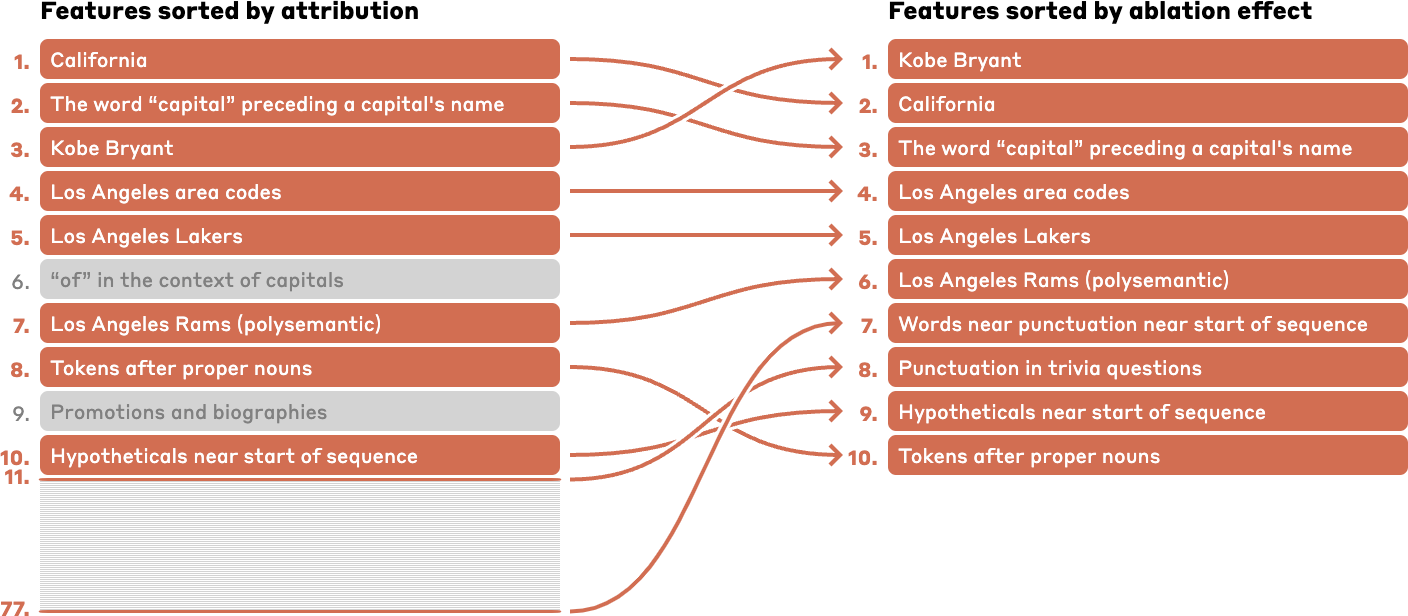
Enlarge / Some of the most important features involved in answering a query about the capital of Kobe Bryant’s team’s state.

Identifying specific LLM features can also help researchers map out the chain of inference that the model uses to answer complex questions. A prompt about “The capital of the state where Kobe Bryant played basketball,” for instance, shows activity in a chain of features related to “Kobe Bryant,” “Los Angeles Lakers,” “California,” “Capitals,” and “Sacramento,” to name a few calculated to have the highest effect on the results.

Here’s what’s really going on inside an LLM’s neural network Read More »

lawmakers-say-section-230-repeal-will-protect-children—opponents-predict-chaos

Lawmakers say Section 230 repeal will protect children—opponents predict chaos

Section 230 repeal bill —

Repeal bill is bipartisan but has opponents from across the political spectrum.

A US lawmaker speaks at a congressional hearing

Enlarge / US Rep. Frank Pallone, Jr. (D-N.J.), right, speaks as House Commerce Committee Chair Cathy McMorris Rodgers (R-Wash.) looks on during a hearing about TikTok on Thursday, March 23, 2023.

Getty Images | Tom Williams

A proposed repeal of Section 230 is designed to punish Big Tech but is also facing opposition from library associations, the Internet Archive, the owner of Wikipedia, and advocacy groups from across the political spectrum who say a repeal is bad for online speech. Opposition poured in before a House hearing today on the bipartisan plan to “sunset” Section 230 of the Communications Decency Act, which gives online platforms immunity from lawsuits over how they moderate user-submitted content.

Lawmakers defended the proposed repeal. House Commerce Committee Ranking Member Frank Pallone, Jr. (D-N.J.) today said that “Section 230 has outlived its usefulness and has played an outsized role in creating today’s ‘profits over people’ Internet” and criticized what he called “Big Tech’s constant scare tactics about reforming Section 230.”

Pallone teamed up with Commerce Committee Chair Cathy McMorris Rodgers (R-Wash.) to propose the Section 230 repeal. The lawmakers haven’t come up with a replacement for the law, a tactic that some critics predict will lead to legislative chaos. A hearing memo said the draft bill “would sunset Section 230 of the Communications Act effective on December 31, 2025,” but claimed the “intent of the legislation is not to have Section 230 actually sunset, but to encourage all technology companies to work with Congress to advance a long-term reform solution to Section 230.”

McMorris Rodgers and Pallone wrote a Wall Street Journal op-ed alleging that “Big Tech companies are exploiting the law to shield them from any responsibility or accountability as their platforms inflict immense harm on Americans, especially children.”

While politicians are focused on Big Tech, one letter sent to lawmakers said the proposal “fails to recognize the indispensable role that Section 230 plays in fostering a diverse and innovative digital landscape across many industries that extends far beyond the realm of only large technology corporations.”

Library and Internet groups defend Section 230

The letter was sent by the American Library Association, the Association of Research Libraries, the Consumer Technology Association, Creative Commons, Educause, Incompas, the Internet Archive, the Internet Infrastructure Coalition, the Internet Society, and the Wikimedia Foundation.

Section 230 is essential for small and medium-sized tech businesses, educational institutions, libraries, ISPs, and many others, the letter said:

By narrowly framing the debate around the interests of “Big Tech,” there is a risk of misunderstanding the far-reaching implications of altering or dismantling Section 230. The heaviest costs and burdens of such action would fall on the millions of stakeholders we represent who, unlike large companies, do not have the resources to navigate a flood of content-based lawsuits. While it may seem that such changes will not “break the Internet,” this perspective overlooks the intricate interplay of legal liability and innovation that underpins the entire digital infrastructure.

Opposition this week also came from the Electronic Frontier Foundation, which said that “Section 230 is essential to protecting individuals’ ability to speak, organize, and create online.”

“The law is not a shield for Big Tech,” the EFF wrote. “Critically, the law benefits the millions of users who don’t have the resources to build and host their own blogs, email services, or social media sites, and instead rely on services to host that speech. Section 230 also benefits thousands of small online services that host speech. Those people are being shut out as the bill sponsors pursue a dangerously misguided policy.”

The EFF said it worries that if Big Tech helps Congress write a Section 230 replacement, the new law won’t “protect and benefit Internet users, as Section 230 does currently.”

Lawmakers say Section 230 repeal will protect children—opponents predict chaos Read More »

a-week-with-the-chevy-blazer-ev-shows-things-to-love—but-also-painful-flaws

A week with the Chevy Blazer EV shows things to love—but also painful flaws

take two —

The decision to drop Apple CarPlay was a mistake.

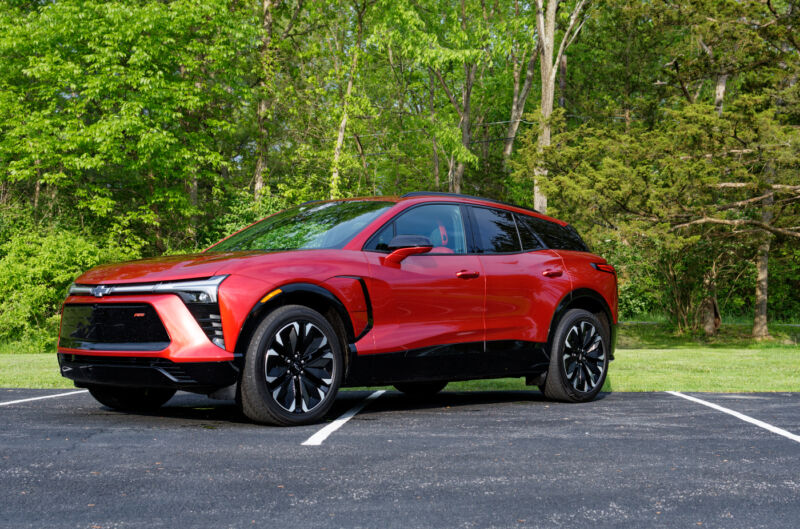
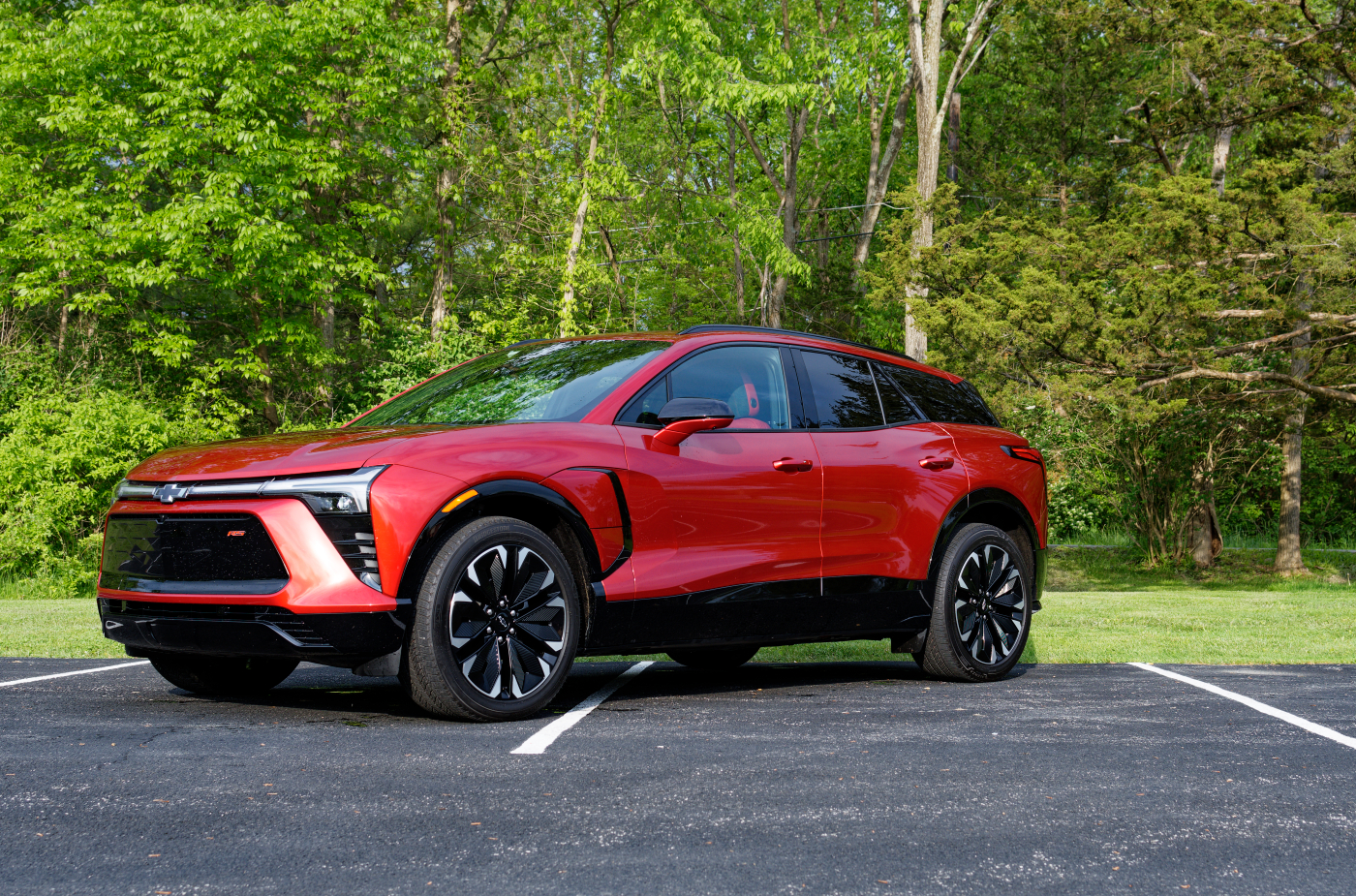
A red Chevrolet Blazer

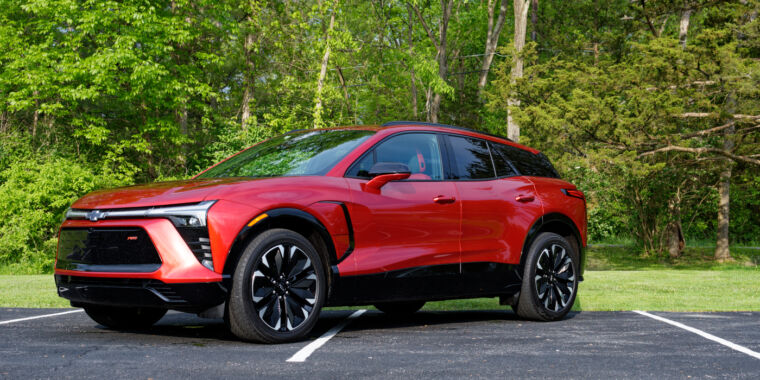
Enlarge / The Chevrolet Blazer was pulled from sale almost immediately after our first drive in December. Now it’s back on sale—with a price cut.

Michael Frank

General Motors appears to have solved the problem that was holding back the production of its Ultium-based electric vehicles. These are now rolling out of factories—you can expect to read about the new Silverado EV tomorrow and the (allegedly affordable) Equinox EV next week, to name but two. We got a first-blush drive of the Blazer this past winter before GM had to put a stop on sales due to some… glitches. Now, with the vehicle back on sale and the software debugged, it’s time to see if the fixes helped.

In reintroducing the Blazer EV and returning it to market, Chevy has also lowered the price pretty significantly, by an average of about $6,000 per model. The LT AWD now starts at $48,800, and there’s a $7,500 incentive for customers who aren’t eligible for the IRS clean vehicle tax credit. The RS AWD, which we tested, has an MSRP of $53,200, but with the delivery charge and GM’s cash on the hood, it came in at $47,095. Both have an 85 kWh battery good for 279 miles (449 km) max range per charge. The longer-range, bigger-battery 102 kWh RS RWD boasts a more impressive 324 miles ( 521 km) per charge and works out to $48,670.

These are pretty competitive prices when you consider the mid-sized EV SUV segment. An obvious comparison: The Ioniq 5 SE AWD costs $49,350 and cannot qualify for the federal tax credit (unless leased), and its range runs shy of the Chevy Blazer RS AWD, too, at 260 miles (418 km) versus the Chevy’s 279.

The Ioniq 5 is a pretty good comparison, too, in terms of being a wagon-ish ride, which is about where the Blazer lands. The Hyundai is too low to think of as an SUV, and ditto the Chevy. Both are very close in terms of interior dimensions, with almost the same hip, shoulder, and legroom front and rear—although if you get the sunroof package on the Blazer, rear seat headroom gets pinched pretty significantly. Our tester didn’t have a sunroof, and six-footers could sit back there without scraping their scalps.

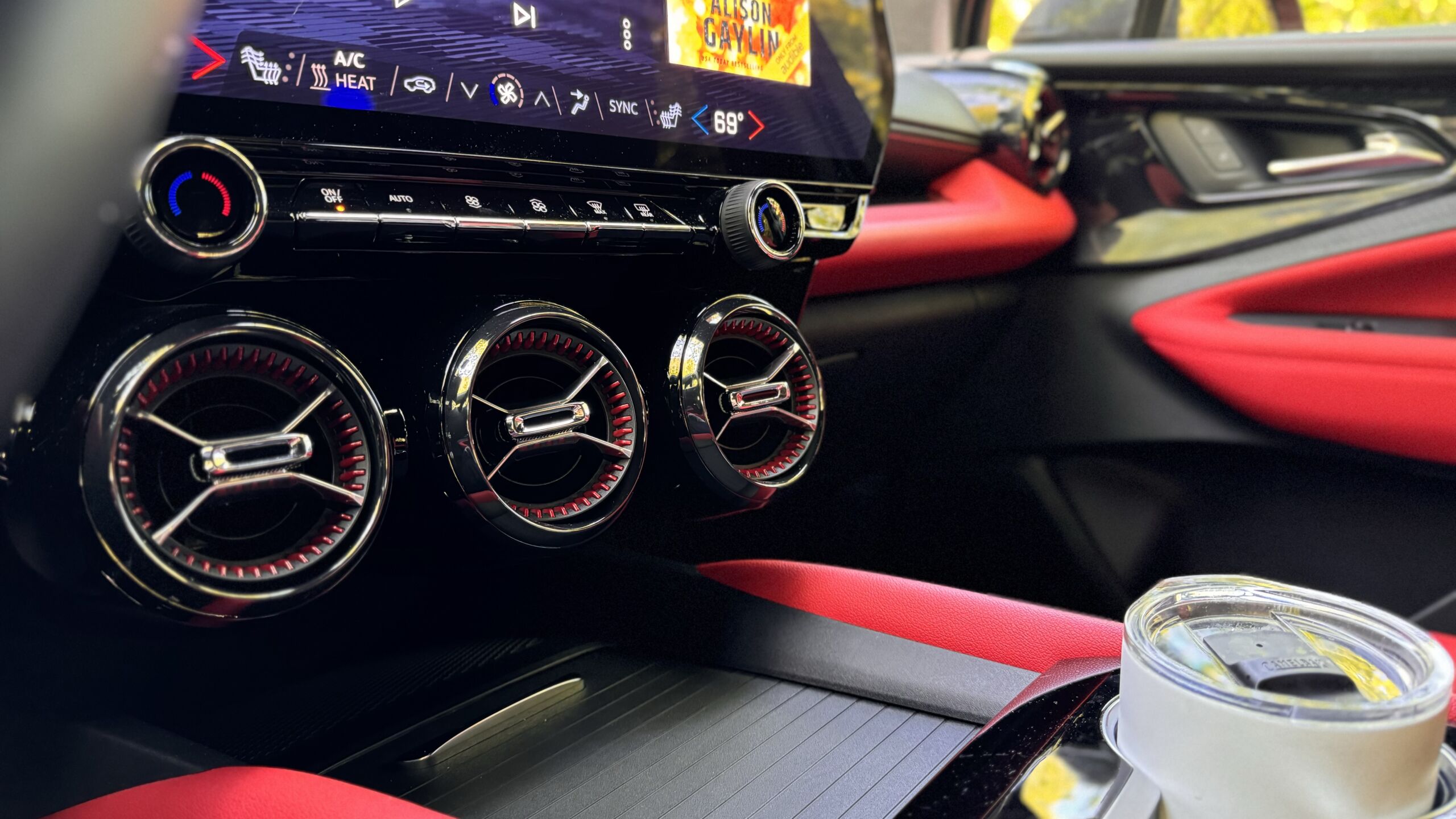
The interior is quite stylized.

Enlarge / The interior is quite stylized.

Michael Frank

The seats in the Blazer EV are surprisingly good. In fact, it was just a darn fine vehicle in terms of driving comfort, in marked contrast to the models we tested in December. Those cars may have suffered from preproduction glitches, but the Blazer EV RS we just spent a week with is comfortable for both fore and aft passengers over long distances, with about the only demerit that the 21-inch wheels feel as big as they are, so there’s a deadness to the steering. Also, if you’re still cross-shopping that Hyundai, the Ioniq 5 is a significantly lighter car, weighing 4,519 lbs (2,050 kg) vs. 5,337 lbs (2,421 kg) for the Blazer RS, and the driver will feel that weight in the form of sluggish transitions through tight corners. The RS stands for “Rally Sport,” via cars like the Camaro, but this isn’t a rig you want to “rally.”

But that’s fine. The Blazer EV is a family car, and as such, it’s pretty great, with 25.5 cubic feet (722 L) of cargo capacity with the rear seatbacks upright, and 59.1 cubic feet (1,673 L) with them flipped forward. The Ioniq 5 offers a couple of cubic feet more cargo volume than the Blazer EV with the rear seats in use, and with the Ioniq 5’s seats folded, it’s basically a wash.

The Chevy Blazer RS AWD EV delivers 288 hp (212 kW) and 333 lb-ft (451 Nm). This feels plenty muscular, if not “blazing,” with 0–60 mph times reported in the six-second range. However, the Ioniq 5 SE’s 320 hp (239 kW) and 446 lb-ft (605 Nm) make that car quite quick indeed, and right on the heels of the other elephant in the family-car throwdown, the Tesla Model Y.

Driving isn’t the issue—the tech is

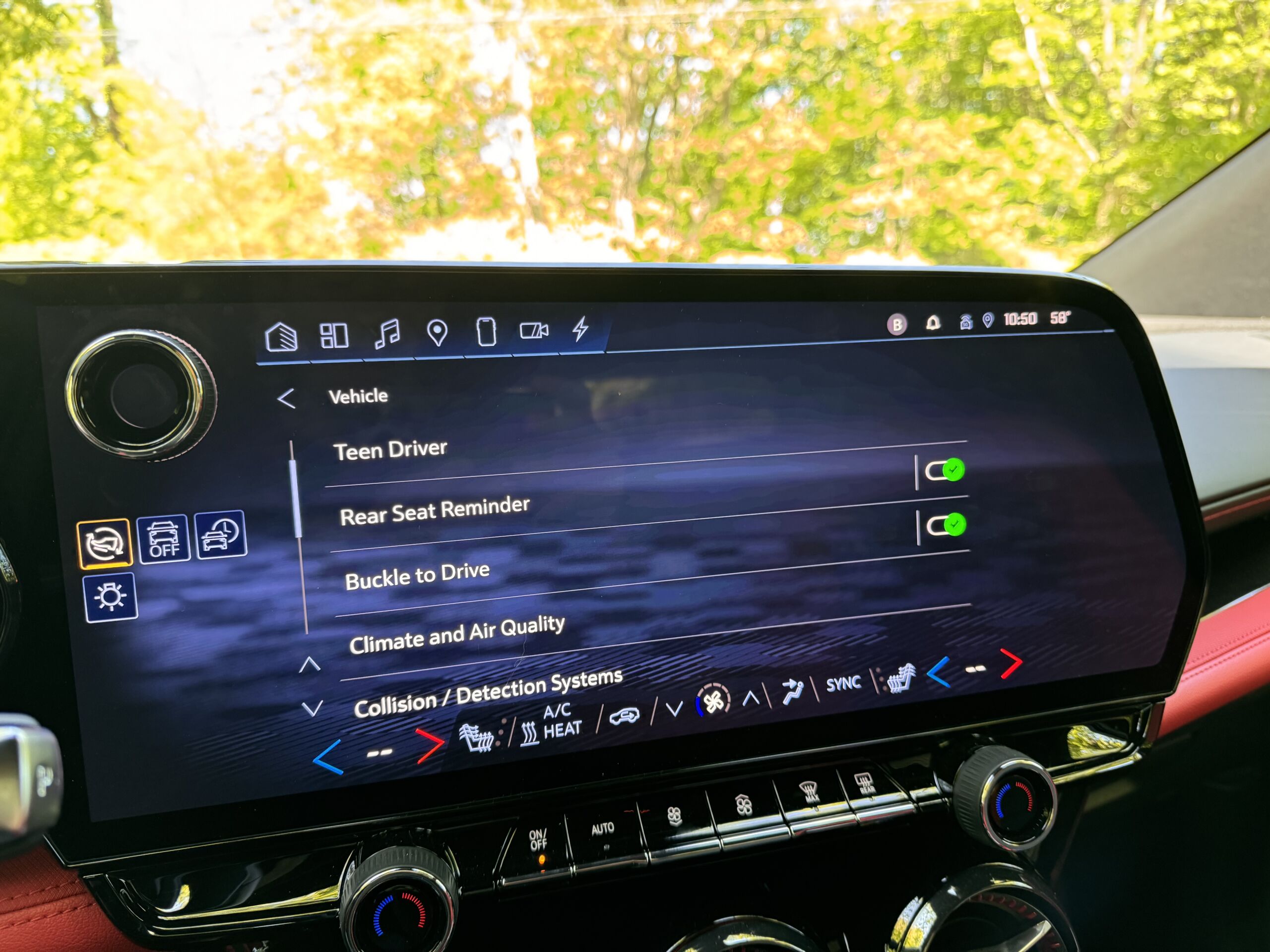
The menu structure here feels illogical.

Enlarge / The menu structure here feels illogical.

Michael Frank

It’s important to mention the Tesla Model Y because that’s another EV that doesn’t bake in Apple CarPlay or Android Auto. Tesla fans tend not to gripe about this, in part because the software in Teslas is very streamlined and pared back. It’s not lovable, but it’s not hard to pair a phone and play what’s on there. By contrast, one reason GM had to yank the cord on sales of the Blazer was that the car’s software was exceedingly glitchy; this wasn’t about GM switching to its proprietary Ultifi UI but that it wasn’t working. For our test drive week, it worked as promised—just not in a way that argues well for eliminating Android Auto or Apple CarPlay.

When GM went to its Ultifi system and ditched Apple CarPlay and Android Auto, the argument was supposedly in part about driver control and using the vehicle’s native UI vs. Apple’s. But if the native UI is worse than Apple’s, you have a problem. And both Android Auto and CarPlay—which are just constrained versions of their phone UIs—have been refined through testing with billions of consumers over hundreds of millions of combined hours of use. No carmaker can make anything like that claim about their in-house UI. Megacorp tech giants are by no means the answer to our prayers, but there is a reason these platforms have gained so much ground as infotainment structures in our cars and homes.

And you can get an “exhibit A” for why that matters when you try to tee up an audio source when driving the Blazer EV.

A week with the Chevy Blazer EV shows things to love—but also painful flaws Read More »

investigation-shows-how-easy-it-is-to-find-escorts,-oxycodone-on-eventbrite

Investigation shows how easy it is to find escorts, oxycodone on Eventbrite

Eventbrite headquarters in downtown San Francisco

This June, approximately 150 motorcycles will thunder down Route 9W in Saugerties, New York, for Ryan’s Ride for Recovery. Organized by Vince Kelder and his family, the barbecue and raffle will raise money to support their sober-living facility and honor their son who tragically died from a heroin overdose in 2015 after a yearslong drug addiction.

The Kelders established Raising Your Awareness about Narcotics (RYAN) to help others struggling with substance-use disorder. For years, the organization has relied on Eventbrite, an event management and ticketing website, to arrange its events. This year, however, alongside listings for Ryan’s Ride and other addiction recovery events, Eventbrite surfaced listings peddling illegal sales of prescription drugs like Xanax, Valium, and oxycodone.

“It’s criminal,” Vince Kelder says. “They’re preying on people trying to get their lives back together.”

Eventbrite prohibits listings dedicated to selling illegal substances on its platform. It’s one of the 16 categories of content the company’s policies restrict its users from posting. But a WIRED investigation found more than 7,400 events published on the platform that appeared to violate one or more of these terms.

Among these listings were pages claiming to sell fentanyl powder “without a prescription,” accounts pushing the sale of Social Security numbers, and pages offering a “wild night with independent escorts” in India. Some linked to sites offering such wares as Gmail accounts, Google reviews (positive and negative), and TikTok and Instagram likes and followers, among other services.

At least 64 of the event listings advertising drugs included links to online pharmacies that the National Association of Boards of Pharmacy have flagged as untrustworthy or unsafe. Amanda Hils, a spokesperson for the US Food and Drug Administration, says the agency does not comment on individual cases without a thorough review, but broadly some online pharmacies that appear to look legitimate may be “operating illegally and selling medicines that can be dangerous or even deadly.”

Eventbrite didn’t just publish these user-generated event listings; its algorithms appeared to actively recommend them to people through simple search queries or in “related events”—a section at the bottom of an event’s page showing users similar events they might be interested in. As well as posts selling illegal prescription drugs in search results appearing next to the RYAN event, a search for “opioid” in the United States showed Eventbrite’s recommendation algorithm suggesting a conference for opioid treatment practitioners between two listings for ordering oxycodone.

Robin Pugh, the executive director of nonprofit cybercrime-fighting organization Intelligence for Good, which first alerted WIRED to some of the listings, says it is quick and easy to identify the illicit posts on Eventbrite and that other websites that allow “user-generated content” are also plagued by scammers uploading posts in similar ways.

Investigation shows how easy it is to find escorts, oxycodone on Eventbrite Read More »

pricey-sonos-ace-headphones-move-the-company-beyond-speakers-for-the-first-time

Pricey Sonos Ace headphones move the company beyond speakers for the first time

ANC —

Sonos jumps into the fray with Sony’s WH-1000XM5 and Apple’s AirPods Max.

  • The new headphones look just like earlier leaks showed.

    Sonos

  • Here’s a marketing render of the headphones, showing the physical buttons.

    Sonos

  • And here’s the other side.

    Sonos

  • A view inside the cups.

    Sonos

  • A side view.

    Sonos

After months of rumors and leaks, audio brand Sonos has announced and revealed its first foray into personal audio with the Sonos Ace, pricey wireless over-ear headphones that compete with the likes of Apple’s AirPods Max and Sony’s popular WH-1000XM5.

The Bluetooth 5.4 headphones were shown to select press outlets in New York this week. It’s too early to judge their sound quality, but they’re priced at the high end, and Sonos has a good reputation on that front.

Each cup has a 40 mm driver, and there are a total of eight microphones for noise control. Notably, the headphones weigh less than Apple’s AirPods Max.

Like competing pairs, they have high-end features like effective active noise cancelling and aware modes, Dolby Atmos spatial audio, and head tracking. The killer feature is for users who are already using Sonos’ other products in their home theaters: you can quickly switch from playing audio on the Sonos Arc soundbar to the headphones and back. That works for any audio from your TV, including set-top boxes or game consoles.

It’s a bit like how Apple’s AirPods Max work with the Apple TV set-top-boxes. Support for other Sonos soundbars like the second-generation beam is coming later this year.

Additionally, the Ace will get a new feature called “TrueCinema” that leverages your Sonos speakers’ ability to create a 3D map of the room in order to simulate the acoustics of your own space when wearing the headphones and using spatial audio, in theory making it sound even more like you’re just listening on a normal in-room surround system. That feature is also coming later in the year, though.

Of course, the timing for this announcement couldn’t be worse for Sonos. The company is currently tangled up in a consumer backlash after it updated its mobile app but left out several features from the previous version, including accessibility options.

The app update was intended primarily to make it easier to get in and out of the app and to do basic tasks like adjust the volume without waiting on screens to load or taking too many steps—and it succeeds at that, which is long overdue. But it doesn’t have all the edge case features its predecessor does, and Sonos is playing damage control with an angry subset of its normally loyal userbase.

For the Ace, the app is needed to do things like adjust EQ and some other special features, but it’s not required for basic listening tasks like adjusting volume or noise cancellation settings. Thankfully, Sonos has opted for physical buttons for those things instead of either touch gestures or an app interface.

The Sonos Ace will release June 5, and it will cost $549.

Listing image by Sonos

Pricey Sonos Ace headphones move the company beyond speakers for the first time Read More »

tesla-shareholder-group-opposes-musk’s-$46b-pay,-slams-board-“dysfunction”

Tesla shareholder group opposes Musk’s $46B pay, slams board “dysfunction”

A photoshopped image of Elon Musk emerging from an enormous pile of money.

Aurich Lawson / Duncan Hull / Getty

A Tesla shareholder group yesterday urged other shareholders to vote against Elon Musk’s $46 billion pay package, saying the Tesla board is dysfunctional and “overly beholden to CEO Musk.” The group’s letter also urged shareholders to vote against the reelection of board members Kimbal Musk and James Murdoch.

“Tesla is suffering from a material governance failure which requires our urgent attention and action,” and its board “is stacked with directors that have close personal ties to CEO Elon Musk,” the letter said. “There are multiple indications that these ties, coupled with excessive director compensation, prevent the level of critical and independent thinking required for effective governance.”

Tesla shareholders approved Elon Musk’s pay package in 2018, but it was nullified by a court ruling in January 2024. After a lawsuit filed by a shareholder, Delaware Court of Chancery Judge Kathaleen McCormick ruled that the pay plan was unfair to Tesla shareholders and must be rescinded.

McCormick wrote that most of Tesla’s board members were beholden to Musk or had compromising conflicts and that Tesla’s board provided false and misleading information to shareholders before the 2018 vote. Musk and the rest of the Tesla board subsequently asked shareholders to approve a transfer of Tesla’s state of incorporation from Delaware to Texas and to reinstate Musk’s pay package. Votes can be submitted before Tesla’s annual meeting on June 13.

The pay package was previously estimated to be worth $56 billion, but the stock options in the plan were more recently valued at $46 billion.

“Tesla has clearly lagged”

From March 2020 to November 2021, Tesla’s share price rose from $28.51 to $409.71. But it “has since fallen to $172.63, a decline of $237.08 or 62 percent from its peak,” the letter opposing the pay package said.

“Over the past three years, and especially over the past year, Tesla has clearly lagged behind its competitors and the broader market. We believe that the distractions caused by Musk’s many projects, particularly his decision to buy Twitter, have played a material role in Tesla’s underperformance,” the letter said.

Tesla’s reputation has been harmed by Musk’s “public fights with regulators, acquisition of Twitter, controversial statements on X, and his legal and personal troubles,” the letter said. The letter was sent by New York City Comptroller Brad Lander and investors including Amalgamated Bank, AkademikerPension, Nordea Asset Management, SOC Investment Group, and United Church Funds.

Musk has taken advantage of lax oversight in order “to use Tesla as a coffer for himself and his other business endeavors,” the letter said. It continued:

In 2022, Musk admitted to using Tesla engineers to work on issues at Twitter (now known as X), and defended the decision by saying that no Tesla Board member had stopped him from using Tesla staff for his other businesses. More recently, Musk has begun poaching top engineers from Tesla’s AI and autonomy team for his new company, xAI, including Ethan Knight, who was computer vision chief at Tesla.

This is on the heels of Musk’s post on X that he is “uncomfortable growing Tesla to be a leader in AI & robotics without having ~25% voting control,” a move widely seen as a threat to push Tesla’s Board to grant him another mega pay package.

The Tesla board “continues to allow Musk to be overcommitted” as he devotes “significant amounts of time to his roles at X, SpaceX, Neuralink, the Boring Company and other companies,” the letter said.

Tesla shareholder group opposes Musk’s $46B pay, slams board “dysfunction” Read More »

after-beating-sonos-case,-google-brings-back-group-speaker-controls

After beating Sonos case, Google brings back group speaker controls

Does Google still care about speakers? —

We’ll likely have to wait until the end of the year for Android 15, though.

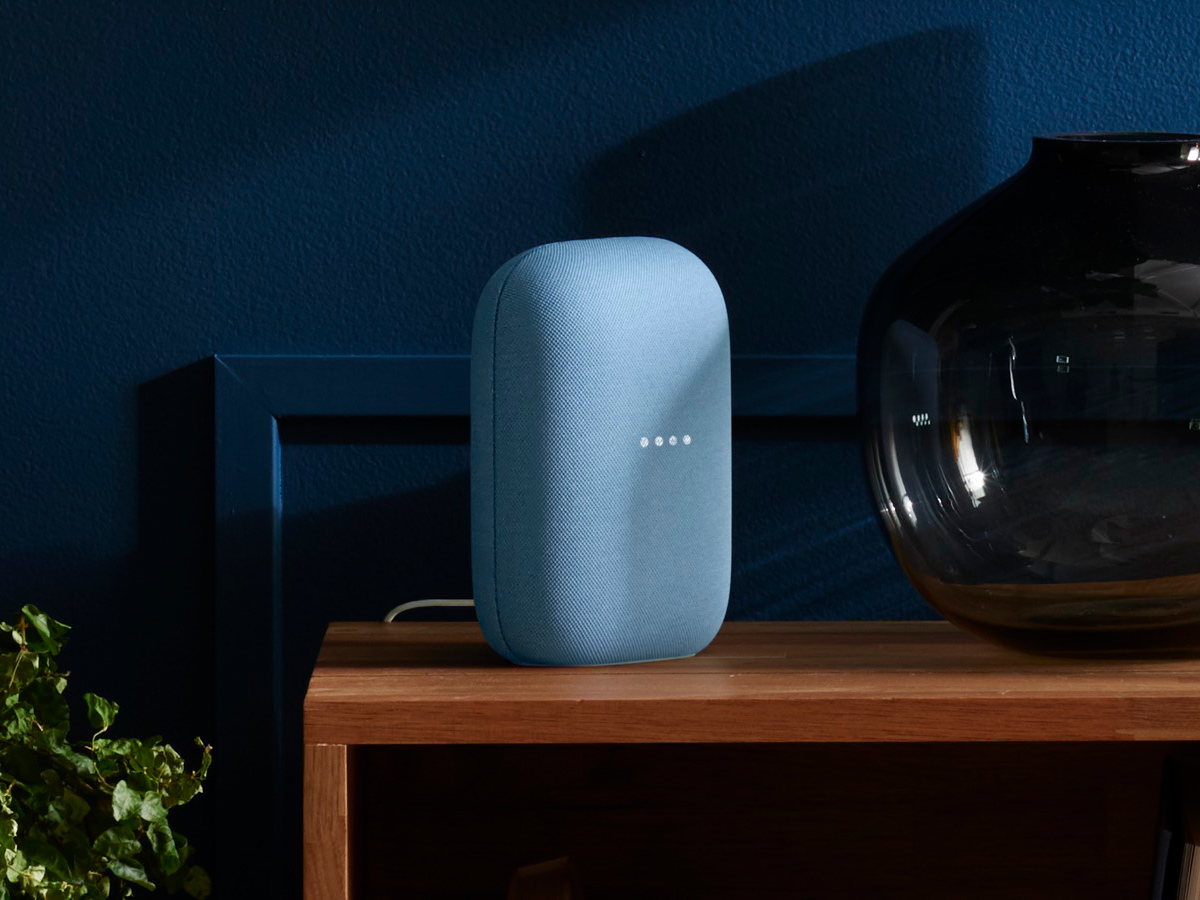
Promotional image of smart speaker.

Enlarge / The Nest Audio.

It’s unclear how much life is left in the 4-year-old Nest Audio or 8-year-old Google Home speakers, but Google is at least bringing back a feature it stripped away from users after losing a legal case. In 2022, Google lost a patent case brought by Sonos, and rather than pay a licensing fee, Google reached into customer homes and removed the ability to control speaker volume as a group. Some of Sonos’ patent wins were thrown out in October 2023, and now Android Authority’s Mishaal Rahman reports that the feature is back in Android 15 Beta 2.

Google’s “group speaker volume” feature is a fairly simple idea. Several Google Home/Nest Audio speakers can work together to seamlessly play music throughout your entire house, using onboard microphones to fix tricky multi-speaker issues like syncing the audio delay. When you’re casting from your phone to a bunch of speakers, it would make sense that you want them all at the same volume instead of one being screaming loud and one being very quiet. While casting, the phone’s volume button would control a unified volume bar for all active speakers. When Google killed the feature, the only option for controlling speaker volume from your phone became opening the app and adjusting a slider for each speaker.

Sonos and Google’s history with connected speakers has been a contentious one. Sonos’ side of the story is that Google got an inside look at its operations in 2013 as part of a sales pitch to bring Google Play Music support to Sonos speakers. Three years later, Google launched its first smart speaker. Sonos claims Google used that access to “blatantly and knowingly” copy Sonos’ features for the Google Home speaker line. Google says it developed its smart speaker features independently of Sonos, and for some of Sonos’ patents, it had the features shipped to consumers years before Sonos filed for a patent. Some of Sonos’ patents were overturned because they were filed in 2019, after everyone had already released all of this smart speaker stuff to market.

After Google’s October 2023 victory, the company promised users would “once again be able to seamlessly group and integrate Google smart speakers.” Android 15’s typical release date would mean Google takes a full year to make good on that promise, but at least it now seems like the feature will be back at some point soon.

After beating Sonos case, Google brings back group speaker controls Read More »

$899-mini-pc-puts-snapdragon-x-elite-into-a-mini-desktop-for-developers

$899 mini PC puts Snapdragon X Elite into a mini desktop for developers

developers developers developers —

Well-specced box includes the best Snapdragon X Elite, 32GB RAM, 512GB SSD.

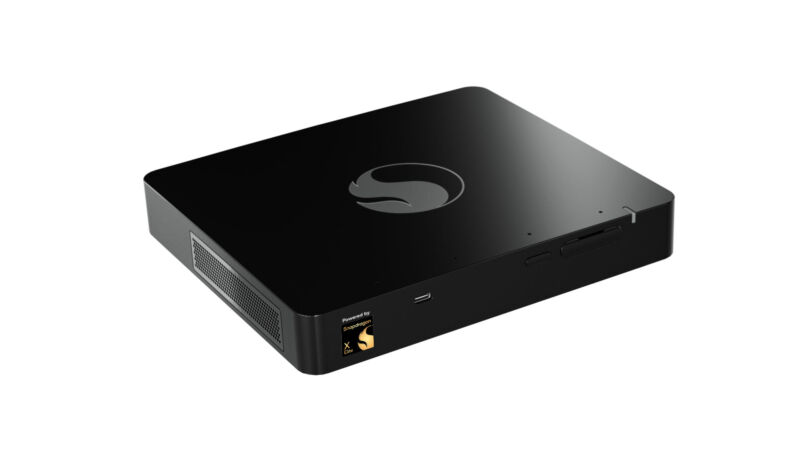
The Qualcomm Snapdragon Dev Kit for Windows fits a Snapdragon X Elite and 32GB of RAM into an $899 mini desktop.

Enlarge / The Qualcomm Snapdragon Dev Kit for Windows fits a Snapdragon X Elite and 32GB of RAM into an $899 mini desktop.

Qualcomm

Microsoft and Qualcomm are both making a concerted effort to make Windows-on-Arm happen after years of slow progress and false starts. One thing the companies have done to get software developers on board is to offer mini PC developer kits, which can be connected to a software developer’s normal multi-monitor setup and doesn’t require the same cash outlay as an equivalently specced Surface tablet or laptop.

Qualcomm has announced the Snapdragon Dev Kit for Windows, a small black plastic mini PC with the same internal hardware as the new wave of Copilot+ PCs with Snapdragon X Plus and Snapdragon X Elite processors in them. The box is fairly generously specced, with a slightly faster-than-normal version of the Snapdragon X Elite that can boost up to 4.3 GHz, 32GB of RAM, and a 512GB NVMe SSD.

Unlike the Windows Dev Kit 2023, which appeared to be a repurposed Surface Pro 9 motherboard thrown into a black plastic box, the Snapdragon Dev Kit appears to be purpose-built. It has a single USB-C port on the front and two USB-C ports, an HDMI port, two USB-A ports, a headphone/speaker jack, and an Ethernet port in the back. This isn’t an overwhelming complement of ports, but it’s in line with what Apple offers in the Mac mini.

Perhaps most importantly for developers hoping to play with Microsoft’s new wave of AI-accelerated features and development tools, the Snapdragon Dev Kit includes the same NPU as all the Copilot+ devices announced yesterday. Qualcomm says the NPU is capable of 45 trillion operations per second (TOPS), a bit above the 40 TOPS that Microsoft has defined as the floor for Copilot+ PCs; this requirement means that no current-generation Intel and AMD laptops and desktops qualify for the label. x86 processors with more capable NPUs should arrive sometime this fall.

The back of the box has two more USB-C ports, plus USB-A, HDMI, Ethernet, and audio. There's a dedicated power jack, so you probably won't be able to power this from a USB-C charger or monitor.

Enlarge / The back of the box has two more USB-C ports, plus USB-A, HDMI, Ethernet, and audio. There’s a dedicated power jack, so you probably won’t be able to power this from a USB-C charger or monitor.

Qualcomm

The bad news is that this kit will run you $899, $300 more than the Windows Dev Kit 2023 (which was released in 2022). It’s also $680 more than the old Snapdragon 7c-based ECS LIVA QC710, the first Arm developer box that Microsoft offered. Though that model was dramatically under-specced, it does seem like there’s room to offer a cheaper box (maybe with a Snapdragon X Plus and 16GB of RAM) to developers or users who still want to experiment with a Copilot+-capable system but don’t want to drop nearly $1,000 on a desktop.

Given that a Surface Laptop with a Snapdragon X Elite chip and 32GB of RAM will run you at least $2,000, the Snapdragon Dev Kit is still a better deal if you plan to use it primarily as a testbed or a general-purpose desktop. You can sign up to preorder the box now, and it begins shipping on June 18.

$899 mini PC puts Snapdragon X Elite into a mini desktop for developers Read More »

“csam-generated-by-ai-is-still-csam,”-doj-says-after-rare-arrest

“CSAM generated by AI is still CSAM,” DOJ says after rare arrest

“CSAM generated by AI is still CSAM,” DOJ says after rare arrest

The US Department of Justice has started cracking down on the use of AI image generators to produce child sexual abuse materials (CSAM).

On Monday, the DOJ arrested Steven Anderegg, a 42-year-old “extremely technologically savvy” Wisconsin man who allegedly used Stable Diffusion to create “thousands of realistic images of prepubescent minors,” which were then distributed on Instagram and Telegram.

The cops were tipped off to Anderegg’s alleged activities after Instagram flagged direct messages that were sent on Anderegg’s Instagram account to a 15-year-old boy. Instagram reported the messages to the National Center for Missing and Exploited Children (NCMEC), which subsequently alerted law enforcement.

During the Instagram exchange, the DOJ found that Anderegg sent sexually explicit AI images of minors soon after the teen made his age known, alleging that “the only reasonable explanation for sending these images was to sexually entice the child.”

According to the DOJ’s indictment, Anderegg is a software engineer with “professional experience working with AI.” Because of his “special skill” in generative AI (GenAI), he was allegedly able to generate the CSAM using a version of Stable Diffusion, “along with a graphical user interface and special add-ons created by other Stable Diffusion users that specialized in producing genitalia.”

After Instagram reported Anderegg’s messages to the minor, cops seized Anderegg’s laptop and found “over 13,000 GenAI images, with hundreds—if not thousands—of these images depicting nude or semi-clothed prepubescent minors lasciviously displaying or touching their genitals” or “engaging in sexual intercourse with men.”

In his messages to the teen, Anderegg seemingly “boasted” about his skill in generating CSAM, the indictment said. The DOJ alleged that evidence from his laptop showed that Anderegg “used extremely specific and explicit prompts to create these images,” including “specific ‘negative’ prompts—that is, prompts that direct the GenAI model on what not to include in generated content—to avoid creating images that depict adults.” These go-to prompts were stored on his computer, the DOJ alleged.

Anderegg is currently in federal custody and has been charged with production, distribution, and possession of AI-generated CSAM, as well as “transferring obscene material to a minor under the age of 16,” the indictment said.

Because the DOJ suspected that Anderegg intended to use the AI-generated CSAM to groom a minor, the DOJ is arguing that there are “no conditions of release” that could prevent him from posing a “significant danger” to his community while the court mulls his case. The DOJ warned the court that it’s highly likely that any future contact with minors could go unnoticed, as Anderegg is seemingly tech-savvy enough to hide any future attempts to send minors AI-generated CSAM.

“He studied computer science and has decades of experience in software engineering,” the indictment said. “While computer monitoring may address the danger posed by less sophisticated offenders, the defendant’s background provides ample reason to conclude that he could sidestep such restrictions if he decided to. And if he did, any reoffending conduct would likely go undetected.”

If convicted of all four counts, he could face “a total statutory maximum penalty of 70 years in prison and a mandatory minimum of five years in prison,” the DOJ said. Partly because of “special skill in GenAI,” the DOJ—which described its evidence against Anderegg as “strong”—suggested that they may recommend a sentencing range “as high as life imprisonment.”

Announcing Anderegg’s arrest, Deputy Attorney General Lisa Monaco made it clear that creating AI-generated CSAM is illegal in the US.

“Technology may change, but our commitment to protecting children will not,” Monaco said. “The Justice Department will aggressively pursue those who produce and distribute child sexual abuse material—or CSAM—no matter how that material was created. Put simply, CSAM generated by AI is still CSAM, and we will hold accountable those who exploit AI to create obscene, abusive, and increasingly photorealistic images of children.”

“CSAM generated by AI is still CSAM,” DOJ says after rare arrest Read More »

blue-origin-resumes-human-flights-to-suborbital-space,-but-it-wasn’t-perfect

Blue Origin resumes human flights to suborbital space, but it wasn’t perfect

“I lied” —

Blue Origin’s space capsule safely landed despite a problem with one of its parachutes.

Ed Dwight, 90, exits Blue Origin's crew capsule Sunday after a 10-minute flight to the edge of space.

Enlarge / Ed Dwight, 90, exits Blue Origin’s crew capsule Sunday after a 10-minute flight to the edge of space.

More than 60 years after he was denied an opportunity to become America’s first Black astronaut, Ed Dwight finally traveled into space Sunday with five other passengers on a 10-minute flight inside a Blue Origin capsule.

Dwight, a retired Air Force captain and test pilot, had a chance to become the first African American astronaut. He was one of 26 pilots the Air Force recommended to NASA for the third class of astronauts in 1963, but the agency didn’t select him. It took another 20 years for America’s first Black astronaut, Guion Bluford, to fly in space in 1983.

“Everything they did, I did, and I did it well,” Dwight said in a video released by Blue Origin. “If politics had changed, I would have gone to space in some kind of capacity.”

At the age of 90, Dwight finally entered the record books Sunday, becoming the oldest person to reach space, displacing the previous record-holder, actor William Shatner, who flew on a similar Blue Origin launch to the edge of space in 2021.

“I thought I didn’t need it in my life,” Dwight said after Sunday’s fight. “But I lied!”

Since retiring from the Air Force, Dwight became an accomplished sculptor. His works, which focus on Black history, are installed at memorials and monuments across the country.

“The transitions, the separations and stuff were a little bit more dynamic than I thought,” Dwight said in remarks after Sunday’s flight. “But that’s how it’s supposed to be. It makes your mind wonder, ‘Is something wrong?’ But no, it was absolutely terrific and the view … absolutely fantastic. This was a life-changing experience. Everybody needs to do this.”

Ed Dwight stands in front of an F-104 jet fighter in 1963.

Enlarge / Ed Dwight stands in front of an F-104 jet fighter in 1963.

Dwight and his five co-passengers lifted off from Blue Origin’s remote launch site in West Texas at 9: 35 am CDT (14: 35 UTC). Strapped into reclining seats inside a pressurized capsule, the passengers rode Blue Origin’s New Shepard rocket into the uppermost layers of the atmosphere. After burning its main engine more than two minutes, the rocket released the crew capsule and continued coasting upward to an apogee, or high point, of nearly 66 miles (107 kilometers), just above the internationally recognized boundary of space.

This was the seventh time Blue Origin, the space company owned by billionaire Jeff Bezos, has flown people to suborbital space, and the 25th flight overall of the company’s fleet of New Shepard rockets. It was the first time Blue Origin has launched people in nearly two years, resuming suborbital service after a rocket failure on an uncrewed research flight in September 2022. In December, Blue Origin launched another uncrewed suborbital research mission to set the stage for the resumption of human missions Sunday.

Joining Dwight on Blue Origin’s capsule were investor Mason Angel, French businessman Sylvain Chiron, software engineer Kenneth Hess, adventurer Carol Schaller, and Gopi Thotakura, an Indian pilot and entrepreneur. Dwight’s ticket with Blue Origin was sponsored by Space for Humanity, a nonprofit that seeks to expand access to space for all people, and the other five participants were paying passengers.

After cutoff of the New Shepard rocket engine, the passengers had a few minutes to unfasten their seatbelts and float around the cabin while taking in the view of Earth. They returned to their seats as the capsule descended back into the atmosphere. The reusable New Shepard booster reignited its main engine for a propulsive landing back in Texas, while the crew capsule deployed parachutes to slow for touchdown a few miles away.

Two of three

However, one of the three main parachutes did not fully unfurl as the capsule drifted back to the ground. The capsule is designed to safely land with two chutes, a capability Blue Origin demonstrated on a test flight in 2016.

“It looks like we do have two parachutes that have full inflation, the third is not quite fully inflated,” said Ariane Cornell, a Blue Origin official hosting the company’s live webcast Sunday. “Landing with two parachutes is perfectly OK for this system.”

Family members and Blue Origin personnel greeted the passengers as they exited the capsule. All six appeared to be in good spirits and good health.

Although it had no obvious ill effects on the crew or the spacecraft, Blue Origin engineers will investigate the malfunction to determine what went wrong. The capsule’s three main parachutes were supplied to Blue Origin by Airborne Systems, which manufactures parachutes for every US human-rated spacecraft.

One of the three main parachutes on Blue Origin's crew capsule did not fully inflate before landing.

Enlarge / One of the three main parachutes on Blue Origin’s crew capsule did not fully inflate before landing.

Blue Origin

Airborne also provides parachutes for SpaceX’s Dragon spacecraft, Boeing’s Starliner, and NASA’s Orion capsule. Those parachutes have different designs and sizes than the chutes used on Blue Origin’s capsule, but it wasn’t immediately clear if there might be any crossover concerns on other programs stemming from the malfunction on Sunday’s flight.

The Federal Aviation Administration, the regulatory agency that oversees US commercial space missions, said in a statement it did not consider the parachute issue a mishap. This statement suggests the incident will not trigger a mishap investigation that would require FAA oversight.

Before the 2022 launch failure, Blue Origin’s New Shepard program achieved a cadence, on average, of roughly one flight every two months. Virgin Galactic, the space tourism company founded by Richard Branson, ramped up the flight rate of its suborbital SpaceShipTwo spaceplane over the last year as Blue Origin’s rocket remained grounded.

But Virgin Galactic is about to halt operations of its own spaceship following one more flight with passengers next month. The company says it decided to suspend flights of the VSS Unity rocket plane to focus its resources on developing a fleet of larger air-launched spaceships that are easier to reuse.

This means Blue Origin, assuming it can regain or build on the cadence it demonstrated in 2021 and 2022, will be the only company serving the suborbital space tourism and research market for at least the next couple of years.

Blue Origin resumes human flights to suborbital space, but it wasn’t perfect Read More »

the-atlantic-hurricane-season-begins-soon—hold-on-to-your-butts

The Atlantic hurricane season begins soon—hold on to your butts

Batten down the hatches —

One reputable forecast team predicts 33 named storms.

Hurricane Dorian's satellite appearance on a Sunday morning in 2019.

Enlarge / Hurricane Dorian’s satellite appearance on a Sunday morning in 2019.

NOAA

Later this week, the US federal agency charged with weather forecasting will release its outlook for the 2024 Atlantic hurricane season at a news conference in Washington, DC. But we already know what the National Oceanic and Atmospheric Administration (NOAA) forecast will say: This year will likely be extremely active in the Atlantic Ocean, Gulf of Mexico, and Caribbean Sea.

The Atlantic season formally begins on June 1, and based on current trends, the first named storm may not develop until the middle of the month or later. But make no mistake—when the light switches on later this summer, the season is likely to be a blockbuster.

Why? Because the oceans are screaming at us.

In the Pacific Ocean, there is an increasingly high likelihood of a La Niña developing during the critical months of August, September, and October, when the Atlantic season peaks. This has a couple of effects in the Atlantic. First, through a combination of weaker trade winds and westerlies over the tropical Atlantic, La Niña tends to create a more placid atmosphere. This leads to less wind shear, which is favorable for the development and strengthening of tropical storms and hurricanes.

Secondly, there is a growing amount of data to support the idea that Atlantic storms tend to recurve into the open ocean less during La Niña years, with fewer systems becoming “fish storms” that do not interact with landmasses. Rather, a stronger high-pressure system such as the Bermuda High steers such storms westward into the Caribbean Sea or Gulf of Mexico—and potentially toward the United States.

Another signal from the oceans is the extremely warm temperatures in the tropical Atlantic right now. Due at least in part to climate change, the ocean is anomalously warm, with seas closer to August “normals” than what is to be expected in late May.

So, if you put together sizzling seas and low wind shear, you get a recipe for lots of hurricane activity.

Blockbuster forecasts

We’ve already seen this in seasonal forecasts from other outfits. The venerable forecast team at Colorado State University, led by Phil Klotzbach, has predicted an “extremely active” 2024 season with 23 named storms and 11 hurricanes. Each of these values is about 60 percent higher than a typical season.

One of the pre-season forecasts that most caught my attention came from the University of Pennsylvania, led by scientists Michael Mann, Shannon Christiansen, and Michael Kozar. They predict an astounding 33 named storms in the tropical Atlantic this year. This would eclipse the previous record of 30 named storms, set in 2020.

It might be easy to dismiss the Pennsylvania forecast. In some corners of the Internet, Mann is viewed as a master of climate doomerism for his outspoken views on the perils of a warming world. But if anything, since its first issuance in 2007, Mann’s forecast has proven to be conservative. In 2020, for example, the team predicted 20 named storms. So it’s a sobering outlook.

If you prefer a purely numerical prediction, the European Centre for Medium-Range Weather Forecasts—which produces the most reliable computational weather forecasts in the world—has been issuing seasonal hurricane outlooks for three decades.

European model seasonal forecast for Atlantic tropical activity over time.

Enlarge / European model seasonal forecast for Atlantic tropical activity over time.

ECMWF

As the center’s time series indicates, the seasonal forecast is far from perfect. (Most hurricane season forecasting, it must be said, is part art and part science.) But it is one of the best forecasts available, and for 2024, it made its highest prediction ever. The European model calls for an “accumulated cyclone energy” forecast twice as high as a normal year. This means that the duration and intensity of tropical activity are expected to double that of a typical season.

As always, a busy hurricane season does not guarantee that any part of the United States, Mexico, Central America, or the Caribbean Islands will get hit. Rather, it simply loads the dice, increasing the odds of a strike during a season. As a coastal resident, I don’t particularly like those odds.

The Atlantic hurricane season begins soon—hold on to your butts Read More »