Enlarge/ A screenshot of Taylor Swift’s Kamala Harris Instagram post, captured on September 11, 2024.
On Tuesday night, Taylor Swift endorsed Vice President Kamala Harris for US President on Instagram, citing concerns over AI-generated deepfakes as a key motivator. The artist’s warning aligns with current trends in technology, especially in an era where AI synthesis models can easily create convincing fake images and videos.
“Recently I was made aware that AI of ‘me’ falsely endorsing Donald Trump’s presidential run was posted to his site,” she wrote in her Instagram post. “It really conjured up my fears around AI, and the dangers of spreading misinformation. It brought me to the conclusion that I need to be very transparent about my actual plans for this election as a voter. The simplest way to combat misinformation is with the truth.”
In August 2024, former President Donald Trump posted AI-generated images on Truth Social falsely suggesting Swift endorsed him, including a manipulated photo depicting Swift as Uncle Sam with text promoting Trump. The incident sparked Swift’s fears about the spread of misinformation through AI.
This isn’t the first time Swift and generative AI have appeared together in the news. In February, we reported that a flood of explicit AI-generated images of Swift originated from a 4chan message board where users took part in daily challenges to bypass AI image generator filters.
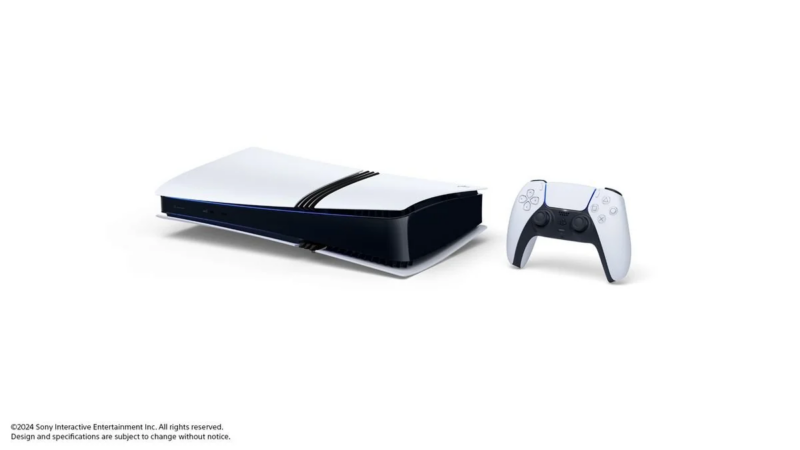
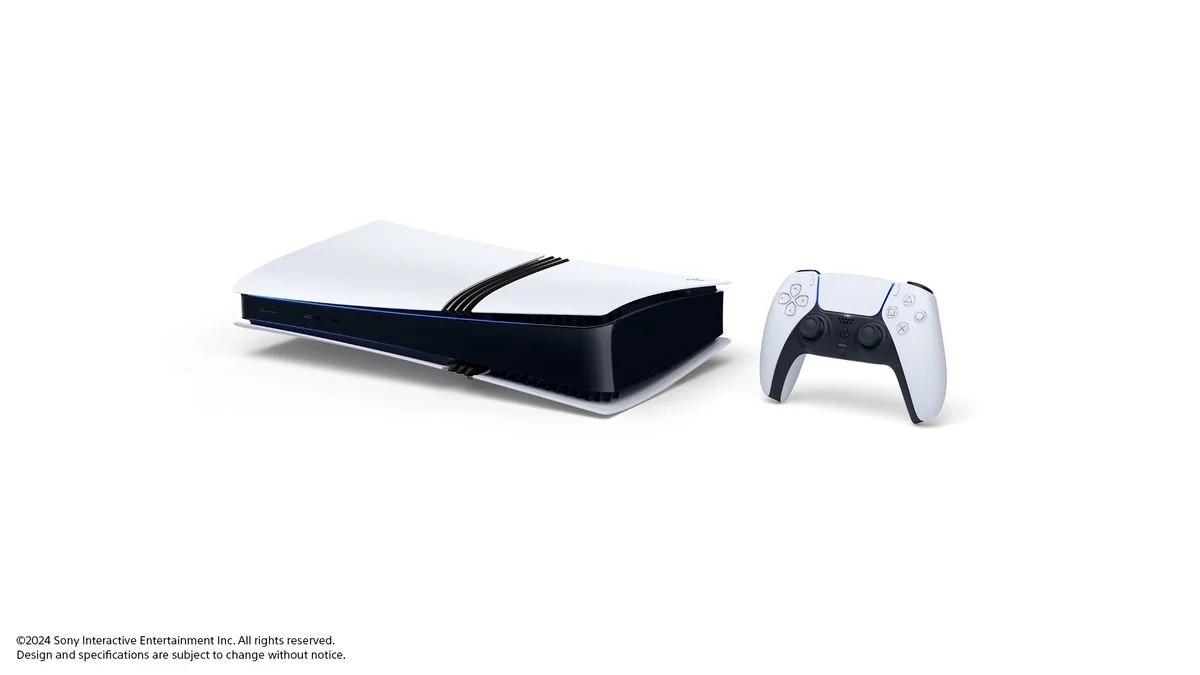
Enlarge/ Notice anything missing from the one and only model of the PS5 Pro?
Sony
Here at Ars, we’ve been publicly musing about whether the world was ready for a disc-free game console since as far back as 2015. Now, though, the better question might be whether the world ever needs a new game console with a built-in disc drive at all.
Yesterday’s announcement of the PlayStation 5 Pro seemed to treat the existence of disc-based games as an afterthought. You had to be watching pretty closely during Mark Cerny’s “technical presentation” video to notice that the coming PS5 Pro is only available in a single disc-drive-free model. And you’d have to read pretty deep into the official PlayStation blog post on the subject to discover that “PS5 Pro is available as a disc-less console, with the option to purchase the currently available Disc Drive for PS5 separately.”
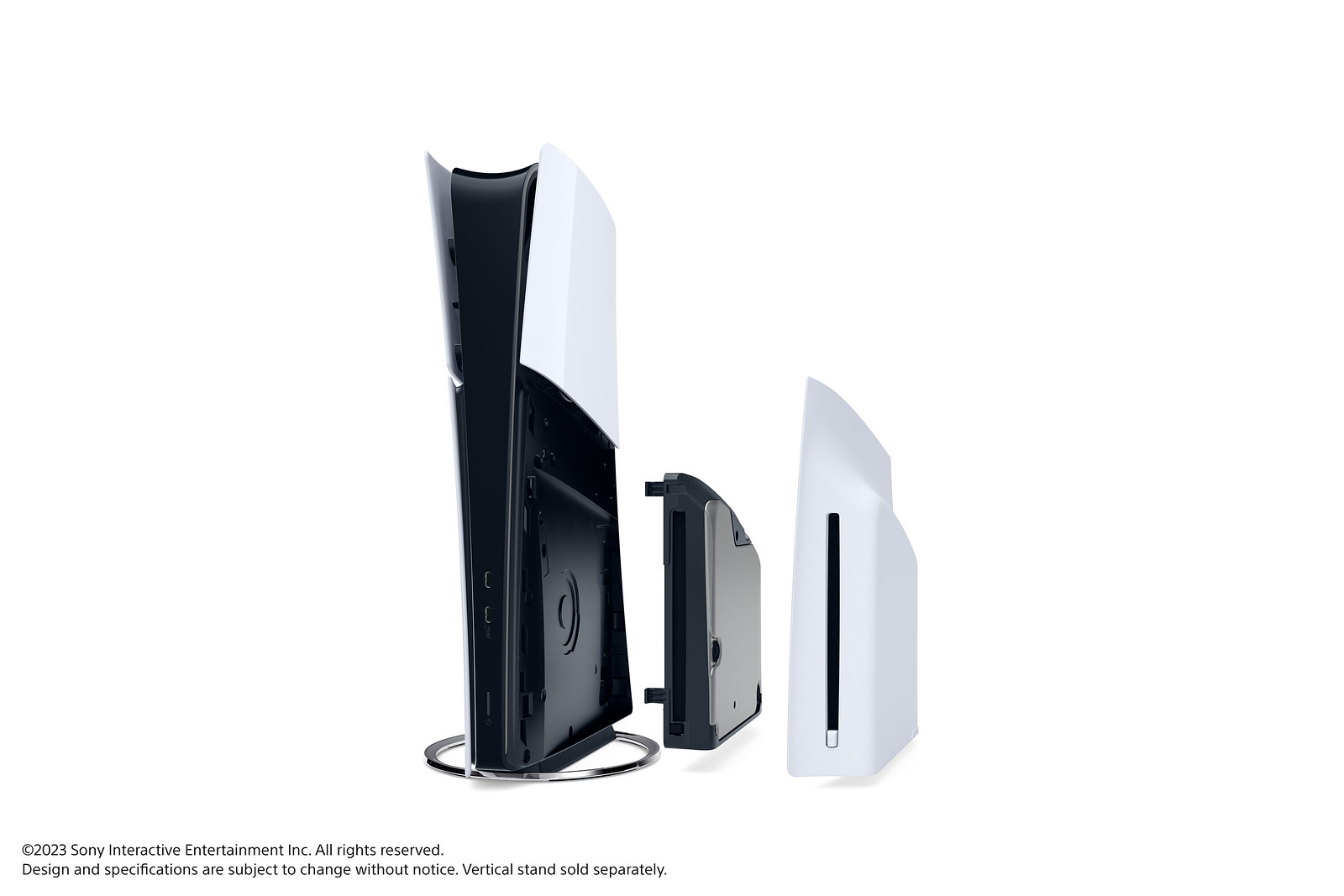
Want to let your Digital Edition PS5 Slim (or PS5 Pro) play physical games? An $80 snap-on disc drive can help with that.
On Microsoft’s side, things seem to be trending away from console disc drives as well. The new Xbox models the company is releasing this holiday season include the first “all-digital” edition of its top-end Xbox Series X, available for about $50 less than the standard edition. Microsoft is also introducing a new “Galaxy Black” Xbox Series X model with a disc drive this holiday season, but it will only be available “in limited quantities,” Microsoft said.
It’s hard to read too much of the disc-free console hardware trend for the moment. The original editions of the PS5 and Xbox Series X still exist with disc drives, of course. And on Sony’s side, that optional disc drive attachment exists as an important release valve for any PS5 Pro customers who want to pay more to enjoy games on discs.
But Sony’s statistics suggest there’s no need to treat physical game discs as the default anymore. Digital downloads represented 70 percent of PlayStation’s full game sales for the 2023 fiscal year (ending March 2024) and nearly 80 percent of such sales for the April to June quarter of 2024. That’s up from downloads representing 53 percent of PlayStation game sales in the 2019 fiscal year and way up from 19 percent in the 2015 fiscal year.
The number of physical console game releases continues to decline even as the number of digital game explodes.
Given trends and numbers like that, why would Sony or Microsoft think a pre-installed disc drive should even be a relevant option for any gaming console going forward? Why would a console maker assume a critical mass of consumers want to spend an extra $50 or more for a disc drive they may never use?
Why not consolidate down to a single, disc-free model as the default and relegate physical games to “needs a weird peripheral” status? The PS5 Pro’s disc-free release suggests Sony is now ready to treat disc-based gamers like virtual reality fans—a small slice of the market that needs to invest in non-standard hardware to play in their non-standard way.
Long overdue
This doesn’t mean physical games are going away soon. There’s still a sizable minority of gamers who want to own their games on physical media for valid reasons, including collectability, accessibility, and long-term preservation. Major publishers and specialist outfits like Limited Run Games will continue to cater to this market segment for the foreseeable future.
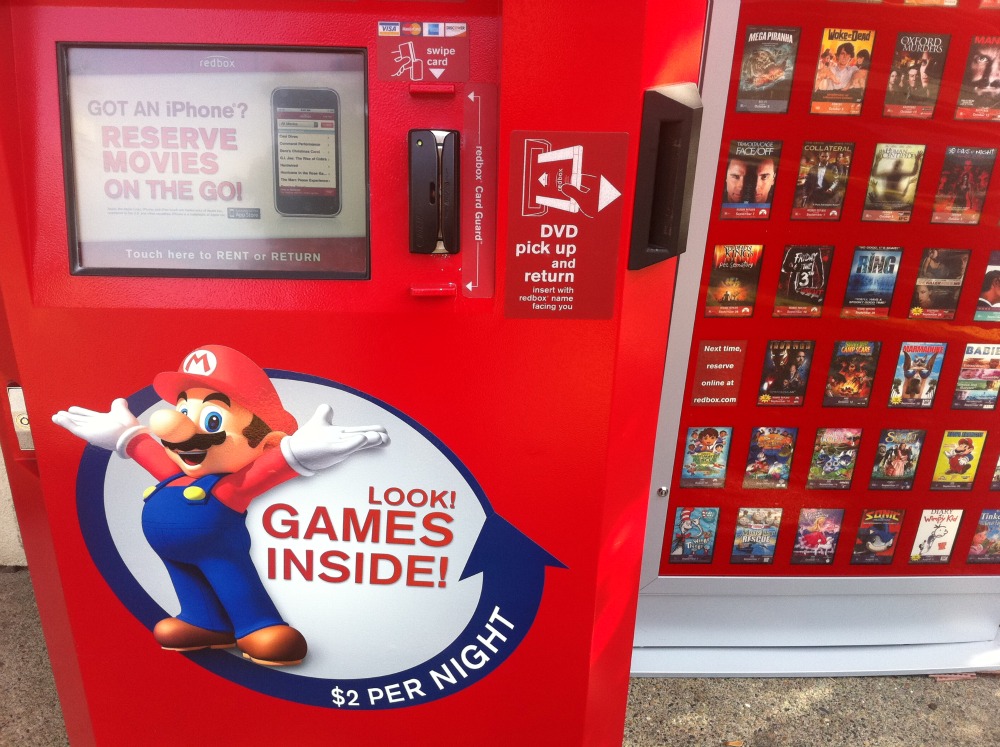
This image, like game rentals as a whole, is now a relic of a bygone era.
Console gaming now seems poised to be the next media format where physical media no longer drives the hardware market. Soon, the idea of a game console with a disc drive may seem as outdated as a laptop with a disc drive or an iPhone with a headphone jack.
Data centers powering the generative AI boom are gulping water and exhausting electricity at what some researchers view as an unsustainable pace. Two entrepreneurs who met in high school a few years ago want to overcome that crunch with a fresh experiment: sinking the cloud into the sea.
Sam Mendel and Eric Kim launched their company, NetworkOcean, out of startup accelerator Y Combinator on August 15 by announcing plans to dunk a small capsule filled with GPU servers into San Francisco Bay within a month. “There’s this vital opportunity to build more efficient computer infrastructure that we’re gonna rely on for decades to come,” Mendel says.
The founders contend that moving data centers off land would slow ocean temperature rise by drawing less power and letting seawater cool the capsule’s shell, supplementing its internal cooling system. NetworkOcean’s founders have said a location in the bay would deliver fast processing speeds for the region’s buzzing AI economy.
But scientists who study the hundreds of square miles of brackish water say even the slightest heat or disturbance from NetworkOcean’s submersible could trigger toxic algae blooms and harm wildlife. And WIRED inquiries to several California and US agencies who oversee the bay found that NetworkOcean has been pursuing its initial test of an underwater data center without having sought, much less received, any permits from key regulators.
The outreach by WIRED prompted at least two agencies—the Bay Conservation and Development Commission and the San Francisco Regional Water Quality Control Board—to email NetworkOcean that testing without permits could run afoul of laws, according to public records and spokespeople for the agencies. Fines from the BCDC can run up to hundreds of thousands of dollars.
The nascent technology has already been in hot water in California. In 2016, the state’s coastal commission issued a previously unreported notice to Microsoft saying that the tech giant had violated the law the year before by plunging an unpermitted server vessel into San Luis Obispo Bay, about 250 miles south of San Francisco. The months-long test, part of what was known as Project Natick, had ended without apparent environmental harm by the time the agency learned of it, so officials decided not to fine Microsoft, according to the notice seen by WIRED.
The renewed scrutiny of underwater data centers has surfaced an increasingly common tension between innovative efforts to combat global climate change and long-standing environmental laws. Permitting takes months, if not years, and can cost millions of dollars, potentially impeding progress. Advocates of the laws argue that the process allows for time and input to better weigh trade-offs.
“Things are overregulated because people often don’t do the right thing,” says Thomas Mumley, recently retired assistant executive officer of the bay water board. “You give an inch, they take a mile. We have to be cautious.”
Over the last two weeks, including during an interview at the WIRED office, NetworkOcean’s founders have provided driblets of details about their evolving plans. Their current intention is to test their underwater vessel for about an hour, just below the surface of what Mendel would only describe as a privately owned and operated portion of the bay that he says is not subject to regulatory oversight. He insists that a permit is not required based on the location, design, and minimal impact. “We have been told by our potential testing site that our setup is environmentally benign,” Mendel says.
Mumley, the retired regulator, calls the assertion about not needing a permit “absurd.” Both Bella Castrodale, the BCDC’s lead enforcement attorney, and Keith Lichten, a water board division manager, say private sites and a quick dip in the bay aren’t exempt from permitting. Several other experts in bay rules tell WIRED that even if some quirk does preclude oversight, they believe NetworkOcean is sending a poor message to the public by not coordinating with regulators.
“Just because these centers would be out of sight does not mean they are not a major disturbance,” says Jon Rosenfield, science director at San Francisco Baykeeper, a nonprofit that investigates industrial polluters.
School project
Mendel and Kim say they tried to develop an underwater renewable energy device together during high school in Southern California before moving onto non-nautical pursuits. Mendel, 23, dropped out of college in 2022 and founded a platform for social media influencers.
About a year ago, he built a small web server using the DIY system Raspberry Pi to host another personal project, and temporarily floated the equipment in San Francisco Bay by attaching it to a buoy from a private boat in the Sausalito area. (Mendel declined to answer questions about permits.) After talking with Kim, also 23, about this experiment, the two decided to move in together and start NetworkOcean.
Their pitch is that underwater data centers are more affordable to develop and maintain, especially as electricity shortages limit sites on land. Surrounding a tank of hot servers with water naturally helps cools them, avoiding the massive resource drain of air-conditioning and also improving on the similar benefits of floating data centers. Developers of offshore wind farms are eager to electrify NetworkOcean vessels, Mendel says.
The human body is full of marvels, some even bordering on miraculous. That includes the limited ability for nerves to regenerate after injuries, allowing people to regain some function and feeling. But that wonder can turn, well, unnerving when those regenerated wires end up in a jumble.
Such is the case for a rare neurological condition called gustatory hyperhidrosis, also known as Frey’s syndrome. In this disorder, nerves regenerate after damage to either of the large saliva glands that sit on either side of the face, just in front of the ears, called the parotid glands. But that nerve regrowth goes awry due to a quirk of anatomy that allows the nerves that control saliva production for eating to get tangled with those that control sweating for temperature control.
In this week’s issue of the New England Journal of Medicine, doctors in Taiwan report an unusual presentation of the disorder in a 76-year-old woman. She told doctors that, for two years, every time she ate, her face would begin profusely sweating. In the clinic, the doctors observed the phenomenon themselves. They watched as she took a bite of pork jerky and began chewing.
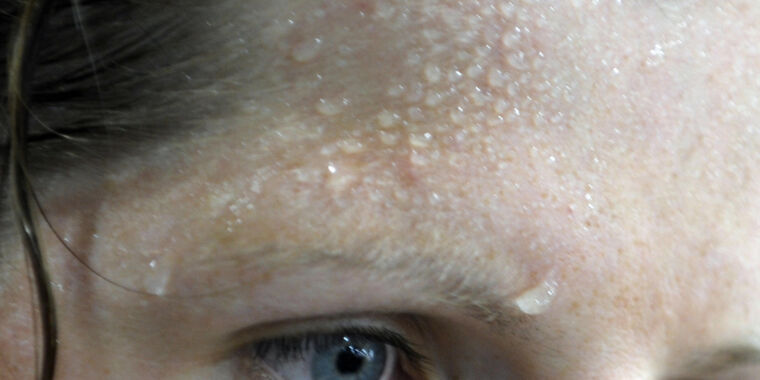
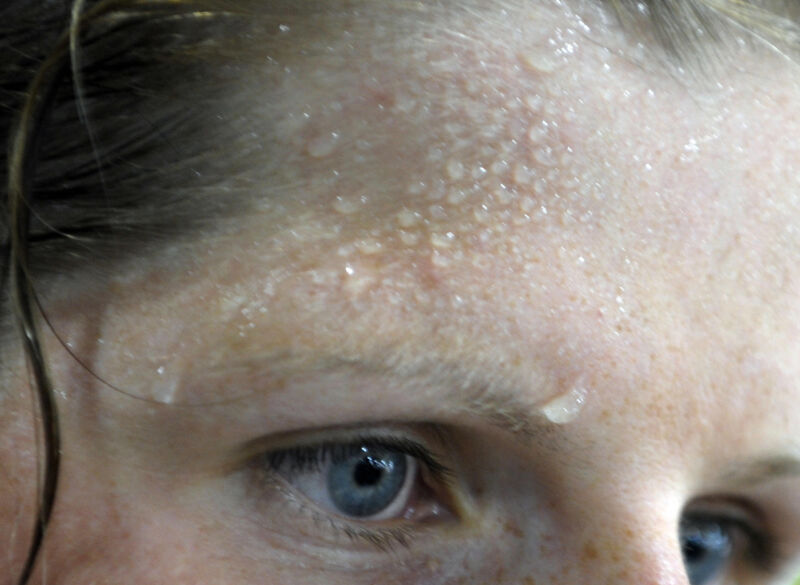
Enlarge/ Panel A, 10 seconds after beginning chewing; Panel B, 30 seconds after; Panel C, 50 seconds after; and Panel D, 75 seconds after.
At the start, her face was dry and had a normal tone. But, within 30 seconds, her left cheek began to glisten with sweat and turn red from flushing. By 50 seconds, large beads of sweat coated her cheek. At 75 seconds, droplets ran down her cheek and onto her neck.
Anatomy quirk
Seven years before that doctor’s appointment, the woman had undergone surgery to remove the parotid gland on that side of her face due to the growth of a benign tumor. Gustatory hyperhidrosis is a common complication after such a removal, called a parotidectomy. Some published studies estimate that up to 96 percent of parotidectomy patients will go on to develop the disorder. But, if it does develop, it usually does so within about six to 18 months after the surgery—the time it can take for nerves to regrow. But, in the woman’s case, it appeared to develop after five years since she reported that it started only two years prior to her appointment. It’s unclear why there was such a delay.
Doctors hypothesize that gustatory hyperhidrosis develops after salivary gland injuries or surgeries because of the way nerve fibers are bundled in that part of the head. The nerves that control the salivary glands are part of the parasympathetic nervous system (PSNS). This division of the nervous system is sometimes described as controlling the relatively calm “rest and digest” bodily functions, which are controlled unconsciously as part of the autonomic nervous system that controls things like heart rate.
The PSNS is in contrast to the other part of the autonomic nervous system, called the sympathetic nervous system (SNS). The SNS controls the unconscious “fight or flight” stress responses, which include sweat glands.
Tangled fibers
While PSNS fibers that control the saliva glands and SNS fibers that control sweat glands are from different divisions, they come together on the side of the face. Specifically, they meet up in a tributary nerve called the auriculotemporal nerve. And, they don’t just feed into the same physical conduit, they also overlap in their chemical regulation. Often SNS and PSNS fibers are activated by different signaling molecules (aka neurotransmitters). But it just so happens that the nerve fibers that control sweat glands are activated by the same neurotransmitter that activates the fibers in the PSNS, including those regulating saliva glands. They’re both regulated by a neurotransmitter called acetylcholine.
When PSNS and SNS nerve fibers are damaged near the parotid salivary gland from injury or surgery, the nerves can regenerate. But, given their physical and chemical overlaps, doctors think that in gustatory hyperhidrosis, PSNS nerve fibers end up growing back abnormally, along the paths of SNS fibers. This ends up connecting the PSNS fibers to sweat glands in the skin. So, upon signals of eating, the crossed nerve fibers lead not to salivation but heat responses, including sweat production and blood vessel dilation, which explains the facial flushing.
Living with it
Thankfully, there are various treatments for people with gustatory hyperhidrosis. They include surgical reconstruction or injections of Botox (botulinum neurotoxin), which can shut down the activity of the sweat glands. Similarly, there are topical anticholinergics, which block and inhibit the activity of acetylcholine, the neurotransmitter that activates the nerve fibers activating the sweat glands. There are also topical antiperspirants that can help.
After the doctors in Taiwan diagnosed their patient with gustatory hyperhidrosis, they discussed these options with her. But she reportedly “opted to live with the symptoms.”
Enlarge/ In the U.S., a folding phone has you carrying around nearly $2,000 of fragile, folding OLED phone. In China and export-friendly countries, the Mate XT adds $1,000 and yet another hinge.
Huawei
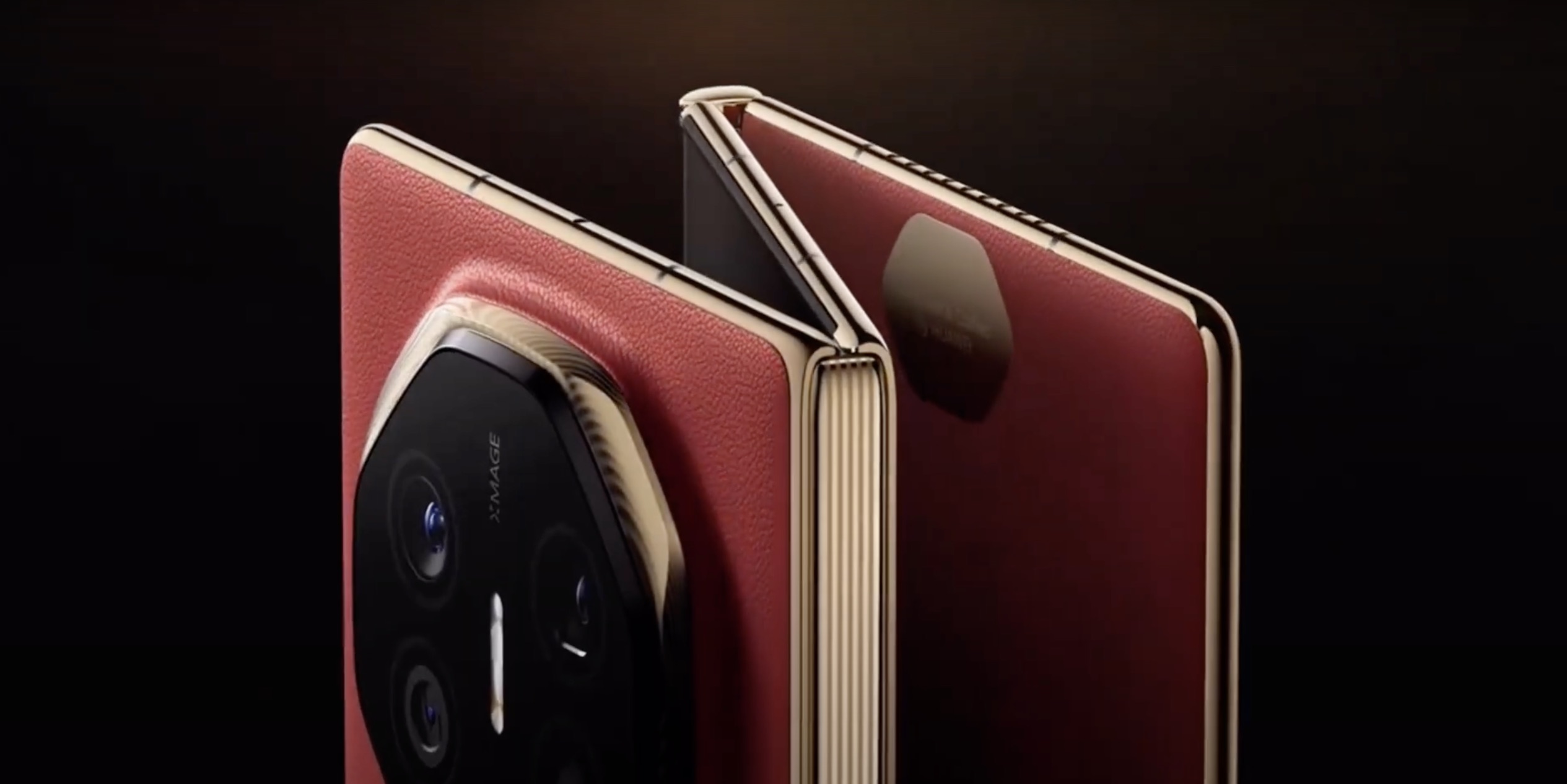
Huawei’s Mate XT Ultimate is a phone that does not flip or fold, at least in the way of its Samsung or Google contemporaries. You could say it collapses, really, across two hinges, from a full 10.2-inch diagonal rectangle (about a half-inch short of a standard iPad) down to a traditional 6.4-inch rectangle phone slab. There’s also an in-between single-fold configuration at 7.9 inches. And there’s an optional folding keyboard.
This phone, which Huawei calls a “trifold,” would cost you the USD equivalent of $2,800 (19,999 yuan) if you could buy it in the US. Most notably, the phone launched just hours after Apple’s iPhone 16 event. As noted by The New York Times, Huawei’s product launches are often timed for maximum pushback against the US, which has sanctioned and attempted to stymie Huawei’s chip tech.
“It’s a piece of work that everyone has thought of but never managed to create,” Richard Yu, Huawei’s consumer group chairman, said during the Mate XT livestream unveiling. “I have always had a dream to put our tablet in my pocket, and we did it.”
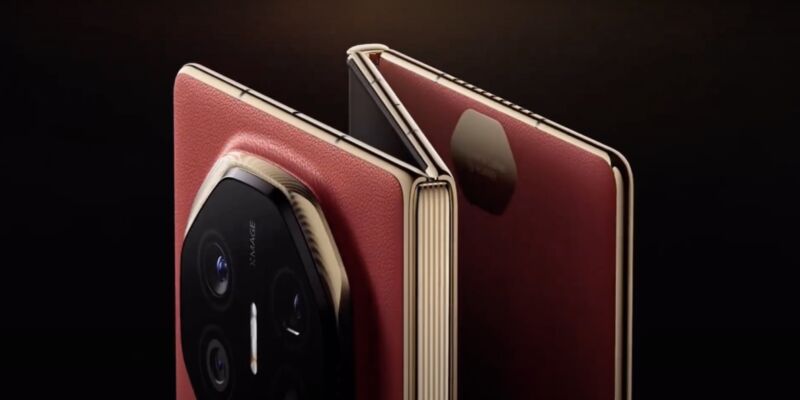
The Mate XT looks incredibly thin on all three panels. You can seemingly unfold the whole thing, or do just two panels.
Huawei
If you can afford the $2,800 Mate XT, a first-generation trifold phone, you can survive every one of your holdings being in the red today.
Alternately, you can afford the Mate XT because you are at an “investing in art” level of wealth.
Huawei
As a folded-up phone, the Mate XT looks rather normal. The circular camera bump gives off early-2000s point-and-shoot digicam vibes.
Huawei
A shot of the Mate XT from Huawei’s promotional trailer, folded up.
Huawei
Another look at the folding style, this one on white.
Huawei
For the price of two really good gaming PCs, you get 256GB storage (with pricier upgrades available), 16GB RAM, a 5,600 mAh battery, a 50-megapixel main camera, and two 12 MP ultrawide and periscope cameras. It weights 298 grams, is just 3.6 mm thick when unfolded, and its screen is an LTPO OLED with 120 Hz refresh. There are, just like US flagship phones, a lot of AI-powered promises stuck onto the software and camera.
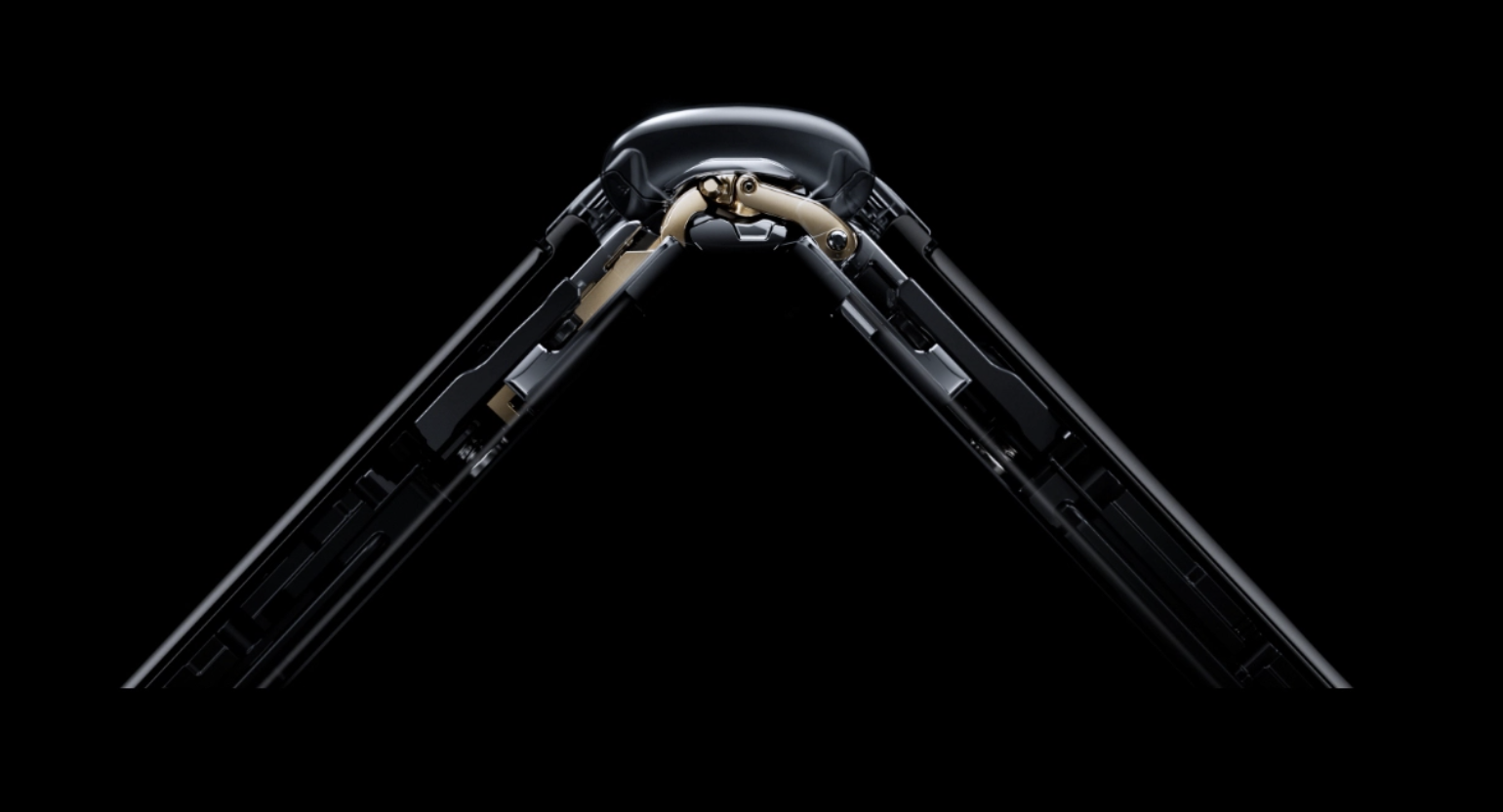
The “Tiangong” hinge system inside the Mate XT Ultimate.
Huawei
Beyond the price, the size, and the AI promises, the Mate XT Ultimate will be most interesting in how its hinges hold up. Huawei named its hinges after the Tiangong space station and says it allows for “internal and external bending” across dual tracks. It is made of a composite laminate and non-Newtonian fluid bits.
The Verge notes that the Mate XT Ultimate has seen some 3.7 million pre-orders through Chinese retailer Vmall—before a price was announced. It does not seem likely that the phone will be released outside China.
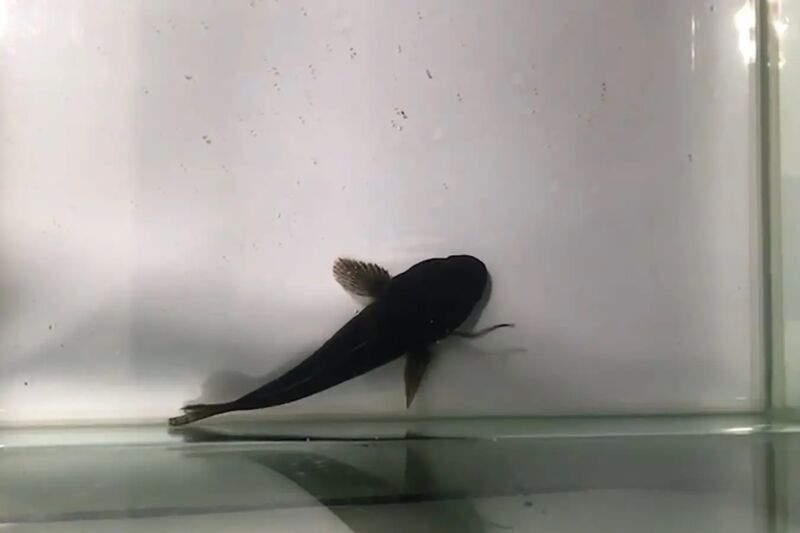
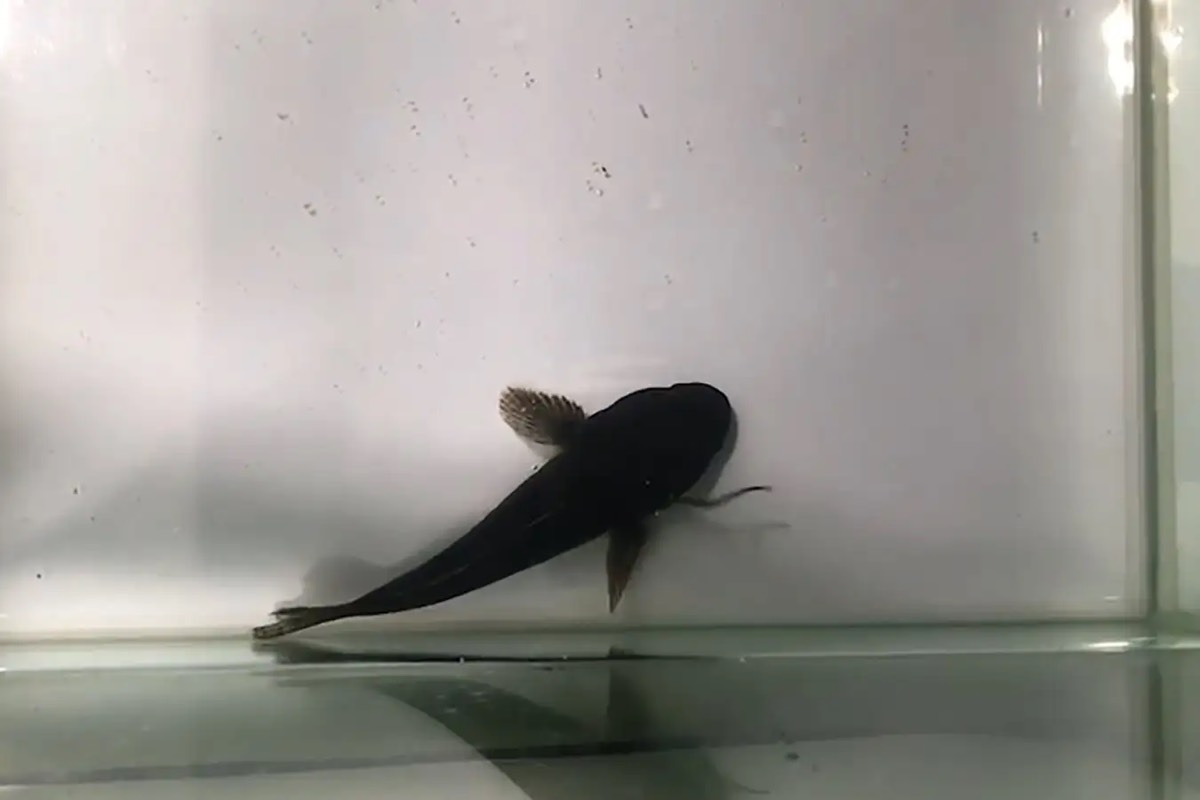
Enlarge/ “The only species of fish confirmed to be able to escape from the digestive tract of the predatory fish after being captured.”
Hasegawa et al./Current Biology
Imagine you’re a Japanese eel, swimming around just minding your own business when—bam! A predatory fish swallows you whole and you only have a few minutes to make your escape before certain death. What’s an eel to do? According to a new paper published in the journal Current Biology, Japanese eels opt to back their way out of the digestive tract, tail first, through the esophagus, emerging from the predatory fish’s gills.
Per the authors, this is the first such study to observe the behavioral patterns and escape processes of prey within the digestive tract of predators. “At this point, the Japanese eel is the only species of fish confirmed to be able to escape from the digestive tract of the predatory fish after being captured,” co-author Yuha Hasegawa at Nagasaki University in Japan told New Scientist.
There are various strategies in nature for escaping predators after being swallowed. For instance, a parasitic worm called Paragordius tricuspidatus can force its way out of a predator’s system when its host organism is eaten. There was also a fascinating study in 2020 by Japanese scientists on the unusual survival strategy of the aquatic beetle Regimbartia attenuata. They fed a bunch of the beetles to a pond frog (Pelophylax nigromaculatus) under laboratory conditions, expecting the frog to spit the beetle out. That’s what happened with prior experiments on bombardier beetles (Pheropsophus jessoensis), which spray toxic chemicals (described as an audible “chemical explosion”) when they find themselves inside a toad’s gut, inducing the toad to invert its own stomach and vomit them back out.
But R. attenuata basically walks through the digestive tract and escapes out of the frog’s anus after being swallowed alive. It proved to be a successful escape route. In the case of the bombardier beetles, between 35 and 57 percent of the toads threw up within 50 minutes on average, ensuring the survival of the regurgitated beetles. R. attenuata‘s survival rate was a whopping 93 percent. In fact, 19 out of 20 walked out of the frog, unharmed, within an hour, although one industrious beetle bolted out in just five minutes. Granted, the beetles often emerged covered in fecal pellets, which can’t have been pleasant. But that didn’t stop them from resuming their little beetle lives; all survived at least two weeks after being swallowed.
Hasegawa co-authored an earlier study in which they observed Japanese eels emerging from a predator’s gills after being swallowed, so they knew this unique strategy was possible. They just didn’t know the details of what was going on inside the digestive tract that enabled the eels to pull off this feat. So the team decided to use X-ray videography to peer inside predatory fish (Odontobutis obscura) after eels had been eaten. They injected barium sulfate into the abdominal cavity and tail of the Japanese eels as a contrast agent, then introduced each eel to a tank containing one O. obscura. The X-ray video system captured the interactions after an eel had been swallowed.
Out through the gills
The escaping behavior of a Japanese eel. Credit: Hasegawa et al./Current Biology
O. obscura swallow their prey whole along with surrounding water, and a swallowed eel quickly ends up in the digestive tract, a highly acidic and oxygen-deprived environment that kills the eels within 211.9 seconds (a little over three minutes). Thirty-two of the eels were eaten, and of those, 13 (or 40.6 percent) managed to poke at least their tails through the gills of their predator. Of those 13, nine (69.2 percent) escaped completely within 56 seconds on average, suggesting “that the period until the tails emerge from the predator’s gill is particularly crucial for successful escape,” the authors wrote. The final push for freedom involved coiling their bodies to extract their head from the gill.
It helps to be swallowed head-first. The researchers discovered that most captured eels tried to escape by swimming back up the digestive tract toward the esophagus and gills, tail-first in the cases where escape was successful. However, eleven eels ended up completely inside the stomach and resorted to swimming around in circles—most likely looking for a possible escape route. Five of those managed to insert their tails correctly toward the esophagus, while two perished because they oriented their tails in the wrong direction.
“The most surprising moment in this study was when we observed the first footage of eels escaping by going back up the digestive tract toward the gill of the predatory fish,” said co-author Yuuki Kawabata, also of Nagasaki University. “At the beginning of the experiment, we speculated that eels would escape directly from the predator’s mouth to the gill. However, contrary to our expectations, witnessing the eels’ desperate escape from the predator’s stomach to the gills was truly astonishing for us.”
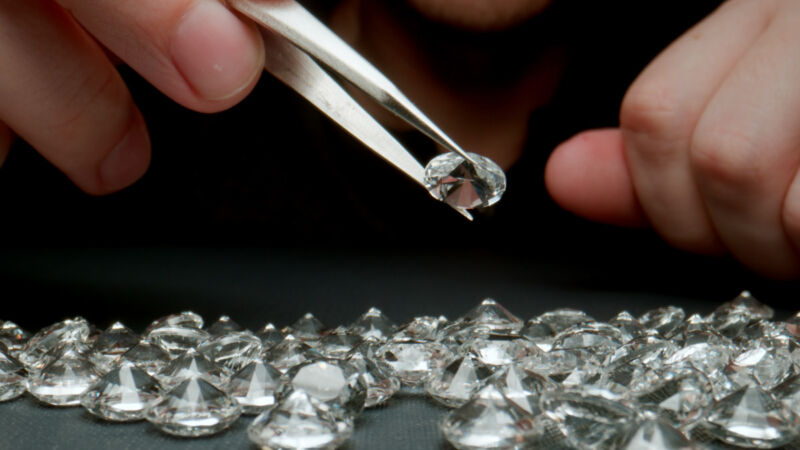
In an age when you can get just about anything online, it’s probably no surprise that you can buy a diamond-making machine for $200,000 on Chinese eCommerce site Alibaba. If, like me, you haven’t been paying attention to the diamond industry, it turns out that the availability of these machines reflects an ongoing trend toward democratizing diamond production—a process that began decades ago and continues to evolve.
The history of lab-grown diamonds dates back at least half a century. According to Harvard graduate student Javid Lakha, writing in a comprehensive piece on lab-grown diamonds published in Works in Progress last month, the first successful synthesis of diamonds in a laboratory setting occurred in the 1950s. Lakha recounts how Howard Tracy Hall, a chemist at General Electric, created the first lab-grown diamonds using a high-pressure, high-temperature (HPHT) process that mimicked the conditions under which diamonds form in nature.
Since then, diamond-making technology has advanced significantly. Today, there are two primary methods for creating lab-grown diamonds: the HPHT process and chemical vapor deposition (CVD). Both types of machines are now listed on Alibaba, with prices starting at around $200,000, as pointed out in a Hacker News comment by engineer John Nagle (who goes by “Animats” on Hacker News). A CVD machine we found is more pricey, at around $450,000.
An image of a “HPHT Cubic Press Synthetic Diamond Making Machine” made by Henan Huanghe Whirlwind Co., Ltd. in China.
A photo of part of a “HPHT Cubic Press Synthetic Diamond Making Machine” made by Henan Huanghe Whirlwind Co., Ltd. in China.
A photo of a factory full of HPHT Cubic Press Synthetic Diamond Making Machines, made by Henan Huanghe Whirlwind Co., Ltd. in China.
Not a simple operation
While the idea of purchasing a diamond-making machine on Alibaba might be intriguing, it’s important to note that operating one isn’t as simple as plugging it in and watching diamonds form. According to Lakha’s article, these machines require significant expertise and additional resources to operate effectively.
For an HPHT press, you’d need a reliable source of high-quality graphite, metal catalysts like iron or cobalt, and precise temperature and pressure control systems. CVD machines require a steady supply of methane and hydrogen gases, as well as the ability to generate and control microwaves or hot filaments. Both methods need diamond seed crystals to start the growth process.
Moreover, you’d need specialized knowledge to manage the growth parameters, handle potentially hazardous materials and high-pressure equipment safely, and process the resulting raw diamonds into usable gems or industrial components. The machines also use considerable amounts of energy and require regular maintenance. Those factors may make the process subject to some regulations that are far beyond the scope of this piece.
In short, while these machines are more accessible than ever, turning one into a productive diamond-making operation would still require significant investment in equipment, materials, expertise, and safety measures. But hey, a guy can dream, right?
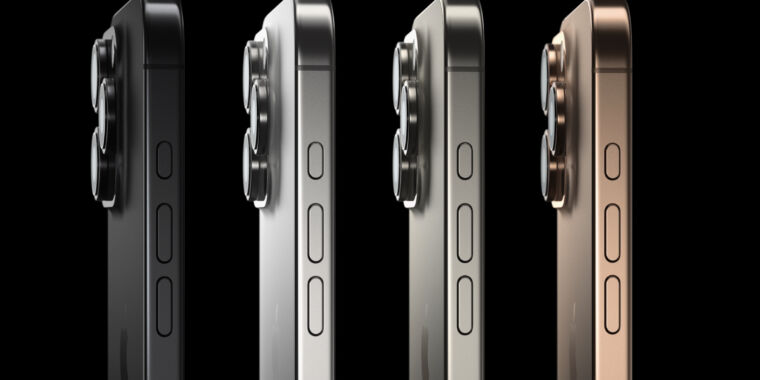
These are the new colors and finishes for the iPhone 16 Pro.
The screens are slightly larger this time around.
Apple
As expected, Apple announced the new iPhone Pro models today during a livestream: the iPhone 16 Pro and iPhone 16 Pro Max. The iPhone 16 Pro has a 6.3-inch display, and the Max has a 6.9-inch display. That’s primarily thanks to thinner borders around the displays.
Like the iPhone 15 Pro, the 16 Pro is made of titanium but with a new texture. Apple claims the phone has improved heat management with its new chassis, which could address some of our complaints about the iPhone 15 Pro—that means up to 20 percent faster sustained performance, too.
Larger batteries and efficiency improvements have led to a promise of battery life improvements, though Apple didn’t say exactly how much longer they’ll last during the livestream.
The iPhone 16 Pro includes the new A18 Pro chip, which is distinct from the A18 found in the regular iPhone 16. Apple says it is faster and more efficient.
It has a 16-core Neural Engine with 17 percent more memory bandwidth. Apple Intelligence features are said to run up to 15 percent faster than on the previous Pro phones. The A18 Pro ships with a 6-core GPU with 20 percent faster performance, and Apple touted its capability for AAA games—and that includes ray tracing performance that’s twice as fast. The 6-core CPU (two performance cores, four efficiency) is a modest 15 percent faster. Alternatively, it can deliver the same performance as the A17 Pro but with 20 percent more efficiency, which suggests battery life and heat improvements. Finally, there’s a new video encoder and ISP, with two times the throughput for data, with a special emphasis on improving video capture.
Like the new iPhone 16, the iPhone 16 Pro includes a new button called the Capture button. You can click it to take a photo quickly, like a traditional camera. But it’s also touch-sensitive, so you can run your finger across it in gestures to tweak the image using existing built-in photography features, like adjusting the zoom.
It has the same three camera types as before: wide-angle, telephoto, and ultra-wide. But there are some hardware improvements. The 48-megapixel wide-angle camera adds a new sensor that can read data twice as fast. There’s a new 48-megapixel ultra-wide camera to enable more detail in close-ups and selfies. The 5x telephoto lens that was exclusive to the 15 Pro Max is now included in both sizes of the iPhone 16 Pro, too.
The big new camera feature is 4K video capture at 120 frames per second and in Dolby Vision, which is a first for the platform. Videos captured this way can see their playback speed adjusted between 120 fps, 60 fps, 30 fps, and 24 fps after the fact in the Photos app. All videos captured can now include spatial audio, too. That’s accompanied by Audio Mix, a feature that allows you to switch between modes that attempt to isolate individual voices or sounds according to a few specific mix styles.
iPhone 16 Pro starts at $999 (128GB) or $1,199 (256GB) for the Max size. They are available for pre-order this coming Friday, and they ship on September 20.
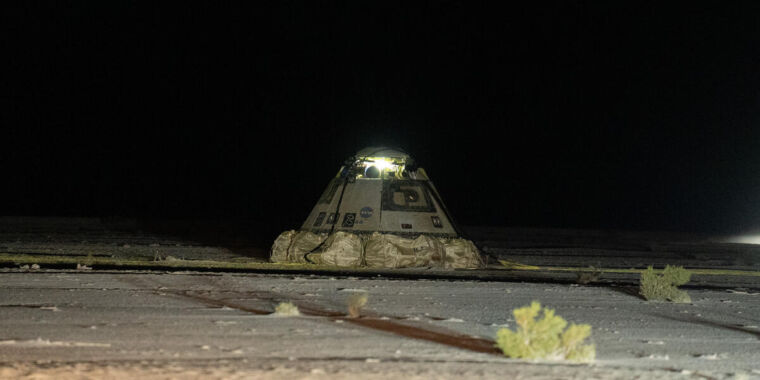
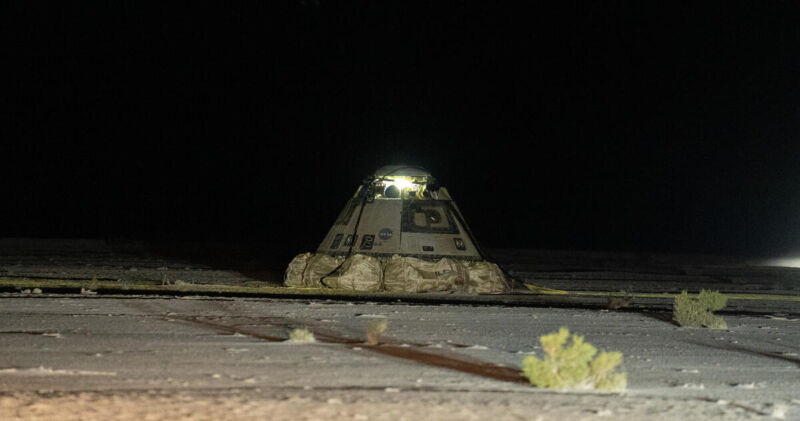
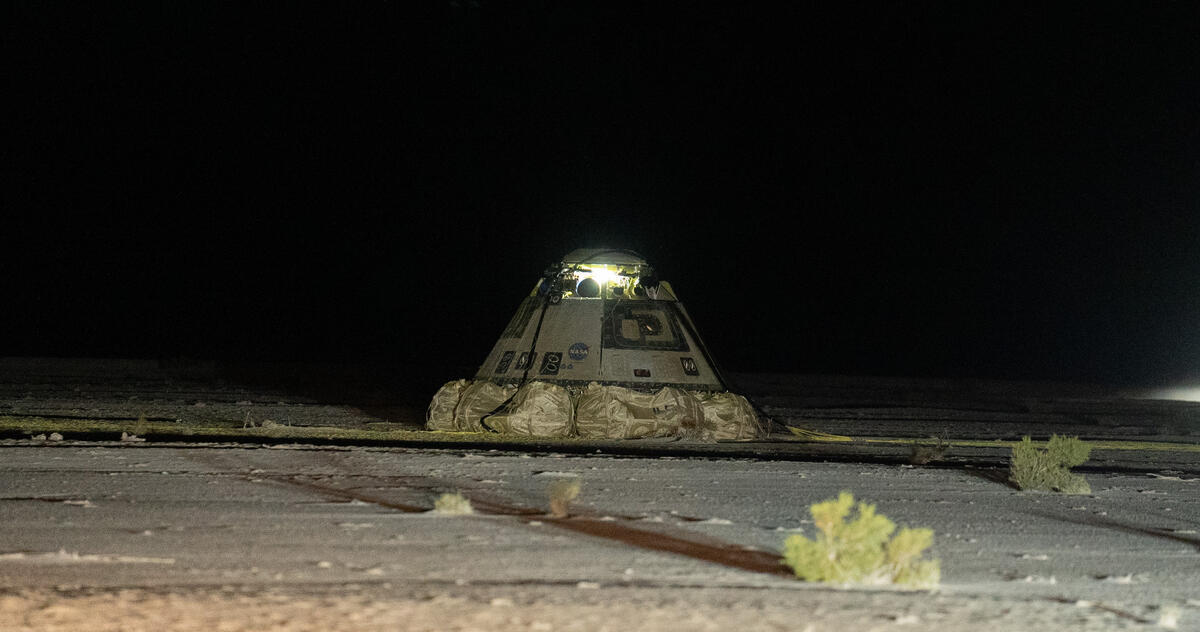
Enlarge/ Boeing’s Starliner spacecraft after landing Friday night at White Sands Space Harbor, New Mexico.
Boeing
Boeing’s Starliner spacecraft sailed to a smooth landing in the New Mexico desert Friday night, an auspicious end to an otherwise disappointing three-month test flight that left the capsule’s two-person crew stuck in orbit until next year.
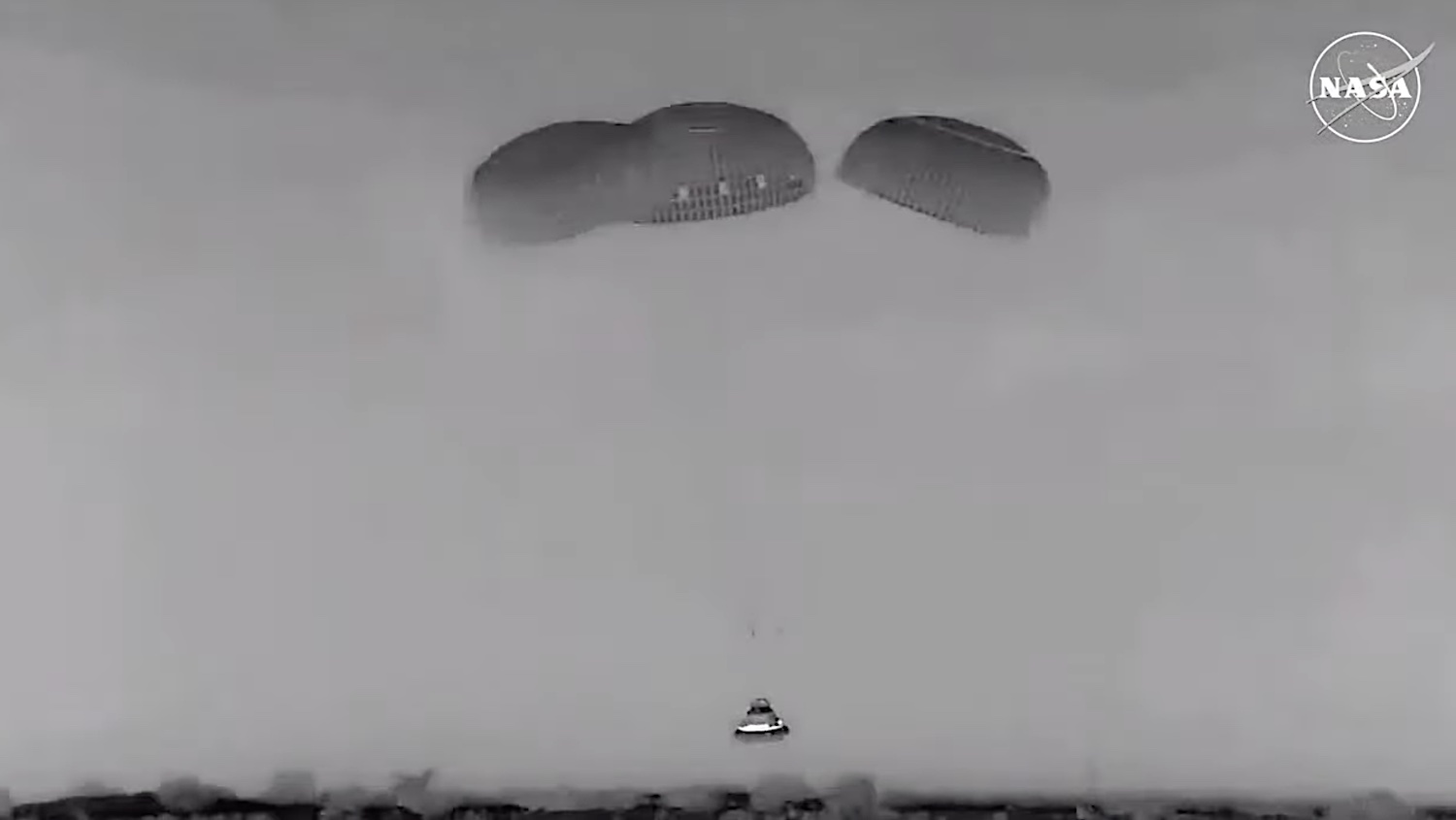
Cushioned by airbags, the Boeing crew capsule descended under three parachutes toward an on-target landing at 10: 01 pm local time Friday (12: 01 am EDT Saturday) at White Sands Space Harbor, New Mexico. From the outside, the landing appeared just as it would have if the spacecraft brought home NASA astronauts Butch Wilmore and Suni Williams, who became the first people to launch on a Starliner capsule on June 5.
But Starliner’s cockpit was empty as it flew back to Earth Friday night. Last month, NASA managers decided to keep Wilmore and Williams on the International Space Station (ISS) until next year after agency officials determined it was too risky for the astronauts to return to the ground on Boeing’s spaceship. Instead of coming home on Starliner, Wilmore and Williams will fly back to Earth on a SpaceX Dragon spacecraft in February. NASA has incorporated the Starliner duo into the space station’s long-term crew.
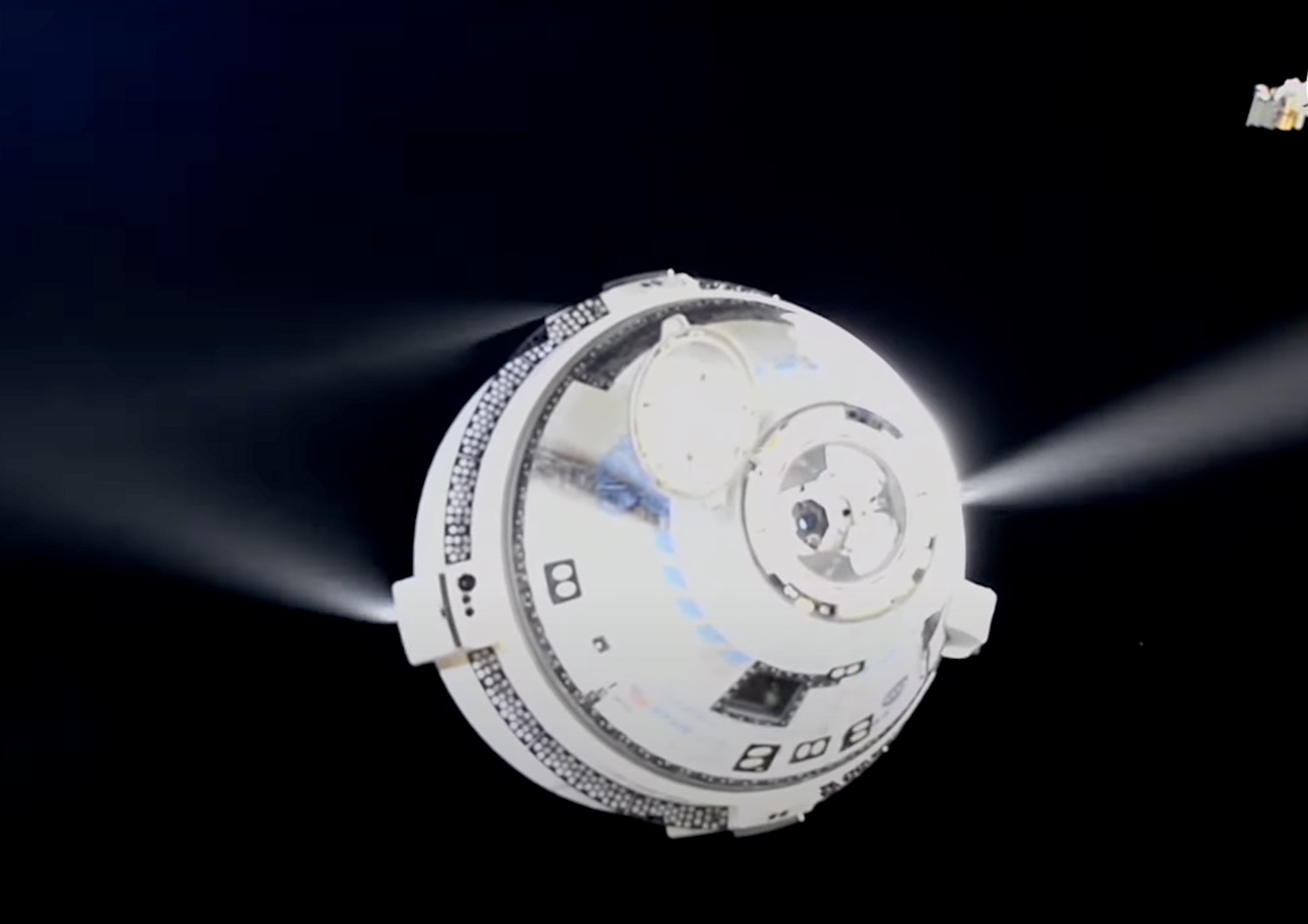
The Starliner spacecraft began the journey home by backing away from its docking port at the space station at 6: 04 pm EDT (22: 04 UTC), one day after astronauts closed hatches to prepare for the ship’s departure. The capsule fired thrusters to quickly back away from the complex, setting up for a deorbit burn to guide Starliner on a trajectory toward its landing site. Then, Starliner jettisoned its disposable service module to burn up over the Pacific Ocean, while the crew module, with a vacant cockpit, took aim on New Mexico.
After streaking through the atmosphere over the Pacific Ocean and Mexico, Starliner deployed three main parachutes to slow its descent, then a ring of six airbags inflated around the bottom of the spacecraft to dampen the jolt of touchdown. This was the third time a Starliner capsule has flown in space, and the second time the spacecraft fell short of achieving all of its objectives.
Not the desired outcome
“I’m happy to report Starliner did really well today in the undock, deorbit, and landing sequence,” said Steve Stich, manager of NASA’s commercial crew program, which manages a contract worth up to $4.6 billion for Boeing to develop, test, and fly a series of Starliner crew missions to the ISS.
While officials were pleased with Starliner’s landing, the celebration was tinged with disappointment.
“From a human perspective, all of us feel happy about the successful landing, but then there’s a piece of us that we wish it would have been the way we had planned it,” Stich said. “We had planned to have the mission land with Butch and Suni onboard. I think there are, depending on who you are on the team, different emotions associated with that, and I think it’s going to take a little time to work through that.”
Nevertheless, Stich said NASA made the right call last month when officials decided to complete the Starliner test flight without astronauts in the spacecraft.
“We made the decision to have an uncrewed flight based on what we knew at the time, and based on our knowledge of the thrusters and based on the modeling that we had,” Stich said. “If we’d had a model that would have predicted what we saw tonight perfectly, yeah, it looks like an easy decision to go say, ‘We could have had a crew tonight.’ But we didn’t have that.”
Boeing’s Starliner managers insisted the ship was safe to bring the astronauts home. It might be tempting to conclude the successful landing Friday night vindicated Boeing’s views on the thruster problems. However, he spacecraft’s propulsion system, provided by Aerojet Rocketdyne, clearly did not work as intended during the flight. NASA had the option of bringing Wilmore and Williams back to Earth on a different, flight-proven spacecraft, so they took it.
“It’s awfully hard for the team,” Stich said. “It’s hard for me, when we sit here and have a successful landing, to be in that position. But it was a test flight, and we didn’t have confidence, with certainty, of the thruster performance.”
Enlarge/ In this infrared view, Starliner descends under its three main parachutes moments before touchdown at White Sands Space Harbor, New Mexico.
NASA
As Starliner approached the space station in June, five of 28 control thrusters on Starliner’s service module failed, forcing Wilmore to take manual control as ground teams sorted out the problem. Eventually, engineers recovered four of the five thrusters, but NASA’s decision makers were unable to convince themselves the same problem wouldn’t reappear, or get worse, when the spacecraft departed the space station and headed for reentry and landing.
Engineers later determined the control jets lost thrust due to overheating, which can cause Teflon seals in valves to swell and deform, starving the thrusters of propellant. Telemetry data beamed back to the mission controllers from Starliner showed higher-than-expected temperatures on two of the service module thrusters during the flight back to Earth Friday night, but they continued working.
Ground teams also detected five small helium leaks on Starliner’s propulsion system soon after its launch in June. NASA and Boeing officials were aware of one of the leaks before the launch, but decided to go ahead with the test flight. Starliner was still leaking helium when the spacecraft undocked from the station Friday, but the leak rate remained within safety tolerances, according to Stich.
A couple of fresh technical problems cropped up as Starliner cruised back to Earth. One of 12 control jets on the crew module failed to ignite at any time during Starliner’s flight home. These are separate thrusters from the small engines that caused trouble earlier in the Starliner mission. There was also a brief glitch in Starliner’s navigation system during reentry.
Where to go from here?
Three NASA managers, including Stich, took questions from reporters in a press conference early Saturday following Starliner’s landing. Two Boeing officials were also supposed to be on the panel, but they canceled at the last minute. Boeing didn’t explain their absence, and the company has not made any officials available to answer questions since NASA chose to end the Starliner test flight without the crew aboard.
“We view the data and the uncertainty that’s there differently than Boeing does,” said Jim Free, NASA’s associate administrator, in an August 24 press conference announcing the agency’s decision on how to end the Starliner test flight. It’s unusual for NASA officials to publicly discuss how their opinions differ from those of their contractors.
Joel Montalbano, NASA’s deputy associate administrator for space operations, said Saturday that Boeing deferred to the agency to discuss the Starliner mission in the post-landing press conference.
Here’s the only quote from a Boeing official on Starliner’s return to Earth. It came in the form of a three-paragraph written statement Boeing emailed to reporters about a half-hour after Starliner’s landing: “I want to recognize the work the Starliner teams did to ensure a successful and safe undocking, deorbit, re-entry and landing,” said Mark Nappi, vice president and program manager of Boeing’s commercial crew program. “We will review the data and determine the next steps for the program.”
Nappi’s statement doesn’t answer one of the most important questions reporters would have asked anyone from Boeing if they participated in Saturday morning’s press conference: Does Boeing still have a long-term commitment to the Starliner program?
So far, the only indications of Boeing’s future plans for Starliner have come from second-hand anecdotes relayed by NASA officials. Boeing has been silent on the matter. The company has reported nearly $1.6 billion in financial charges to pay for previous delays and cost overruns on the Starliner program, and Boeing will again be on the hook to pay to fix the problems Starliner encountered in space over the last three months.
Montalbano said Boeing’s Starliner managers met with ground teams at mission control in Houston following the craft’s landing. “The Boeing managers came into the control room and congratulated the team, talked to the NASA team, so Boeing is committed to continue their work with us,” he said.
Enlarge/ Boeing’s Starliner spacecraft fires thrusters during departure from the International Space Station on Friday.
NASA
NASA isn’t ready to give up on Starliner. A fundamental tenet of NASA’s commercial crew program is to foster the development of two independent vehicles to ferry astronauts to and from the International Space Station, and eventually commercial outposts in low-Earth orbit. NASA awarded multibillion-dollar contracts to Boeing and SpaceX in 2014 to complete development of their Starliner and Crew Dragon spaceships.
SpaceX’s Dragon started flying astronauts in 2020. NASA would like to have another US spacecraft for crew rotation flights to support the ISS. If Boeing had more success with this Starliner test flight, NASA expected to formally certify the spacecraft for operational crew flights beginning next year. Once that happens, Starliner will enter a rotation with SpaceX’s Dragon to transport crews to and from the station in six-month increments.
Stich said Saturday that NASA has not determined whether the agency will require Boeing launch another Starliner test flight before certifying the spacecraft for regular crew rotation missions. “It’ll take a little time to determine the path forward, but today we saw the vehicle perform really well,” he said.
On to Starliner-1?
But some of Stich’s other statements Saturday suggested NASA would like to proceed with certifying Starliner and flying the next mission with a full crew complement of four astronauts. NASA calls Boeing’s first operational crew mission Starliner-1. It’s the first of at least three and potentially up to six crew rotation missions on Boeing’s contract.
“It’s great to have the spacecraft back, and we’re now focused on Starliner-1,” Stich said.
Before that happens, NASA and Boeing engineers must resolve the thruster problems and helium leaks that plagued the test flight this summer. Stich said teams are studying several ways to improve the reliability of Starliner’s thrusters, including hardware modifications and procedural changes. This will probably push back the next crew flight of Starliner, whether it’s Starliner-1 or another test flight, until the end of next year or 2026, although NASA officials have not laid out a schedule.
The overheating thrusters are located inside four doghouse-shaped propulsion pods around the perimeter of Starliner’s service module. It turns out the doghouses retain heat like a thermos—something NASA and Boeing didn’t fully appreciate before this mission—and the thrusters don’t have time to cool down when the spacecraft fires its control jets in rapid pulses. It might help if Boeing removes some of the insulating thermal blankets from the doghouses, Stich said.
The easiest method of resolving the problem of Starliner’s overheating thrusters would be to change the rate and duration of thruster firings.
“What we would like to do is try not to change the thruster. I think that is the best path,” Stich said. “There thrusters have shown resilience and have shown that they perform well, as long as we keep their temperatures down and don’t fire them in a manner that causes the temperatures to go up.”
There’s one thing from this summer’s test flight that might, counterintuitively, help NASA certify the Starliner spacecraft to begin operational flights with its next mission. Rather than staying at the space station for eight days, Starliner remained docked at the research lab for three months, half of the duration of a full-up crew rotation flight. Despite the setbacks, Stich estimated the test flight achieved about 85 to 90 percent of its objectives.
“There’s a lot of learning that happens in that three months that is invaluable for an increment mission,” Stich said. “So, in some ways, the mission overachieved some objectives, in terms of being there for extra time. Not having the crew onboard, obviously, there are some things that we lack in terms of Butch and Suni’s test pilot expertise, and how the vehicle performed, what they saw in the cockpit. We won’t have that data, but we still have the wealth of data from the spacecraft itself, so that will go toward the mission objectives and the certification.”
Enlarge/ The First Combat of Gav and Talhand’, Folio from a Shahnama (Book of Kings), ca. 1330–40, Attributed to Iran, probably Isfahan, Ink, opaque watercolor, gold, and silver on paper, Page: 8 1/16 x 5 1/4 in. (20.5 x 13.3 cm), Codices, Three battles between two Indian princes – half brothers contending for the throne – resulted in the invention of the game of chess, to explain the death of one of them to their grieving mother. The Persian word shah mat, or checkmate, indicating a position of no escape, describes the plight of Talhand at the end of the third battle. (Photo by: Sepia Times/Universal Images Group via Getty Images)
The three princes of Sarandib—an ancient Persian name for Sri Lanka—get exiled by their father the king. They are good boys, but he wants them to experience the wider world and its peoples and be tested by them before they take over the kingdom. They meet a cameleer who has lost his camel and tell him they’ve seen it—though they have not—and prove it by describing three noteworthy characteristics of the animal: it is blind in one eye, it has a tooth missing, and it has a lame leg.
After some hijinks the camel is found, and the princes are correct. How could they have known? They used their keen observational skills to notice unusual things, and their wit to interpret those observations to reveal a truth that was not immediately apparent.
It is a very old tale, sometimes involving an elephant or a horse instead of a camel. But this is the version written by Amir Khusrau in Delhi in 1301 in his poem The Eight Tales of Paradise, and this is the version that one Christopher the Armenian clumsily translated into the Venetian novel The Three Princes of Serendip, published in 1557; a publication that, in a roundabout way, brought the word “serendipity” into the English language.
In no version of the story do the princes accidentally stumble across something important they were not looking for, or find something they were looking for but in a roundabout, unanticipated manner, or make a valuable discovery based on a false belief or misapprehension. Chance, luck, and accidents, happy or otherwise, play no role in their tale. Rather, the trio use their astute observations as fodder for their abductive reasoning. Their main talent is their ability to spot surprising, unexpected things and use their observations to formulate hypotheses and conjectures that then allow them to deduce the existence of something they’ve never before seen.
Defining serendipity
This is how Telmo Pievani, the first Italian chair of Philosophy of Biological Sciences at the University of Padua, eventually comes to define serendipity in his new book, Serendipity: the Unexpected in Science. It’s hardly a mind-bending or world-altering read, but it is a cute and engaging one, especially when his many stories of discovery veer into ruminations on the nature of inquiry and of science itself.
He starts with the above-mentioned romp through global literature, culminating in the joint coining and misunderstanding of the term as we know it today: in 1754, after reading the popular English translation entitled The Travels and Adventures of Three Princes of Serendip, the intellectual Horace Walpole described “Serendipity, a very expressive word,” as “discoveries, by accidents and sagacity, of things which they were not in quest of.”
Pievani knows a lot, but like a lot, about the history of science, and he puts it on display here. He quickly debunks all of the instances of alleged serendipity that are always trotted out: Fleming the microbiologist had been studying antibiotics and searching for a commercially viable one for years before his moldy plate led him to penicillin. Yes, Röntgen discovered X-rays by a fluke, but it was only because of the training he received in his studies of cathode rays that he recognized he was observing a new form of radiation. Plenty of people over the course of history splashed some volume of water out of the baths they were climbing into and watched apples fall, but only Archimedes—who had recently been tasked by his king to figure out if his crown was made entirely of gold—and Newton—polymathic inventor of calculus—leapt from these (probably apocryphal) mundane occurrences to their famous discoveries of density and gravity, respectively.
After dispensing with these tired old saws, Pievani then suggests some cases of potentially real—or strong, as he deems it—serendipity. George de Mestral’s inventing velcro after noticing burrs stuck to his pants while hiking in the Alps; he certainly wasn’t searching for anything, and he parlayed his observation into a useful technology. DuPont chemists’ developing nylon, Teflon, and Post-it notes while playing with polymers for assorted other purposes. Columbus “discovering” the Americas (for the fourth time) since he thought the Earth was about a third smaller than Eratosthenes of Cyrene had correctly calculated it to be almost two thousand years earlier, forgotten “due to memory loss and Eurocentric prejudices.”
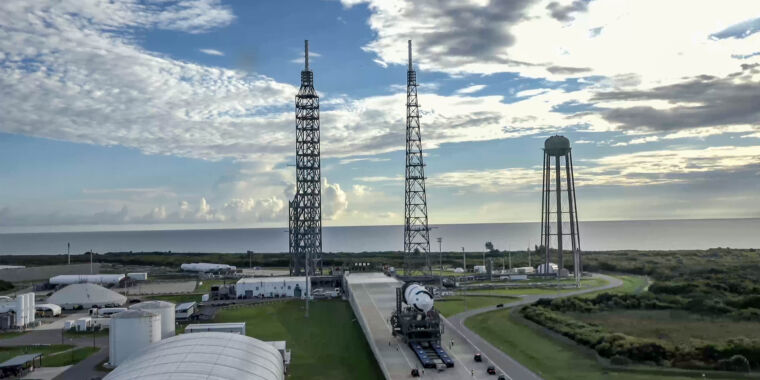
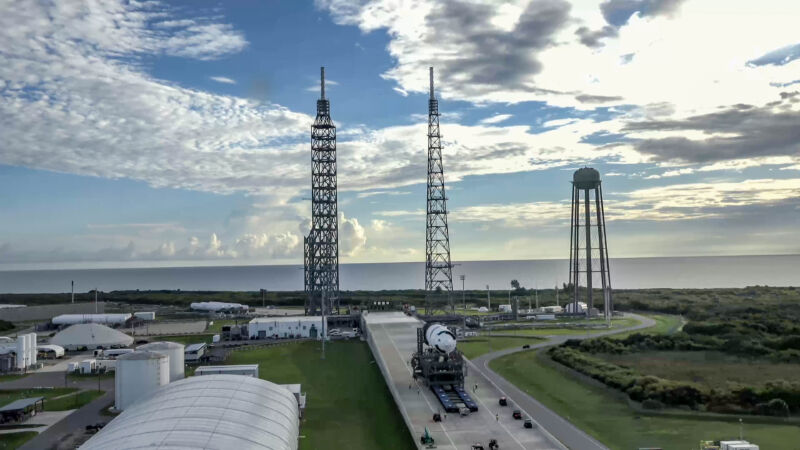
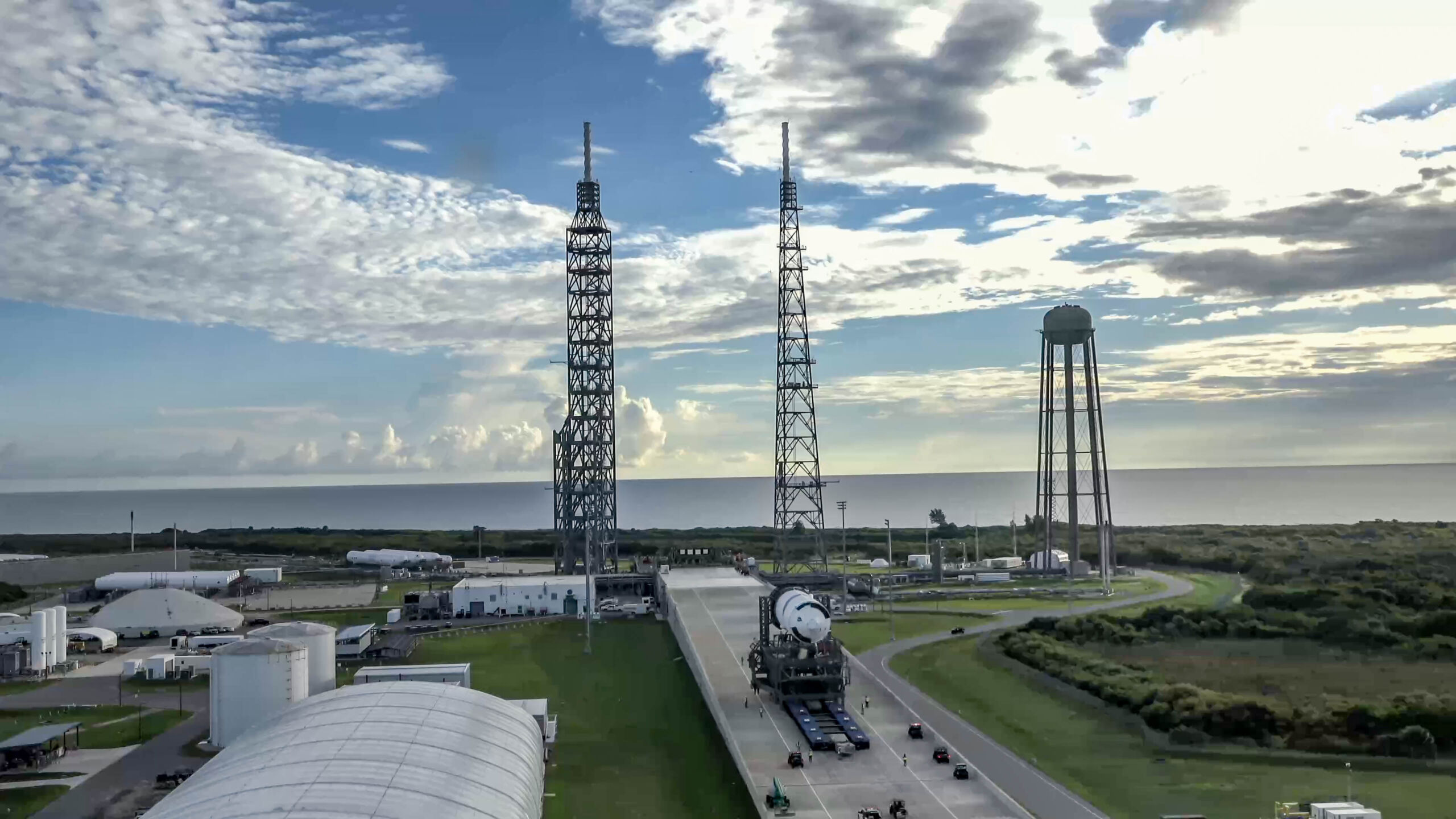
Enlarge/ The second stage of the New Glenn rocket rolls to the launch pad on Tuesday.
Blue Origin
Welcome to Edition 7.10 of the Rocket Report! It has been a big week for seeing new hardware from Blue Origin. We’ve observed the second stage of New Glenn rolling out to its launch pad in Florida, and the rocket’s first stage recovery ship, Jacklyn, arriving at a nearby port. It looks like the pieces are finally coming into place for the debut launch of the massive new rocket.
As always, we welcome reader submissions, and if you don’t want to miss an issue, please subscribe using the box below (the form will not appear on AMP-enabled versions of the site). Each report will include information on small-, medium-, and heavy-lift rockets as well as a quick look ahead at the next three launches on the calendar.
Vega rocket makes its final flight. The final flight of Europe’s Vega rocket lifted off Wednesday night from French Guiana, carrying an important environmental monitoring satellite for the European Union’s flagship Copernicus program, Ars reports. About an hour after liftoff, the Vega rocket’s upper stage released Sentinel-2C into an on-target orbit. Then, Sentinel-2C radioed its status to ground controllers, confirming the satellite was healthy in space. The Vega rocket will be replaced by the larger Vega-C rocket, with a more powerful booster stage and a wider payload fairing. One of the primary purposes of the Vega-C will be to launch future Copernicus satellites for Europe.
A mixed record of commercial success … “I think it was a great success,” said Giulio Ranzo, Avio’s CEO, in an interview with Ars a few hours before Wednesday night’s mission. “It was our first launcher. It was our first experience as a major player in the launcher domain.” However, in a dozen years of service, the Vega rocket never really took off in the commercial launch market. It averaged about two flights per year and primarily deployed satellites for the European Space Agency and other European government agencies, which prefer launching their payloads on European rockets.
ABL Space lays off staff. Launch vehicle developer ABL Space Systems has laid off a significant portion of its workforce, citing the need to reduce costs after the loss of a rocket in a static-fire test, Space News reports. In a post on LinkedIn on August 30, Harry O’Hanley, chief executive of ABL, said the company was laying off an unspecified number of people. The layoffs came after the company’s second RS1 rocket was lost in a fire after a static-fire test at the Pacific Spaceport Complex – Alaska on Kodiak Island on July 19.
Era of easy money ends … O’Hanley said in the email that the company had been working to reduce costs at the company even ahead of that test, citing changes in the market and access to capital. The company had raised several hundred million dollars, including $200 million in October 2021 and $170 million in March 2021. Hanley wrote that starting in 2023, “we cut costs and positioned the company for leaner operations with smaller teams, restrained hiring, and more conservative spending.” That was working, he said, until the static-fire incident. (submitted by brianrhurley and Ken the Bin)
The easiest way to keep up with Eric Berger’s space reporting is to sign up for his newsletter, we’ll collect his stories in your inbox.
So many un-spac-tacular results. A recent feature in Space News reviewed how the special purpose acquisition company, or SPAC, process has gone for several new space firms. Fortunes have been decidedly mixed for the space businesses that merged with publicly traded shell companies in search of capital as COVID-19 ravaged the economy, the publication says.
Launch does not fare well … “Wildly missed revenue projections from most of the class in their eagerness to drum up investor support for their SPAC merger have not helped their reputation,” the author, Jason Rainbow, writes. The list includes four launch companies: Virgin Galactic, Virgin Orbit, Astra, and Rocket Lab. Of these, Virgin Orbit has gone bankrupt, and Astra’s results were so disastrous that it went private again. Then there’s Virgin Galactic, a company whose shares publicly trade at $7, down nearly 90 percent from its peak during the pandemic. Only Rocket Lab gets a gold star for its post-SPAC performance.
New investor suit filed against Branson over Virgin Galactic. A newly unsealed lawsuit alleges that Richard Branson exploited bogus hype about the capabilities of Virgin Galactic’s spacecraft to make $1 billion worth of illegal insider stock sales, Bloomberg Law reports. A shareholder sued Branson, saying he spent years misleading the public about the readiness of Virgin Galactic’s flagship space tourism vessel, Unity, then dumped “massive portions of his stock” across 2020 and 2021. The sales included $300 million in August 2021, shortly after Branson flew on the spaceship. Branson founded Virgin Galactic about two decades ago.
Branson says suit is meritless … “Despite the near misses, loss of life, and questionable safety record, Branson was determined to be the first billionaire in space” so he could “secure billionaire bragging rights” and try to bail out a travel business empire that lost nearly $1.9 billion during the COVID-19 pandemic, the suit says. Branson and Virgin Galactic disputed the court claims in separate statements Wednesday. Branson called the claims meritless through a spokesperson, saying he would “vigorously defend against them.” The case involves shareholder derivative claims, which are technically brought on a corporation’s behalf against its leaders or owners.
MaiaSpace working toward stage testing. French launch firm MaiaSpace has announced that it is preparing to conduct the first hot fire test of the upper stage of its Maia rocket in 2025, European Spaceflight reports. The company is developing a partially reusable two-stage rocket called Maia that will be capable of delivering payloads of up to 1,500 kilograms when launched in an expandable configuration. For both of its stages, the rocket will use Prometheus rocket engines, which are being developed by ArianeGroup under a European Space Agency contract.
Is it new space or old space? … MaiaSpace is an interesting company. It positions itself as a launch startup, but it is also a wholly owned subsidiary of ArianeGroup, which is as traditional a launch company as can be. The rocket’s first stage will essentially be the Themis reusable booster demonstrator, which is also being developed by ArianeGroup under an ESA contract. (submitted by Ken the Bin)
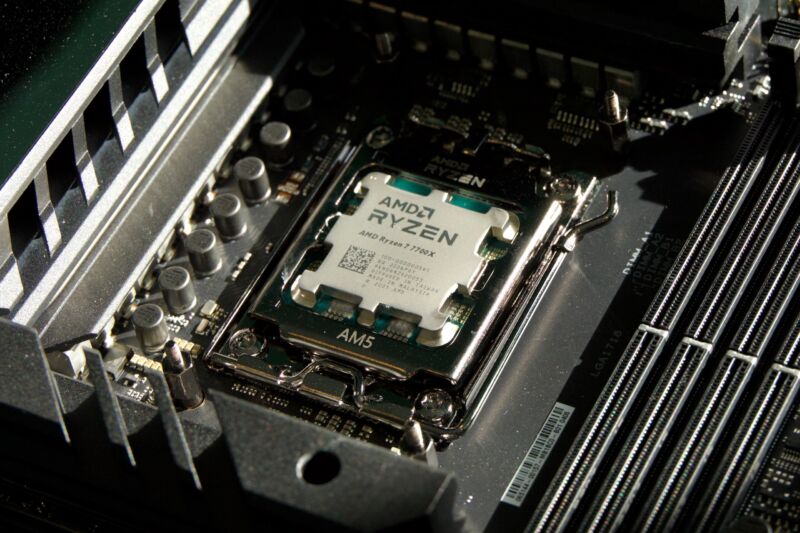
But that doesn’t make it a bad time to buy a PC, especially if you’re looking for some cost-efficient builds. Prices of CPUs and GPUs have both fallen a fair bit since we did our last build guide a year or so ago, which means all of our builds are either cheaper than they were before or we can squeeze out a little more performance than before at similar prices.
We have six builds across four broad tiers—a budget office desktop, a budget 1080p gaming PC, a mainstream 1440p-to-4K gaming PC, and a price-conscious workstation build with a powerful CPU and lots of room for future expandability.
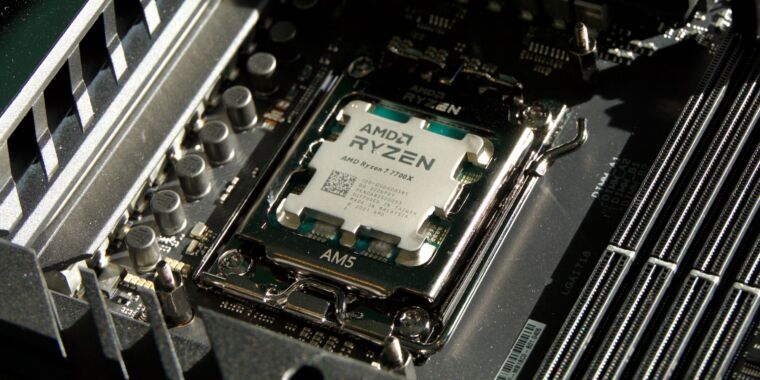
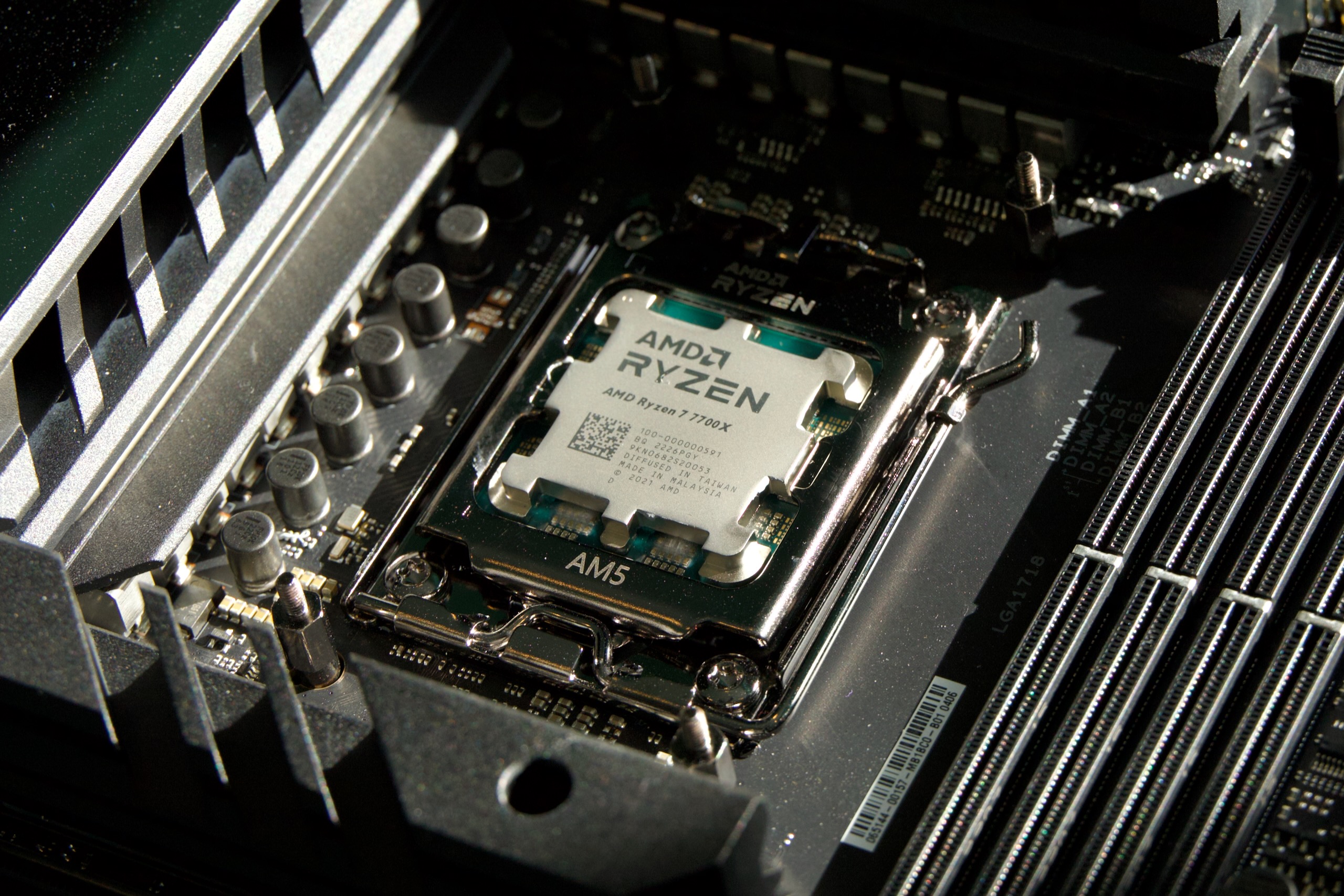
You won’t find a high-end “god box” this time around, though; for a money-is-no-object high-end build, it’s probably worth waiting for Intel’s upcoming Arrow Lake desktop processors, AMD’s expected Ryzen 9000X3D series, and whatever Nvidia’s next-generation GPU launch is. All three of those things are expected either later this year or early next.
We have a couple of different iterations of the more expensive builds, and we also suggest multiple alternate components that can make more sense for certain types of builds based on your needs. The fun of PC building is how flexible and customizable it is—whether you want to buy what we recommend and put it together or want to treat these configurations as starting points, hopefully, they give you some idea of what your money can get you right now.
Notes on component selection
Part of the fun of building a PC is making it look the way you want. We’ve selected cases that will physically fit the motherboards and other parts we’re recommending and which we think will be good stylistic fits for each system. But there are many cases out there, and our picks aren’t the only options available.
As for power supplies, we’re looking for 80 Plus certified power supplies from established brands with positive user reviews on retail sites (or positive professional reviews, though these can be somewhat hard to come by for any given PSU these days). If you have a preferred brand, by all means, go with what works for you. The same goes for RAM—we’ll recommend capacities and speeds, and we’ll link to kits from brands that have worked well for us in the past, but that doesn’t mean they’re better than the many other RAM kits with equivalent specs.
For SSDs, we mostly stick to drives from known brands like Samsung, Crucial, or Western Digital, though going with a lesser-known brand can save you a bit of money. All of our builds also include built-in Bluetooth and Wi-Fi, so you don’t need to worry about running Ethernet wires and can easily connect to Bluetooth gamepads, keyboards, mice, headsets, and other accessories.
We also haven’t priced in peripherals, like webcams, monitors, keyboards, or mice, as we’re assuming most people will re-use what they already have or buy those components separately. If you’re feeling adventurous, you could even make your own DIY keyboard! If you need more guidance, Kimber Streams’ Wirecutter keyboard guides are exhaustive and educational.
Finally, we won’t be including the cost of a Windows license in our cost estimates. You can pay a lot of different prices for Windows—$139 for an official retail license from Microsoft, $120 for an “OEM” license for system builders, or anywhere between $15 and $40 for a product key from shady gray market product key resale sites. Windows 10 keys will also work to activate Windows 11, though Microsoft stopped letting old Windows 7 and Windows 8 keys activate new Windows 10 and 11 installs relatively recently. You could even install Linux, given recent advancements to game compatibility layers!