Author name: Paul Patrick

framework-gives-its-13-inch-laptop-another-boost-with-ryzen-ai-300-cpu-update

Framework gives its 13-inch Laptop another boost with Ryzen AI 300 CPU update

Framework announced two new systems to its lineup today: the convertible Framework 12 and a gaming-focused (but not-very-upgradeable) mini ITX Framework Desktop PC. But it’s continuing to pay attention to the Framework Laptop 13, too—the company’s first upgrade-friendly repairable laptop is getting another motherboard update, this time with AMD’s latest Ryzen AI 300-series processors. It’s Framework’s second AMD Ryzen-based board, following late 2023’s Ryzen 7040-based refresh.

The new boards are available for preorder today and will begin shipping in April. Buyers new to the Framework ecosystem can buy a laptop, which starts at $1,099 as a pre-built system with an OS, storage, and RAM included, or $899 for a build-it-yourself kit where you add those components yourself. Owners of Framework Laptops going all the way back to the original 11th-generation Intel version can also buy a bare board to drop into their existing systems; these start at $449.

Framework will ship six- and eight-core Ryzen AI 300 processors on lower-end configurations, most likely the Ryzen AI 5 340 and Ryzen AI 7 350 that AMD announced at CES in January. These chips include integrated Radeon 840M and 860M GPUs with four and eight graphics cores, respectively.

People who want to use the Framework Laptop as a thin-and-light portable gaming system will want to go for the top-tier Ryzen AI 9 HX 370, which includes 12 CPU cores and a Radeon 890M with 16 GPU cores. We’ve been impressed by this chip’s performance when we’ve seen it in other systems, though Framework’s may be a bit slower because it’s using slower socketed DDR5 memory instead of soldered-down RAM. This is a trade-off that Framework’s target customers are likely to be fine with.
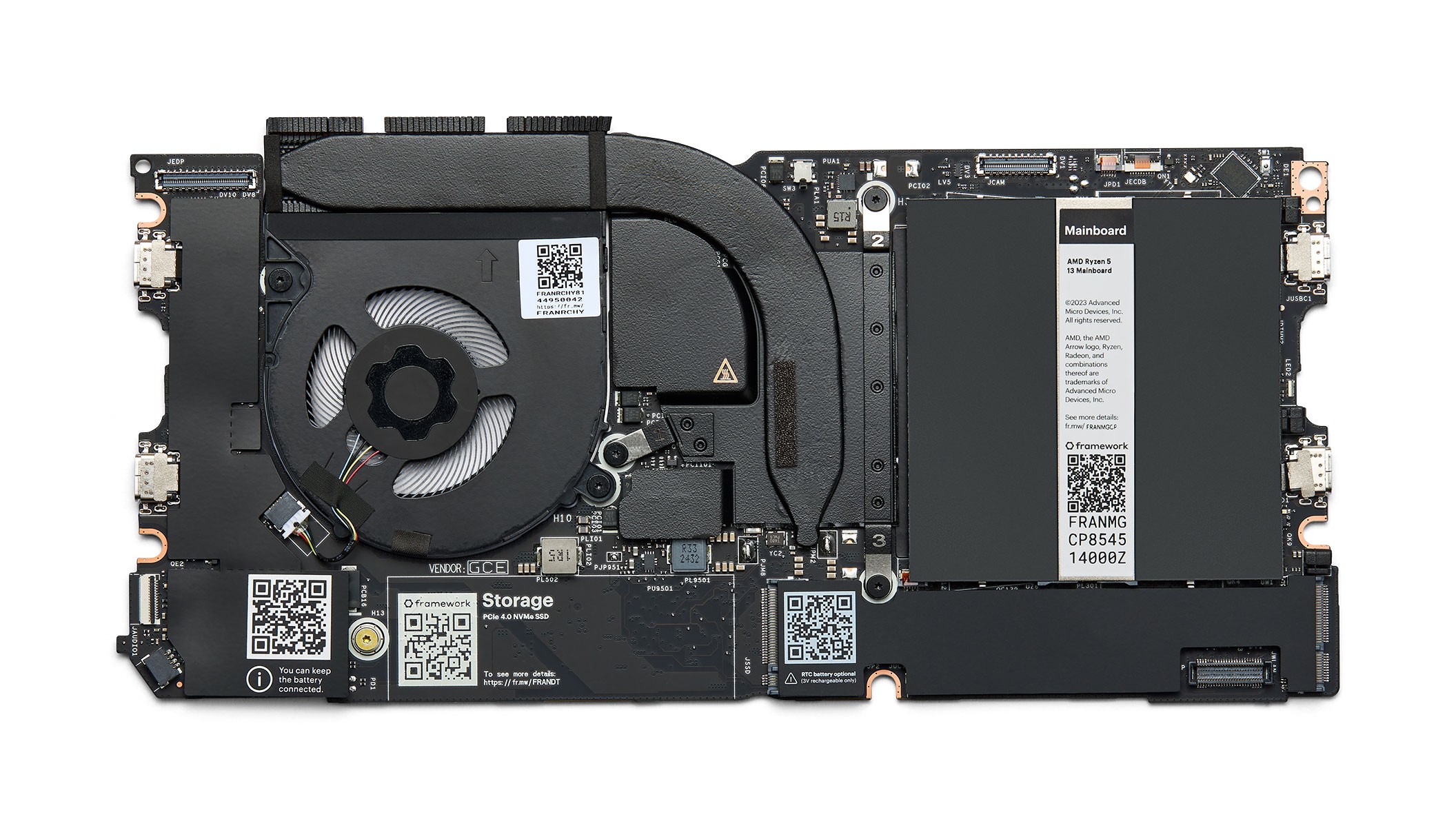
The Ryzen AI 300-series motherboard. Framework says an updated heatpipe design helps to keep things cool. Credit: Framework

One of the issues with the original Ryzen Framework board was that the laptop’s four USB-C ports didn’t all support the same kinds of expansion cards, limiting the laptop’s customizability somewhat. That hasn’t totally gone away with the new version—the two rear USB ports support full 40Gbps USB4 speeds, while the front two are limited to 10Gbps USB 3.2—but all four ports do support display output instead of just three.

Framework gives its 13-inch Laptop another boost with Ryzen AI 300 CPU update Read More »
framework’s-first-desktop-is-a-strange—but-unique—mini-itx-gaming-pc

Framework’s first desktop is a strange—but unique—mini ITX gaming PC

In Framework’s first-party case, the PC starts at $1,099, which gets you a Ryzen AI Max 385 (that’s an 8-core CPU and 32 GPU cores) and 32GB of RAM. A fully loaded 128GB with a Ryzen AI Max+ 395 configuration (16 CPU cores, 40 GPU cores) will run you $1,999. There’s also an in-between build with the Ryzen AI Max+ 395 chip and 64GB of RAM for $1,599. If you just want the mini ITX board to put in a case of your choosing, that starts at $799.

None of these are impulse buys, exactly, but they’re priced a bit better than a gaming-focused mini PC like the Asus ROG NUC, which starts at nearly $1,300 as of this writing and comes with half as much RAM. It’s also priced well compared to what you can get out of a DIY mini ITX PC based on integrated graphics—the Ryzen 7 8700G, an AM5 ITX motherboard, and 32GB of DDR5 can all be had for around $500 collectively before you add a case, power supply, or SSD, but for considerably slower performance.

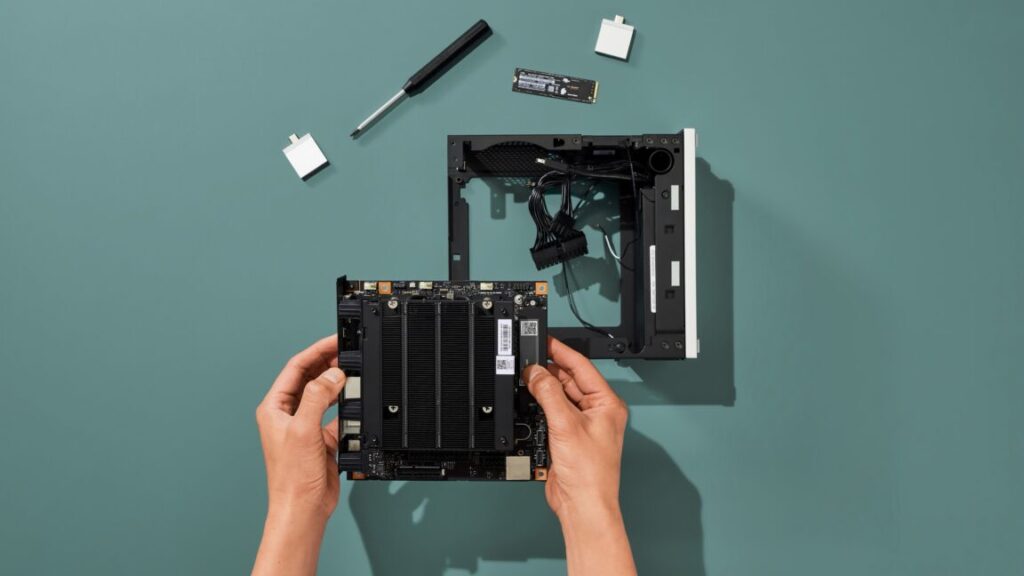
The volume of the Framework Desktop’s first-party case is just 4.5 liters—for reference, the SSUPD Meshroom S is 14.9 liters, a fairly middle-of-the-road volume for an ITX case that can fit a full-size GPU. An Xbox Series X is about 6.9 liters, and the Xbox Series S is 4.4 liters. Apple’s Mac Studio is about 3.7 liters. The Framework Desktop isn’t breaking records, but it’s definitely tiny.

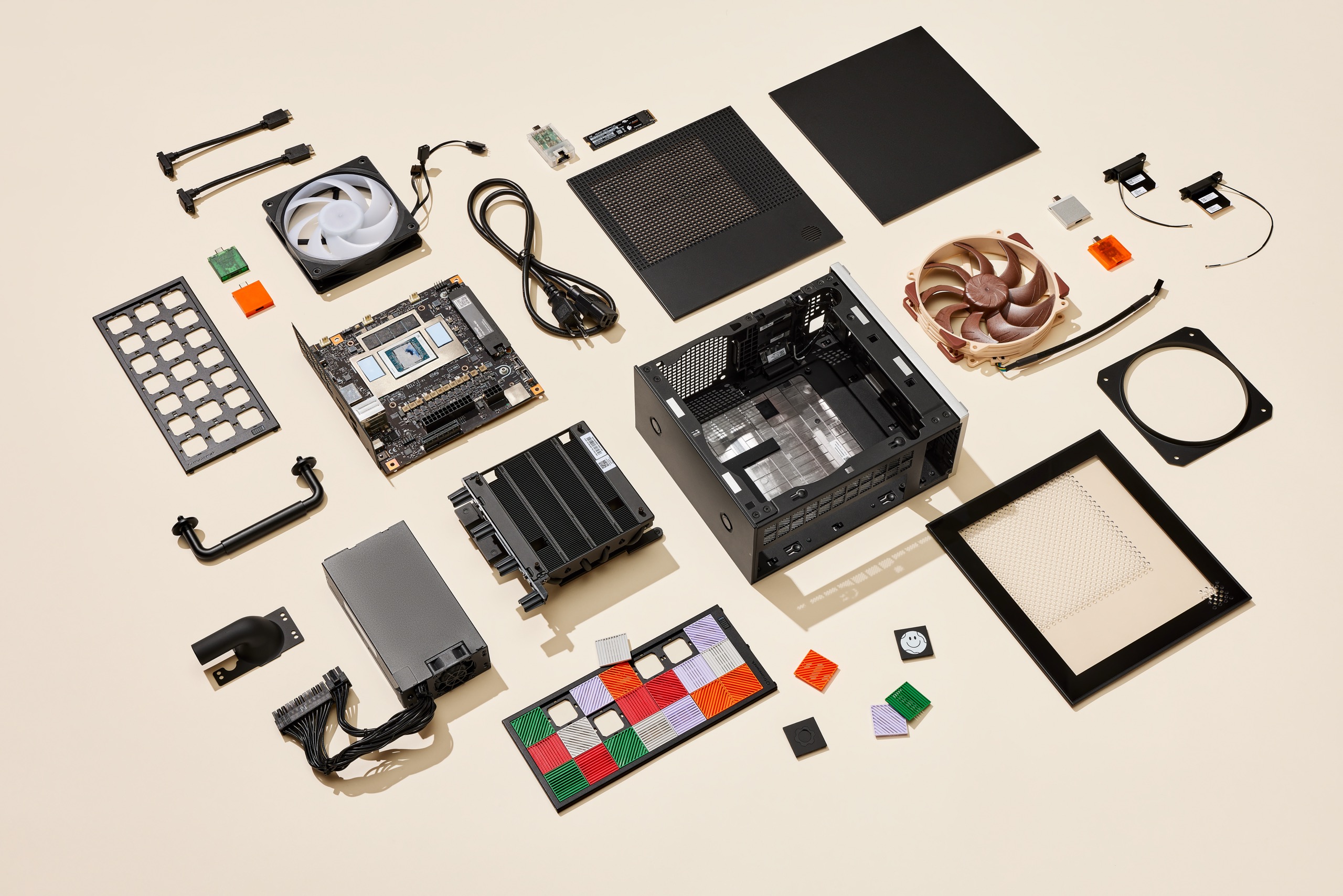
Despite the non-upgradeability of the main components, Framework has tried to stick to existing standards where it can by using a flex ATX power supply, ATX headers on the motherboard, regular 120 mm fans that can be changed out, and of course the mini ITX form factor itself. Credit: Framework

So the pitch for the system is easy: You get a reasonably powerful 1440p-capable gaming and workstation PC inside a case the size of a small game console. “If the Series S could run Windows, I’d buy it in a second” is a thought that has occurred to me, so I can see the appeal, even though it costs at least three times as much.

But it does feel like a strange fit for Framework, given that it’s so much less upgradeable than most PCs. The CPU and GPU are one piece of silicon, and they’re soldered to the motherboard. The RAM is also soldered down and not upgradeable once you’ve bought it, setting it apart from nearly every other board Framework sells.

Framework’s first desktop is a strange—but unique—mini ITX gaming PC Read More »

hands-on:-this-3.5-inch-smart-display-makes-my-digital-calendars-more-digestible

Hands-on: This 3.5-inch smart display makes my digital calendars more digestible

My preferred methods of organizing my schedule could be considered dated, so when I got a chance to try out a gadget meant to streamline my various digital calendars, I took it.

While I do use digital calendars and to-do lists, my go-to method for organizing my day’s tasks, goals, and upcoming events is pen and paper. I use paper calendars in agendas for a visual layout of events, including those as far away as next month. They give me a sense of control, as I’m able to highlight, circle, draw arrows, underline, erase, and so on. I also write more to-do lists than might be considered efficient (as evidenced by “make to-do list” being a frequent line on my to-do lists).

But there are many benefits to using tech for staying organized, too. With digital options, I can easily check my availability on the go with my phone and get alerts to remind me of events.

But it’s hard to find a simple, stripped-down tech solution to put my work calendar, work goals, personal calendar, and personal to-do lists in one place while minimizing distraction. When checking what time I set aside to work out, for example, I typically don’t want to think about whether the event is recurring, who else knows about it, what “type” of event it is, or how many minutes before, during, and after the event I’ll get phone alerts about it. Those details are often valuable for creating a highly informative digital calendar, but they can also be distracting and result in information overload.

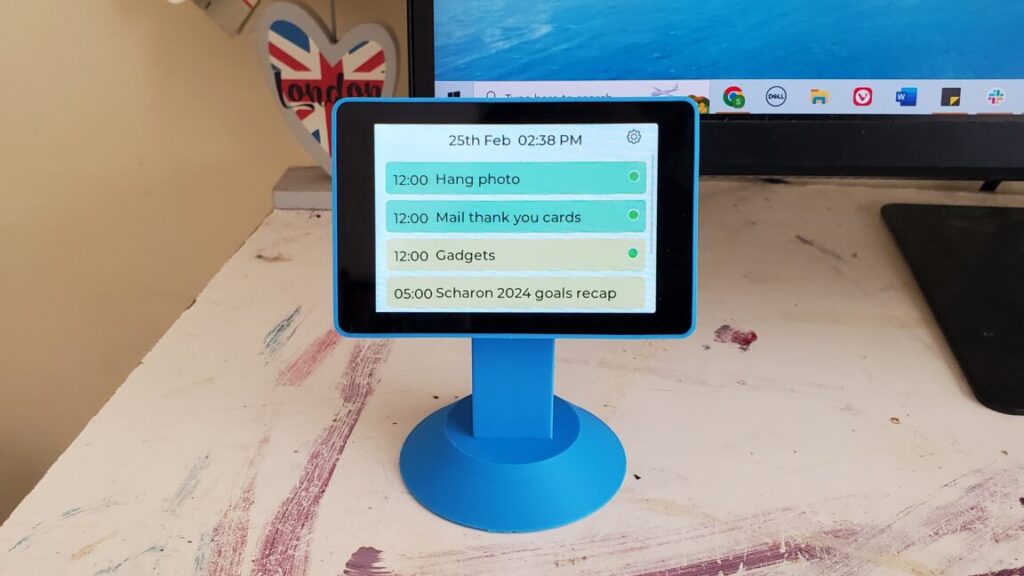
Enter a smart display called DeskBuddy. The 3.5-inch touchscreen device has essentially one capability: showing today’s events from your synced digital calendars. Blueberry Consultants, a custom software development firm headquartered in Birmingham, England, crowdfunded the desktop accessory via Kickstarter in December 2023 and currently sells it online, including on Etsy.

Hands-on: This 3.5-inch smart display makes my digital calendars more digestible Read More »

sec’s-“scorched-earth”-lawsuit-against-coinbase-to-be-dropped,-company-says

SEC’s “scorched-earth” lawsuit against Coinbase to be dropped, company says

On Friday, a Coinbase executive declared the “war against crypto” over—”at least as it applies to Coinbase.”

According to Coinbase Chief Legal Officer Paul Grewal, the US Securities and Exchange Commission (SEC) plans to drop its lawsuit against the largest US cryptocurrency exchange as the agency shifts to embrace Donald Trump’s new approach to regulating cryptocurrency in the US.

The SEC sued Coinbase in 2023, accusing Coinbase of “operating its crypto asset trading platform as an unregistered national securities exchange, broker, and clearing agency” and “failing to register the offer and sale of its crypto asset staking-as-a-service program.”

“Since at least 2019, Coinbase has made billions of dollars unlawfully facilitating the buying and selling of crypto asset securities,” the SEC alleged.

At that time, the SEC claimed that Coinbase’s supposedly dodgy operations were depriving investors of “significant protections, including inspection by the SEC, recordkeeping requirements, and safeguards against conflicts of interest, among others.” The litigation was intended to protect Coinbase customers, the SEC said, by holding Coinbase to the same standards as any service acting as an exchange, broker, or clearing agency.

Former SEC Chair Gary Gensler, long considered an adversary in the crypto industry, had warned that Coinbase “deliberately” flouted rules to cheat investors out of protections for financial gain. That left customers exposed to risks, Gensler claimed, and allowed for insider trading that resulted in a settlement.

“You simply can’t ignore the rules because you don’t like them or because you’d prefer different ones: the consequences for the investing public are far too great,” Gensler said.

SEC’s “scorched-earth” lawsuit against Coinbase to be dropped, company says Read More »

nvidia-geforce-rtx-5070-ti-review:-an-rtx-4080-for-$749,-at-least-in-theory

Nvidia GeForce RTX 5070 Ti review: An RTX 4080 for $749, at least in theory


may the odds be ever in your favor

It’s hard to review a product if you don’t know what it will actually cost!

The Asus Prime GeForce RTX 5070 Ti. Credit: Andrew Cunningham

The Asus Prime GeForce RTX 5070 Ti. Credit: Andrew Cunningham

Nvidia’s RTX 50-series makes its first foray below the $1,000 mark starting this week, with the $749 RTX 5070 Ti—at least in theory.

The third-fastest card in the Blackwell GPU lineup, the 5070 Ti is still far from “reasonably priced” by historical standards (the 3070 Ti was $599 at launch). But it’s also $50 cheaper and a fair bit faster than the outgoing 4070 Ti Super and the older 4070 Ti. These are steps in the right direction, if small ones.

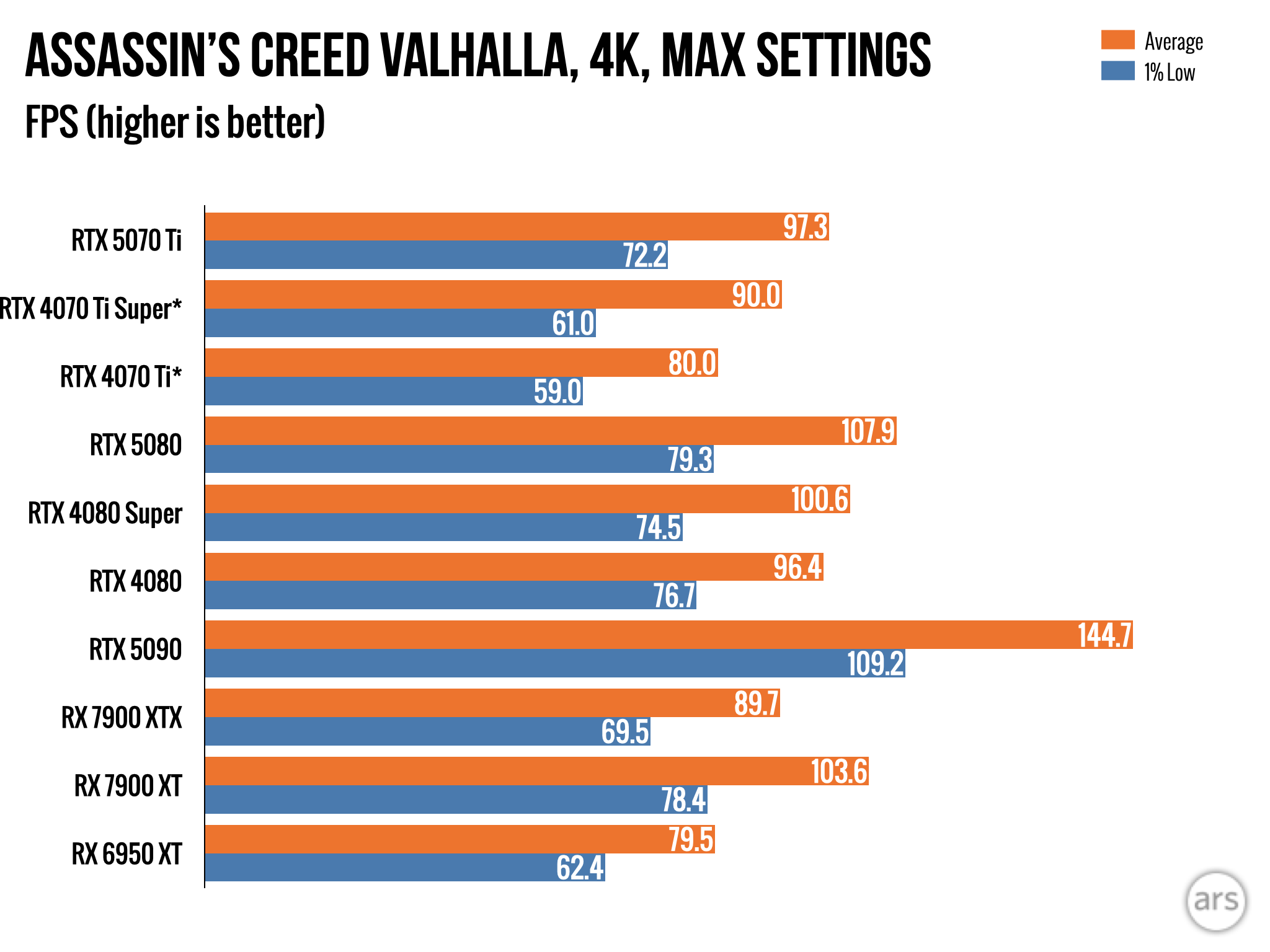
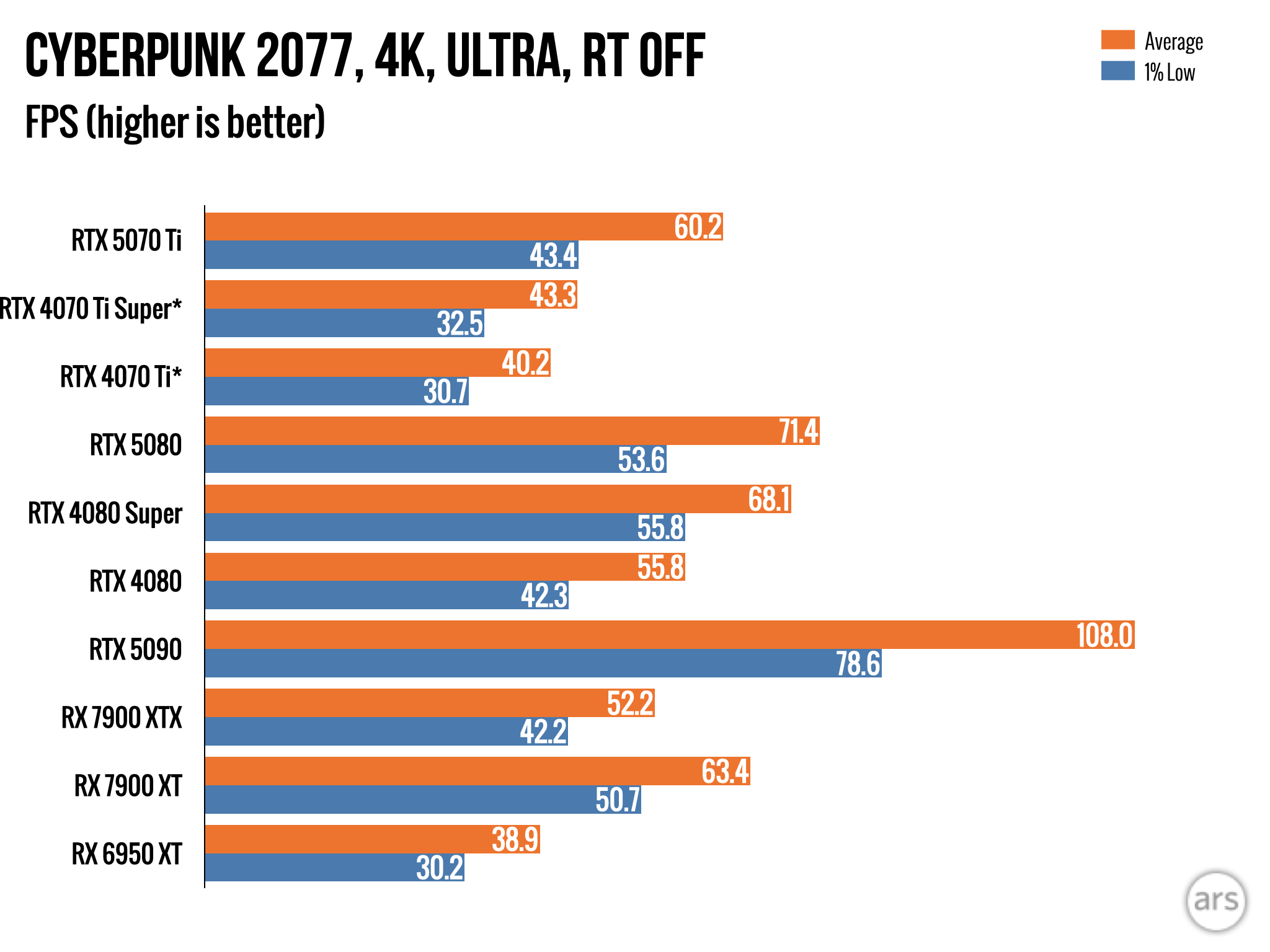
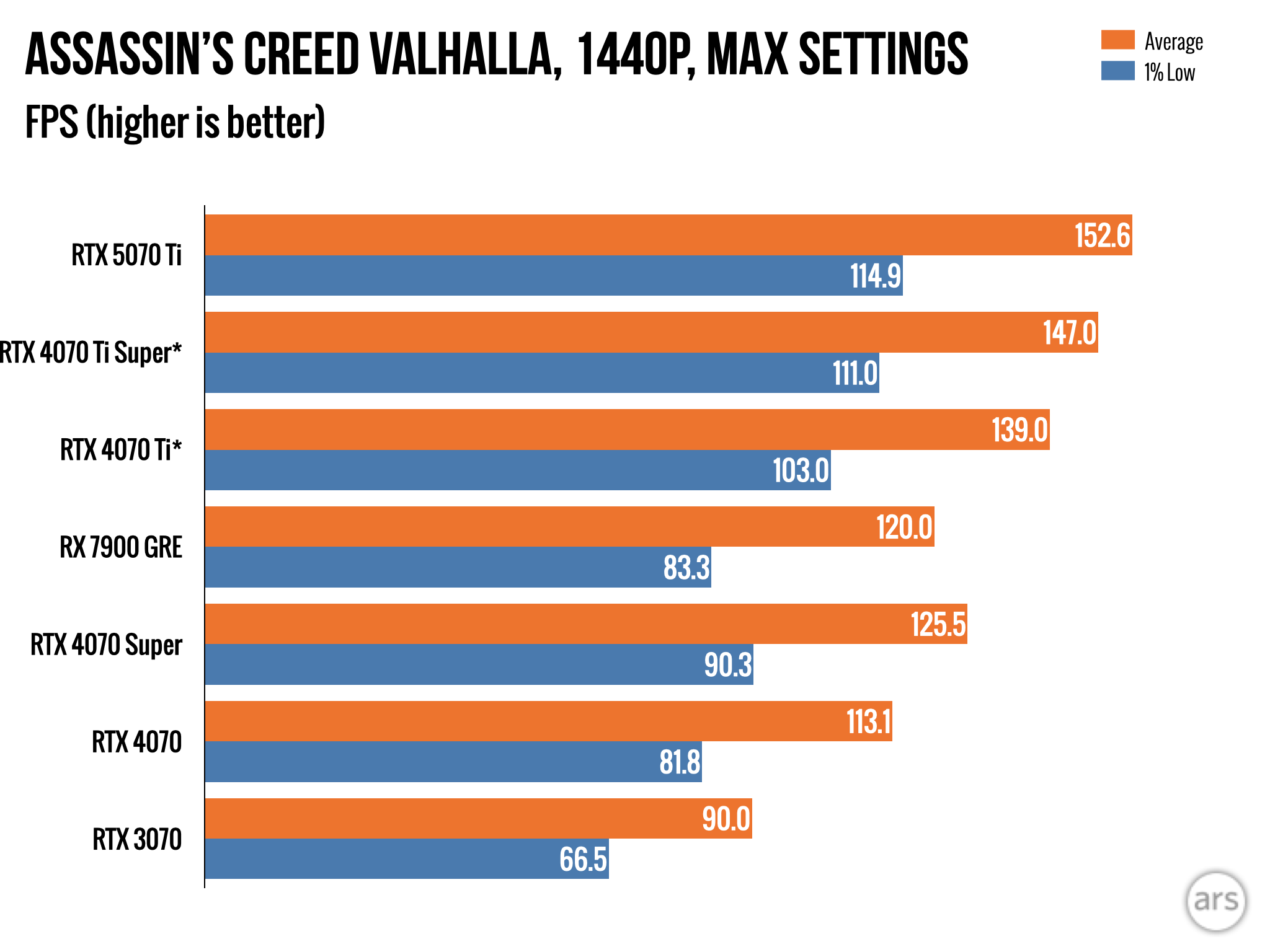
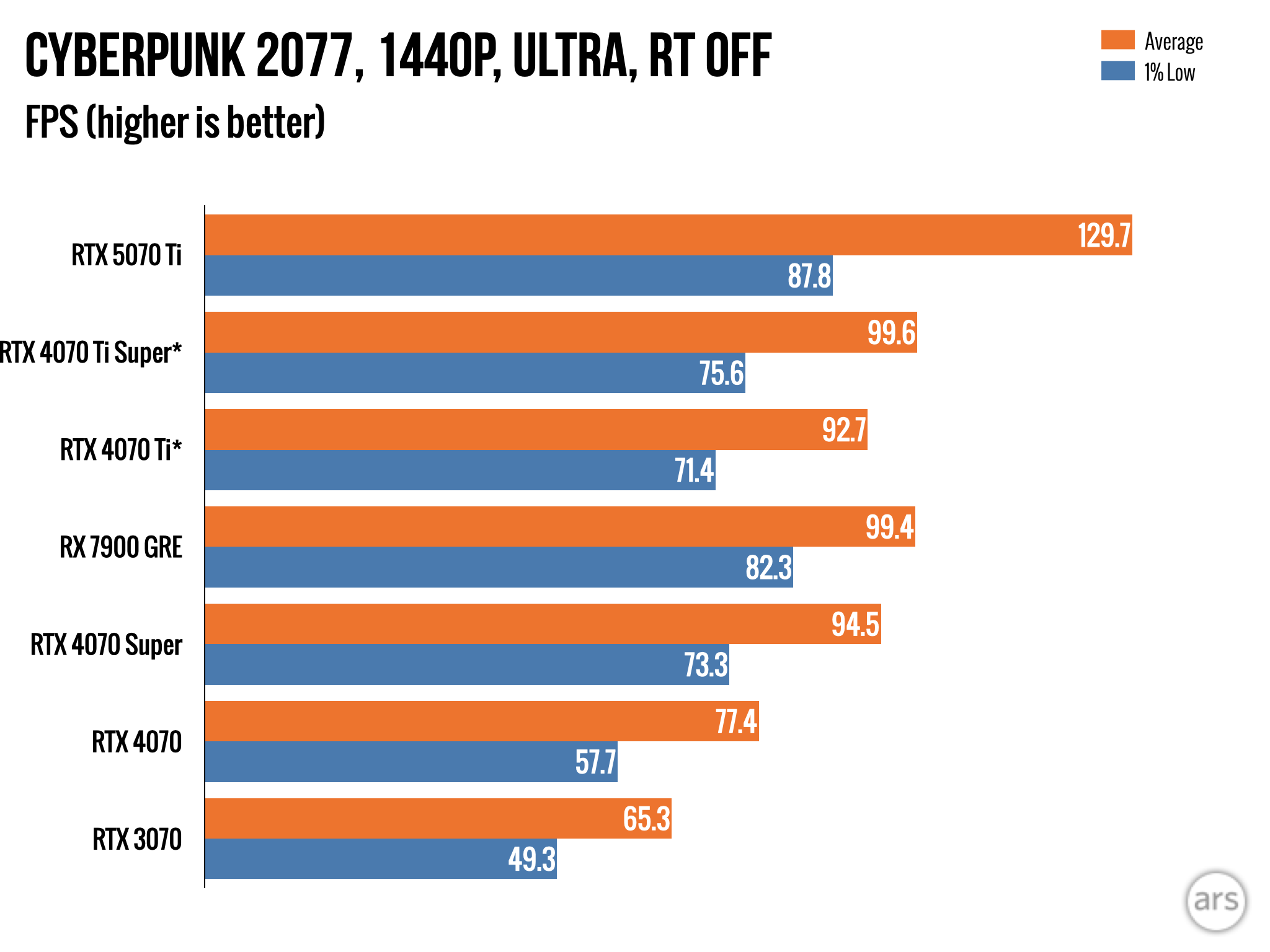
We’ll talk more about its performance shortly, but at a high level, the 5070 Ti’s performance falls in the same general range as the 4080 Super and the original RTX 4080, a card that launched for $1,199 just over two years ago. And it’s probably your floor for consistently playable native 4K gaming for those of you out there who don’t want to rely on DLSS or 4K upscaling to hit that resolution (it’s also probably all the GPU that most people will need for high-FPS 1440p, if that’s more your speed).

But it’s a card I’m ambivalent about! It’s close to 90 percent as fast as a 5080 for 75 percent of the price, at least if you go by Nvidia’s minimum list prices, which for the 5090 and 5080 have been mostly fictional so far. If you can find it at that price—and that’s a big “if,” since every $749 model is already out of stock across the board at Newegg—and you’re desperate to upgrade or are building a brand-new 4K gaming PC, you could do worse. But I wouldn’t spend more than $749 on it, and it might be worth waiting to see what AMD’s first 90-series Radeon cards look like in a couple weeks before you jump in.

Meet the GeForce RTX 5070 Ti

RTX 5080 RTX 4080 Super RTX 5070 Ti RTX 4070 Ti Super RTX 4070 Ti RTX 5070
CUDA Cores 10,752 10,240 8,960 8,448 7,680 6,144
Boost Clock 2,617 MHz 2,550 MHz 2,452 MHz 2,610 MHz 2,610 MHz 2,512 MHz
Memory Bus Width 256-bit 256-bit 256-bit 256-bit 192-bit 192-bit
Memory Bandwidth 960 GB/s 736 GB/s 896 GB/s 672 GB/s 504 GB/s 672 GB/s
Memory size 16GB GDDR7 16GB GDDR6X 16GB GDDR7 16GB GDDR6X 12GB GDDR6X 12GB GDDR7
TGP 360 W 320 W 300 W 285 W 285 W 250 W

Nvidia isn’t making a Founders Edition version of the 5070 Ti, so this time around our review unit is an Asus Prime GeForce RTX 5070 Ti provided by Asus and Nvidia. These third-party cards will deviate a little from the stock specs listed above, but factory overclocks tend to be inordinately mild, and done mostly so the GPU manufacturer can slap a big “overclocked” badge somewhere on the box. We tested this Asus card with its BIOS switch set to “performance” mode, which elevates the boost clock by an entire 30 MHz; you don’t need to be a math whiz to guess that a 1.2 percent overclock is not going to change performance much.

Compared to the 4070 Ti Super, the 5070 Ti brings two things to the table: a roughly 6 percent increase in CUDA cores and a 33 percent increase in memory bandwidth, courtesy of the switch from GDDR6X to GDDR7. The original 4070 Ti had even fewer CUDA cores, but most importantly for its 4K performance included just 12GB of memory on a 192-bit bus.

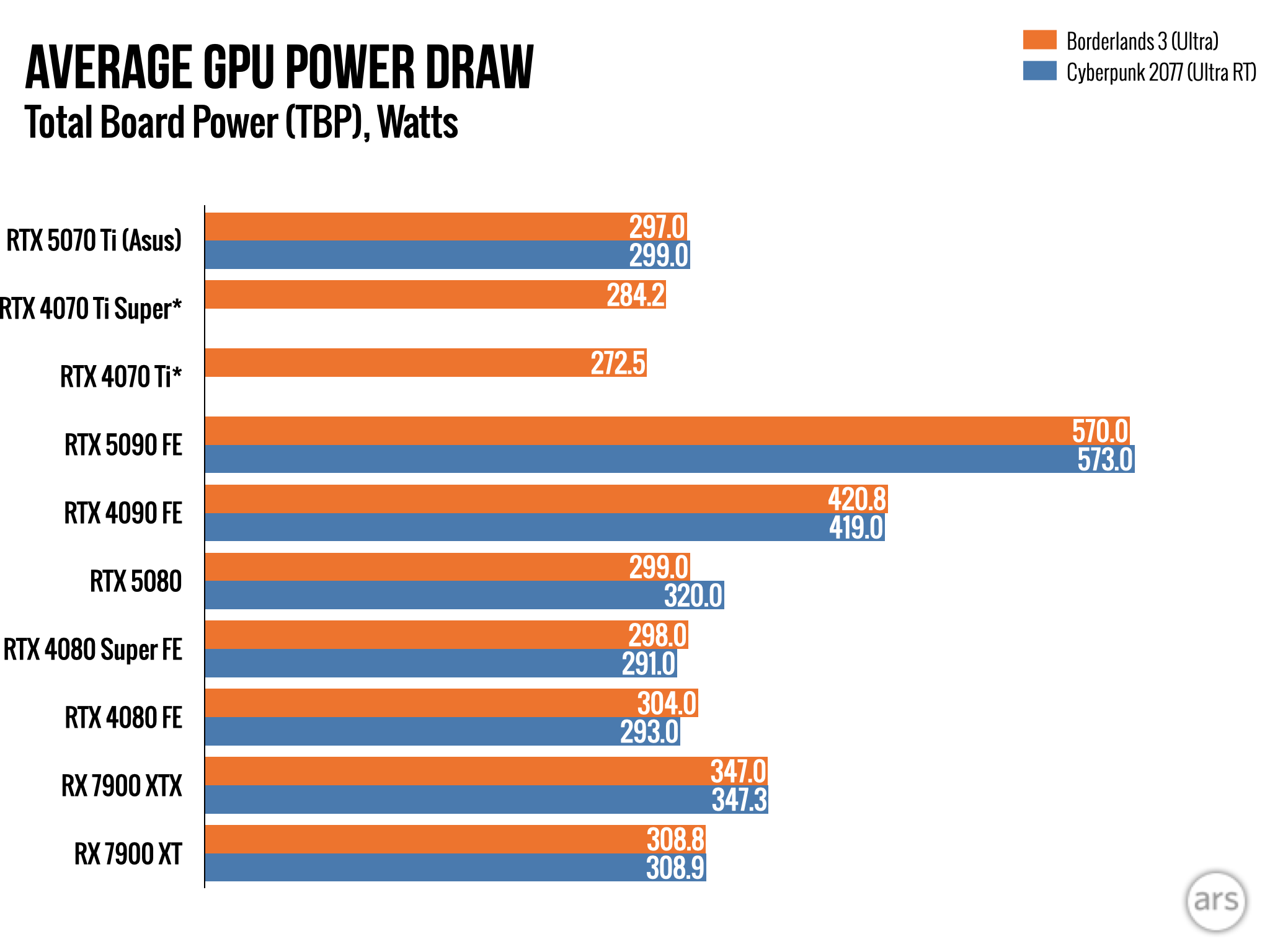
The 5070 Ti is based on the same GB203 GPU silicon as the 5080 series, but with 1,792 CUDA cores disabled. But there are a lot of similarities between the two, including the 16GB bank of GDDR7 and the 256-bit memory bus. It looks nothing like the yawning gap between the RTX 5090 and the RTX 5080, and the two cards’ similar-ish specs meant they weren’t too far away from each other in our testing. The 5070 Ti’s 300 W power requirement is also a bit lower than the 5080’s 360 W, but it’s pretty close to the 4080 and 4080 Super’s 320 W; in practice, the 5070 Ti draws about as much as the 4080 cards do under load.

Asus’ design for its Prime RTX 5070 Ti is an inoffensive 2.5-slot, triple-fan card that should fit without a problem in most builds. Credit: Andrew Cunningham

As a Blackwell GPU, the 5070 Ti also supports Nvidia’s most-hyped addition to the 50-series: support for DLSS 4 and Multi-Frame Generation (MFG). We’ve already covered this in our 5090 and 5080 reviews, but the short version is that MFG works exactly like Frame Generation did in the 40-series, except that it can now insert up to three AI-generated frames in between natively rendered frames instead of just one.

Especially if you’re already running at a reasonably high frame rate, this can make things look a lot smoother on a high-refresh-rate monitor without introducing distractingly excessive lag or weird rendering errors. The feature is mainly controversial because Nvidia is comparing 50-series performance numbers with DLSS MFG enabled to older 40-series cards without DLSS MFG to make the 50-series cards seem a whole lot faster than they actually are.

We’ll publish some frame-generation numbers in our review, both using DLSS and (for AMD cards) FSR. But per usual, we’ll continue to focus on natively rendered performance—more relevant for all the games out there that don’t support frame generation or don’t benefit much from it, and more relevant because your base performance dictates how good your generated frames will look and feel anyway.

Testbed notes

We tested the 5070 Ti in the same updated testbed and with the same updated suite of games that we started using in our RTX 5090 review. The heart of the build is an AMD Ryzen 9800X3D, ensuring that our numbers are limited as little as possible by the CPU speed.

Per usual, we prioritize testing GPUs at resolutions that we think most people will use them for. For the 5070 Ti, that means both 4K and 1440p—this card is arguably still overkill for 1440p, but if you’re trying to hit 144 or 240 Hz (or even more) on a monitor, there’s a good case to be made for it. We also use a mix of ray-traced and non-ray-traced games. For the games we test with upscaling enabled, we use DLSS on Nvidia cards and the newest supported version of FSR (usually 2.x or 3.x) for AMD cards.

Though we’ve tested and re-tested multiple cards with recent drivers in our updated testbed, we don’t have a 4070 Ti Super, 4070 Ti, or 3070 Ti available to test with. We’ve provided some numbers for those GPUs from past reviews; these are from a PC running older drivers and a Ryzen 7 7800X3D instead of a 9800X3D, and we’ve put asterisks next to them in our charts. They should still paint a reasonably accurate picture of the older GPUs’ relative performance, but take them with that small grain of salt.

Performance and power

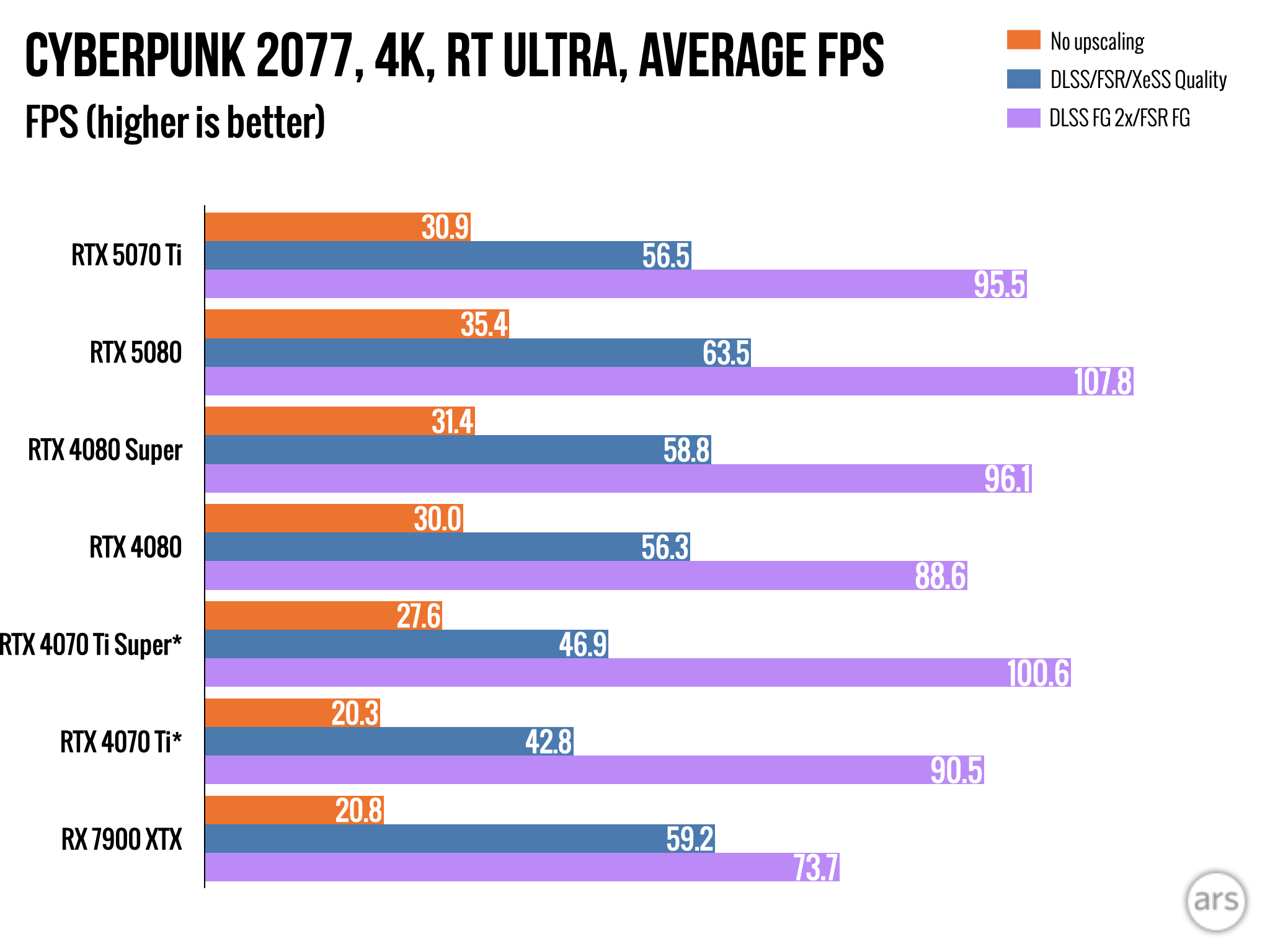
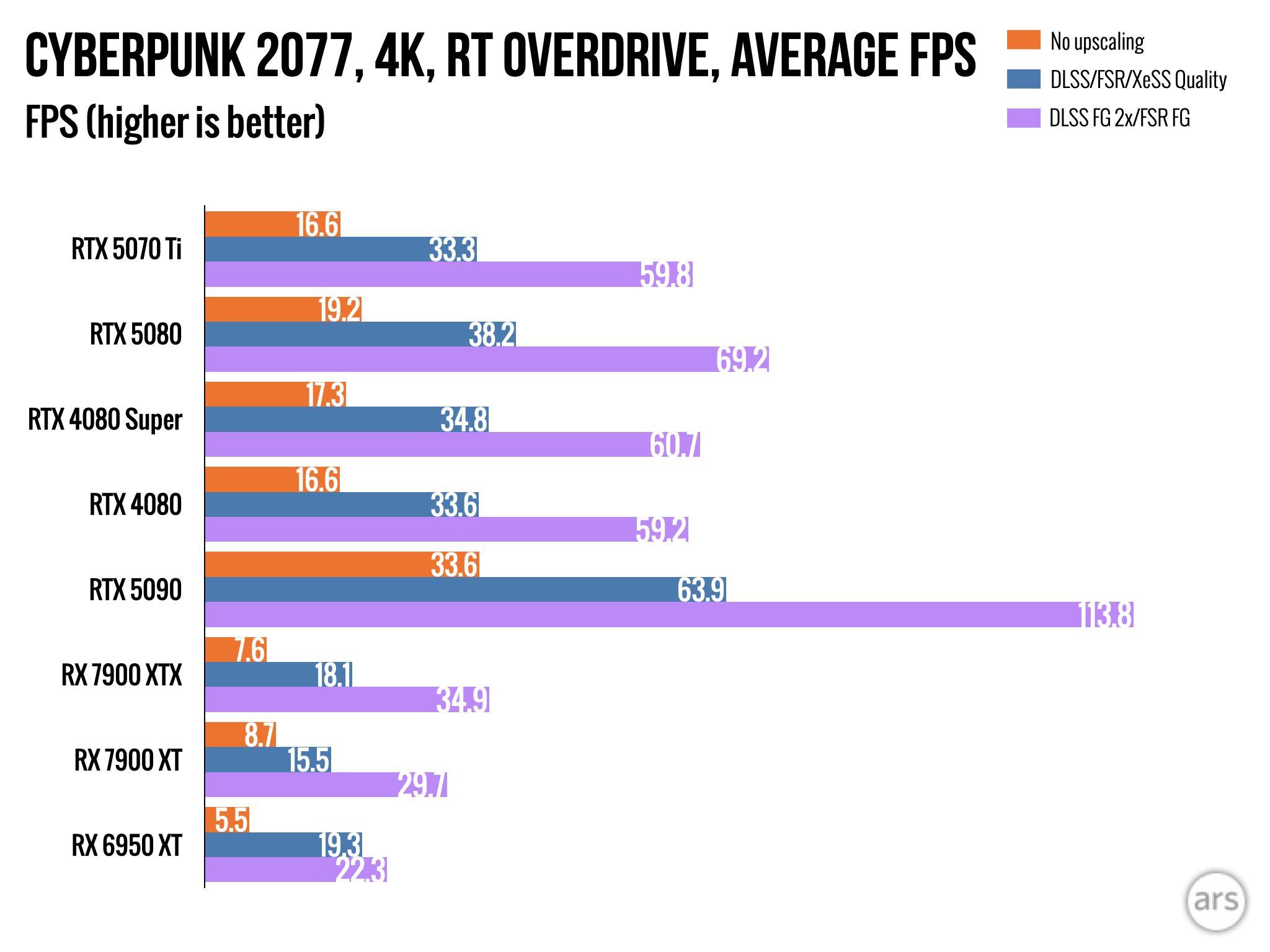
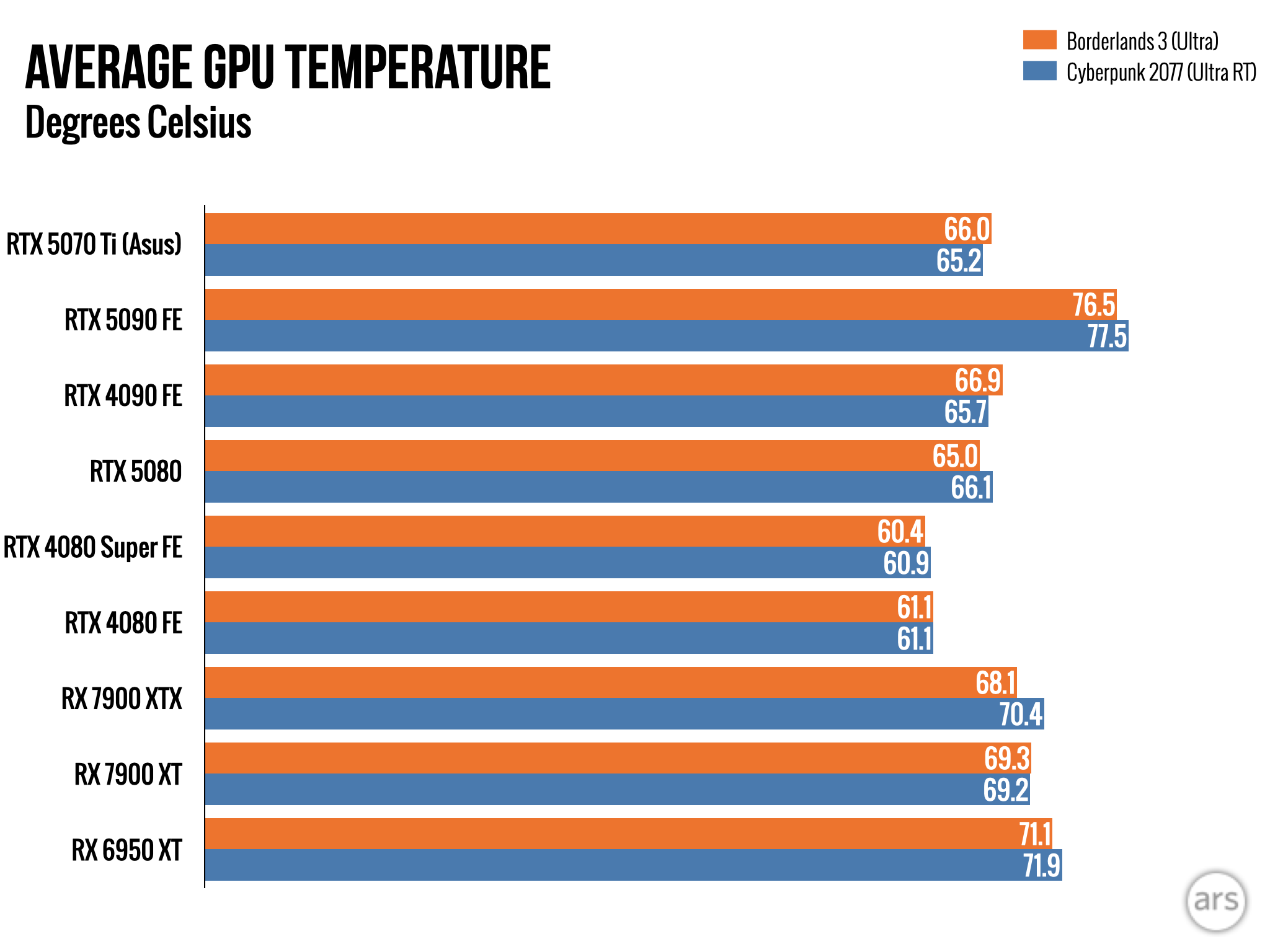
Despite including fewer CUDA cores than either version of the 4080, some combination of architectural improvements and memory bandwidth increases help the card keep pace with both 4080 cards almost perfectly. In most of our tests, it landed in the narrow strip right in between the 4080 and the 4080 Super, and its power consumption under load was also almost identical.

Benchmarks with DLSS/FSR and/or frame generation enabled.

In every way that matters, the 5070 Ti is essentially an RTX 4080 that also supports DLSS Multi-Frame Generation. You can see why we’d be mildly enthusiastic about it at $749 but less and less impressed the closer the price creeps to $1,000.

Being close to a 4080 also means that the performance gap between the 5070 Ti and the 5080 is usually pretty small. In most of the games we tested, the 5070 Ti hovers right around 90 percent of the 5080’s performance.

The 5070 Ti is also around 60 percent as fast as an RTX 5090. The performance is a lot lower, but the price-to-performance ratio is a lot higher, possibly reflecting the fact that the 5070 Ti actually has other GPUs it has to compete with (in non-ray-traced games, the Radeon RX 7900 XTX generally keeps pace with the 5070 Ti, though at this late date it is mostly out of stock unless you’re willing to pay way more than you ought to for one).

Compared to the old 4070 Ti, the 5070 Ti can be between 20 and 50 percent faster at 4K, depending on how limited the game is by the 4070 Ti’s narrower memory bus and 12GB bank of RAM. The performance improvement over the 4070 Ti Super is more muted, ranging from as little as 8 percent to as much as 20 percent in our 4K tests. This is better than the RTX 5080 did relative to the RTX 4080 Super, but as a generational leap, it’s still pretty modest—it’s clear why Nvidia wants everyone to look at the Multi-Frame Generation numbers when making comparisons.

Waiting to put theory into practice

Asus’ RTX 5070 Ti, replete with 12-pin power plug. Credit: Andrew Cunningham

Being able to get RTX 4080-level performance for several hundred dollars less just a couple of years after the 4080 launched is kind of exciting, though that excitement is leavened by the still high-ish $749 price tag (again, assuming it’s actually available at or anywhere near that price). That certainly makes it feel more like a next-generation GPU than the RTX 5080 did—and whatever else you can say about it, the 5070 Ti certainly feels like a better buy than the 5080.

The 5070 Ti is a fast and 4K-capable graphics card, fast enough that you should be able to get some good results from all of Blackwell’s new frame-generation trickery if that’s something you want to play with. Its price-to-performance ratio does not thrill me, but if you do the math, it’s still a much better value than the 4070 Ti series was—particularly the original 4070 Ti, with the 12GB allotment of RAM that limited its usefulness and future-proofness at 4K.

Two reasons to hold off on buying a 5070 Ti, if you’re thinking about it: We’re waiting to see how AMD’s 9070 series GPUs shake out, and Nvidia’s 50-series launch so far has been kind of a mess, with low availability and price gouging both on retail sites and in the secondhand market. Pay much more than $749 for a 5070 Ti, and its delicate value proposition fades quickly. We should know more about the AMD cards in a couple of weeks. The supply situation, at least so far, seems like a problem that Nvidia can’t (or won’t) figure out how to solve.

The good

  • For a starting price of $749, you get the approximate performance and power consumption of an RTX 4080, a GPU that cost $1,199 two years ago and $999 one year ago.
  • Good 4K performance and great 1440p performance for those with high-refresh monitors.
  • 16GB of RAM should be reasonably future-proof.
  • Multi-Frame Generation is an interesting performance-boosting tool to have in your toolbox, even if it isn’t a cure-all for low framerates.
  • Nvidia-specific benefits like DLSS support and CUDA.

The bad

  • Not all that much faster than a 4070 Ti Super.
  • $749 looks cheap compared to a $2,000 GPU, but it’s still enough money to buy a high-end game console or an entire 1080p gaming PC.

The ugly

  • Pricing and availability for other 50-series GPUs to date have both been kind of a mess.
  • Will you actually be able to get it for $749? Because it doesn’t make a ton of sense if it costs more than $749.
  • Seriously, it’s been months since I reviewed a GPU that was actually widely available at its advertised price.
  • And it’s not just the RTX 5090 or 5080, it’s low-end stuff like the Intel Arc B580 and B570, too.
  • Is it high demand? Low supply? Scalpers and resellers hanging off the GPU market like the parasites they are? No one can say!
  • It makes these reviews very hard to do.
  • It also makes PC gaming, as a hobby, really difficult to get into if you aren’t into it already!
  • It just makes me mad is all.
  • If you’re reading this months from now and the GPUs actually are in stock at the list price, I hope this was helpful.

Photo of Andrew Cunningham

Andrew is a Senior Technology Reporter at Ars Technica, with a focus on consumer tech including computer hardware and in-depth reviews of operating systems like Windows and macOS. Andrew lives in Philadelphia and co-hosts a weekly book podcast called Overdue.

Nvidia GeForce RTX 5070 Ti review: An RTX 4080 for $749, at least in theory Read More »

spacex-engineers-brought-on-at-faa-after-probationary-employees-were-fired

SpaceX engineers brought on at FAA after probationary employees were fired

Kiernan is currently a lead software engineer at SpaceX, according to his LinkedIn page. Before joining SpaceX in May 2020, he worked at Wayfair and is a 2017 Dartmouth graduate.

Smeal is a software engineer who has worked at SpaceX since September 2021, according to his LinkedIn. He graduated from Saint Vincent College in 2018.

Glantz is a software engineer who has worked at SpaceX since May 2024 and worked as an engineering analyst at Goldman Sachs from 2019 to 2021, according to his LinkedIn, and graduated from the University of Michigan in 2019.

Malaska, Kiernan, Smeal, and Glantz did not immediately respond to requests for comment. The FAA also did not immediately respond to requests for comment.

In his post on X, Duffy wrote, “Because I know the media (and Hillary Clinton) will claim Elon’s team is getting special access, let me make clear that the @FAANews regularly gives tours of the command center to both media and companies.”

But on Wednesday, FAA acting administrator Chris Rocheleau wrote in an email to FAA staff, viewed by WIRED, that DOGE and the teams of special government employees deployed in federal agencies were “top-of-mind,” before noting that the agency had “recently welcomed” a team of special government employees who had already toured some FAA facilities. “We are asking for their help to engineer solutions while we keep the airspace open and safe,” he wrote, adding that the new employees had already visited the FAA Command Center and Potomac TRACON, a facility that controls the airspace around and provides air traffic control services to airports in the DC, Maryland, and Virginia areas.

In a Department of Transportation all-hands meeting late last week, Duffy responded to a question about DOGE’s role in national airspace matters, and without explicitly mentioning the new employees, suggested help was needed on reforming Notice to Air Mission (NOTAM) alerts, a critical system that distributes real-time data and warnings to pilots but which has had significant outages, one as recently as this month. “If I can get ideas from really smart engineers on how we can fix it, I’m going to take those ideas,” he said, according to a recording of the meeting reviewed by WIRED. “Great engineers” might also work on airspace issues, he said.

SpaceX engineers brought on at FAA after probationary employees were fired Read More »

google’s-new-ai-generates-hypotheses-for-researchers

Google’s new AI generates hypotheses for researchers

Over the past few years, Google has embarked on a quest to jam generative AI into every product and initiative possible. Google has robots summarizing search results, interacting with your apps, and analyzing the data on your phone. And sometimes, the output of generative AI systems can be surprisingly good despite lacking any real knowledge. But can they do science?

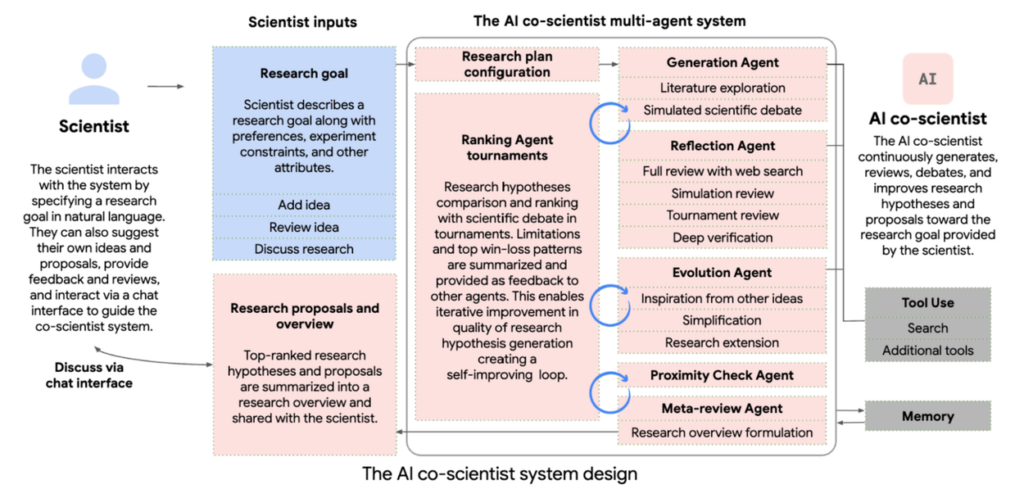
Google Research is now angling to turn AI into a scientist—well, a “co-scientist.” The company has a new multi-agent AI system based on Gemini 2.0 aimed at biomedical researchers that can supposedly point the way toward new hypotheses and areas of biomedical research. However, Google’s AI co-scientist boils down to a fancy chatbot. 

A flesh-and-blood scientist using Google’s co-scientist would input their research goals, ideas, and references to past research, allowing the robot to generate possible avenues of research. The AI co-scientist contains multiple interconnected models that churn through the input data and access Internet resources to refine the output. Inside the tool, the different agents challenge each other to create a “self-improving loop,” which is similar to the new raft of reasoning AI models like Gemini Flash Thinking and OpenAI o3.

This is still a generative AI system like Gemini, so it doesn’t truly have any new ideas or knowledge. However, it can extrapolate from existing data to potentially make decent suggestions. At the end of the process, Google’s AI co-scientist spits out research proposals and hypotheses. The human scientist can even talk with the robot about the proposals in a chatbot interface. 

Google AI co-scientist

The structure of Google’s AI co-scientist.

You can think of the AI co-scientist as a highly technical form of brainstorming. The same way you can bounce party-planning ideas off a consumer AI model, scientists will be able to conceptualize new scientific research with an AI tuned specifically for that purpose. 

Testing AI science

Today’s popular AI systems have a well-known problem with accuracy. Generative AI always has something to say, even if the model doesn’t have the right training data or model weights to be helpful, and fact-checking with more AI models can’t work miracles. Leveraging its reasoning roots, the AI co-scientist conducts an internal evaluation to improve outputs, and Google says the self-evaluation ratings correlate to greater scientific accuracy. 

The internal metrics are one thing, but what do real scientists think? Google had human biomedical researchers evaluate the robot’s proposals, and they reportedly rated the AI co-scientist higher than other, less specialized agentic AI systems. The experts also agreed the AI co-scientist’s outputs showed greater potential for impact and novelty compared to standard AI models. 

This doesn’t mean the AI’s suggestions are all good. However, Google partnered with several universities to test some of the AI research proposals in the laboratory. For example, the AI suggested repurposing certain drugs for treating acute myeloid leukemia, and laboratory testing suggested it was a viable idea. Research at Stanford University also showed that the AI co-scientist’s ideas about treatment for liver fibrosis were worthy of further study. 

This is compelling work, certainly, but calling this system a “co-scientist” is perhaps a bit grandiose. Despite the insistence from AI leaders that we’re on the verge of creating living, thinking machines, AI isn’t anywhere close to being able to do science on its own. That doesn’t mean the AI-co-scientist won’t be useful, though. Google’s new AI could help humans interpret and contextualize expansive data sets and bodies of research, even if it can’t understand or offer true insights. 

Google says it wants more researchers working with this AI system in the hope it can assist with real research. Interested researchers and organizations can apply to be part of the Trusted Tester program, which provides access to the co-scientist UI as well as an API that can be integrated with existing tools.

Google’s new AI generates hypotheses for researchers Read More »

trump-order-declares-independent-us-agencies-aren’t-independent-anymore

Trump order declares independent US agencies aren’t independent anymore

The White House fact sheet said the goal of this provision is to ensure that the president and attorney general “interpret the law for the executive branch, instead of having separate agencies adopt conflicting interpretations.”

John Bergmayer, legal director of consumer advocacy group Public Knowledge, said Trump’s order is based on a “unitary executive” theory that “has made its way from the fringes of academia to the halls of power.”

“In this latest Executive Order, the Trump regime purports to seize for itself the power Congress delegated to independent regulatory agencies, and as written, declares the White House’s interpretation of the law as ‘authoritative,’ with no mention of the courts,” Bergmayer said. “Of course, the president is not, and never has been, the final arbiter of what is lawful. Lawyers working for the government owe their allegiance to the American people, not to President Donald J. Trump.”

Trump’s OMB director, Russell Vought, told Tucker Carlson in a recent interview that “there are no independent agencies. Congress may have viewed them as such—SEC or the FCC, CFPB, the whole alphabet soup—but that is not something that the Constitution understands. So there may be different strategies with each one of them about how you dismantle them, but as an administration, the whole notion of an independent agency should be thrown out.”

Extending Trump’s grip

Although the president nominates commissioners and appoints chairs at agencies like the FCC, independent agencies are supposed to make their own decisions. A 2023 report by the Congressional Research Service said an independent agency is “a freestanding executive branch organization that is not part of any department or other agency,” and which has “greater autonomy from the President’s leadership and insulation from partisan politics than is typical of executive branch agencies.”

Other independent agencies include the National Labor Relations Board and Consumer Financial Protection Bureau, the report said. Laws approved by Congress specify the authority of independent agencies along with the agencies’ “goals, principles, missions, and mandates,” the report said.

Trump order declares independent US agencies aren’t independent anymore Read More »

in-a-last-minute-decision,-white-house-decides-not-to-terminate-nasa-employees

In a last-minute decision, White House decides not to terminate NASA employees

So what changed?

It was not immediately clear why. A NASA spokesperson in Washington, DC, offered no comment on the updated guidance. Two sources indicated that it was plausible that private astronaut Jared Isaacman, whom President Trump has nominated to lead the space agency, asked for the cuts to be put on hold.

Although this could not be confirmed, it seems reasonable that Isaacman would want to retain some control over where cuts at the agency are made. Firing all probationary employees—which is the most expedient way to reduce the size of government—is a blunt instrument. It whacks new hires that the agency may have recruited for key positions, as well as high performers who earned promotions.

The reprieve in these terminations does not necessarily signal that NASA will escape significant budget or employment cuts in the coming months.

The administration could still seek to terminate probationary employees. In addition, Ars reported earlier that directors at the agency’s field centers have been told to prepare options for a “significant” reduction in force in the coming months. The scope of these cuts has not been defined, and it’s likely they would need to be negotiated with Congress.

In a last-minute decision, White House decides not to terminate NASA employees Read More »

streamer-completes-hitless-run-of-seven-fromsoft-soulslikes-without-leveling-up

Streamer completes hitless run of seven FromSoft Soulslikes without leveling up

What now?

In a follow-up stream on Monday, Nico called his latest gaming achievement “by far the most difficult run I have ever completed. We did the same run leveled, but it is not even close to as difficult as the level 1 run. The level 1 run, the difficulty level is just insane.”

Aside from being an incredible individual achievement, Nico’s level 1 God Run helps put FromSoft’s reputation for difficulty into perspective. While these games can punish failure very harshly—and require lots of arcane knowledge to play well—Nico shows that they’re also designed to be fair to players with the steely nerves to attack and dodge with perfect timing.

After almost 2 years of attempts!

IT’S FINALLY DONE!

7 Games, 0 Hits, Character Level 1!

WE DID IT!

Here is the last fight! (and sorry that it is cinder again) 😅https://t.co/0g24MY4wRy

— Nico (@dinossindgeil) February 16, 2025

With his ultimate FromSoft achievement now complete, Nico said he’s “going to take a vacation now. And by vacation, I mean I’ll continue doing hitless runs, I will continue being live every day… but we’re going to do some smaller ones for now.” In the longer term, Nico hinted that he is “going to work on one really big project again,” but wasn’t willing to provide details just yet.

If you want to follow in Nico’s hitless FromSoft footsteps, he puts out instructional videos laying out the specific paths and strategies needed to get through specific games (Pro tip: It involves a lot of well-timed rolling and memorizing attack and stagger patterns). Nico also took the time to recently rank how hard he finds each game in the God Run, putting Elden Ring in the easiest tier and Dark Souls II in the hardest.

Streamer completes hitless run of seven FromSoft Soulslikes without leveling up Read More »

nasa-nominee-previews-his-vision-for-the-agency:-mars,-hard-work,-inspiration

NASA nominee previews his vision for the agency: Mars, hard work, inspiration

“When I see a picture like this, it is impossible not to feel energized about the future,” he wrote. “I think it is so important for people to understand the profound implications of sending humans to another planet.”

Among these, Isaacman cited the benefits of advancing state-of-the-art technologies including propulsion, habitability, power generation, in-situ resource utilization, and manufacturing.

“We will create systems, countermeasures, and pharmaceuticals to sustain human life in extreme conditions, addressing challenges like radiation and microgravity over extended durations,” he said. “These advancements will form the foundation for lower-cost, more frequent crewed and robotic missions across the solar system, creating a flywheel effect to accelerate world-changing discoveries.”

Additionally, Isaacman said taking the first steps toward humanity living beyond Earth was critical to the long-term survival of the species, and that such an achievement would inspire a new generation of scientific and technological leaders.

“Achieving such an outrageous endeavor—like landing American astronauts on another planet—will inspire generations of dreamers to build upon these accomplishments, set even bolder goals, and drive humankind’s greatest adventure forward,” he wrote.

Upon being asked about his thoughts about sending humans to Mars during the launch window in late 2028 or early 2029, Isaacman said he remains on the outside of NASA’s planning process for now. But he did say the United States should start to put serious effort toward sending humans to Mars.

“We should invest a reasonable amount of resources coupled with extreme work intensity and then make them a reality,” he wrote. “Even getting 90% there in the near term would set humankind on an incredible trajectory for the long term.”

NASA nominee previews his vision for the agency: Mars, hard work, inspiration Read More »

arm-to-start-making-server-cpus-in-house

Arm to start making server CPUs in-house

Cambridge-headquartered Arm has more than doubled in value to $160 billion since it listed on Nasdaq in 2023, carried higher by explosive investor interest in AI. Arm’s partnerships with Nvidia and Amazon have driven its rapid growth in the data centers that power AI assistants from OpenAI, Meta, and Anthropic.

Meta is the latest big tech company to turn to Arm for server chips, displacing those traditionally provided by Intel and AMD.

During last month’s earnings call, Meta’s finance chief Susan Li said it would be “extending our custom silicon efforts to [AI] training workloads” to drive greater efficiency and performance by tuning its chips to its particular computing needs.

Meanwhile, an Arm-produced chip is also likely to eventually play a role in Sir Jony Ive’s secretive plans to build a new kind of AI-powered personal device, which is a collaboration between the iPhone designer’s firm LoveFrom, OpenAI’s Sam Altman, and SoftBank.

Arm’s designs have been used in more than 300 billion chips, including almost all of the world’s smartphones. Its power-efficient designs have made its CPUs, the general-purpose workhorse that sits at the heart of any computer, an increasingly attractive alternative to Intel’s chips in PCs and servers at a time when AI is making data centers much more energy-intensive.

Arm, which started out in a converted turkey barn in Cambridgeshire 35 years ago, became ubiquitous in the mobile market by licensing its designs to Apple for its iPhone chips, as well as Android suppliers such as Qualcomm and MediaTek. Maintaining its unique position in the center of the fiercely competitive mobile market has required a careful balancing act for Arm.

But Son has long pushed for Arm to make more money from its intellectual property. Under Haas, who became chief executive in 2022, Arm’s business model began to evolve, with a focus on driving higher royalties from customers as the company designs more of the building blocks needed to make a chip.

Going a step further by building and selling its own complete chip is a bold move by Haas that risks putting it on a collision course with customers such as Qualcomm, which is already locked in a legal battle with Arm over licensing terms, and Nvidia, the world’s most valuable chipmaker.

Arm, SoftBank, and Meta declined to comment.

Additional reporting by Hannah Murphy.

© 2025 The Financial Times Ltd. All rights reserved. Not to be redistributed, copied, or modified in any way.

Arm to start making server CPUs in-house Read More »