Author name: Paul Patrick

ghost-forests-are-growing-as-sea-levels-rise

Ghost forests are growing as sea levels rise

Like giant bones planted in the earth, clusters of tree trunks, stripped clean of bark, are appearing along the Chesapeake Bay on the United States’ mid-Atlantic coast. They are ghost forests: the haunting remains of what were once stands of cedar and pine. Since the late 19th century, an ever-widening swath of these trees have died along the shore. And they won’t be growing back.

These arboreal graveyards are showing up in places where the land slopes gently into the ocean and where salty water increasingly encroaches. Along the United States’ East Coast, in pockets of the West Coast, and elsewhere, saltier soils have killed hundreds of thousands of acres of trees, leaving behind woody skeletons typically surrounded by marsh.

What happens next? That depends. As these dead forests transition, some will become marshes that maintain vital ecosystem services, such as buffering against storms and storing carbon. Others may become home to invasive plants or support no plant life at all—and the ecosystem services will be lost. Researchers are working to understand how this growing shift toward marshes and ghost forests will, on balance, affect coastal ecosystems.

Many of the ghost forests are a consequence of sea level rise, says coastal ecologist Keryn Gedan of George Washington University in Washington, DC, coauthor of an article on the salinization of coastal ecosystems in the 2025 Annual Review of Marine Science. Rising sea levels can bring more intense storm surges that flood saltwater over the top of soil. Drought and sea level rise can shift the groundwater table along the coast, allowing saltwater to journey farther inland, beneath the forest floor. Trees, deprived of fresh water, are stressed as salt accumulates.

Yet the transition from living forest to marsh isn’t necessarily a tragedy, Gedan says. Marshes are important features of coastal ecosystems, too. And the shift from forest to marsh has happened throughout periods of sea level rise in the past, says Marcelo Ardón, an ecosystem ecologist and biogeochemist at North Carolina State University in Raleigh.

“You would think of these forests and marshes kind of dancing together up and down the coast,” he says.

Marshes provide many ecosystem benefits. They are habitats for birds and crustaceans, such as salt marsh sparrows, marsh wrens, crabs, and mussels. They are also a niche for native salt-tolerant plants, like rushes and certain grasses, which provide food and shelter for animals.

Ghost forests are growing as sea levels rise Read More »

nintendo-raises-planned-switch-2-accessory-prices-amid-tariff-“uncertainty”

Nintendo raises planned Switch 2 accessory prices amid tariff “uncertainty”

The Switch 2 hardware will still retail for its initially announced $449.99, alongside a $499.99 bundle including a digital download of Mario Kart World. Nintendo revealed Thursday that the Mario Kart bundle will only be produced “through Fall 2025,” though, and will only be available “while supplies last.” Mario Kart World will retail for $79.99 on its own, while Donkey Kong Bananza will launch in July for a $69.99 MSRP.

Most industry analysts expected Nintendo to hold the price for the Switch 2 hardware steady, even as Trump’s wide-ranging tariffs threatened to raise the cost the company incurred for systems built in China and Vietnam. “I believe it is now too late for Nintendo to drive up the price further, if that ever was an option in the first place,” Kantan Games’ Serkan Toto told GamesIndustry.biz. “As far as tariffs go, Nintendo was looking at a black box all the way until April 2, just like everybody else. As a hardware manufacturer, Nintendo most likely ran simulations to get to a price that would make them tariff-proof as much as possible.”

But that pricing calculus might not hold forever. “If the tariffs persist, I think a price increase in 2026 might be on the table,” Ampere Analysis’ Piers Harding-Rolls told GameSpot. “Nintendo will be treading very carefully considering the importance of the US market.”

Since the Switch 2 launch details were announced earlier this month, Nintendo’s official promotional livestreams have been inundated with messages begging the company to “DROP THE PRICE.”

Nintendo raises planned Switch 2 accessory prices amid tariff “uncertainty” Read More »

microsoft’s-“1‑bit”-ai-model-runs-on-a-cpu-only,-while-matching-larger-systems

Microsoft’s “1‑bit” AI model runs on a CPU only, while matching larger systems

Does size matter?

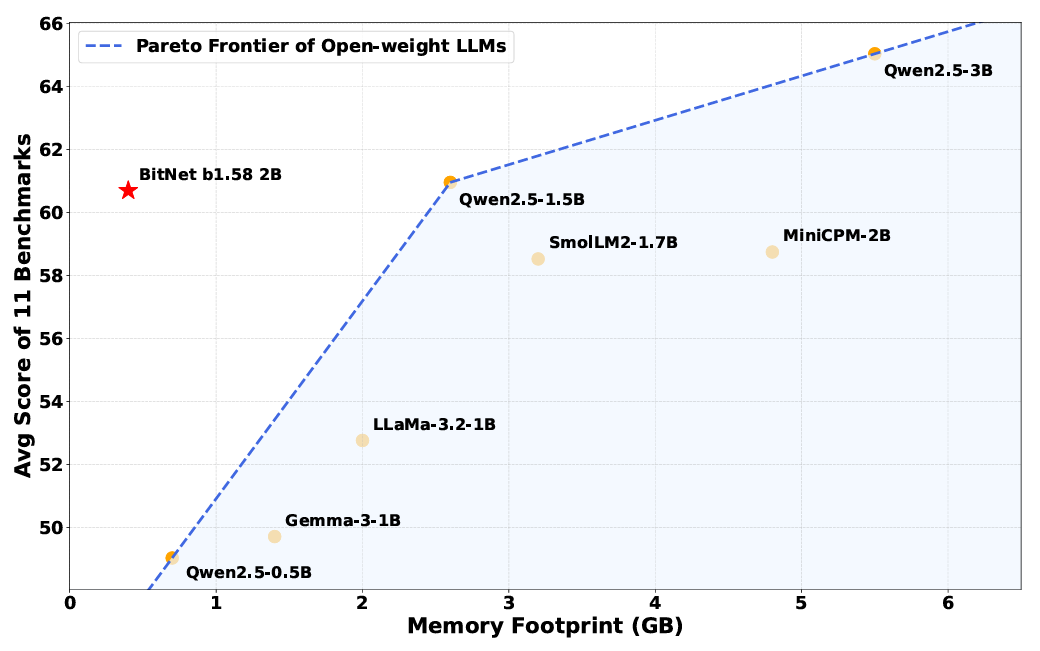
Memory requirements are the most obvious advantage of reducing the complexity of a model’s internal weights. The BitNet b1.58 model can run using just 0.4GB of memory, compared to anywhere from 2 to 5GB for other open-weight models of roughly the same parameter size.

But the simplified weighting system also leads to more efficient operation at inference time, with internal operations that rely much more on simple addition instructions and less on computationally costly multiplication instructions. Those efficiency improvements mean BitNet b1.58 uses anywhere from 85 to 96 percent less energy compared to similar full-precision models, the researchers estimate.

A demo of BitNet b1.58 running at speed on an Apple M2 CPU.

By using a highly optimized kernel designed specifically for the BitNet architecture, the BitNet b1.58 model can also run multiple times faster than similar models running on a standard full-precision transformer. The system is efficient enough to reach “speeds comparable to human reading (5-7 tokens per second)” using a single CPU, the researchers write (you can download and run those optimized kernels yourself on a number of ARM and x86 CPUs, or try it using this web demo).

Crucially, the researchers say these improvements don’t come at the cost of performance on various benchmarks testing reasoning, math, and “knowledge” capabilities (although that claim has yet to be verified independently). Averaging the results on several common benchmarks, the researchers found that BitNet “achieves capabilities nearly on par with leading models in its size class while offering dramatically improved efficiency.”

Despite its smaller memory footprint, BitNet still performs similarly to “full precision” weighted models on many benchmarks.

Despite its smaller memory footprint, BitNet still performs similarly to “full precision” weighted models on many benchmarks.

Despite the apparent success of this “proof of concept” BitNet model, the researchers write that they don’t quite understand why the model works as well as it does with such simplified weighting. “Delving deeper into the theoretical underpinnings of why 1-bit training at scale is effective remains an open area,” they write. And more research is still needed to get these BitNet models to compete with the overall size and context window “memory” of today’s largest models.

Still, this new research shows a potential alternative approach for AI models that are facing spiraling hardware and energy costs from running on expensive and powerful GPUs. It’s possible that today’s “full precision” models are like muscle cars that are wasting a lot of energy and effort when the equivalent of a nice sub-compact could deliver similar results.

Microsoft’s “1‑bit” AI model runs on a CPU only, while matching larger systems Read More »

regrets:-actors-who-sold-ai-avatars-stuck-in-black-mirror-esque-dystopia

Regrets: Actors who sold AI avatars stuck in Black Mirror-esque dystopia

In a Black Mirror-esque turn, some cash-strapped actors who didn’t fully understand the consequences are regretting selling their likenesses to be used in AI videos that they consider embarrassing, damaging, or harmful, AFP reported.

Among them is a 29-year-old New York-based actor, Adam Coy, who licensed rights to his face and voice to a company called MCM for one year for $1,000 without thinking, “am I crossing a line by doing this?” His partner’s mother later found videos where he appeared as a doomsayer predicting disasters, he told the AFP.

South Korean actor Simon Lee’s AI likeness was similarly used to spook naïve Internet users but in a potentially more harmful way. He told the AFP that he was “stunned” to find his AI avatar promoting “questionable health cures on TikTok and Instagram,” feeling ashamed to have his face linked to obvious scams.

As AI avatar technology improves, the temptation to license likenesses will likely grow. One of the most successful companies that’s recruiting AI avatars, UK-based Synthesia, doubled its valuation to $2.1 billion in January, CNBC reported. And just last week, Synthesia struck a $2 billion deal with Shutterstock that will make its AI avatars more human-like, The Guardian reported.

To ensure that actors are incentivized to license their likenesses, Synthesia also recently launched an equity fund. According to the company, actors behind the most popular AI avatars or featured in Synthesia marketing campaigns will be granted options in “a pool of our company shares” worth $1 million.

“These actors will be part of the program for up to four years, during which their equity awards will vest monthly,” Synthesia said.

For actors, selling their AI likeness seems quick and painless—and perhaps increasingly more lucrative. All they have to do is show up and make a bunch of different facial expressions in front of a green screen, then collect their checks. But Alyssa Malchiodi, a lawyer who has advocated on behalf of actors, told the AFP that “the clients I’ve worked with didn’t fully understand what they were agreeing to at the time,” blindly signing contracts with “clauses considered abusive,” even sometimes granting “worldwide, unlimited, irrevocable exploitation, with no right of withdrawal.”

Regrets: Actors who sold AI avatars stuck in Black Mirror-esque dystopia Read More »

women-rely-partly-on-smell-when-choosing-friends

Women rely partly on smell when choosing friends

For their study, Gaby et al. organized an on-campus “Speed-Friending” event for 40 female volunteers, consisting of four distinct phases. First, participants had their headshots taken. Next, they looked at pictures of all the other women participating and rated friendship potential based solely on visual cues. Then the women wore a T-shirt for 12 hours as they went about their daily activities, which were then collected and placed in plastic bags. Finally, participants rated the friendship potential of anonymized participants based solely on smelling each T-shirt, followed by a live session during which they interacted with each woman for four minutes and rated their friendship potential. This was followed by a second round of smelling the T-shirts and once again rating friendship potential.

The results: There was a strong correlation between the in-person evaluations of friendship potential and those based solely on smelling the T-shirts, with remarkable consistency. And the ratings made after live interactions accurately predicted changes in the assessments made in the final round of odor-based testing, suggesting a learned response element.

“Everybody showed they had a consistent signature of what they liked,” said co-author Vivian Zayas of Cornell University. “And the consistency was not that, in the group, one person smelled really bad and one person smelled really good. No, it was idiosyncratic. I might like person A over B over C based on scent, and this pattern predicts who I end up liking in the chat. People take a lot in when they’re meeting face to face. But scent—which people are registering at some level, though probably not consciously—forecasts whether you end up liking this person.”

The authors acknowledged that their study was limited to college-aged heterosexual women and that there could be differences in how olfactory and other cues function in other groups: older or younger women, non-American women, men, and so forth. “Future studies might consider a wider age range, investigate individuals at different stages of development, focus on how these cues function in male-male platonic interactions, or examine how scent in daily interactions shapes friendship judgments in other cultures,” they wrote.

Scientific Reports, 2025. DOI: 10.1038/s41598-025-94350-1  (About DOIs).

Women rely partly on smell when choosing friends Read More »

resist,-eggheads!-universities-are-not-as-weak-as-they-have-chosen-to-be.

Resist, eggheads! Universities are not as weak as they have chosen to be.

The wholesale American cannibalism of one of its own crucial appendages—the world-famous university system—has begun in earnest. The campaign is predictably Trumpian, built on a flagrantly pretextual basis and executed with the sort of vicious but chaotic idiocy that has always been a hallmark of the authoritarian mind.

At a moment when the administration is systematically waging war on diversity initiatives of every kind, it has simultaneously discovered that it is really concerned about both “viewpoint diversity” and “antisemitism” on college campuses—and it is using the two issues as a club to beat on the US university system until it either dies or conforms to MAGA ideology.

Reaching this conclusion does not require reading any tea leaves or consulting any oracles; one need only listen to people like Vice President JD Vance, who in 2021 gave a speech called “The Universities are the Enemy” to signal that, like every authoritarian revolutionary, he intended to go after the educated.

“If any of us want to do the things that we want to do for our country,” Vance said, “and for the people who live in it, we have to honestly and aggressively attack the universities in this country.” Or, as conservative activist Christopher Rufo put it in a New York Times piece exploring the attack campaign, “We want to set them back a generation or two.”

The goal is capitulation or destruction. And “destruction” is not a hyperbolic term; some Trump aides have, according to the same piece, “spoken privately of toppling a high-profile university to signal their seriousness.”

Consider, in just a few months, how many battles have been launched:

  • The Trump administration is now snatching non-citizen university students, even those in the country legally, off the streets using plainclothes units and attempting to deport them based on their speech or beliefs.
  • It has opened investigations of more than 50 universities.
  • It has threatened grants and contracts at, among others, Brown ($510 million), Columbia ($400 million), Cornell ($1 billion), Harvard ($9 billion), Penn ($175 million), and Princeton ($210 million).
  • It has reached a widely criticized deal with Columbia that would force Columbia to change protest and security policies but would also single out one academic department (Middle Eastern, South Asian, and African Studies) for enhanced scrutiny. This deal didn’t even get Columbia its $400 million back; it only paved the way for future “negotiations” about the money. And the Trump administration is potentially considering a consent decree with Columbia, giving it leverage over the school for years to come.
  • It has demanded that Harvard audit every department for “viewpoint diversity,” hiring faculty who meet the administration’s undefined standards.
  • Trump himself has explicitly threatened to revoke Harvard’s tax-exempt nonprofit status after it refused to bow to his demands. And the IRS looks ready to do it.
  • The government has warned that it could choke off all international students—an important diplomatic asset but also a key source of revenue—at any school it likes.
  • Ed Martin—the extremely Trumpy interim US Attorney for Washington, DC—has already notified Georgetown that his office will not hire any of that school’s graduates if the school “continues to teach and utilize DEI.”

What’s next? Project 2025 lays it out for us, envisioning the federal government getting heavily involved in accreditation—thus giving the government another way to bully schools—and privatizing many student loans. Right-wing wonks have already begun to push for “a never-ending compliance review” of elite schools’ admissions practices, one that would see the Harvard admissions office filled with federal monitors scrutinizing every single admissions decision. Trump has also called for “patriotic education” in K–12 schools; expect similar demands of universities, though probably under the rubrics of “viewpoint discrimination” and “diversity.”

Universities may tell themselves that they would never comply with such demands, but a school without accreditation and without access to federal funds, international students, and student loan dollars could have trouble surviving for long.

Some of the top leaders in academia are ringing the alarm bells. Princeton’s president, Christopher Eisgruber, wrote a piece in The Atlantic warning that the Trump administration has already become “the greatest threat to American universities since the Red Scare of the 1950s. Every American should be concerned.”

Lee Bollinger, who served as president of both the University of Michigan and Columbia University, gave a fiery interview to the Chronicle of Higher Education in which he said, “We’re in the midst of an authoritarian takeover of the US government… We cannot get ourselves to see how this is going to unfold in its most frightening versions. You neutralize the branches of government; you neutralize the media; you neutralize universities, and you’re on your way. We’re beginning to see the effects on universities. It’s very, very frightening.”

But for the most part, even though faculty members have complained and even sued, administrators have stayed quiet. They are generally willing to fight for their cash in court—but not so much in the court of public opinion. The thinking is apparently that there is little to be gained by antagonizing a ruthless but also chaotic administration that just might flip the money spigot back on as quickly as it was shut off. (See also: tariff policy.)

This academic silence also comes after many universities course-corrected following years of administrators weighing in on global and political events outside a school’s basic mission. When that practice finally caused problems for institutions, as it did following the Gaza/Israel fighting, numerous schools adopted a posture of “institutional neutrality” and stopped offering statements except on core university concerns. This may be wise policy, but unfortunately, schools are clinging to it even though the current moment could not be more central to their mission.

To critics, the public silence looks a lot like “appeasement”—a word used by our sister publication The New Yorker to describe how “universities have cut previously unthinkable ‘deals’ with the Administration which threaten academic freedom.” As one critic put it recently, “still there is no sign of organized resistance on the part of universities. There is not even a joint statement in defense of academic freedom or an assertion of universities’ value to society.”

Even Michael Roth, the president of Wesleyan University, has said that universities’ current “infatuation with institutional neutrality is just making cowardice into a policy.”

Appeasing narcissistic strongmen bent on “dominance” is a fool’s errand, as is entering a purely defensive crouch. Weakness in such moments is only an invitation to the strongman to dominate you further. You aren’t going to outlast your opponent when the intended goal appears to be not momentary “wins” but the weakening of all cultural forces that might resist the strongman. (See also: Trump’s brazen attacks on major law firms and the courts.)

As an Atlantic article put it recently, “Since taking office, the Trump administration has been working to dismantle the global order and the nation’s core institutions, including its cultural ones, to strip them of their power. The future of the nation’s universities is very much at stake. This is not a challenge that can be met with purely defensive tactics.”

The temperamental caution of university administrators means that some can be poor public advocates for their universities in an age of anger and distrust, and they may have trouble finding a clear voice to speak with when they come under thundering public attacks from a government they are more used to thinking of as a funding source.

But the moment demands nothing less. This is not a breeze; this is the whirlwind. And it will leave a state-dependent, nationalist university system in its wake unless academia arises, feels its own power, and non-violently resists.

Fighting back

Finally, on April 14, something happened: Harvard decided to resist in far more public fashion. The Trump administration had demanded, as a condition of receiving $9 billion in grants over multiple years, that Harvard reduce the power of student and faculty leaders, vet every academic department for undefined “viewpoint diversity,” run plagiarism checks on all faculty, share hiring information with the administration, shut down any program related to diversity or inclusion, and audit particular departments for antisemitism, including the Divinity School. (Numerous Jewish groups want nothing to do with the campaign, writing in an open letter that “our safety as Jews has always been tied to the rule of law, to the safety of others, to the strength of civil society, and to the protection of rights and liberties for all.”)

If you think this sounds a lot like government control, giving the Trump administration the power to dictate hiring and teaching practices, you’re not alone; Harvard president Alan Garber rejected the demands in a letter, saying, “The university will not surrender its independence or relinquish its constitutional rights. Neither Harvard nor any other private university can allow itself to be taken over by the federal government.”

The Trump administration immediately responded by cutting billions in Harvard funding, threatening the university’s tax-exempt status, and claiming it might block international students from attending Harvard.

Perhaps Harvard’s example will provide cover for other universities to make hard choices. And these are hard choices. But Columbia and Harvard have already shown that the only way you have a chance at getting the money back is to sell whatever soul your institution has left.

Given that, why not fight? If you have to suffer, suffer for your deepest values.

Fare forward

“Resistance” does not mean a refusal to change, a digging in, a doubling down. No matter what part of the political spectrum you inhabit, universities—like most human institutions—are “target-rich environments” for complaints. To see this, one has only to read about recent battles over affirmative action, the Western canon, “legacy” admissions, the rise and fall of “theory” in the humanities, Gaza/Palestine protests, the “Varsity Blues” scandal, critiques of “meritocracy,” mandatory faculty “diversity statements,” the staggering rise in tuition costs over the last few decades, student deplatforming of invited speakers, or the fact that so many students from elite institutions cannot imagine a higher calling than management consulting. Even top university officials acknowledge there are problems.

Famed Swiss theologian Karl Barth lost his professorship and was forced to leave Germany in 1935 because he would not bend the knee to Adolf Hitler. He knew something about standing up for one’s academic and spiritual values—and about the importance of not letting any approach to the world ossify into a reactionary, bureaucratic conservatism that punishes all attempts at change or dissent. The struggle for knowledge, truth, and justice requires forward movement even as the world changes, as ideas and policies are tested, and as cultures develop. Barth’s phrase for this was “Ecclesia semper reformanda est“—the church must always be reformed—and it applies just as well to the universities where he spent much of his career.

As universities today face their own watershed moment of resistance, they must still find ways to remain intellectually curious and open to the world. They must continue to change, always imperfectly but without fear. It is important that their resistance not be partisan. Universities can only benefit from broad-based social support, and the idea that they are fighting “against conservatives” or “for Democrats” will be deeply unhelpful. (Just as it would be if universities capitulated to government oversight of their faculty hires or gave in to “patriotic education.”)

This is difficult when one is under attack, as the natural reaction is to defend what currently exists. But the assault on the universities is about deeper issues than admissions policies or the role of elite institutions in American life. It is about the rule of law, freedom of speech, scientific research, and the very independence of the university—things that should be able to attract broad social and judicial support if schools do not retreat into ideology.

Why it matters

Ars Technica was founded by grad students and began with a “faculty model” drawn from universities: find subject matter experts and turn them loose to find interesting stories in their domains of expertise, with minimal oversight and no constant meetings.

From Minnesota Bible colleges to the halls of Harvard, from philosophy majors to chemistry PhDs, from undergrads to post-docs, Ars has employed people from a wide range of schools and disciplines. We’ve been shaped by the university system, and we cover it regularly as a source of scientific research and computer science breakthroughs. While we differ in many ways, we recognize the value of a strong, independent, mission-focused university system that, despite current flaws, remains one of America’s storied achievements. And we hope that universities can collectively find the strength to defend themselves, just as we in the media must learn to do.

The assault on universities and on the knowledge they produce has been disorienting in its swiftness, animus, and savagery. But universities are not starfish, flopping about helplessly on a beach while a cruel child slices off their arms one by one. They can do far more than hope to survive another day, regrowing missing limbs in some remote future. They have real power, here and now. But they need to move quickly, they need to move in solidarity, and they need to use the resources that they have, collectively, assembled.

Because, if they aren’t going to use those resources when their very mission comes under assault, what was the point of gathering them in the first place?

Here are a few of those resources.

Money

Cash is not always the most important force in human affairs, but it doesn’t hurt to have a pile of it when facing off against a feral US government. When the government threatened Harvard with multiyear cuts of $9 billion, for instance, it was certainly easier for the university to resist while sitting on a staggering $53 billion endowment. In 2024, the National Association of College and University Business Officers reported that higher ed institutions in the US collectively have over $800 billion in endowment money.

It’s true that many endowment funds are donor-restricted and often invested in non-liquid assets, making them unavailable for immediate use or to bail out university programs whose funding has been cut. But it’s also true that $800 billion is a lot of money—it’s more than the individual GDP of all but two dozen countries.

No trustee of this sort of legacy wants to squander an institution’s future by spending money recklessly, but what point is there in having a massive endowment if it requires your school to become some sort of state-approved adjunct?

Besides, one might choose not to spend that money now only to find that it is soon requisitioned regardless. People in Trump’s orbit have talked for years about placing big new taxes on endowment revenue as a way of bringing universities to heel. Trump himself recently wrote on social media that Harvard “perhaps” should “lose its Tax Exempt Status and be Taxed as a Political Entity if it keeps pushing political, ideological, and terrorist inspired/supporting “Sickness?” Remember, Tax Exempt Status is totally contingent on acting in the PUBLIC INTEREST!”

So spend wisely, but do spend. This is the kind of moment such resources were accumulated to weather.

Students

Fifteen million students are currently enrolled in higher education across the country. The total US population is 341 million people. That means students comprise over 4 percent of the total population; when you add in faculty and staff, higher education’s total share of the population is even greater.

So what? Political science research over the last three decades looked at nonviolent protest movements and found that they need only 3.5 percent of the population to actively participate. Most movements that hit that threshold succeed, even in authoritarian states. Higher ed alone has those kinds of numbers.

Students are not a monolith, of course, and many would not participate—nor should universities look at their students merely as potential protesters who might serve university interests. But students have been well-known for a willingness to protest, and one of the odd features of the current moment has been that so many students protested the Gaza/Israel conflict even though so few have protested the current government assault on the very schools where they have chosen to spend their time and money. It is hard to say whether both schools and their students are burned out from recent, bruising protests, or whether the will to resist remains.

But if it does, the government assault on higher education could provoke an interesting realignment of forces: students, faculty, and administrators working together for once in resistance and protest, upending the normal dynamics of campus movements. And the numbers exist to make a real national difference if higher ed can rally its own full range of resources.

Institutions

Depending on how you count, the US has around 4,000 colleges and universities. The sheer number and diversity of these institutions is a strength—but only if they can do a better job working together on communications, lobbying, and legal defenses.

Schools are being attacked individually, through targeted threats rather than broad laws targeting all higher education. And because schools are in many ways competitors rather than collaborators, it can be difficult to think in terms of sharing resources or speaking with one voice. But joint action will be essential, given that many smaller schools are already under economic pressure and will have a hard time resisting government demands, losing their nonprofit status, or finding their students blocked from the country or cut off from loan money.

Plenty of trade associations and professional societies exist within the world of higher education, of course, but they are often dedicated to specific tasks and lack the public standing and authority to make powerful public statements.

Faculty/alumni

The old stereotype of the out-of-touch, tweed-wearing egghead, spending their life lecturing on the lesser plays of Ben Jonson, is itself out of touch. The modern university is stuffed with lawyers, data scientists, computer scientists, cryptographers, marketing researchers, writers, media professionals, and tech policy mavens. They are a serious asset, though universities sometimes leave faculty members to operate so autonomously that group action is difficult or, at least, institutionally unusual. At a time of crisis, that may need to change.

Faculty are an incredible resource because of what they know, of course. Historians and political scientists can offer context and theory for understanding populist movements and authoritarian regimes. Those specializing in dialogue across difference, or in truth and reconciliation movements, or in peace and conflict studies, can offer larger visions for how even deep social conflicts might be transcended. Communications professors can help universities think more carefully about articulating what they do in the public marketplace of ideas. And when you are on the receiving end of vindictive and pretextual legal activity, it doesn’t hurt to have a law school stuffed with top legal minds.

But faculty power extends beyond facts. Relationships with students, across many years, are a hallmark of the best faculty members. When generations of those students have spread out into government, law, and business, they make a formidable network.

Universities that realize the need to fight back already know this. Ed Martin, the interim US Attorney for the District of Columbia, attacked Georgetown in February and asked if it had “eliminated all DEI from your school and its curriculum?” He ended his “clarification” letter by claiming that “no applicant for our fellows program, our summer internship, or employment in our office who is a student or affiliated with a law school or university that continues to teach and utilize DEI will be considered.”

When Georgetown Dean Bill Treanor replied to Martin, he did not back down, noting Martin’s threat to “deny our students and graduates government employment opportunities until you, as Interim United States Attorney for the District of Columbia, approve of our curriculum.” (Martin himself had managed to omit the “interim” part of his title.) Such a threat would violate “the First Amendment’s protection of a university’s freedom to determine its own curriculum and how to deliver it.”

There was no “negotiating” here, no attempt to placate a bully. Treanor barely addressed Martin’s questions. Instead, he politely but firmly noted that the inquiry itself was illegitimate, even under recent Supreme Court jurisprudent and Trump Department of Education policy. And he tied everything in his response to the university’s mission as a Jesuit school committed to “intellectual, ethical, and spiritual understanding.”

The letter’s final paragraph, in which Treanor told Martin that he expected him to back down from his threats, opened with a discussion of Georgetown’s faculty.

Georgetown Law has one of the preeminent faculties in the country, fostering groundbreaking scholarship, educating students in a wide variety of perspectives, and thriving on the robust exchange of ideas. Georgetown Law faculty have educated world leaders, members of Congress, and Justice Department officials, from diverse backgrounds and perspectives.

Implicit in these remarks are two reminders:

  1. Georgetown is home to many top legal minds who aren’t about to be steamrolled by a January 6 defender whose actions in DC have already been so comically outrageous that Sen. Adam Schiff has placed a hold on his nomination to get the job permanently.
  2. Georgetown faculty have good relationships with many powerful people across the globe who are unlikely to sympathize with some legal hack trying to bully their alma mater.

The letter serves as a good reminder: Resist with firmness and rely on your faculty. Incentivize their work, providing the time and resources to write more popular-level distillations of their research or to educate alumni groups about the threats campuses are facing. Get them into the media and onto lecture hall stages. Tap their expertise for internal working groups. Don’t give in to the caricatures but present a better vision of how faculty contribute to students, to research, and to society.

Real estate

Universities collectively possess a real estate portfolio of land and buildings—including lecture halls, stages, dining facilities, stadiums, and dormitories—that would make even a developer like Donald Trump salivate. It’s an incredible resource that is already well-used but might be put toward purposes that meet the moment even more clearly.

Host more talks, not just on narrow specialty topics, but on the kinds of broad-based political debates that a healthy society needs. Make the universities essential places for debate, discussion, and civic organizing. Encourage more campus conferences in summer, with vastly reduced rates for groups that effectively aid civic engagement, depolarization, and dialogue across political differences. Provide the physical infrastructure for fruitful cross-party political encounters and anti-authoritarian organizing. Use campuses to house regional and national hubs that develop best practices in messaging, legal tactics, local outreach, and community service from students, faculty, and administrators.

Universities do these things, of course; many are filled with “dialogue centers” and civic engagement offices. But many of these resources exist primarily for students; to survive and thrive, universities will need to rebuild broader social confidence. The other main criticism is that they can be siloed off from the other doings of the university. If “dialogue” is taken care of at the “dialogue center,” then other departments and administrative units may not need to worry about it. But with something as broad and important as “resistance,” the work cannot be confined to particular units.

With so many different resources, from university presses to libraries to lecture halls, academia can do a better job at making its campuses useful both to students and to the surrounding community—so long as the universities know their own missions and make sure their actions align with them.

Athletics

During times of external stress, universities need to operate more than ever out of their core, mission-driven values. While educating the whole person, mentally and physically, is a worthy goal, it is not one that requires universities to submit to a Two Minutes Hate while simultaneously providing mass entertainment and betting material for the gambling-industrial complex.

When up against a state that seeks “leverage” of every kind over the university sector, realize that academia itself controls some of the most popular sports competitions in America. That, too, is leverage, if one knows how to use it.

Such leverage could, of course, be Trumpian in its own bluntness—no March Madness tournament, for instance, so long as thousands of researchers are losing their jobs and health care networks are decimated and the government is insisting on ideological control over hiring and department makeup. (That would certainly be interesting—though quite possibly counterproductive.)

But universities might use their control of NCAA sporting events to better market themselves and their impact—and to highlight what’s really happening to them. Instead, we continue to get the worst kinds of anodyne spots during football and basketball games: frisbee on the quad, inspiring shots of domes and flags, a professor lecturing in front of a chalkboard.

Be creative! But do something. Saying and doing nothing—letting the games go on without comment as the boot heel comes down on the whole sector, is a complete abdication of mission and responsibility.

DOD and cyber research

The Trump administration seems to believe that it has the only thing people want: grant funding. It seems not even to care if broader science funding in the US simply evaporates, if labs close down, or if the US loses its world-beating research edge.

But even if “science” is currently expendable, the US government itself relies heavily on university researchers to produce innovations required by the Department of Defense and the intelligence community. Cryptography, cybersecurity tools, the AI that could power battlefield drone swarms—much of it is produced by universities under contract with the feds. And there’s no simple, short-term way for the government to replace this system.

Even other countries believe that US universities do valuable cyber work for the federal government; China just accused the University of California and Virginia Tech of aiding in an alleged cyberattack by the NSA, for instance.

That gives the larger universities—the one who often have these contracts—additional leverage. They should find a way to use it.

Medical facilities

Many of the larger universities run sprawling and sophisticated health networks that serve whole communities and regions; indeed, much of the $9 billion in federal money at issue in the Harvard case was going to Harvard’s medical system of labs and hospitals.

If it seems unthinkable to you that the US government would treat the health of its own people as collateral damage in a war to become the Thought Police, remember that this is the same administration that has already tried to stop funds to the state of Maine—funds used to “feed children and disabled adults in schools and care settings across the state”—just because Maine allowed a couple of transgender kids to play on sports teams. What does the one have to do with the other? Nothing—except that the money provides leverage.

But health systems are not simply weapons for the Trump administration to use by refusing or delaying contracts, grants, and reimbursements. Health systems can improve people’s lives in the most tangible of ways. And that means they ought to be shining examples of community support and backing, providing a perfect opportunity to highlight the many good things that universities do for society.

Now, to the extent that these health care systems in the US have suffered from the general flaws of all US health care—lack of universal coverage leading to medical debt and the overuse of emergency rooms by the indigent, huge salaries commanded by doctors, etc.—the Trump war on these systems and on the universities behind them might provide a useful wake-up call from “business as usual.” Universities might use this time to double down on mission-driven values, using these incredible facilities even more to extend care, to lower barriers, and to promote truly public and community health. What better chance to show one’s city, region, and state the value of a university than massively boosting free and easy access to mental and physical health resources? Science research can be esoteric; saving someone’s body or mind is not.

Conclusion

This moment calls out for moral clarity and resolve. It asks universities to take their mission in society seriously and to resist being co-opted by government forces.

But it asks something of all of us, too. University leaders will make their choices, but to stand strong, they need the assistance of students, faculty, and alumni. In an age of polarization, parts of society have grown skeptical about the value of higher education. Some of these people are your friends, family, and neighbors. Universities must continue to make changes as they seek to build knowledge and justice and community, but those of us no longer within their halls and quads also have a part to play in sharing a more nuanced story about the value of the university system, both to our own lives and to the country.

If we don’t, our own degrees may be from institutions that have become almost unrecognizable.

Resist, eggheads! Universities are not as weak as they have chosen to be. Read More »

ap:-trump-admin-to-kill-irs-free-tax-filing-service-that-intuit-lobbied-against

AP: Trump admin to kill IRS free tax-filing service that Intuit lobbied against

Sen. Elizabeth Warren (D-Mass.) criticized Intuit’s lobbying against Direct File and told the AP that Trump and Musk “are going after Direct File because it stops giant tax prep companies from ripping taxpayers off for services that should be free. Americans want a free and easy way to file their taxes—Trump and Musk want to take that away.”

Intuit’s TurboTax offers free filing for simple returns, but has faced lawsuits alleging that its ads misled consumers who had to pay. In 2022, Intuit agreed to pay $141 million in restitution to millions of consumers and stop a specific ad campaign that promised free filing.

The Federal Trade Commission ruled last year that Intuit violated US law with deceptive advertising and ordered the company to stop telling consumers that TurboTax is free without more obvious disclaimers. Intuit responded by suing the FTC in a case that is still pending at the US Court of Appeals for the 5th Circuit.

The free IRS filing program is also limited to simple returns, but there was hope of expanding its usefulness. The program accepted returns from 140,803 taxpayers in the 12-state 2024 pilot, which was followed by a May 2024 announcement that Direct File would become “a permanent option for filing federal tax returns starting in the 2025 tax season.”

The IRS said in the 2024 announcement that it was looking for ways to cover more complicated tax returns. “Over the coming years, the agency’s goal is to expand Direct File to support most common tax situations, with a particular focus on those situations that impact working families,” the IRS said at the time. The Treasury Department estimated that over 30 million taxpayers were eligible for Direct File this year, but hasn’t said yet how many people used it.

House Republicans urged Trump to act even more quickly to kill the program, saying in a December 2024 letter that he should issue “a day-one executive order to end the Internal Revenue Service’s (IRS) unauthorized and wasteful Direct File pilot program.”

AP: Trump admin to kill IRS free tax-filing service that Intuit lobbied against Read More »

robobee-sticks-the-landing

RoboBee sticks the landing

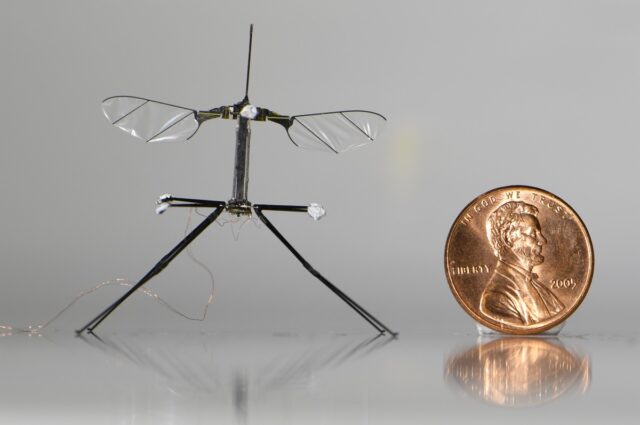
Image of the RoboBee with insect-inspired legs standing next to a US penny for scale.

The RoboBee is only slightly larger than a penny. Credit: Harvard Microrobotics Laboratory

The first step was to perform experiments to determine the effects of oscillation on the newly designed robotic legs and leg joints. This involved manually disturbing the leg and then releasing it, capturing the resulting oscillations on high-speed video. This showed that the leg and joint essentially acted as an “underdamped spring-mass-damper model,” with a bit of “viscoelastic creep” for good measure. Next, the team performed a series of free-fall experiments with small fiberglass crash-test dummy vehicles with mass and inertia similar to RoboBee’s, capturing each free fall on high-speed video. This was followed by tests of different takeoff and landing approaches.

The final step was running experiments on consecutive takeoff and landing sequences using RoboBee, with the little robot taking off from one leaf, hovering, then moving laterally before hovering briefly and landing on another leaf nearby. The basic setup was the same as prior experiments, with the exception of placing a plant branch in the motion-capture arena. RoboBee was able to safely land on the second leaf (or similar uneven surfaces) over repeated trials with varying parameters.

Going forward, Wood’s team will seek to further improve the mechanical damping upon landing, drawing lessons from stingless bees and mosquitoes, as well as scaling up to larger vehicles. This would require an investigation into more complex leg geometries, per the authors. And RoboBee still needs to be tethered to off-board control systems. The team hopes one day to incorporate onboard electronics with built-in sensors.

“The longer-term goal is full autonomy, but in the interim we have been working through challenges for electrical and mechanical components using tethered devices,” said Wood. “The safety tethers were, unsurprisingly, getting in the way of our experiments, and so safe landing is one critical step to remove those tethers.” This would make RoboBee more viable for a range of practical applications, including environmental monitoring, disaster surveillance, or swarms of RoboBees engaged in artificial pollination.

Science Robotics, 2025. DOI: 10.1126/scirobotics.adq3059  (About DOIs).

RoboBee sticks the landing Read More »

autism-rate-rises-slightly;-rfk-jr.-claims-he’ll-“have-answers-by-september“

Autism rate rises slightly; RFK Jr. claims he’ll “have answers by September“

Among the sites, there were large differences. Prevalence ranged from 9.7 per 1,000 children who were 8 years old in Texas (Laredo) to 53.1 in California. These differences are likely due to “differences in availability of services for early detection and evaluation and diagnostic practices,” the CDC and network researchers wrote.

For instance, California—the site with the highest prevalence among 8-year-olds and also 4-year-olds—has a local initiative called the Get SET Early model. “As part of the initiative, hundreds of local pediatricians have been trained to screen and refer children for assessment as early as possible, which could result in higher identification of ASD, especially at early ages,” the authors write. “In addition, California has regional centers throughout the state that provide evaluations and service coordination for persons with disabilities and their families.”

On the other hand, the low ASD rates at the network’s two Texas sites could “suggest lack of access or barriers to accessing identification services,” the authors say. The two Texas sites included primarily Hispanic and lower-income communities.

The newly revealed higher rates in some of the network’s underserved communities could link ASD prevalence to social determinants of health, such as low income and housing and food insecurity, the authors say. Other factors, such as higher rates of preterm birth, which is linked to neurodevelopmental disabilities, as well as lead poisoning and traumatic brain injuries, may also contribute to disparities.

Anti-vaccine voices

The detailed, data-heavy report stands in contrast to the position of health secretary Robert F. Kennedy Jr., a longtime anti-vaccine advocate who promotes the false and thoroughly debunked claim that autism is caused by vaccines. Last month, Kennedy hired the discredited anti-vaccine advocate David Geier to lead a federal study examining whether vaccines cause autism, despite numerous high-quality studies already finding no link between the two.

Geier, who has no medical or scientific background, has long worked with his father, Mark Geier, to promote the idea that vaccines cause autism. In 2011, Mark Geier was stripped of his medical license for allegedly mistreating children with autism, and David Geier was fined for practicing medicine without a license.

In a media statement Tuesday in response to the new report, Kennedy called autism an “epidemic” that is “running rampant.” He appeared to reference his planned study with Geier, saying: “We are assembling teams of world-class scientists to focus research on the origins of the epidemic, and we expect to begin to have answers by September.”

Autism rate rises slightly; RFK Jr. claims he’ll “have answers by September“ Read More »

razer-built-a-game-streaming-app-on-top-of-moonlight,-and-it’s-not-too-bad

Razer built a game-streaming app on top of Moonlight, and it’s not too bad

I intentionally touched as few settings as I could on each device (minus a curious poke or two at the “Optimize” option), and the experience was fairly streamlined. I didn’t have to set resolutions or guess at a data-streaming rate; Razer defaults to 30Mbps, which generally provides rock-solid 1080p and pretty smooth 1440p-ish resolutions. My main complaints were the missing tricks I had picked up in Moonlight, like holding the start/menu button to activate a temporary mouse cursor or hitting a button combination to exit out of games.

Razer’s app is not limited to Steam games like Steam Link or Xbox/Game Pass titles like Remote Play and can work with pretty much any game you have installed. It is, however, limited to Windows and the major mobile platforms, leaving out Macs, Apple TVs, Linux, Steam Deck and other handhelds, Raspberry Pi setups, and so on. Still, for what it does, it works pretty well, and its interface, while Razer-green and a bit showy, was easier to navigate than Moonlight. I did not, for example, have to look up the launching executables and runtime options for certain games to make them launch directly from my mobile device.

Streaming-wise, I noticed no particular differences from the Moonlight experience, which one might expect, given the shared codebase. The default choice of streaming at my iPad’s native screen resolution and refresh rate saved me the headaches of figuring out the right balance of black box cut-offs and resolution that I would typically go through with Steam Link or sometimes Moonlight.

Razer built a game-streaming app on top of Moonlight, and it’s not too bad Read More »

trump-white-house-budget-proposal-eviscerates-science-funding-at-nasa

Trump White House budget proposal eviscerates science funding at NASA

This week, as part of the process to develop a budget for fiscal-year 2026, the Trump White House shared the draft version of its budget request for NASA with the space agency.

This initial version of the administration’s budget request calls for an approximately 20 percent overall cut to the agency’s budget across the board, effectively $5 billion from an overall topline of about $25 billion. However, the majority of the cuts are concentrated within the agency’s Science Mission Directorate, which oversees all planetary science, Earth science, astrophysics research, and more.

According to the “passback” documents given to NASA officials on Thursday, the space agency’s science programs would receive nearly a 50 percent cut in funding. After the agency received $7.5 billion for science in fiscal-year 2025, the Trump administration has proposed a science topline budget of just $3.9 billion for the coming fiscal year.

Detailing the cuts

Among the proposals were: A two-thirds cut to astrophysics, down to $487 million; a greater than two-thirds cut to heliophysics, down to $455 million; a greater than 50 percent cut to Earth science, down to $1.033 billion; and a 30 percent cut to Planetary science, down to $1.929 billion.

Although the budget would continue support for ongoing missions such as the Hubble Space Telescope and the James Webb Space Telescope, it would kill the much-anticipated Nancy Grace Roman Space Telescope, an observatory seen as on par with those two world-class instruments that is already fully assembled and on budget for a launch in two years.

“Passback supports continued operation of the Hubble and James Webb Space Telescopes and assumes no funding is provided for other telescopes,” the document states.

Trump White House budget proposal eviscerates science funding at NASA Read More »

the-trek-madone-slr-9-axs-gen-8-tears-up-the-roads-and-conquers-climbs

The Trek Madone SLR 9 AXS Gen 8 tears up the roads and conquers climbs


Trek’s top-of-the-line performance road bike offers some surprises.

The Madone SLR 9 Gen 8 AXS with Lake Michigan in the background on a brisk morning ride. Credit: Eric Bangeman

When a cyclist sees the Trek Madone SLR 9 AXS Gen 8 for the first time, the following thoughts run through their head, usually in this order:

“What a beautiful bike.”

“Damn, that looks really fast.”

“The owner of this bike is extremely serious about cycling and has a very generous budget for fitness gear.”

Indeed, almost every conversation I had while out and about on the Madone started and ended with the bike’s looks and price tag. And for good reason.

A shiny bike

Credit: Eric Bangeman

Let’s get the obvious out of the way. This is an expensive and very high-tech bike, retailing at $15,999. Part of the price tag is the technology—this is a bicycle that rides on the bleeding edge of tech. And another part is the Project One Icon “Tête de la Course” paint job on the bike; less-flashy options start at $13,499. (And if $15,999 doesn’t break your budget, there’s an even fancier Icon “Stellar” paint scheme for an extra $1,000.) That’s a pretty penny but not an unusual price point in the world of high-end road bikes. If you’re shopping for, say, a Cervélo S5 or Specialized S-Works Tarmac SL8, you’ll see the same price tags.

Madone is Trek’s performance-oriented road bike, and the Gen 8 is the latest and greatest from the Wisconsin-based bike manufacturer. It’s more aerodynamic than the Gen 7 (with a pair of aero water bottles) and a few hundred grams weightier than Trek’s recently discontinued Emonda climbing-focused bike.

I put nearly 1,000 miles on the Gen 8 Madone over a two-month period, riding it on the roads around Chicagoland. Yes, the land around here is pretty flat, but out to the northwest there are some nice rollers, including a couple of short climbs with grades approaching 10 percent. Those climbs gave me a sense of the Madone’s ability on hills.

Trek manufactures the Gen 8 Madone out of its 900 series OCLV carbon, and at 15.54 lb (7.05 kg)—just a hair over UCI’s minimum weight for racing bikes—the bike is 320 g lighter than the Gen 7. But high-tech bikes aren’t just about lightweight carbon and expensive groupsets. Even the water bottles matter. During the development of the Gen 8 Madone, Trek realized the water bottles were nearly as important as the frame when it came to squeezing out every last possible aerodynamic gains.

Perhaps the most obvious bit of aerodynamic styling is the diamond-shaped seat tube cutout. That cutout allows the seat tube to flex slightly on rougher pavement while cutting back on lateral flex. It’s slightly smaller than on the Gen 7 Madone, and it looks odd, but it contributes to a surprisingly compliant ride quality.

For the wheelset, Trek has gone with the Aeolus RSL for the Madone SLR 9. The tubeless-ready wheels offer a 51 mm rim depth and can handle a max tire size of 32 mm. Those wheels are paired with a set of 28 mm Bontrager Aeolus RSL TLR road tires. About four weeks into my testing, the rear tire developed what looked like a boil along one of the seams near the edge of the tire. Trek confirmed it was a manufacturing defect that occurred with a batch of tires due to a humidity-control issue within the factory, so affected tires should be out of stores by now.

Cockpit shot

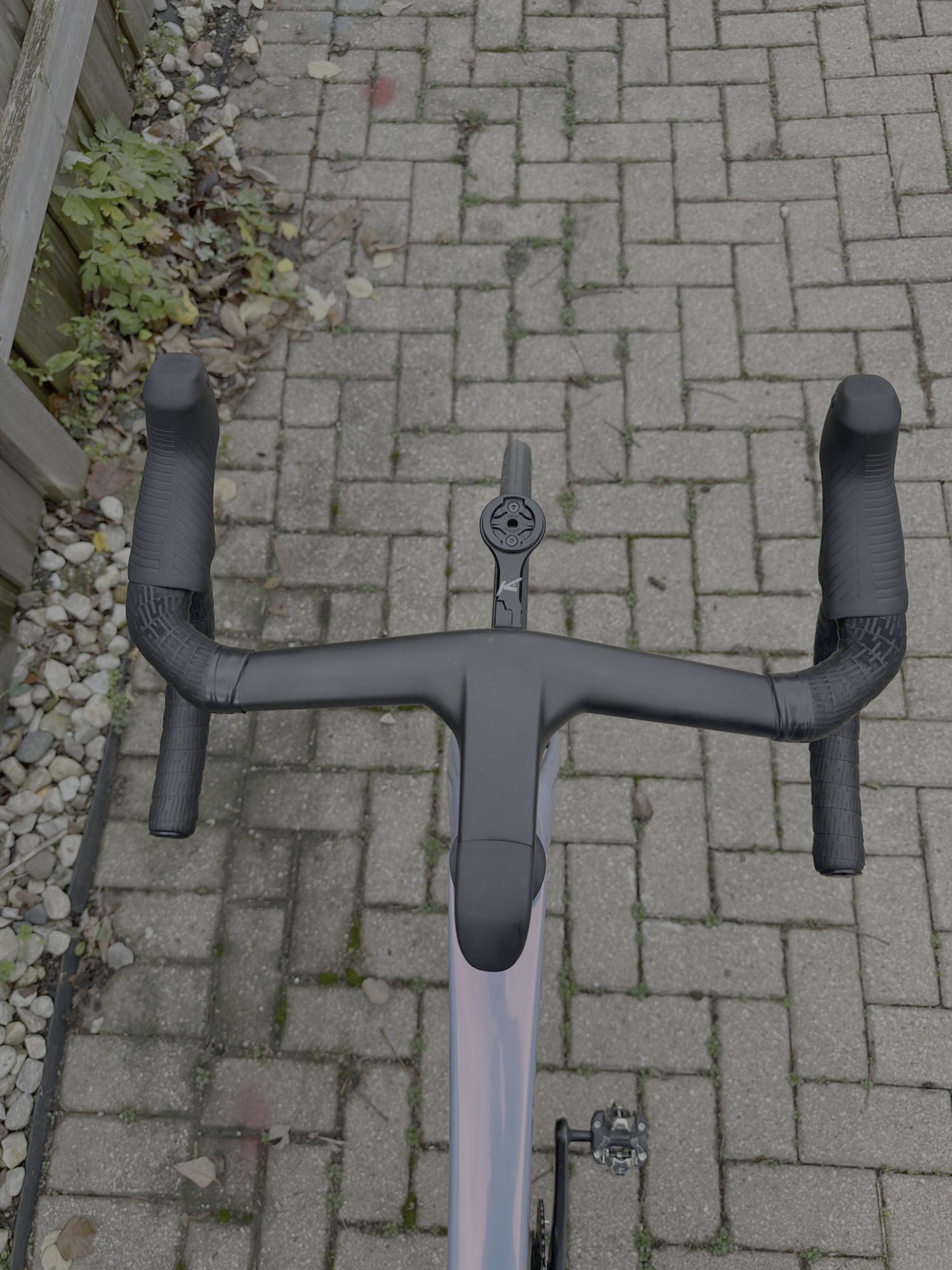
No wires coming off the integrated handlebar and stem.

Credit: Eric Bangeman

No wires coming off the integrated handlebar and stem. Credit: Eric Bangeman

You’ll pilot the Madone with Trek’s new one-piece Aero RSL handlebar and stem combo. It’s a stiff cockpit setup, but I found it comfortable enough even on 80-plus-mile rides. Visually, it’s sleek-looking with a complete absence of wires (and the handlebar-stem combo can only be used with electronic groupsets). The downside is that there’s not enough clearance for a Garmin bike computer with a standard mount; I had to use a $70 K-Edge mount to mount my Garmin.

The Gen 8 Madone also replaces Trek’s Emonda lineup of climbing-focused bikes. Despite weighing 36 grams more than the Emonda SLR 9, Trek claims the Gen 8 Madone has an 11.3 W edge over the climbing bike at 22 mph (and a more modest 0.1 W improvement over the Gen 7 Madone at the same speed).

Of climbs and hero pulls

Paint job

The Tête de la Course colorway in iridescent mode.

Credit: Eric Bangeman

The Tête de la Course colorway in iridescent mode. Credit: Eric Bangeman

The first time I rode the Madone SLR 9 Gen 8 on my usual lunchtime route, I set a personal record. I wasn’t shooting for a new PR—it just sort of happened while I was putting the bike through its paces to see what it was capable of. It turns out it’s capable of a lot.

Riding feels almost effortless. The Madone’s outstanding SRAM Red AXS groupset contributes to that free-and-easy feeling. Shifting through the 12-speed 10-33 cassette is both slick and quick, perfect for when you really want to get to a higher gear in order to drop the hammer. At the front of the drivetrain is a 172.5 mm crank paired with 48t/35t chainrings, more than adequate for everything the local roads were able to confront me with. I felt faster on the flats and quicker through the corners, which led to more than a couple of hero pulls on group rides. The Madone also has a power meter, so you know exactly how many watts you cranked out on your rides.

There’s no derailleur hanger on the Gen 8 Madone, which opens the door to the SRAM Red XPLR groupset.

Credit: Eric Bangeman

There’s no derailleur hanger on the Gen 8 Madone, which opens the door to the SRAM Red XPLR groupset. Credit: Eric Bangeman

There’s also a nice bit of future-proofing with the Madone. Lidl-Trek has been riding some of the cobbled classics with the SRAM Red XPLR AXS groupset, a 13-speed gravel drivetrain that doesn’t need a derailleur hanger. Danish all-arounder Mads Pedersen rode a Madone SLR 9 Gen 8 with a single 56t chainring up front, paired with the Red XPLR to victory at Gent-Wevelgem at the end of March. So if you want to spend another thousand or so on your dream bike setup, that’s an option, as the Madone SLR 9 Gen 8 is one of the few high-performance road bikes that currently supports this groupset.

Living in northeastern Illinois, I lacked opportunities to try the new Madone on extended climbs. Traversing the rollers in the far northwestern suburbs of Chicago, however, the bike’s utility on climbs was apparent. Compared to my usual ride, an endurance-focused road bike, I felt like I was getting the first few seconds of a climb for free. The Madone felt lightweight, nimble, and responsive each time I hit an ascent.

What surprised me the most about the Madone was its performance on long rides. I went into testing with the assumption that I would be trading speed for comfort—and I was happy to be proven wrong. The combination of Trek’s aerodynamic frame design (which it calls IsoFlow), carbon wheelset, and tubeless tires really makes a difference on uneven pavement; there was almost no trade-off between pace and comfort.

What didn’t I like? The water bottles, mainly. My review bike came equipped with a pair of Trek RSL Aero water bottles, which fit in a specially designed cage. Trek says the bottles offer 1.8 W of savings at 22 mph compared to round bottles. That’s not worth it to me. The bottles hold less (~650 ml) than a regular water bottle and are irritating to fill, and getting them in and out of the RSL Aero cages takes a bit of awareness during the first few rides. Thankfully, you don’t need to use the aero bottles; normal cylindrical water bottles work just fine.

The price bears mentioning again. This is an expensive bike! If your cycling budget is massive and you want every last bit of aerodynamic benefit and weight savings, get the SLR 9 with your favorite paint job. Drop down to the Madone SLR 7, and you get the same frame with a Shimano Ultegra Di2 groupset, 52t/36t crank, and a 12-speed 11-30 cassette for $7,000 less than this SLR 9. The SL 7, with its 500 Series OCLV carbon frame (about 250 grams heavier), different handlebars and fork, and the same Ultegra Di2 groupset as the SLR 7 is $2,500 cheaper still.

In conceiving the Gen 8 Madone, Trek prioritized aerodynamic performance and weight savings over all else. The result is a resounding, if expensive, success. The color-shifting Project One paint job is a treat for the eyes, as is the $13,499 Team Replica colorway—the same one seen on Lidl-Trek’s bikes on the UCI World Tour.

At the end of the day, though, looks come a distant second to performance. And with the Gen 8 Madone, performance is the winner by a mile. Trek has managed to take a fast, aerodynamic road bike and make it faster and more aerodynamic without sacrificing compliance. The result is a technological marvel—not to mention a very expensive bike—that is amazing to ride.

Let me put it another way—the Madone made me feel like a boss on the roads. My daily driver is no slouch—a 5-year-old endurance bike with SRAM Red, a Reserve Turbulent Aero 49/42 wheelset, and Continental GP5000s, which I dearly love. But during my two-plus months with the Madone, I didn’t miss my bike at all. I was instead fixated on riding the Madone, dreaming of long rides and new PRs. That’s the way it should be.

Photo of Eric Bangeman

Eric Bangeman is the Managing Editor of Ars Technica. In addition to overseeing the daily operations at Ars, Eric also manages story development for the Policy and Automotive sections. He lives in the northwest suburbs of Chicago, where he enjoys cycling and playing the bass.

The Trek Madone SLR 9 AXS Gen 8 tears up the roads and conquers climbs Read More »