A toy company has voluntarily dismissed its lawsuit against a popular TikTok and Instagram account called “Sylvanian Drama.”
Epoch Company Ltd., is the US maker of adorable fuzzy dolls called Calico Critters. Those dolls are known as “Sylvanian Families” in other markets, and more recently, they became a viral sensation after an Ireland-based content creator, Thea Von Engelbrechten, started making funny videos in which the dolls acted out dark, cringey adult storylines.
Claiming that the “Sylvanian Drama” videos infringed on Epoch’s intellectual property rights, including using an Epoch marketing image as her account’s profile picture while profiting off partnerships with major brands featured in her videos, the toymaker sued Von Engelbrechten, prompting her to immediately stop posting videos last year. Although some fans predicted the account might never come back, experts told Ars that Epoch may come to regret the lawsuit, perhaps alienating a potential market for their toys by going after a widely beloved content creator.
To some, Epoch appeared to be lashing out after Von Engelbrechten secured brand partnerships that seemed to be more lucrative than the toy company’s own brand deals. In that way, they also perhaps overlooked an opportunity to partner with Von Engelbrechten themselves, experts told Ars.
On Friday, Von Engelbrechten’s response was due in the lawsuit, but a story posted to her Instagram earlier this week signaled that a resolution may have been in the works. Ars could not reach Von Engelbrechten for comment, but she asked her fans to recommend a new account name in her story and confirmed that she would also be changing her account’s profile picture.
Bad news if you’re one of the handful of people using Steam to play games on a Chromebook: Google and Valve are preparing to end support for the still-in-beta ChromeOS version of Steam on January 1, 2026, according to 9to5Google. Steam can still be installed on Chromebooks, but it now comes with a notice announcing the end of support.
“The Steam for Chromebook Beta program will conclude on January 1st, 2026,” reads the notification. “After this date, games installed as part of the Beta will no longer be available to play on your device. We appreciate your participation in and contribution to learnings from the beta program, which will inform the future of Chromebook gaming.”
Steam originally launched on Chromebooks in early 2022 as an alpha that ran on just a handful of newer and higher-specced devices with Intel chips inside. A beta version arrived later that year, with reduced system requirements and support for AMD CPUs and GPUs. Between then and now, neither Google nor Valve had said much about it.
The Steam beta was one component of a “gaming Chromebook” push that Google made in 2022 and 2023. It saw the release of laptops with better hardware and high-refresh-rate screens and optimized versions of GeForce Now and Xbox Cloud Gaming. Google had reportedly been working to add Steam support to ChromeOS since at least 2020.
The nation’s premier group of scientific advisers announced Thursday that it will conduct an independent, fast-track review of the latest climate science. It will do so with an eye to weighing in on the Trump administration’s planned repeal of the government’s 2009 determination that greenhouse gas emissions harm human health and the environment.
The move by the National Academies of Sciences, Engineering, and Medicine to self-fund the study is a departure from their typical practice of responding to requests by government agencies or Congress for advice. The Academies intend to publicly release it in September, in time to inform the Environmental Protection Agency’s decision on the so-called “endangerment finding,” they said in a prepared statement.
“It is critical that federal policymaking is informed by the best available scientific evidence,” said Marcia McNutt, president of the National Academy of Sciences. “Decades of climate research and data have yielded expanded understanding of how greenhouse gases affect the climate. We are undertaking this fresh examination of the latest climate science in order to provide the most up-to-date assessment to policymakers and the public.”
The Academies are private, nonprofit institutions that operate under an 1863 congressional charter, signed by President Abraham Lincoln, directing them to provide independent, objective analysis and advice to inform public policy decisions.
The Trump administration’s move to rescind the endangerment finding, announced last month, would eliminate the legal underpinning of the most important actions the federal government has taken on climate change—regulation of carbon pollution from motor vehicles and power plants under the Clean Air Act. Since assuming his role, EPA Administrator Lee Zeldin has made clear he intends to repeal the climate rules that were put in place under the Biden administration, but his job will be far easier with the elimination of the endangerment finding.
The EPA based its proposal mainly on a narrow interpretation of the agency’s legal authority, but the agency also cited uncertainties in the science, pointing to a report published the same day by the Department of Energy that was authored by a hand-picked quintet of well-known skeptics of the mainstream consensus on climate change. The administration has given a short window of opportunity—30 days—for the public to respond to its endangerment finding proposal and to the DOE report on climate science.
The EPA did not immediately respond to a request for comment on the announcement by the National Academies. Critics of the Trump administration’s approach applauded the decision by the scientific panel.
“I think the National Academies have identified a very fundamental need that is not being met, which is the need for independent, disinterested expert advice on what the science is telling us,” said Bob Sussman, who served as deputy administrator of the EPA in the Clinton administration and was a senior adviser in the agency during the Obama administration.
Earlier Thursday, before the National Academies announcement, Sussman posted a blog at the Environmental Law Institute website calling for a “blue-ribbon review” of the science around the endangerment finding. Sussman noted the review of the state of climate science that the National Academies conducted in 2001 at the request of President George W. Bush’s administration. Since then, the Academies have conducted numerous studies on aspects of climate change, including the development of a “climate-ready workforce,” how to power AI sustainably, and emerging technologies for removing carbon from the atmosphere, for example.
The National Academies announced in 2023 that they were developing a rapid response capacity to address the many emerging scientific policy issues the nation was facing. The first project they worked on was an assessment of the state of science around diagnostics for avian influenza.
Andrew Dessler, director of the Texas Center for Extreme Weather at Texas A&M University, said the new controversy that the Trump administration had stirred around climate science was a fitting subject for a fast-track effort by the National Academies.
“The National Academies [were] established exactly to do things like this—to answer questions of scientific importance for the government,” he said. “This is what the DOE should have done all along, rather than hire five people who represent a tiny minority of the scientific community and have views that virtually nobody else agrees with.”
Dessler is leading an effort to coordinate a response from the scientific community to the DOE report, which would also be submitted to the EPA. He said that he had heard from about 70 academics eager to participate after putting out a call on the social media network Bluesky. He said that work will continue because it seems to have a slightly different focus than the National Academies’ announced review, which does not mention the DOE report but talks about focusing on the scientific evidence on the harms of greenhouse gas emissions that has emerged since 2009, the year the endangerment finding was adopted by the EPA.
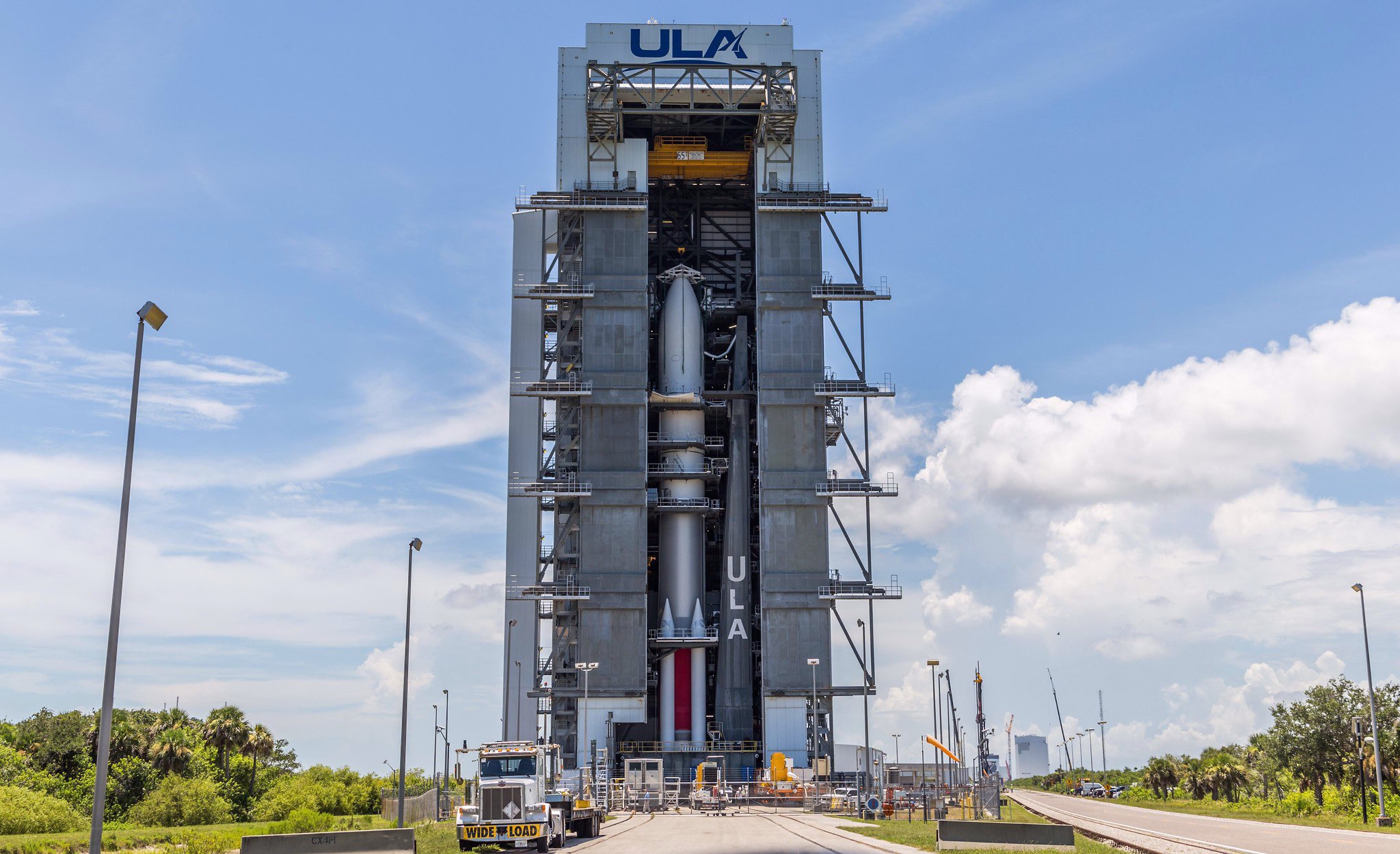
The Vulcan rocket for ULA’s first national security mission nears its initial launch, NET August 12. Credit: United Launch Alliance
The Vulcan rocket for ULA’s first national security mission nears its initial launch, NET August 12. Credit: United Launch Alliance
Welcome to Edition 8.06 of the Rocket Report! After years of disappointing results from SPACs and space companies, it is a good sign to see Firefly’s more traditional initial public offering doing so well. The company has had such a long and challenging road over more than a decade; the prospect of their success should be heartening to the commercial space industry.
As always, we welcome reader submissions. If you don’t want to miss an issue, please subscribe using the box below (the form will not appear on AMP-enabled versions of the site). Each report will include information on small-, medium-, and heavy-lift rockets as well as a quick look ahead at the next three launches on the calendar.
Virgin Galactic delays resumption of spaceflights. The Richard Branson-founded company plans to resume private space tourism trips in the autumn of 2026 after its Delta spacecraft’s first commercial flight, a research mission that was delayed from summer 2026 to also occur in the fall, Bloomberg reports. Virgin Galactic announced an updated timeline on Wednesday, when it reported quarterly financial results that fell short of analysts’ expectations. Revenue was about $410,000 for the second quarter.
Waiting on Delta … The company paused commercial operations in June 2024 to focus on developing the upgraded Delta vehicle, which is being optimized for reusability and faster turnaround time between flights. Virgin Galactic had been selling seats on the Delta spacecraft for about $600,000 and said that it plans to raise prices when ticket sales resume in the first quarter of 2026. The company also recently adjusted the size of its in-house engineering team and reduced the overall headcount by 7 percent to control costs.
Firefly is a big hit with investors. Shares in the Cedar Park, Texas-based space company began trading at $70 on the NASDAQ stock exchange midday Thursday under the symbol FLY, jumping from their initial public offering price of $45, The Wall Street Journal reports. The company sold more than 19 million shares in the listing, raising $868 million. Bankers and traders are closely tracking the stock’s performance as a sign of both the US IPO market strength and investor interest in space companies. The offering will allow the company to accelerate production and its launch cadence, Firefly CEO Jason Kim said in an interview.
Time to build and fly … “We have to execute,” said Kim, who led a Boeing satellite business before taking the top role at Firefly last year. “We’ve got a really strong backlog.” Firefly’s listing comes five months after it successfully guided its Blue Ghost lander to the lunar surface, carrying scientific gear to research moondust and ground temperatures. The NASA-funded mission marked the first fully successful private moon landing, following misfires on three other flights handled by competitors. The company’s next challenge is to prove that its other vehicles can work as well, including the Alpha rocket.
The easiest way to keep up with Eric Berger’s and Stephen Clark’s reporting on all things space is to sign up for our newsletter. We’ll collect their stories and deliver them straight to your inbox.
iRocket says it has signed a huge deal. A largely unknown small launch startup, iRocket, says it has signed a multi-year agreement with SpaceBelt KSA valued at up to $640 million. iRocket will support up to 30 satellite launches, providing mission planning, propulsion systems, and integration services to help establish a secure, autonomous space communications network across Saudi Arabia and the Gulf region.
Yes, but … iRocket says the agreement represents a significant commercial milestone. However, since its founding in 2018, New York-based iRocket hasn’t released much information on any technical progress toward a first flight of the Shockwave launch vehicle. It is difficult to know how much (if any) money changed hands with this agreement.
Indian space startup builds 3D-printed engine. The Chennai-based startup Agnikul Cosmos has announced the successful development of the world’s largest single-piece 3D-printed Inconel rocket engine, Business Today reports. The engine, printed in one go without any welds, joints, or fasteners, represents a leap in additive manufacturing for aerospace, the company said.
Earned a patent … Agnikul also said it has been granted a US patent for the design and manufacturing process of single-piece rocket engines. “Means something to have a completely Indian-origin design patented in the US—a nation that has built some of the most complex engines in this industry,” the company said. Agnikul is developing a small-lift booster that can put about 100 kg to low-Earth orbit.
Skyrora wins first UK launch license. Skyrora became the first British commercial rocket manufacturer to secure a launch license from the UK Civil Aviation Authority, paving the way for its Skylark L suborbital rocket to lift off from the SaxaVord spaceport in the Shetland Islands, Payload reports. Derek Harris, Skyrora’s business development lead, said this test flight could take place as early as May 2026.
Waiting on launch pads … Skyrora said it could launch sooner if it opted to fly from an international launch pad. That’s the route it took in 2022, when it launched a rocket from Iceland’s mobile Langanes launch site. “Unfortunately, we are still technically locked out of SaxaVord,” Harris said. “What is still open to us is Oman, and Australia, or even going back to Iceland…[but] it would be a sad indictment of what’s going on with the government funding if we have to go elsewhere to launch it.”
The Philippines condemns China’s rocket launch. A top Philippine security official on Tuesday condemned China’s latest rocket launch, which caused suspected debris to fall near a western Philippine province, the AP reports. Authorities said the incident sparked alarm and posed a danger to people, ships, and aircraft. There were no immediate reports of injuries or damage from the suspected Chinese rocket debris that fell near Palawan province Monday night, following a launch of the medium-lift Long March 12.
No NOTAMs it seems … China’s official Xinhua News Agency reported that the Long March-12 rocket that lifted off Monday night from a commercial spacecraft launch site on the southern island province of Hainan successfully carried a group of Internet satellites into pre-set orbit. It was not immediately clear whether Chinese authorities had notified nearby countries, such as the Philippines, of possible debris from its latest rocket launch. Philippine aircraft and vessels were deployed on Tuesday to search for the rocket debris.
Crew-11 mission launches from Florida. The next four-person team to live and work aboard the International Space Station departed from NASA’s Kennedy Space Center last Friday, taking aim at the massive orbiting research complex for a planned stay of six to eight months, Ars reports. Spacecraft commander Zena Cardman leads the mission, designated Crew-11, with three others aboard SpaceX’s Crew Dragon Endeavour capsule: veteran NASA astronaut Mike Fincke, Kimiya Yui of Japan, and Oleg Platonov of Russia.
Au revoir to an old friend … The Falcon 9’s reusable first stage booster detached and returned to a propulsive touchdown at Landing Zone 1 (LZ-1) at Cape Canaveral Space Force Station, a few miles south of the launch site. This was the 53rd and final rocket landing at LZ-1 since SpaceX aced the first intact recovery of a Falcon 9 booster there on December 21, 2015. SpaceX will move onshore rocket landings to new landing zones to be constructed next to the two Falcon 9 launch pads at the Florida spaceport. Landing Zone 2, located adjacent to Landing Zone 1, will also be decommissioned and handed back over to the Space Force once SpaceX activates the new landing sites.
NASA says it will move a space shuttle. The head of NASA has decided to move one of the agency’s retired space shuttles to Houston, but which shuttle remains unclear, Ars reports. Senator John Cornyn (R-Texas), who earlier this year introduced and championed an effort to relocate the space shuttle Discovery from the Smithsonian to Space Center Houston, issued a statement on Tuesday evening applauding the decision. The senator did not state which of NASA’s winged orbiters would be making the move.
Playing coy for no clear reason … The legislation that required Duffy to choose a “space vehicle” that had “flown in space” and “carried people” did not specify an orbiter by name, but the language in the “One Big Beautiful Bill” that President Donald Trump signed into law last month was inspired by Cornyn and fellow Texas Senator Ted Cruz’s bill to relocate Discovery. It is unclear why the choice of orbiters is being kept a secret. According to the bill, the decision was to be made “with the concurrence of an entity designated” by the NASA administrator to display the shuttle. Cornyn’s release only confirmed that Duffy had identified the location to be “a non-profit near the Johnson Space Center.”
SpaceX begins offering Starship services to Mars. On Thursday, Gwynne Shotwell, the president and chief operating officer of SpaceX, announced that the company has begun selling rides to Mars. “Get on board! We are going to Mars! SpaceX is now offering Starship services to the red planet,” Shotwell said on X. As part of the announcement, Shotwell said SpaceX has signed a “first of its kind” agreement with the Italian Space Agency.
Racing the Giro d’Mars … The president of the Italian Space Agency, Teodoro Valente, confirmed the news, saying the first Starship flights to Mars (which will, of course, be uncrewed) will carry Italian experiments. “The payloads will gather scientific data during the missions. Italy continues to lead in space exploration!” Valente wrote on X. Left unsaid, of course, is when such flights will take place. It is difficult to see Starship now being ready for a late 2026 window, but early 2029 seems plausible.
ULA will eventually test reuse technology. On Thursday, ahead of the first Vulcan launch of a national security payload next week, United Launch Alliance chief executive Tory Bruno spoke with reporters about various topics, NASA Spaceflight reports. A highlight was ULA’s progress on SMART Reuse, a system aimed at recovering and reusing booster components to reduce costs. Bruno announced that the critical design review for key components is complete, paving the way for building flight-like hardware for certification.
Testing remains a ways away … As development progresses, ULA plans to relocate more components to the aft section of the booster for recovery. “By the time that path is finished, pretty much the only thing being discarded from the booster will be the fuel tanks,” he said. Experimental flights incorporating SMART Reuse could begin as early as 2026, or at least by 2027, but only when aligned with customer needs. One wonders when actual engine recovery and reuse might begin.
Next three launches
August 8: Falcon 9 | Project Kuiper KF-02 | Cape Canaveral Space Force Station, Florida | 13: 40 UTC
August 8: Jielong 3 | Undeclared payload | Offshore site, Chinese coastal waters | 16: 30 UTC
August 10: Falcon 9 | Starlink 17-4 | Vandenberg Space Force Base, Calif. | 03: 43 UTC
Eric Berger is the senior space editor at Ars Technica, covering everything from astronomy to private space to NASA policy, and author of two books: Liftoff, about the rise of SpaceX; and Reentry, on the development of the Falcon 9 rocket and Dragon. A certified meteorologist, Eric lives in Houston.
Some stone tools found near a river on the Indonesian island of Sulawesi suggest that the first hominins had reached the islands by at least 1.04 million years ago. That’s around the same time that the ancestors of the infamously diminutive “Hobbits” may have reached the island of Flores.
Archaeologist Budianto Hakim of Indonesia’s National Research and Innovation Agency and his colleagues were the ones who recently unearthed the tools from a site on Sulawesi. Although a handful of stone flakes from that island don’t tell us who the ancestors of the small species were or how they reached remote islands like Flores and Luzon, the tools are one more piece in the puzzle. And this handful of stone flakes may eventually play a role in helping us understand how other hominin species conquered most of the world long before we came along.
Crossing the ocean a million years ago
Sometimes the deep past leaves the smallest traces. At the Calio site, a sandstone outcrop in what’s now a cornfield outside the village of Ujung in southern Sulawesi, people left behind just a handful of sharp stone flakes roughly a million years ago. There are seven of them, ranging from 22 to 60 millimeters long, and they’re scratched, worn, and chipped from tumbling around at the bottom of a river. But it’s still clear that they were once shaped by skilled human—or at least human-like—hands that used hard stones as hammers to make sharp-edged chert flakes for cutting and scraping.
The oldest of these tools is likely to be between 1.04 and 1.48 million years old. Hakim and his colleagues dated teeth from a wild pig to around 1.26 million years ago. They were part of a jawbone archaeologists unearthed from a layer just above the oldest flake. Throw in some statistical modeling, and you get the range of likely dates for the stone flake buried in the deepest layer of soil.
Even the younger end of that estimate would make these tools the oldest evidence yet of hominins (of any species) in the islands of Indonesia and the Philippines. This area, sometimes called Wallacea, lies between the continents of Asia and Australia, separated from both by wide channels of deep ocean.
“But the Calio site has yet to yield any hominin fossils,” said Brumm, “so while we now know there were tool-makers on Sulawesi a million years ago, their identity remains a mystery.” But they may be related to the Hobbits, a short-statured group of hominins who lived hundreds of kilometers away on the island of Flores until around 50,000 years ago.
“The discovery of Early Pleistocene artifacts at Calio suggests that Sulawesi was populated by hominins at around the same time as Flores, if not earlier,” wrote Hakim and his colleagues in their recent paper.
The Flores connection
The islands that now make up Indonesia and the Philippines have been a hominin hotspot for at least a million years. Our species wandered onto the scene sometime between 63,000 and 73,000 years ago, but at least one other hominin species had already been there for at least a million years. We’re just not sure exactly who they were, when they arrived, or how.
“Precisely when hominins first crossed to Sulawesi remains an open question, as does the taxonomic affinity of the colonizing population,” the authors note.
This map shows the islands of Wallacea. The large one just east of Java is Sulawesi. Credit: Darren O’Connell
That’s why the handful of stone tools the team recently unearthed at Calio matter: They’re another piece of that puzzle, albeit a small one. Every slightly older date is one step closer to the first hominin tools, bones, or footprints in these islands, and another pin on the map of who was where and when.
And that map is accumulating quite a lot of pins, representing an ever-increasing number of species. Once the first hominins made it across the Makassar Strait, they found themselves in isolated groups on islands cut off from the mainland—and each other—so the hominin family tree started branching very quickly. On at least two islands, Flores and Luzon, those original hominin settlers eventually gave rise to local species, Homo floresiensis and Homo luzonensis. And University of Wollongong paleoanthropologist Richard Roberts, a co-discoverer of Homo floresiensis, thinks there are probably more isolated island hominin species.
In 2019, when Homoluzonensis was first described, Roberts told Ars, “These new fossils, and the assignation of them to a new species (Homo luzonensis), fulfills one of the predictions Mike Morwood and others (myself included) made when we first reported (15 years ago!) the discovery of Homo floresiensis: that other unknown species of hominins would be found in the islands of Southeast Asia.”
Both Homo floresiensis (the original “Hobbits”) and Homo luzonensis were short, clocking in at just over a meter tall. Their bones and teeth are different enough from each other to set them apart as a unique species, but they have enough in common that they probably share a common ancestor—one they don’t share with us. They’re more like our distant cousins, and the islands of Wallacea may have been home to many other such cousins, if Roberts and his colleagues are correct.
Complicated family history
But who was the common ancestor of all these hominin cousins? That’s where things get complicated (as if they weren’t already). Most paleoanthropologists lean toward Homo erectus, but there’s a chance—along with some tantalizing hints, and no direct evidence—that much more ancient human relatives called Australopithecines may have made the journey a million (or two) years before Homo erectus.
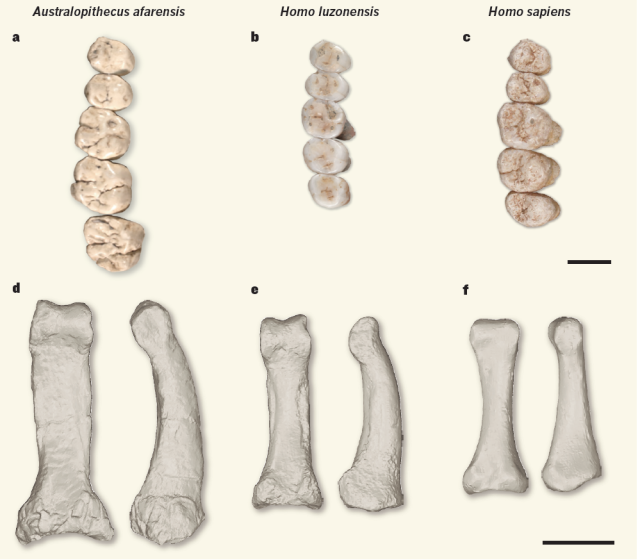
Finger and toe bones from Homo luzonensis are curved, as if they spent as much of their lives climbing trees as walking. That’s more like Australopithecines than any member of our genus Homo. But their teeth are smaller and shaped more like ours. Anthropologists call this mix of features a mosaic, and it can make it tough to figure out how hominin species are related. That’s part of why the question of when the ancestors of the Hobbits arrived on their respective islands is so important.
Compare the teeth and phalanx of Homo luzonensis to those of Homo sapiens (right) and Australopithecus afarensis (left). Credit: Tocheri 2019
We don’t know the answer yet, but we do know that someone was making stone tools on Flores by 1.02 million years ago. Those toolmakers may have been Homo erectus, Australopithecines, or something already recognizable as tiny Homo floresiensis. The Hobbits (or their ancestors) were distinctly “Hobbity” by around 700,000 years ago; fossil teeth and bones from a handful of hominins at a site called Mata Menge make that clear. The Hobbits discovered at Liang Bua Cave on Flores date to somewhere between 50,000 and 100,000 years ago.
Meanwhile, 2,800 kilometers away on the island of Luzon, the oldest stone tools, along with their obvious cut marks left behind on animal bones, date back to 700,000 years ago. That’s as old as the Mata Menge Hobbits on Flores. The oldest Homo luzonensis fossils are between 50,000 and 67,000 years old. It’s entirely possible that older evidence, of the island’s original settlers and of Homo luzonensis, may eventually be found, but until then, we’re left with a lot of blank space and a lot of questions.
And now we know that the oldest traces of hominin presence on Sulawesi is at least 1.04 million years old. But might Sulawesi have its own diminutive hominins?
So are there more Hobbits out there?
“Sulawesi is a wild card—it’s like a mini-continent in itself,” said Brumm. “If hominins were cut off on this huge and ecologically rich island for a million years, would they have undergone the same evolutionary changes as the Flores hobbits? Or would something totally different have happened?”
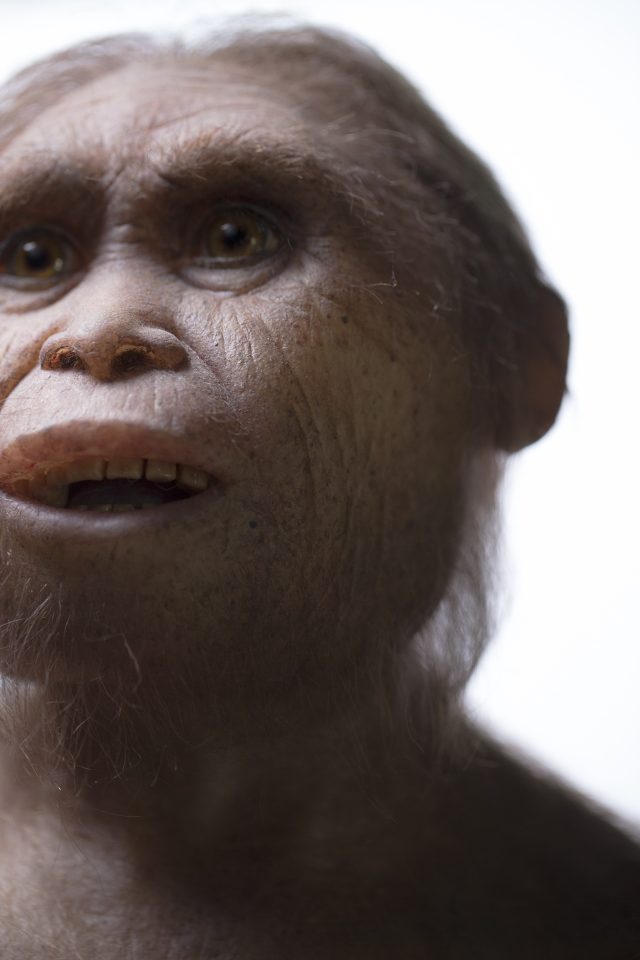
Reconstruction of Homo floresiensis by Atelier Elisabeth Daynes. Credit: Kinez Riza
A phenomenon called island dwarfism played a role in Homo floresiensis‘ evolution; species that live in relative isolation on small islands tend to evolve into either much larger or much smaller versions of their ancestors (which is why the Hobbits shared their island home with pygmy elephants and giant moas). But how small does an island need to be before island dwarfism kicks in? Sulawesi is about 12 times as large as Flores, for example. So what might the descendants of the Calio toolmakers have looked like by 100,000 years ago?
That’s something that we’ll only know if archaeologists on Sulawesi, like Hakim and his team, find fossil remains of those hominins.
Seafarers or tsunami survivors?
Understanding exactly when hominins first set foot on the island of Sulawesi might eventually help us figure out how they got there. These islands are thousands of kilometers from the Southeast Asian mainland and from each other, so getting there would have meant crossing vast stretches of deep, open ocean.
Archaeologists haven’t found any evidence that anyone who came before our species built boats or rafts, although those watercraft would have been made of materials that tend to decay pretty quickly, so even scraps of ancient wood and rope are extremely rare and lucky finds. But some ancient hominins did have a decent grasp of all the basic skills they’d need for at least a simple raft: woodworking and rope-making.
Another possibility is that hominins living on the coast of mainland Southeast Asia could have been swept out to sea by a tsunami, and some of them could have been lucky enough to survive the misadventure and wash ashore someplace like Sulawesi, Flores, or Luzon (RIP to any others). But for that scenario to work, enough hominins would have had to reach each island to create a lasting population, and it probably had to happen more than once to end up with hominin groups on at least three distant islands.
Either way, it’s no small feat, even for a Hobbit with small feet.
He clearly has no idea what antigenic shift means.
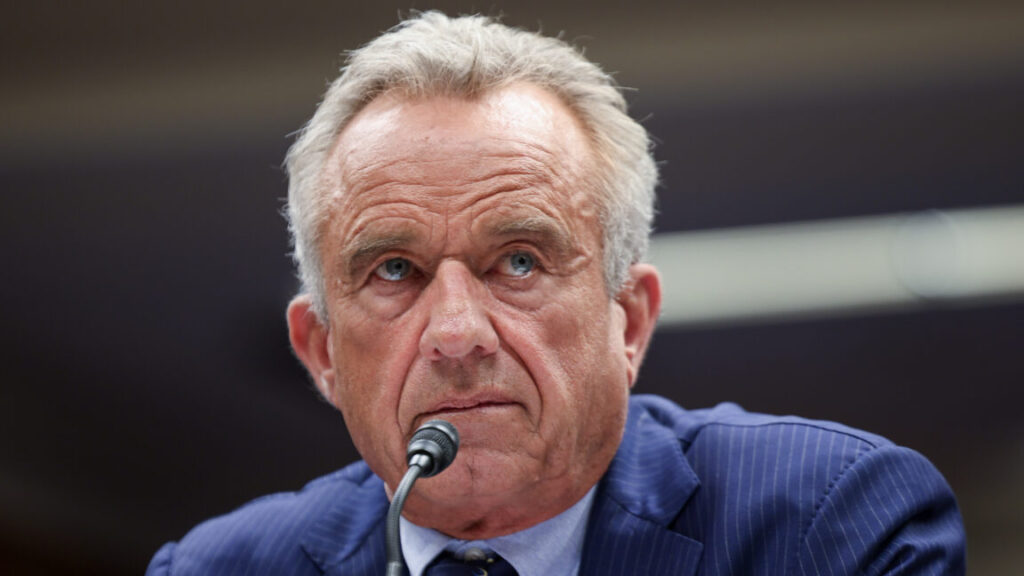
US Secretary of Health and Human Services Robert F. Kennedy Jr. testifies before the Senate Committee on Health, Education, Labor, and Pensions on Capitol Hill on May 20, 2025 in Washington, DC. Credit: Getty | Tasos Katopodis
If anyone needed a reminder that US health secretary and fervent anti-vaccine advocate Robert F. Kennedy Jr. has no background in science or medicine, look no further than the video he posted on social media Tuesday evening.
In the two-and-a-half-minute clip, Kennedy announced that he is cancelling nearly $500 million in funding for the development of mRNA-based vaccines against diseases that pose pandemic threats. The funding will be clawed back from 22 now-defunct contracts awarded through the federal agency tasked with developing medical countermeasures to public health threats. The agency is the Biomedical Advanced Research and Development Authority (BARDA).
Kennedy is generally opposed to vaccines, but he is particularly hostile to mRNA-based vaccines. Since the remarkably successful debut of mRNA COVID-19 vaccines during the COVID-19 pandemic—which were developed and mass-produced with unprecedented speed—Kennedy has continually disparaged and spread misinformation about them.
In the video on Tuesday, Kennedy continued that trend, erroneously saying that, “as the pandemic showed us, mRNA vaccines don’t perform well against viruses that infect the upper respiratory tract.” In reality, COVID-19 vaccines are estimated to have saved more than 3 million lives in the US in just the first two years of the pandemic and additionally prevented more than 18 million hospitalizations in the US in that time. Nearly all COVID-19 vaccines used in the US are mRNA-based.
However, Kennedy’s video only went more off the rails from there. He continued on with this nonsensical explanation:
Here’s the problem: mRNA only codes for a small part of viral proteins usually a single antigen. One mutation, and the vaccine becomes ineffective. This dynamic drives a phenomenon called antigenic shift meaning that the vaccine paradoxically encourages new mutations and can actually prolong pandemics as the virus constantly mutates to escape the protective effects of the vaccine.
Fact-check
To unpack this nonsense, let’s start with how mRNA-based vaccines work. These vaccines deliver a snippet of genetic code—in the form of messenger RNA (mRNA)—to cells. Our cells then translate that mRNA code into a protein that the immune system can, essentially, use for target practice, producing antibodies and cell-based responses against it. After that, if the immune system ever encounters that snippet on an actual invading virus or other germ, it will then recognize it and mount a protective response. Such snippets of germs or other harmful things that can prompt an immune response are generally called antigens.
In the case of COVID-19 vaccines, the mRNA snippet codes for a portion of the SARS-CoV-2 virus’s spike protein, which is a critical external protein that the virus uses to attach to and infect cells. That portion of the spike protein is considered an antigen.
SARS-CoV-2, including its spike protein, is continually evolving, regardless of whether people are vaccinated or not, let alone what type of vaccine they’ve received. The virus racks up mutations as it continuously replicates. Some of these mutations help a virus evade immune responses, whether they’re from vaccination or previous infection. These immune-evading mutations can accumulate and give rise to new variants or strains, making it part of a process called antigenic drift (not shift). Antigenic drift does reduce the efficacy of vaccines over time. It’s why, for example, people can get influenza repeatedly in their lifetimes, and why flu shots are updated annually. However, it does not mean that vaccines are immediately rendered ineffective upon single mutations, as Kennedy says.
For example, the current leading SARS-CoV-2 variant in the US is NB.1.8.1, which has six notable mutations in its spike protein compared to the previous leading variant, LP.8.1. Further, NB.1.8.1 has seven notable spike mutations compared to the JN.1 variant, an ancestor for this line of variants. Yet, studies suggest that current mRNA COVID-19 vaccines targeting JN.1 are still effective against NB.1.8.1. In fact, the Food and Drug Administration, in line with its expert advisors, left open the possibility that vaccine makers could carry over the same JN.1-targeting seasonal COVID-19 vaccine formula from last season for use in this season.
Drift vs. shift
While antigenic drift is an accumulation of small, immune-evading mutations over time, Kennedy mentioned antigenic shift, which is something different. Antigenic shift is much more dramatic, infrequent, and is typically discussed in the context of influenza viruses, which have segmented genomes. Antigenic shift is often defined as “the reassortment of viral gene segments between various influenza viruses of human or zoological origin, which leads to the emergence of new strains.” The Centers for Disease Control and Prevention gives an example of such a shift in 2009. That’s when a new influenza virus with a collection of genome segments from influenza viruses found in North American swine, Eurasian swine, humans, and birds emerged to cause the H1N1 pandemic.
In the video, Kennedy went on to muddle these concepts of drifts and shifts, saying:
Millions of people maybe even you or someone you know caught the omicron variant despite being vaccinated, that’s because a single mutation can make mRNA vaccines ineffective.
Among the COVID-19 variants that have risen to dominance only to be quickly usurped, there’s usually a small handful of mutations—like the examples above with six or seven mutations in the spike protein. But omicron was a different story. Omicron emerged carrying an extremely large suite of mutations—there were 37 mutations in its spike protein compared to its predecessors. Kennedy’s suggestion that it rose to prominence because of a single mutation is egregiously false.
However, due to the extreme number of mutations, some researchers have suggested that omicron does represent an antigenic shift for SARS-CoV-2. Although the pandemic virus—which is a coronavirus—does not have a segmented genome, the “magnitude of Omicron-mediated immune evasion” fits with an antigenic shift, the researchers said.
“Highly vulnerable”
While long-term drifts and rare shifts can reduce the effectiveness of vaccines, creating the need for updated shots, the point only bolsters the case for using mRNA vaccines in the event of another health emergency. Currently, no other vaccine platform beats the development and production speeds of mRNA vaccines. Kennedy said that instead of mRNA vaccines, he’ll shift to developing vaccines using strategies like whole-virus vaccines. But this decades-old strategy requires growing up large supplies of virus in eggs or cell culture, which takes months longer than mRNA vaccines. Further, using whole, inactivated viruses can often produce more side effects than other types of vaccines because they include more antigens.
Overall, experts were aghast that Kennedy has abandoned mRNA vaccines for pandemic preparedness programs. One expert, who asked not to be named for fear of reprisal, told Stat News: “It’s self-evident that this is the single best technology we have now to rapidly produce a vaccine for the largest number of people,” the expert said. “And you are throwing away a technology which was exceedingly valuable in saving lives during the most recent pandemic.”
Michael Osterholm, director of the University of Minnesota’s Center for Infectious Disease Research and Policy, told the outlet that the move “leaves us highly vulnerable. Highly vulnerable.”
Beth is Ars Technica’s Senior Health Reporter. Beth has a Ph.D. in microbiology from the University of North Carolina at Chapel Hill and attended the Science Communication program at the University of California, Santa Cruz. She specializes in covering infectious diseases, public health, and microbes.
OpenAI announced an agreement to supply more than 2 million workers for the US federal executive branch access to ChatGPT and related tools at practically no cost: just $1 per agency for one year.
The deal was announced just one day after the US General Services Administration (GSA) signed a blanket deal to allow OpenAI and rivals like Google and Anthropic to supply tools to federal workers.
The workers will have access to ChatGPT Enterprise, a type of account that includes access to frontier models and cutting-edge features with relatively high token limits, alongside a more robust commitment to data privacy than general consumers of ChatGPT get. ChatGPT Enterprise has been trialed over the past several months at several corporations and other types of large organizations.
The workers will also have unlimited access to advanced features like Deep Research and Advanced Voice Mode for a 60-day period. After the one-year trial period, the agencies are under no obligation to renew.
A limited deployment of ChatGPT for federal workers was already done via a pilot program with the US Department of Defense earlier this summer.
In a blog post, OpenAI heralded this announcement as an act of public service:
This effort delivers on a core pillar of the Trump Administration’s AI Action Plan by making powerful AI tools available across the federal government so that workers can spend less time on red tape and paperwork, and more time doing what they came to public service to do: serve the American people.
The AI Action Plan aims to expand AI-focused data centers in the United States while bringing AI tools to federal workers, ostensibly to improve efficiency.
Scout Motors, the new SUV brand from Volkswagen Group, has also raised some hackles with its plan to sell direct. VW and Audi dealers are suing the company, claiming they should have been offered the right to sell its cars since they also sell other brands from the giant automaker. (The dealers’ argument conveniently ignores the fact that those dealers don’t have a right to franchises for Porsches, Lamborghinis, Bugattis, or the other brands within the VW Group empire, but don’t go expecting consistency here.) A separate group of California car dealers is also suing Scout over direct car sales.
Rivian v. Ohio
In Ohio’s case, the most recent affirmation against direct car sales came in 2014, with a state law that forbids issuing a license to sell cars to anyone who is “a manufacturer, or a parent company, subsidiary, or affiliated entity of a manufacturer, applying for a license to sell or lease new or used motor vehicles at retail,” although it did make an exception for Tesla.
Rivian says that Ohio has no legitimate interest in preventing it from selling cars to Ohioans and that the state “allows manufacturers like Rivian to perform warranty service and other repairs on vehicles in Ohio, to rent vehicles to consumers in Ohio, and even to sell new vehicles to Ohioans from out-of-state dealerships that can be delivered to Rivian service centers in Ohio. Nonsensically, the thing that Rivian cannot do is actually complete the sale of Rivian vehicles in Ohio.”
Last year, Rivian CEO and founder RJ Scaringe told journalists that the “horrific state-by-state level of rules… are as close as you can get to corruption,” and that “you essentially have lots of dealers that paid for lots of laws that make it really hard for us to interact directly with the customer.”
He’s not wrong about the vociferous opposition to OEM direct car sales. “The direct sale model is nothing more than an effort to crush competition and suck profits out of local communities to Silicon Valley and Wall Street,” the New Jersey Coalition of Automotive Retailers said.
And Rivian has faced lawsuits from dealerships in Michigan (successfully) and Illinois (unsuccessfully) in the past.
“We wanted to have a fuel system that was green instead of using hypergolics, so we could land it on a runway and we could walk up to the vehicle without being in hazmat suits,” Tom Vice, then Sierra’s chief executive, told Ars in late 2023. “That was hard, I have to say.”
Apparently it still is because, according to Weigel, the process to finish testing of the propulsion system and certify it for an uncrewed spaceflight remains ongoing.
“We still have some of our integrated safety reviews to do, and we’re in the process with updating both of our schedules to try to understand where does that really put us,” she said. “And so Sierra’s working on that, and so I need to wait and just get information back from them to see where they think some of that work lines out.”
First mission may not berth with ISS
According to one source, Sierra is considering a modification to its first mission to shorten the certification period.
The company had planned to fly the vehicle close enough to the space station such that it could be captured and berthed to the orbiting laboratory. One option now under consideration is a mission that would bring Dream Chaser close enough to the station to test key elements of the vehicle in flight but not have it berth.
This would increase confidence in the spacecraft’s propulsion system and provide the data NASA and partner space agencies need to clear the vehicle to approach and berth with the station on its second flight. However, this would require a modification of the company’s contract with NASA, and a final decision has not yet been reached on whether to perform a flyby mission before an actual berthing.
It appears highly unlikely that Dream Chaser will be ready for its debut spaceflight this year for these technical reasons. Another challenge is the availability of its Vulcan launch vehicle. After years of delays, Vulcan is finally due to make its first national security launch as early as this coming Sunday. Assuming this launch is successful, Vulcan has a busy manifest in the coming months for the US Space Force.
Given this, it is uncertain when a Vulcan launch vehicle will become available for Dream Chaser, which was initially designated to fly on Vulcan’s second flight. However, because Dream Chaser was not ready last fall, that rocket flew with a mass simulator on this second launch, back in October 2024.
According to the DOE, the site produced 165 million gallons of radioactive liquid waste, which has been evaporated to 34 million gallons. The site has 51 waste tanks, eight of which have been operationally closed, with the remaining 43 in various states of the closure process.
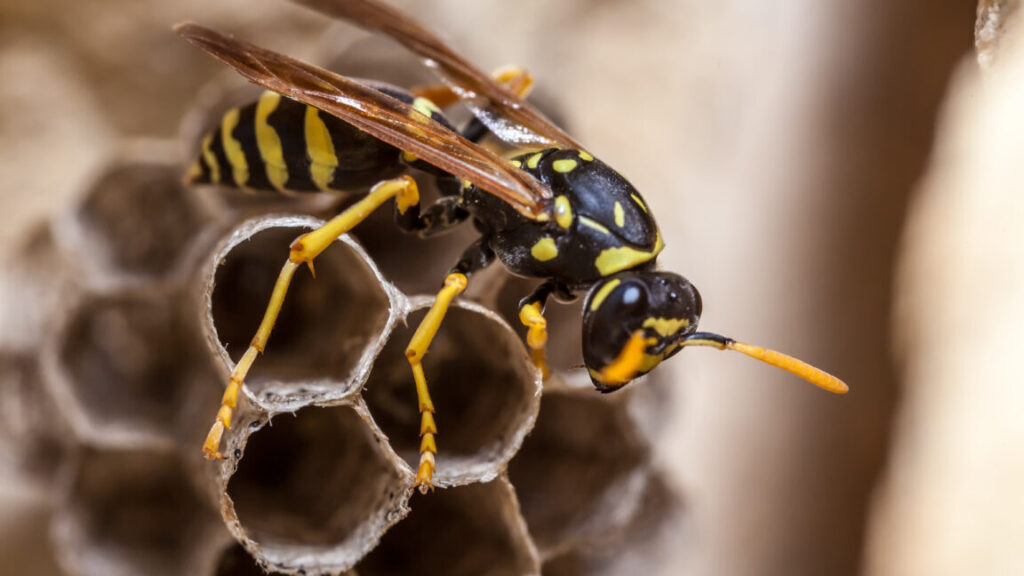
Outside experts have been quick to point out critical information missing from the DOE’s nest report, including the absolute level of radioactivity found in the nest, the specific isotopes that were found, and the type of wasps that built the nest. Some wasps build their nests from mud, while others might use chewed-up pulp from wood.
Timothy Mousseau, a biologist at the University of South Carolina who studies organisms and ecosystems in radioactive regions, told the Times that the DOE’s explanation that the wasps gathered legacy contamination for their homes is not unreasonable. “There’s some legacy radioactive contamination sitting around in the mud in the bottom of the lakes, or, you know, here and there,” he said.
“The main concern relates to whether or not there are large areas of significant contamination that have escaped surveillance in the past,” Mousseau said. “Alternatively, this could indicate that there is some new or old radioactive contamination that is coming to the surface that was unexpected.”
The DOE report of the first wasp nest said that the nest was sprayed to kill wasps, then bagged as radioactive waste. The ground and area around where the nest had been did not have any further contamination.
In a statement to the Aiken Standard, officials working at the DOE site noted that the wasps themselves pose little risk to the community—they likely have lower contamination on them and generally don’t stray more than a few hundred yards from their nests.
However, the Times pointed out a report from 2017, when officials at SRS found radioactive bird droppings on the roof of a building at the site. Birds can carry radioactive material long distances, Mousseau said.
Idaho charts a new path as trust in public health craters.
Some 280,000 people live in the five northernmost counties of Idaho. One of the key public officials responsible for their health is Thomas Fletcher, a retired radiologist who lives on a 160-acre farm near Sandpoint.
Fletcher grew up in Texas and moved to Idaho in 2016, looking for a place where he could live a rural life alongside likeminded conservatives. In 2022, he joined the seven-member board of health of the Panhandle Health District, the regional public health authority, and he was appointed chairman last summer.
PHD handles everything from cancer screenings to restaurant hygiene inspections, and the business of the board is often mundane, almost invisible. Then, this February, Fletcher issued a short announcement online. Parents, he wrote, should be informed of the potential harms of common childhood vaccines. It was time for the board to discuss how best to communicate those risks, rather than “withholding information contra the CDC narrative.” Fletcher invited everyone who believes in “full disclosure and transparency when providing informed consent on childhood vaccines” to attend the next monthly meeting of the board, on a Thursday afternoon.
PHD board meetings tend to be sparsely attended. This one was standing-room only—the start of a monthslong debate over vaccine safety and the question of what, exactly, it means to provide informed consent.
Versions of that debate are playing out across the United States in the aftermath of the COVID-19 pandemic, which many Americans believe was badly mismanaged. The backlash has upended longstanding norms in public health: The nation’s top health official, Robert F. Kennedy Jr., publicly questions the value of common vaccines. Prominent vaccine skeptics now sit on a key advisory committee that shapes immunization practices nationwide. Polls suggest that trust in health authorities is politically polarized — and perhaps historically low. Immunization rates are dropping across the country. And many advocates are promoting a vision of public health that’s less dependent on mandates and appeals to authority, and more deferent to individuals’ beliefs.
Much of that energy has been reflected in Kennedy’s Make American Healthy Again, or MAHA, movement. The coalition is diverse — and has sometimes fractured over vaccination issues—but often channels a long-running argument that Americans should have more freedom to choose or reject vaccines and other health measures.
The backlash against traditional health authorities, said Columbia University medical historian James Colgrove, is unprecedented in recent US history. “It’s been a very, very long time since we’ve been in a place like this,” he said.
Perhaps more than anywhere else in the country, Idaho has experienced these shifts—an ongoing experiment that shows what it looks like to put a vision of individual health freedom into practice. And places like the Panhandle Health District have become testing grounds for big questions: What happens when communities move away from widespread and mandated vaccination? And what does it mean to turn MAHA principles into local public health policy?
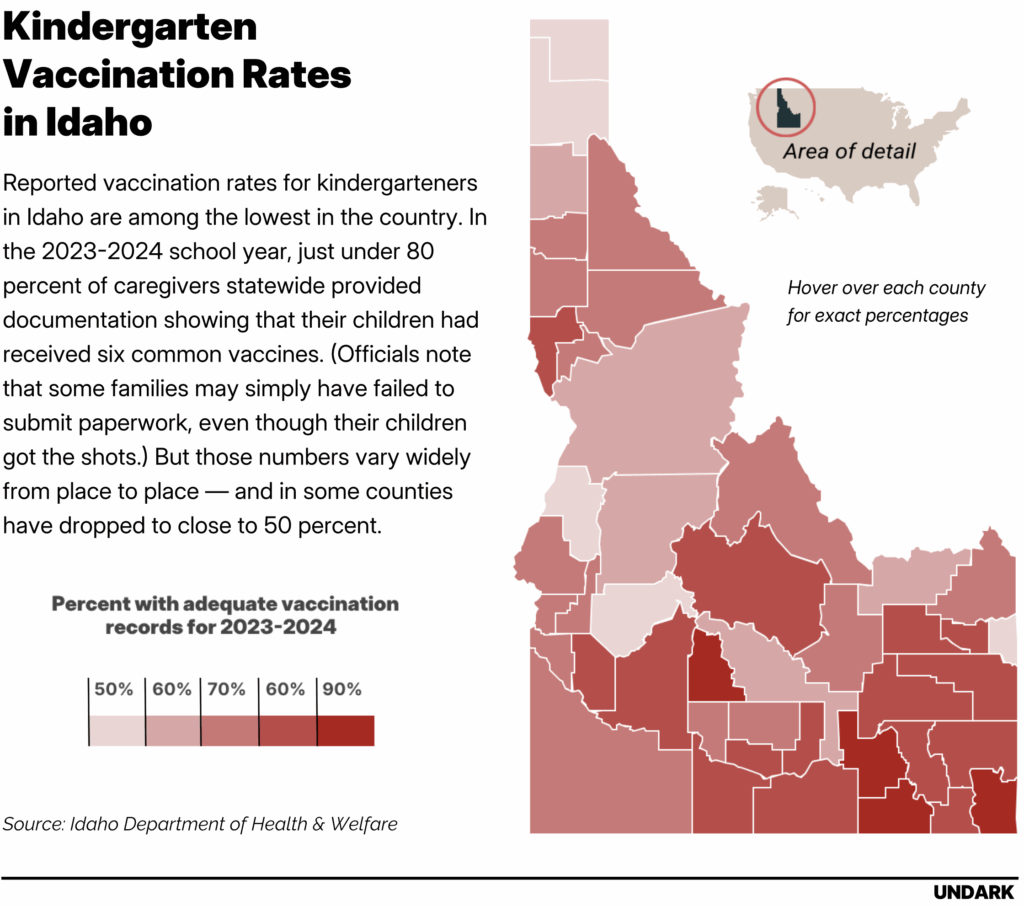
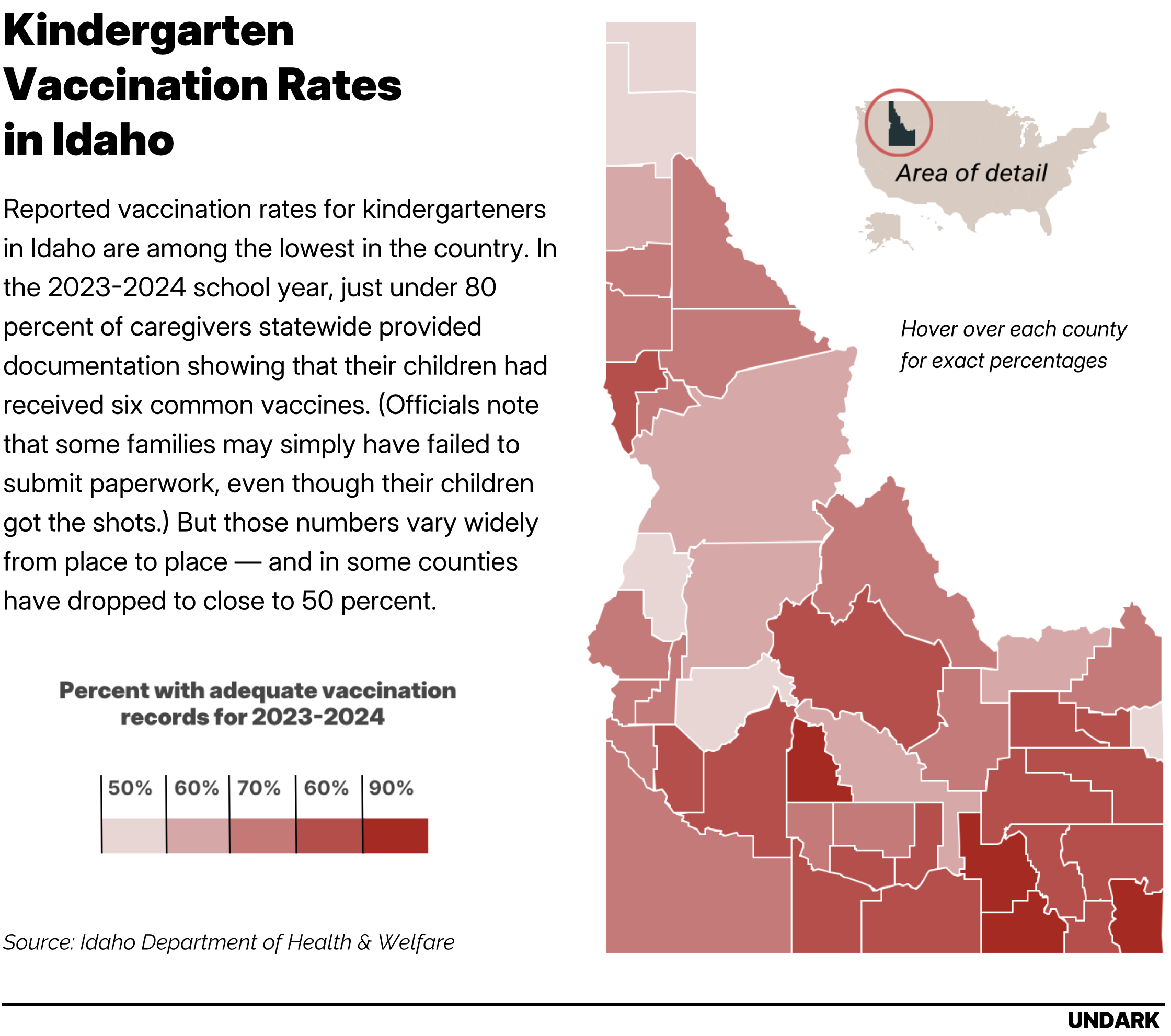
During a recent visit to Idaho, Kennedy described the state as “the home of medical freedom.” In April, Gov. Brad Little signed the Idaho Medical Freedom Act, which bans schools, businesses, and government agencies from requiring people to participate in medical interventions, such as mask-wearing or vaccination, in order to receive services. It’s the first legislation of its kind in the country. The bill has a carveout that keeps school vaccine requirements in place, but those requirements are already mostly symbolic: The state’s exemption policy is so broad that, as one Idaho pediatrician told Undark, “you can write on a napkin, ‘I don’t want my kids to get shots because of philosophical reasons,’ and they can go to kindergarten.” Overall, reported vaccination rates for kindergarteners in Idaho are now lower than in any other state that reported data to the federal government—especially in the Panhandle Health District, where fewer than two-thirds arrive with records showing that they are up-to-date on common shots.
“It’s really kind of like watching a car accident in slow motion,” said Ted Epperly, a physician and the CEO of Full Circle Health, which operates a network of clinics in the Boise area.
A view of Sandpoint, Idaho, which sits on the shores of Lake Pend Oreille. The city, a part of Bonner County, is served by the Panhandle Health District.
Credit: Kirk Fisher/iStock/Getty Images Plus
A view of Sandpoint, Idaho, which sits on the shores of Lake Pend Oreille. The city, a part of Bonner County, is served by the Panhandle Health District. Credit: Kirk Fisher/iStock/Getty Images Plus
Public health leaders often ascribe the low vaccination rates to the work of bad-faith actors who profit from falsehoods, to the spread of misinformation, or to failures of communication: If only leaders could better explain the benefits of vaccination, this thinking goes, more people would get shots.
In interviews and public statements, health freedom advocates in Idaho describe a far deeper rift: They do not believe that public health institutions are competent or trustworthy. And restoring that trust, they argue, will require radical changes.
Fletcher, for his part, describes himself as an admirer of RFK Jr. and the Make America Healthy Again movement. With the recent appointment of a new member, he said, MAHA supporters now hold a majority on the board, where they are poised to reimagine public health work in the district.
Local public health
In the US, public health is mostly local. Agencies like the Centers for Disease Control and Prevention conduct research and issue influential recommendations. But much of the actual power rests with the country’s thousands of state, local, and tribal public health authorities—with institutions, in other words, like the Panhandle Health District, and with leaders like Fletcher and his fellow PHD board of health member Duke Johnson.
Johnson says he grew up in Coeur d’Alene, Idaho, in the 1960s, the descendant of homesteaders who arrived in the 19th century. He attended medical school at the University of California, Los Angeles and eventually returned to Idaho, where he runs a family medical practice and dietary supplement business in the town of Hayden.
In Idaho, health boards are appointed by elected county commissioners. The commissioners of Kootenai County gave Johnson the nod in July 2023. Johnson took the role, he said, in order to restore trust in a medical system that he characterized as beholden to rigid dogmas and protocols rather than independent thinking.
In interviews and public statements, health freedom advocates in Idaho describe a far deeper rift: They do not believe that public health institutions are competent or trustworthy.
Last winter, Johnson took a tour of one of the PHD clinics. Among other services, it provides routine childhood immunizations, especially for families with limited access to health care. As is standard in pediatrics practices, the clinic hands out flyers from the CDC that review the potential side effects of common vaccines, including “a very remote chance” of severe outcomes. Johnson was unimpressed with the CDC writeup. “I thought: This isn’t completely covering all of the risk-benefit ratio,” Johnson said. He felt families could be better informed about what he sees as the substantial risks of common shots.
Johnson is an outlier among physicians. The overwhelming majority of laboratory scientists, epidemiologists, and pediatricians who have devoted their lives to the study of childhood disease say that routine immunizations are beneficial, and that serious side effects are rare. Large-scale studies have repeatedly failed to find purported links between the measles-mumps-rubella, or MMR, vaccine and autism, or to identify high rates of severe side effects for other routine childhood immunizations. The introduction of mass vaccinations in the US in the 1950s and 1960s was followed by dramatic declines in the rates of childhood diseases like polio and measles that once killed hundreds of American children each year, and sent tens of thousands more to the hospital. Similar declines have been recorded around the world.
Children can suffer side effects from common shots like the MMR vaccine, ranging from mild symptoms like a rash or fever to rare fatal complications. Public health agencies and vaccine manufacturers study and track those side effects. But today, many Americans simply do not trust that those institutions are being transparent about the risks of vaccination.
Johnson shares some of those concerns. The website for his clinic, Heart of Hope Health, describes offering services for “injection-injured” patients, encouraging them to receive a $449 heart scan, and advertises “no forced masks or vaccinations.” (During a PHD board meeting, Johnson said that one of his own children suffered an apparent bad reaction to a vaccine many years ago.) “The lack of trust in established medicine is probably 10 times bigger than the people at Harvard Medical School realize,” Johnson told Undark during an evening phone call, after a long day seeing patients. Top medical institutions have brilliant scientists on staff, he continued. But, he suggested, those experts have lost touch with how they’re seen by much of the public: “I think sometimes you can spend so much time talking to the same people who agree with you that you’re not reaching the people on the street who are the ones who need the care. And I’m in the trenches.”
Many public health experts agree that restoring trust is an urgent priority, and they are convinced that it will come through better communication, a reduction in the circulation of misinformation, and a re-building of relationships. Johnson and others in the health freedom movement frequently adopt the language of restoring trust, too. But for them, the process tends to mean something different: an overhaul of public health institutions and a frank accounting of their perceived failures.
At the board meeting in February, Johnson laid out the proposal for a change in policy: What if the board wrote up its own document for parents, explaining the evidence behind specific vaccines, and laying out the risks and benefits of the shots? The goal, he told Undark, was “to make sure that the people that we’re responsible for in our in our district can make an informed decision.”
Fletcher was also hoping to change the way PHD communicated about vaccines. Why did a push for informed consent appeal to him? “I can summarize the answer to that question with one word,” Fletcher said. “COVID.”
Nobody’s telling me what to do
Idaho is ideologically diverse, with blue pockets in cities like Boise, and texture to its overwhelming Republican majority. (Latter-Day Saint conservatives in East Idaho, for example, may not always be aligned with government-skeptical activists clustered in the north.) Parts of the state have a reputation for libertarian politics—and for resistance to perceived excesses of government authority.
People came West because “they wanted to get out to a place where nobody would tell them what to do,” said Epperly, the Boise-area physician and administrator. That libertarian ethos, he said, can sometimes translate into a skepticism of things like school vaccination requirements, even as plenty of Idahoans, including Epperly, embrace them.
Like all US states, Idaho technically requires vaccination for children to attend school. But it is relatively easy to opt out of the requirement. In 2021, Idaho lawmakers went further, instructing schools to be proactive and notify parents they had the option to claim an exemption.
“Idaho has some of the strongest languages in the US when it comes to parental rights and vaccine exemptions,” the vaccine-skeptical advocacy group Health Freedom Idaho wrote in 2021. In the 2024–2025 school year, more than 15 percent of kindergarten parents in the state claimed a non-medical exemption, the highest percentage, by far, of the states that reported data.
The pandemic, Epperly and other Idaho health care practitioners said, accelerated many of these trends. In his view, much of that backlash was about authority and control. “The pandemic acted as a catalyst to increase this sense of governmental overreach, if you will,” he said. The thinking, he added, was: “‘How dare the federal government mandate that we wear masks, that we socially distance, that we hand-wash?’”
Recently, advocates have pushed to remove medical mandates in the state altogether through the Idaho Medical Freedom Act, which curtails the ability of local governments, businesses, and schools to impose things like mask mandates or vaccine requirements.
The author of the original bill is Leslie Manookian, an Idaho activist who has campaigned against what she describes as the pervasive dangers of some vaccines, and who leads a national nonprofit, the Health Freedom Defense Fund. In testimony to an Idaho state Senate committee this February, she described feeling shocked by mitigation measures during the COVID-19 pandemic. “Growing up, I could have never, ever imagined that Idaho would become a place that locked its people down, forced citizens to cover their faces, stand on floor markers 6 feet apart, or produce proof of vaccination in order to enter a venue or a business,” Manookian told the senators.
“Idaho has some of the strongest languages in the US when it comes to parental rights and vaccine exemptions.”
Where some public health officials saw vital interventions for the public’s well-being, Manookian saw a form of government overreach, based on scant evidence. Her home state, she argued, could be a leader in building a post-COVID vision of public health. “Idaho wants to be the shining light on the Hill, that leads the way for the rest of the nation in understanding that we and we alone are sovereign over our bodies, and that our God-given rights belong to us and to no one else,” Manookian said during the hearing. A modified version of the bill passed both houses with large majorities, and became law in April.
Epperly, like many physicians and public health workers in the state, has watched these changes with concern. The family medicine specialist grew up in Idaho. During the pandemic, he was a prominent local figure advocating for masking and COVID-19 vaccinations. When the pandemic began, he had been serving on the board of the Boise-area Central District Health department for more than a decade. Then, in 2021, Ada County commissioners declined to renew his appointment, selecting a physician and vocal opponent of COVID-19 vaccines instead.
A transformative experience
For Thomas Fletcher, the Panhandle Health District board of health chair, the experience of the pandemic was transformative. Fletcher has strong political views; he moved away from Texas, in part, over concerns that the culture there was growing too liberal, and out of a desire to live in a place that was, as he put it, “more representative of America circa 1950.” But before the pandemic, he said, although he was a practicing physician, he rarely thought about public health.
Then COVID-19 arrived, and it felt to him that official messaging was disconnected from reality. In early 2020, the World Health Organization said that COVID-19 was not an airborne virus. (There’s a scientific consensus today that it actually is.) Prominent scientists argued that it was a conspiracy theory to say that COVID-19 emerged from a lab. (The issue is still hotly debated, but many scientists now acknowledge that a lab leak is a real possibility.) The World Health Organization appeared to indicate that the fatality rate of COVID-19 was upwards of 3 percent. (It’s far lower.)
Many people today understand these reversals as the results of miscommunications, evolving evidence, or good-faith scientific error. Fletcher came to believe that Anthony Fauci—a member of the White House Coronavirus Task Force during the pandemic—and other public health leaders were intentionally, maliciously misleading the public. Fletcher reads widely on the platform Substack, particularly writers who push against the medical establishment, and he concluded that COVID-19 vaccines were dangerous, too—a toxic substance pushed by pharma, and backed knowingly by the medical elite. “They lied to us,” he said.
That shift ultimately led the retired physician to question foundational ideas in his field. “Once you realize they’re lying to us, then you ask the question, ‘Well, where else are they lying?’” Fletcher said during one of several lengthy phone conversations with Undark. “I was a card-carrying allopathic physician,” he said. “I believed in the gospel.” But he soon began to question the evidence behind cholesterol medication, and then antidepressants, and then the childhood vaccination schedule.
In 2022, lawmakers in Bonner County appointed Fletcher to the board of health. Last year, he took the helm of the board, which oversees an approximately 90-person agency with a $12 million budget.
“As Chairman of Panhandle Health, I feel a certain urge to restore the trust—public trust in public health—because that trust has been violated,” he said.
The informed consent measure seemed like one way to get there.
Conversations around informed consent
On a February afternoon, in a conference room at the health district office in Hayden, a few dozen attendees and board members gathered to discuss vaccination policy and informed consent in the district.
During the lengthy public comment periods, members of the public spoke about their experiences with vaccination. One woman described witnessing the harms of diseases that have been suppressed by vaccination, noting that her mother has experienced weakness in her limbs as the result of a childhood polio infection. Several attendees reported firsthand encounters with what they understood to be vaccine side effects; one cited rising autism rates. They wanted parents to hear more about those possibilities before getting shots.
In response, some local pediatrics providers insisted they already facilitated informed consent, through detailed conversations with caregivers. They also stressed the importance of routine shots; one brought up the measles outbreak emerging in Texas, which would go on to be implicated in the deaths of two unvaccinated children.
“Once you realize they’re lying to us, then you ask the question, ‘Well, where else are they lying?’”
Johnson, defending the measure, proposed a document that listed both pros and cons for vaccination. The PHD Board, he argued, “would have a much better chance of providing good information than the average person on the Internet.”
The conversation soon bogged down over what, exactly, the document should look like. “If the vote is yay or nay for informed consent, I’m all in with two hands,” said board member Jessica Jameson, an anesthesiologist who ultimately voted against the measure. “But my concern is that we have to be very careful about the information we present and the way that it’s presented.” The board members, she added, were neither “the subject matter experts nor the stakeholders,” and studies that seemed strong on first-glance could be subject to critique.
Marty Williams, a nurse practitioner in Coeur d’Alene who works in pediatrics, had heard about the meeting that morning, as materials about the measure circulated online.
Williams is a former wildland firefighter, a father of five, and a Christian; he snowboards and bowhunts in his free time, and speaks with the laid-back affect of someone who has spent years coaching anxious parents through childhood scrapes and illnesses. A document associated with the proposal looked to him less like an attempt at informed consent, and more like a bid to talk parents out of giving their children immunizations. “If you read this, you would be like, ‘Well, I would never vaccinate my child,’” he recalled. “It was beyond informed consent. It seemed to be full of bias.”
He and his practice partner, Jeanna Padilla, canceled appointments in order to attend the meeting and speak during a public comment period. “The thought of it coming from our public health department made me sick,” Williams said. “We’re in the business of trying to prevent disease, and I had a strong feeling that this was going to bring more fear onto an already anxiety-provoking subject.” The issue felt high-stakes to him: That winter, he had seen more cases of pertussis, a vaccine-preventable illness, than at any point in his 18-year career.
Williams has always encountered some parents who are hesitant about vaccination. But those numbers began to rise during the COVID-19 pandemic. Trust in public health was dropping, and recommendations to vaccinate children against COVID-19, in particular, worried him. “Is this going to push people over the edge, where they just withdraw completely from vaccines?” he wondered at the time. Something did shift, he said: “We have families that historically have vaccinated their children, and now they have a new baby, and they’re like, ‘Nope, we’re not doing it. Nope, nope, nope.’”
In his practice, Williams described a change in how he’s approached parents. “I don’t say, ‘Well, you know, it’s time for Junior’s two months shots. Here’s what we’re going to do.’ I don’t approach it that way anymore, because greater than 40 or 50 percent of people are going to say, ‘Well, no, I’m not doing vaccines. And they get defensive right away,’” he said. Instead, he now opens up a conversation, asking families whether they’ve thought about vaccination, answering their questions, providing resources, talking about his personal experiences treating illness—even inviting them to consider the vaccine schedules used in Denmark or Sweden, which recommend shots for fewer diseases, if they are adamant about not following CDC guidelines.
The approach can be effective, he said, but also time-consuming and draining. “It’s emotional for me too, because there’s a piece of this that being questioned every single day in regards to the standard of care, as if you’re harming children,” he said.
“If you read this, you would be like, ‘Well, I would never vaccinate my child.’ It was beyond informed consent. It seemed to be full of bias.”
Williams doubts his comments at the February meeting achieved much. “I was shocked by what I was hearing, because it was so one-sided,” he said. What seemed to be missing, he said, was an honest account of the alternatives: “There was no discussion of, OK, then, if we don’t vaccinate children, what is our option? How else are we going to protect them from diseases that our grandparents dealt with that we don’t have to deal with in this country?”
The board punted: They’d discuss the issue again down the road.
This isn’t new
Versions of this debate have played out across Idaho—and across the country — since the end of COVID-19’s emergency phase. In an apparent national first, one Idaho health district banned COVID-19 vaccines altogether. In Louisiana, Surgeon General Ralph Abraham told public health departments to stop recommending specific vaccines. “Government should admit the limitations of its role in people’s lives and pull back its tentacles from the practice of medicine,” Abraham and his deputy wrote in a statement explaining the decision. “The path to regaining public trust lies in acknowledging past missteps, refocusing on unbiased data collection, and providing transparent, balanced information for people to make their own health decisions.”
In several states, Republican lawmakers have moved to make it easier for people to opt out of vaccines. Not all those efforts have been successful: In West Virginia this past March, for example, the Republican-dominated legislature rejected a bill that would have made it easier to obtain exemptions. Keith Marple, a Republican lawmaker who voted against the measure, cited his personal experiences with people who had been left disabled by polio. “West Virginia needs to look after its children,” he said, according to the news site West Virginia Watch.
In an apparent national first, one Idaho health district banned COVID-19 vaccines altogether.
In Idaho, like many states, vaccination rates have dropped. In the 2023-2024 school year, a bit more than 65 percent of kindergarten families in the Panhandle Health District furnished records showing they’ve received the MMR vaccine and five other common immunizations, down from just over 69 percent in the 2019-2020 school year. (State officials note that some children may have received shots, but their parents did not submit the paperwork to prove it.) Such figures, infectious disease modelers say, leave the area vulnerable to outbreaks of measles and other illnesses.
During an interview with Undark earlier this year, Sarah Leeds, who directs the immunization program for the Idaho Department of Health and Welfare, noted her colleagues across the country are reporting resistance to their work. “Sometimes it’s hard when you might be feeling like people think we’re the villain,” she said. “But I know our team and our leadership knows we do good work, and it’s based on sound science, and it’s important work for the community. And we just keep that at the front of our minds.”
When the board reconvened in early March, more advocates for the informed consent policy came out to back it. Among them was Rick Kirschner, a retired naturopathic doctor, author, and speaker. (His best-known book is titled “Dealing With People You Can’t Stand.”) Kirschner lived for decades in Ashland, Oregon. Early in 2020, he began to diverge from his neighbors over COVID-19 policies. He and his wife visited north Idaho that summer, and bought a home there weeks later. Compared to pandemic-conscious Oregon, it felt like a different reality. That Thanksgiving, he said during a recent Zoom interview, they attended a celebration “with 10 families and all their kids running around. It just was, ‘Oh, we’re Americans again.’ And it was just terrific.”
At the meeting in March, several people said that it was necessary to restore trust in public health institutions. But what, exactly, did that mean? Kirschner argued that it required more information, including more detailed accountings of all the ways public health interventions like vaccination could cause harm, and more detail on where the scientific literature falls short. “Denying information risks backfiring when risks that were hidden become known and trust in authorities craters,” he said during the hearing.
“I find that people are smarter than these public health people give them credit for,” he said during his call with Undark. There was a tendency in public health, he felt, to treat people like cattle. “The mindset of public health is, ‘They’re dummies, and we need to direct them and to what we think is in their interest,’” he said.
Others at the meeting pushed back against suggestions that public health workers and clinicians were not already providing detailed information to patients. “It’s not like Panhandle Health is against informed consent, or does not have that as part of the process” said Peggy Cuvala, a member of the board. Cuvala has personal experience with the issue: She spent more than three decades as a public health nurse and nurse practitioner with the Panhandle Health District. “I would never force anyone into vaccination,” she said in a phone interview.
Cuvala is well aware that vaccine side effects happen—one of her own children, she said, suffered an adverse reaction to a shot—but she’s also seen transformative benefits. For years, she had to fill out reports on cases of Haemophilus influenzae that had caused meningitis in young children, including one case in which an infant died. Then a vaccine arrived. “Within a year of that vaccine coming out, I didn’t have to do those reports anymore,” she told Undark.
Cuvala describes herself as feeling perplexed by the recent direction of the board. “I think protecting and promoting the health and well being of the residents in North Idaho is critical,” she wrote in an email. “This work should be directed by the board collectively without political bias.”
During the meeting, legal questions came up, too: What were the liability implications of drawing up a custom PHD vaccine safety document?
In a previous meeting, Fletcher had pushed for a document that just gave basic details on the duration and scope of the randomized controlled trials that common vaccines had been subjected to. Such information, he argued, would demonstrate how poorly vetted the shots were—and show how they could be dangerous, even fatal. After that, he said in an interview, it was the parent’s choice. “If some mom wants her kid to get it, fine, give it to him,” Fletcher said. The ultimate arbiter of who was correct would be the brutal process of natural selection: “Let Darwin figure it out.”
In the March meeting, the board voted against creating a subcommittee to explore how to draft the document. “It’s dead,” said Fletcher during a phone call in early May.
A matter of trust
The discussion around the informed consent measure, though, was not entirely gone. On a Saturday morning in early May, the board held a lengthy public planning session at a government building in Coeur d’Alene. During a visioning session, attendees put stickers on pieces of paper next to words describing opportunities for the district. At the bottom of the page, someone wrote, in large, all-caps: “TRUST.”
Kirschner spoke again at the meeting, urging the board to revive the measure. So did a handful of other attendees, including Ron Korn, a county commissioner.
In a short interview at the meeting, PHD spokesperson Katherine Hoyer expressed some uncertainty about what substantive differences, precisely, the measure would offer over what’s already taking place in clinics. “What they’re proposing is that we provide patients with information on medical practices and vaccines,” she said. “That is happening.”
Fletcher sees opportunities ahead. In July, the board unanimously reelected him as chair. And, he said, he has a new ally in the push for an informed consent policy. Jessica Jameson, one of the board members who opposed the measure, recently resigned. Fletcher described her successor, a naturopathic doctor who was appointed to the board last month, as aligned with the MAHA movement. That brings the total MAHA-aligned members, by his count, to four — securing a majority on the seven-member board. “My plan is unfolding just as I wanted,” he said during a call in late July.
During an earlier conversation, Fletcher had reflected on the strange position of RFK Jr., who is perched atop the Department of Health and Human Services, which is staffed by many of the people he spent his career opposing. “He has hundreds of thousands of employees; 99.99 percent of them think he’s full of shit,” Fletcher said. Fletcher, in some ways, has his own miniature version of that problem: An antagonist of institutional public health, overseeing a public health organization.
The precise informed consent measure, he acknowledged, may not come to pass. But the debate itself has merit, he said: “Even if we lose, whatever lose means, even if we don’t make any positive forward motion — you never know. Every time you talk about this, you maybe change someone’s sentiment. You maybe move things forward a little bit. Which is why I do it.”
Fletcher’s role is small. But, he suggested, added together, the cumulative efforts of local politicking could amount to a revolution. “Robert Kennedy needs as many people putting their oar in the water and stroking in the same direction,” Fletcher said. “He can’t do it alone. So if there are 10,000 Thomas Fletchers out there, all going in the same direction, then maybe we can have hope.”
Sadly, the US is unlikely to get the Econeer trim, which uses a seat fabric made entirely from recycled PET bottles (instead, we should be getting an eco vinyl option).
Of course, you need to do more than just pick better materials, some of which have been recycled, if you want to seriously dent the carbon footprint of your new vehicle. That’s especially true if it’s electric—for all an EV’s benefits, they remain significantly more energy-intensive to build than a new internal combustion engine vehicle. And automakers do need to make serious dents in their carbon footprints: BMW has to slash its carbon emissions from a 2019 level of 150 million tons down to 109 million tons in 2030. For 2024, it was down to 135 million tons, the company told us.
Fishing nets are turned into plastic granules, then used to make bits of the car.
The Neue Klasse is essential to meeting that goal. The factory in Debrecen, Hungary, is powered entirely by renewable energy, including an entirely electric paint shop, and it generates two-thirds the amount of CO2 as one of BMW’s established factories. And the battery pack, which uses an all-new BMW cylindrical cell, has a 42 percent smaller carbon footprint per kWh than the prismatic cells used in BMW’s current 5th-generation EVs.
We can’t say much about the expected efficiency of the new 6th-gen powertrain until later this month, but we can say that BMW calculates that the iX3 can reach its break-even point with an ICE vehicle within just a year. Charge the car with entirely renewable electricity, and within just 10,900 miles (17,500 km), it’s on par with an ICE vehicle; using the normal European energy generation mix, that crossover comes at a little more than 13,300 miles (21,000 km).
At 124,000 miles (200,000 km), the iX3 should have a lifetime carbon footprint of 23 tons (or 14.6 tons exclusively using renewable energy); by contrast, a conventionally powered BMW X3 crossover would have a footprint of 52.8 tons.
Check back on August 25, when we can tell you what else we learned about BMW’s next EV crossover.