Author name: Paul Patrick

broadcom-owned-vmware-kills-the-free-version-of-esxi-virtualization-software

Broadcom-owned VMware kills the free version of ESXi virtualization software

freesphere —

Software’s free version was a good fit for tinkerers and hobbyists.

Broadcom-owned VMware kills the free version of ESXi virtualization software

VMware

Since Broadcom’s $61 billion acquisition of VMware closed in November 2023, Broadcom has been charging ahead with major changes to the company’s personnel and products. In December, Broadcom began laying off thousands of employees and stopped selling perpetually licensed versions of VMware products, pushing its customers toward more stable and lucrative software subscriptions instead. In January, it ended its partner programs, potentially disrupting sales and service for many users of its products.

This week, Broadcom is making a change that is smaller in scale but possibly more relevant for home users of its products: The free version of VMware’s vSphere Hypervisor, also known as ESXi, is being discontinued.

ESXi is what is known as a “bare-metal hypervisor,” lightweight software that runs directly on hardware without requiring a separate operating system layer in between. ESXi allows you to split a PC’s physical resources (CPUs and CPU cores, RAM, storage, networking components, and so on) among multiple virtual machines. ESXi also supports passthrough for PCI, SATA, and USB accessories, allowing guest operating systems direct access to components like graphics cards and hard drives.

The free version of ESXi had limits compared to the full, paid enterprise versions—it could only support up to two physical CPUs, didn’t come with any software support, and lacked automated load-balancing and management features. But it was still useful for enthusiasts and home users who wanted to run multipurpose home servers or to split a system’s time between Windows and one or more Linux distributions without the headaches of dual booting. It was also a useful tool for people who used the enterprise versions of the vSphere Hypervisor but wanted to test the software or learn its ins and outs without dealing with paid licensing.

For the latter group, a 60-day trial of the VMware vSphere 8 software is still available. Tinkerers will be better off trying to migrate to an alternative product instead, like Proxmox, XCP-ng, or even the Hyper-V capabilities built into the Pro versions of Windows 10 and 11.

Broadcom-owned VMware kills the free version of ESXi virtualization software Read More »

scientists-found-a-stone-age-megastructure-submerged-in-the-baltic-sea

Scientists found a Stone Age megastructure submerged in the Baltic Sea

They built a wall —

“Blinkerwall” may have been a “desert kite,” used to channel and hunt reindeer.

Graphical reconstruction of a Stone Age wall as it may been used: as a hunting structure in a glacial landscape.

Enlarge / Graphical reconstruction of a Stone Age wall as it may been used: as a hunting structure in a glacial landscape.

Michał Grabowski

In 2021, Jacob Geersen, a geophysicist with the Leibniz Institute for Baltic Sea Research in the German port town of Warnemünde, took his students on a training exercise along the Baltic coast. They used a multibeam sonar system to map the seafloor about 6.2 miles (10 kilometers) offshore.  Analyzing the resulting images back in the lab, Geersen noticed a strange structure that did not seem like it would have occurred naturally.

Further investigation led to the conclusion that this was a manmade megastructure built some 11,000 years ago to channel reindeer herds as a hunting strategy. Dubbed the “Blinkerwall,” it’s quite possibly the oldest such megastructure yet discovered, according to a new paper published in the Proceedings of the National Academy of Sciences—although precisely dating these kinds of archaeological structures is notoriously challenging.

As previously reported, during the 1920s, aerial photographs revealed the presence of large kite-shaped stone wall mega-structures in deserts in Asia and the Middle East that most archaeologists believe were used to herd and trap wild animals. More than 6,000 of these “desert kites” have been identified as of 2018, although very few have been excavated. Last year, archaeologists found two stone engravings—one in Jordan, the other in Saudi Arabia—that they believe represent the oldest architectural plans for these desert kites.

However, these kinds of megastructures are almost unknown in Europe, according to Geersen et al., because they simply didn’t survive the ensuing millennia. But the Baltic Sea basins, which incorporate the Bay of Mecklenburg where Geersen made his momentous discovery, are known to harbor a dense population of submerged archaeological sites that are remarkably well-preserved—like the Blinkerwall.

Morphology of the southwest–northeast trending ridge that hosts the Blinkerwall and the adjacent mound.

Enlarge / Morphology of the southwest–northeast trending ridge that hosts the Blinkerwall and the adjacent mound.

J. Geersen et al., 2024

After they first spotted the underwater wall, Geeren enlisted several colleagues to lower a camera down to the structure. The images revealed a neat row of stones forming a wall under 1 meter (3.2 feet) in height. There are 10 large stones weighing several tons, spaced at intervals, and connected by more than 1,600 smaller stones (less than 100 kilograms or 220 pounds).  “Overall, the ten heaviest stones are all located within regions where the stonewall changes is strike direction,” the authors wrote. The length of the wall is 971 meters (a little over half a mile).

They concluded that the wall didn’t form through natural processes like a moving glacier or a tsunami, especially given the careful placement of the larger stones wherever the wall zigs or zags. It is more likely the structure is manmade and built over 10,000 years ago, although the lack of other archaeological evidence like stone tools or other artifacts makes dating the site difficult. They reasoned that before then, the region would have been covered in a sheet of ice. The immediate vicinity would have had plenty of stones laying about to build the Blinkerwall. Rising sea levels then submerged the structure until it was rediscovered in the 21st century. This would make the Blinkerwall among the oldest and largest Stone Age megastructures in Europe.

As for why the wall was built, Geeren et al. suggest that it was used as a desert kite similar to those found in Asia and the Middle East. There are usually two walls in a desert kite, forming a V shape, but the Blinkerwall happens to run along what was once a lake. Herding reindeer into the lake would have slowed the animals, making them easier to hunt. It’s also possible that there is a second wall hidden underneath the sediment on the seafloor. “When you chase the animals, they follow these structures, they don’t attempt to jump over them,” Geersen told The Guardian. “The idea would be to create an artificial bottleneck with a second wall or with the lake shore.”

3D model of a section of the Blinkerwall adjacent to the large boulder at the western end of the wall.

Enlarge / 3D model of a section of the Blinkerwall adjacent to the large boulder at the western end of the wall.

Philipp Hoy, Rostock University

A similar submerged stone-walled drive lane, known as “Drop 45,” is located in Lake Huron in the US; divers found various lithic artifacts around the drive lane, usually in circular spots that could have served as hunting blinds. The authors suggest that the larger blocks of the Blinkerwall could also have been hunting blinds, although further archaeological surveys will be needed to test this hypothesis.

“I think the case is well made for the wall as an artificial structure built to channel movements of migratory reindeer,” archaeologist Geoff Bailey of the University of York, who is not a co-author on the paper, told New Scientist. Vincent Gaffney of the University of Bradford concurred. “Such a find suggests that extensive prehistoric hunting landscapes may survive in a manner previously only seen in the Great Lakes,” he said. “This has very great implications for areas of the coastal shelves which were previously habitable.”

PNAS, 2024. DOI: 10.1073/pnas.2312008121 (About DOIs).

Scientists found a Stone Age megastructure submerged in the Baltic Sea Read More »

openai-experiments-with-giving-chatgpt-a-long-term-conversation-memory

OpenAI experiments with giving ChatGPT a long-term conversation memory

“I remember…the Alamo” —

AI chatbot “memory” will recall facts from previous conversations when enabled.

A pixelated green illustration of a pair of hands looking through file records.

Enlarge / When ChatGPT looks things up, a pair of green pixelated hands look through paper records, much like this. Just kidding.

Benj Edwards / Getty Images

On Tuesday, OpenAI announced that it is experimenting with adding a form of long-term memory to ChatGPT that will allow it to remember details between conversations. You can ask ChatGPT to remember something, see what it remembers, and ask it to forget. Currently, it’s only available to a small number of ChatGPT users for testing.

So far, large language models have typically used two types of memory: one baked into the AI model during the training process (before deployment) and an in-context memory (the conversation history) that persists for the duration of your session. Usually, ChatGPT forgets what you have told it during a conversation once you start a new session.

Various projects have experimented with giving LLMs a memory that persists beyond a context window. (The context window is the hard limit on the number of tokens the LLM can process at once.) The techniques include dynamically managing context history, compressing previous history through summarization, links to vector databases that store information externally, or simply periodically injecting information into a system prompt (the instructions ChatGPT receives at the beginning of every chat).

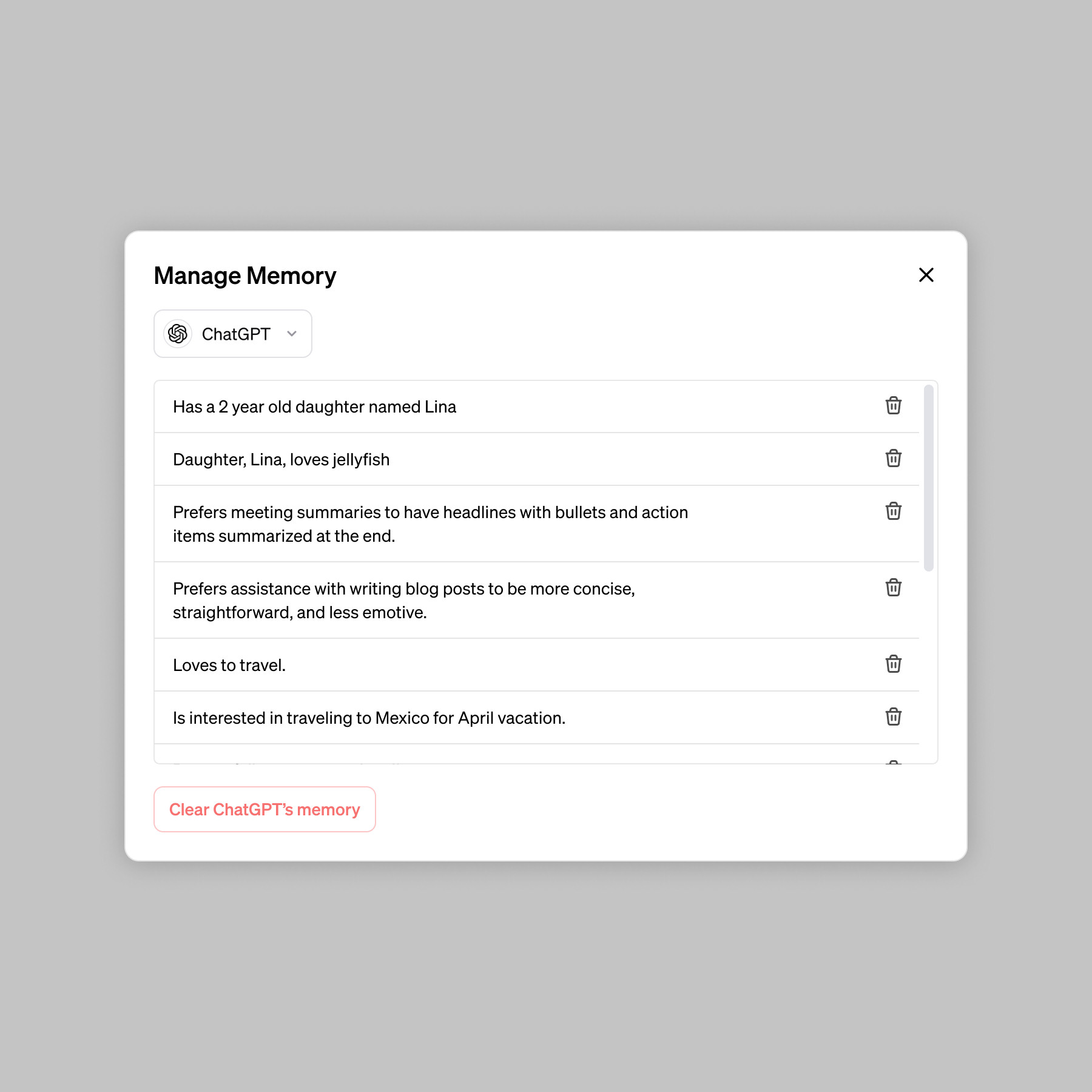
A screenshot of ChatGPT memory controls provided by OpenAI.

Enlarge / A screenshot of ChatGPT memory controls provided by OpenAI.

OpenAI

OpenAI hasn’t explained which technique it uses here, but the implementation reminds us of Custom Instructions, a feature OpenAI introduced in July 2023 that lets users add custom additions to the ChatGPT system prompt to change its behavior.

Possible applications for the memory feature provided by OpenAI include explaining how you prefer your meeting notes to be formatted, telling it you run a coffee shop and having ChatGPT assume that’s what you’re talking about, keeping information about your toddler that loves jellyfish so it can generate relevant graphics, and remembering preferences for kindergarten lesson plan designs.

Also, OpenAI says that memories may help ChatGPT Enterprise and Team subscribers work together better since shared team memories could remember specific document formatting preferences or which programming frameworks your team uses. And OpenAI plans to bring memories to GPTs soon, with each GPT having its own siloed memory capabilities.

Memory control

Obviously, any tendency to remember information brings privacy implications. You should already know that sending information to OpenAI for processing on remote servers introduces the possibility of privacy leaks and that OpenAI trains AI models on user-provided information by default unless conversation history is disabled or you’re using an Enterprise or Team account.

Along those lines, OpenAI says that your saved memories are also subject to OpenAI training use unless you meet the criteria listed above. Still, the memory feature can be turned off completely. Additionally, the company says, “We’re taking steps to assess and mitigate biases, and steer ChatGPT away from proactively remembering sensitive information, like your health details—unless you explicitly ask it to.”

Users will also be able to control what ChatGPT remembers using a “Manage Memory” interface that lists memory items. “ChatGPT’s memories evolve with your interactions and aren’t linked to specific conversations,” OpenAI says. “Deleting a chat doesn’t erase its memories; you must delete the memory itself.”

ChatGPT’s memory features are not currently available to every ChatGPT account, so we have not experimented with it yet. Access during this testing period appears to be random among ChatGPT (free and paid) accounts for now. “We are rolling out to a small portion of ChatGPT free and Plus users this week to learn how useful it is,” OpenAI writes. “We will share plans for broader roll out soon.”

OpenAI experiments with giving ChatGPT a long-term conversation memory Read More »

cdc-to-update-its-covid-isolation-guidance,-ditching-5-day-rule:-report

CDC to update its COVID isolation guidance, ditching 5-day rule: Report

update —

The agency is reportedly moving from the fixed time to a symptom-based isolation period.

CDC to update its COVID isolation guidance, ditching 5-day rule: Report

The Centers for Disease Control and Prevention is preparing to update its COVID-19 isolation guidance, moving from a minimum five-day isolation period to one that is solely determined by symptoms, according to a report from The Washington Post.

Currently, CDC isolation guidance states that people who test positive for COVID-19 should stay home for at least five days, at which point people can end their isolation as long as their symptoms are improving and they have been fever-free for 24 hours.

According to three unnamed officials who spoke with the Post, the CDC will update its guidance to remove the five-day minimum, recommending more simply that people can end their isolation any time after being fever-free for 24 hours without the aid of medication, as long as any other remaining symptoms are mild and improving. The change, which is expected to be released in April, would be the first to loosen the guidance since the end of 2021.

In an email to Ars, a CDC spokesperson did not confirm or deny the report, saying only that, “There are no updates to COVID guidelines to announce at this time. We will continue to make decisions based on the best evidence and science to keep communities healthy and safe.”

The Post notes that the proposed update to the guidance matches updated guidance from California and Oregon, as well as other countries.

The officials who spoke with the outlet noted that the loosened guidelines reflect that most people in the US have developed some level of immunity to the pandemic coronavirus from prior infections and vaccinations.

A report earlier this month found that the 2023–2024 COVID-19 vaccine was about 54 percent effective at preventing symptomatic COVID-19 when compared against people who had not received the latest vaccine. However, the CDC estimates that only about 22 percent of adults have received the updated shot.

Currently, the CDC recommends that people wear a mask for 10 days after testing positive unless they have two negative tests 48 hours apart. The Post reported that it’s unclear if the CDC will update its mask recommendation.

CDC to update its COVID isolation guidance, ditching 5-day rule: Report Read More »

judge-rejects-most-chatgpt-copyright-claims-from-book-authors

Judge rejects most ChatGPT copyright claims from book authors

Insufficient evidence —

OpenAI plans to defeat authors’ remaining claim at a “later stage” of the case.

Judge rejects most ChatGPT copyright claims from book authors

A US district judge in California has largely sided with OpenAI, dismissing the majority of claims raised by authors alleging that large language models powering ChatGPT were illegally trained on pirated copies of their books without their permission.

By allegedly repackaging original works as ChatGPT outputs, authors alleged, OpenAI’s most popular chatbot was just a high-tech “grift” that seemingly violated copyright laws, as well as state laws preventing unfair business practices and unjust enrichment.

According to judge Araceli Martínez-Olguín, authors behind three separate lawsuits—including Sarah Silverman, Michael Chabon, and Paul Tremblay—have failed to provide evidence supporting any of their claims except for direct copyright infringement.

OpenAI had argued as much in their promptly filed motion to dismiss these cases last August. At that time, OpenAI said that it expected to beat the direct infringement claim at a “later stage” of the proceedings.

Among copyright claims tossed by Martínez-Olguín were accusations of vicarious copyright infringement. Perhaps most significantly, Martínez-Olguín agreed with OpenAI that the authors’ allegation that “every” ChatGPT output “is an infringing derivative work” is “insufficient” to allege vicarious infringement, which requires evidence that ChatGPT outputs are “substantially similar” or “similar at all” to authors’ books.

“Plaintiffs here have not alleged that the ChatGPT outputs contain direct copies of the copyrighted books,” Martínez-Olguín wrote. “Because they fail to allege direct copying, they must show a substantial similarity between the outputs and the copyrighted materials.”

Authors also failed to convince Martínez-Olguín that OpenAI violated the Digital Millennium Copyright Act (DMCA) by allegedly removing copyright management information (CMI)—such as author names, titles of works, and terms and conditions for use of the work—from training data.

This claim failed because authors cited “no facts” that OpenAI intentionally removed the CMI or built the training process to omit CMI, Martínez-Olguín wrote. Further, the authors cited examples of ChatGPT referencing their names, which would seem to suggest that some CMI remains in the training data.

Some of the remaining claims were dependent on copyright claims to survive, Martínez-Olguín wrote.

Arguing that OpenAI caused economic injury by unfairly repurposing authors’ works, even if authors could show evidence of a DMCA violation, authors could only speculate about what injury was caused, the judge said.

Similarly, allegations of “fraudulent” unfair conduct—accusing OpenAI of “deceptively” designing ChatGPT to produce outputs that omit CMI—”rest on a violation of the DMCA,” Martínez-Olguín wrote.

The only claim under California’s unfair competition law that was allowed to proceed alleged that OpenAI used copyrighted works to train ChatGPT without authors’ permission. Because the state law broadly defines what’s considered “unfair,” Martínez-Olguín said that it’s possible that OpenAI’s use of the training data “may constitute an unfair practice.”

Remaining claims of negligence and unjust enrichment failed, Martínez-Olguín wrote, because authors only alleged intentional acts and did not explain how OpenAI “received and unjustly retained a benefit” from training ChatGPT on their works.

Authors have been ordered to consolidate their complaints and have until March 13 to amend arguments and continue pursuing any of the dismissed claims.

To shore up the tossed copyright claims, authors would likely need to provide examples of ChatGPT outputs that are similar to their works, as well as evidence of OpenAI intentionally removing CMI to “induce, enable, facilitate, or conceal infringement,” Martínez-Olguín wrote.

Ars could not immediately reach the authors’ lawyers or OpenAI for comment.

As authors likely prepare to continue fighting OpenAI, the US Copyright Office has been fielding public input before releasing guidance that could one day help rights holders pursue legal claims and may eventually require works to be licensed from copyright owners for use as training materials. Among the thorniest questions is whether AI tools like ChatGPT should be considered authors when spouting outputs included in creative works.

While the Copyright Office prepares to release three reports this year “revealing its position on copyright law in relation to AI,” according to The New York Times, OpenAI recently made it clear that it does not plan to stop referencing copyrighted works in its training data. Last month, OpenAI said it would be “impossible” to train AI models without copyrighted materials, because “copyright today covers virtually every sort of human expression—including blogposts, photographs, forum posts, scraps of software code, and government documents.”

According to OpenAI, it doesn’t just need old copyrighted materials; it needs current copyright materials to ensure that chatbot and other AI tools’ outputs “meet the needs of today’s citizens.”

Rights holders will likely be bracing throughout this confusing time, waiting for the Copyright Office’s reports. But once there is clarity, those reports could “be hugely consequential, weighing heavily in courts, as well as with lawmakers and regulators,” The Times reported.

Judge rejects most ChatGPT copyright claims from book authors Read More »

cryptocurrency-maker-sues-former-ars-reporter-for-writing-about-fraud-lawsuit

Cryptocurrency maker sues former Ars reporter for writing about fraud lawsuit

Promotional image of a man using a machine that looks like an ATM and is labeled

Enlarge / Image from Bitcoin Latinum’s website

Bitcoin Latinum

The cryptocurrency firm Bitcoin Latinum has sued journalists at Forbes and Poker.org, claiming that the writers made false and defamatory statements in articles that described securities fraud lawsuits filed against the crypto firm.

Bitcoin Latinum and its founder, Donald Basile, filed a libel lawsuit against Forbes reporter Cyrus Farivar and another libel lawsuit against Poker.org and its reporter Haley Hintze. (Farivar was a long-time Ars Technica reporter.)

The lawsuits are surprising because the Forbes article and the Poker.org article, both published in 2022, are very much like thousands of other news stories that describe allegations in a lawsuit. In both articles, it is clear that the allegations come from the filer of the lawsuit and not from the author of the article.

But both of Bitcoin Latinum’s lawsuits, which were filed last week in Delaware’s Court of Chancery, demand that the articles be retracted. They contain the following claim in exactly the same words:

The Article contains statements which insinuate and lead the reader to believe that Assofi’s allegations against Plaintiff Latinum and Plaintiff Basile are factual and correct, and which statements are not couched as the opinion of the author, but rather, are presented as fact, and therefore do not fall under any applicable privilege.

“Assofi’s allegations” are those made in a lawsuit filed against Bitcoin Latinum and Basile in November 2022. That lawsuit from Arshad Assofi, who said he lost over $15 million investing in worthless tokens, alleged that Bitcoin Latinum “is a scam” and accused the defendants of securities fraud and other violations. Bitcoin Latinum calls itself “the future of Bitcoin.”

Lawsuit cites wrong article

It’s especially surprising that Bitcoin Latinum’s lawsuit against Hintze contains the statement about “Assofi’s allegations” because the Hintze article cited in the lawsuit never mentions Assofi. The Hintze article on Poker.org is about a different lawsuit from different plaintiffs who also alleged securities fraud.

In fact, the Hintze article was published in February 2022, 10 months before the Assofi lawsuit was filed. TechDirt’s Mike Masnick pointed out this error in an article yesterday:

It appears that Latinum’s lawyer actually meant to sue over a different Poker.org article, that was published in November about the Assofi lawsuit, but repeatedly claims that the article was published on February 5, 2022, rather than the actual publication date of the article she meant, which was November 21, 2022. Also, Latinum’s lawyer included the February 5th article as the exhibit, rather than the November 21st article. Such attention to detail to talk about the wrong article and include the wrong article as an exhibit. Top notch lawyering.

Masnick also points out that the statute of limitations is two years, and the lawsuit against Hintze was filed more than two years after her February 2022 article.

In libel cases, journalists may defend themselves with the “fair report privilege.” This applies to accurate reporting on official government matters, including court proceedings.

The lawyer for Bitcoin Latinum in the Farivar and Hintze cases is Holly Whitney, who specializes in estate planning and probate cases. We contacted Whitney and Bitcoin Latinum about the lawsuits today and will update this article if we get a response.

Cryptocurrency maker sues former Ars reporter for writing about fraud lawsuit Read More »

windows-11-24h2-goes-from-“unsupported”-to-“unbootable”-on-some-older-pcs

Windows 11 24H2 goes from “unsupported” to “unbootable” on some older PCs

is anyone still reading this using a Core 2 Duo? —

New Windows version needs CPU features that became common in the late 00s.

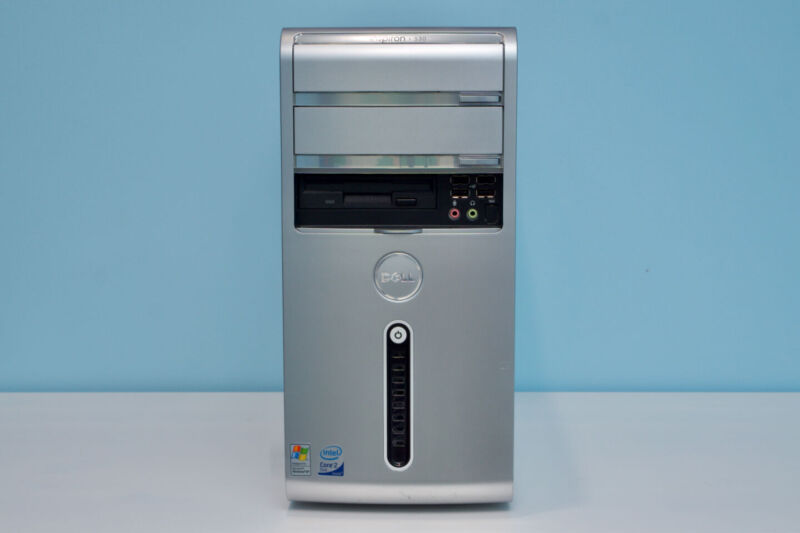
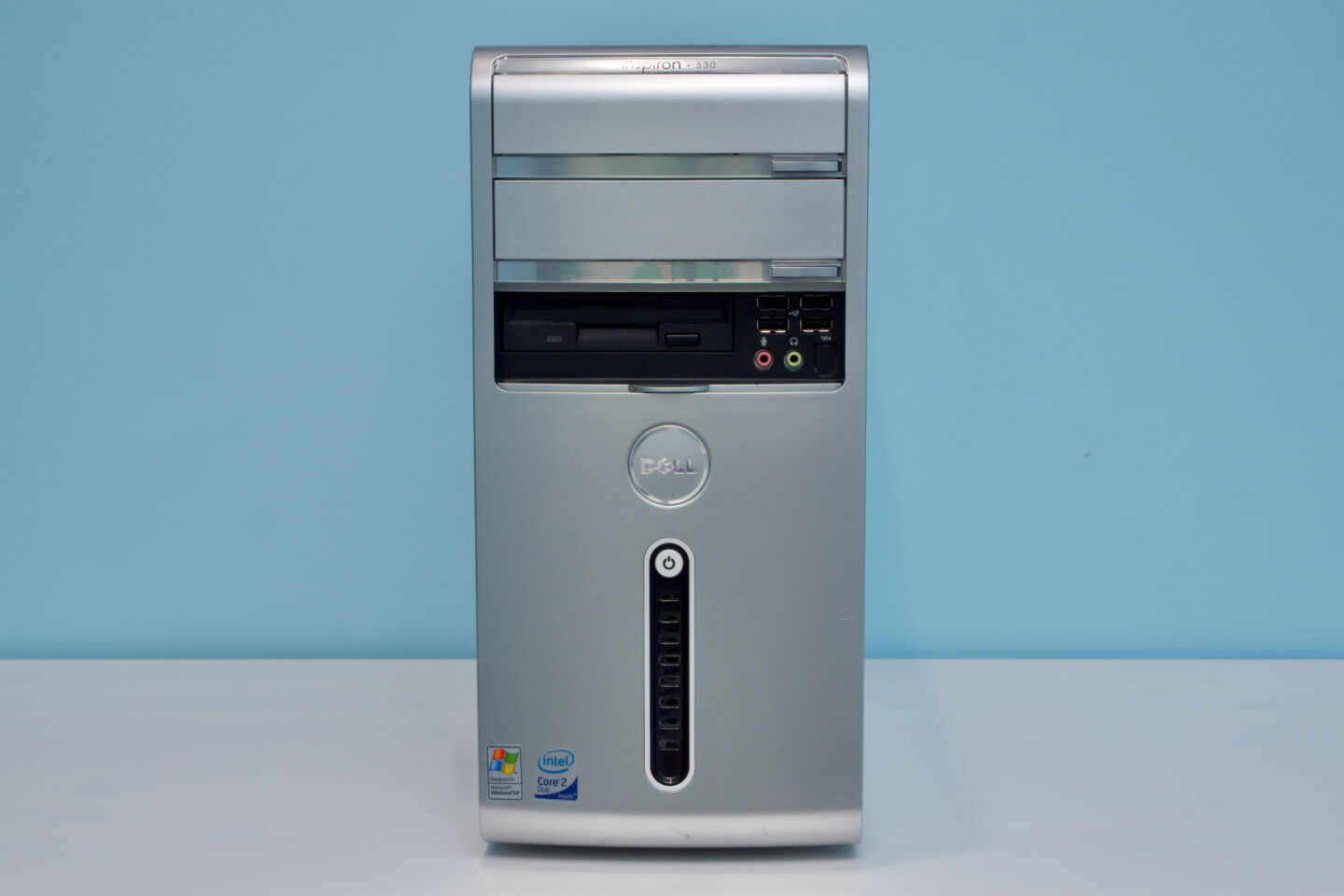
We've installed Windows 11 on systems as old as this Core 2 Duo Inspiron tower. As of version 24H2, the OS may no longer be bootable on these systems.

Enlarge / We’ve installed Windows 11 on systems as old as this Core 2 Duo Inspiron tower. As of version 24H2, the OS may no longer be bootable on these systems.

Andrew Cunningham

Officially, Windows 11 has higher system requirements than Windows 10. But to date, once you’ve bypassed those requirement checks, there have been few consequences to running Windows 11 on old hardware. Unsupported or not, Windows 11 would run on pretty much any 64-bit PC that could boot Windows 10—we’ve run it on PCs as old as a Windows XP-era Core 2 Duo desktop.

That’s apparently changing a bit in Windows 11’s 24H2 update, which Microsoft began testing earlier this month. According to posts from a user named Bob Pony on X, formerly Twitter, the latest Windows 11 builds refuse to boot on older processors that don’t support a relatively obscure instruction called “POPCNT.” Short for “population count,” it’s used for “counting the number of bits in a machine word,” according to an explainer by programmer Vaibhav Sagar.

It’s unclear why POPCNT has become the load-bearing CPU instruction for a whole bunch of Windows components, but it looks like the Windows kernel, the system’s USB and network drivers, and other core system files now require the instruction as of Windows 11 24H2.

In modern x86 CPUs, POPCNT is implemented as part of the SSE4 instruction set. For Intel’s chips, it was added as part of SSE4.2 in the original first-generation Core architecture, codenamed Nehalem. In AMD’s processors, it’s included in SSE4a, first used in Phenom, Athlon, and Sempron CPUs based on the K10 architecture. These architectures date back to 2008 and 2007, respectively.

That effectively bars mid-2000s Intel Core 2 Duo systems and early Athlon 64-era PCs from booting Windows 11 at all, not that they officially supported it in the first place. This means the change should mainly affect retro-computing enthusiasts who spend their days making YouTube videos in the “we installed Windows 11 on a potato, let’s see how it runs” genre rather than users of actual systems. Even if you upgraded these PCs with 4 or 8GB of RAM and changed out the creaky old hard drives for SSDs, these are not PCs that will run Windows 10, Windows 11, or any modern apps particularly well.

These same retro-computing enthusiasts may also find a way around this requirement eventually. Windows 10 and 11 won’t boot on systems without SSE2 support, for example, but that hasn’t stopped people from finding a way to do it anyway.

Though Windows 11’s system requirements suggest CPU clock speed and the amounts of RAM and storage your PC has, system requirements in the modern era have become more granular and esoteric. For example, it seems as though Windows 11’s CPU requirement (an 8th-gen Intel Core CPU or newer, or an AMD Ryzen 2000-series CPU or newer) is driven at least partly by support for “mode-based execution control” (MBEC), a security feature that accelerates some of the operating system’s memory integrity protections. No CPU manufacturer is including stuff like POPCNT or MBEC in their marketing materials, but modern Windows support is increasingly dictated by these kinds of features.

Listing image by Microsoft

Windows 11 24H2 goes from “unsupported” to “unbootable” on some older PCs Read More »

judge-tosses-big-pharma-suit-claiming-drug-price-negotiation-is-unconstitutional

Judge tosses Big Pharma suit claiming drug price negotiation is unconstitutional

tossed —

The judge ruled that the court lacks jurisdiction.

Stephen Ubl, president and chief executive officer of Pharmaceutical Research and Manufacturers of America (PhRMA), speaks during a Bloomberg Live discussion in Washington, DC, on Tuesday, Sept. 19, 2017.

Enlarge / Stephen Ubl, president and chief executive officer of Pharmaceutical Research and Manufacturers of America (PhRMA), speaks during a Bloomberg Live discussion in Washington, DC, on Tuesday, Sept. 19, 2017.

A federal judge in Texas dismissed a lawsuit Monday brought by a heavy-hitting pharmaceutical trade group, which argued that forcing drug makers to negotiate Medicare drug prices is unconstitutional.

The dismissal is a small win for the Biden administration, which is defending the price negotiations on multiple fronts. The lawsuit dismissed Monday is just one of nine from the pharmaceutical industry, all claiming in some way that the price negotiations laid out in the Inflation Reduction Act of 2022 are unconstitutional. The big pharmaceutical companies suing the government directly over the negotiations include Johnson & Johnson, Bristol Myers Squibb, Novo Nordisk, Merck, and AstraZeneca.

Last month, a federal judge in Delaware heard arguments from AstraZeneca’s lawyers, which reportedly went poorly. AstraZeneca argued that Medicare’s new power to negotiate drug prices violates the company’s rights under the Fifth Amendment’s due process clause. The forced negotiations deprive the company of “property rights in their drug products and their patent rights” without due process, AstraZeneca claimed. But Colm Connolly, chief judge of the US District Court of Delaware, was skeptical of how that could be the case, according to a Stat reporter who was present for the hearing. Connolly noted that AstraZeneca doesn’t have to sell drugs to Medicare. “You’re free to do what you want,” Connolly reportedly said. “You may not make as much money.”

At a later point, Connolly bluntly commented: “I don’t find their argument compelling.”

Though the plaintiffs in the now-dismissed Texas also made an argument based on the Fifth Amendment’s due process clause, the case didn’t make it that far. US District Judge David Ezra in Austin, Texas, dismissed the case brought by one of the case’s three plaintiffs, saying the court lacked jurisdiction. And, because that one plaintiff is the only one based in the Western District of Texas, where the lawsuit was filed, he dismissed the case completely.

The three plaintiffs in the case were PhRMA, a powerful drug industry trade group representing high-profile drug makers, including Pfizer, GSK, Eli Lilly, and Sanofi; the Global Colon Cancer Association (GCCA); and the Texas-based National Infusion Center Association (NICA). Lawyers for the Biden administration filed a motion to dismiss the case, arguing that NICA is not a proper plaintiff.

Ezra found that for NICA to bring constitutional claims against Medicare’s price negotiations in a court, it is first required under federal rules to bring those claims through an administrative review process under the Medicare Act or the Centers for Medicare and Medicaid Services. Without a prior administrative review, the court has no jurisdiction.

“The Court lacks jurisdiction over NICA’s claims because the claims here ‘arise under’ the Medicare Act and the claims do not fall under the exception carved out for when claims may completely avoid judicial or administrative review. Therefore, NICA’s claims are dismissed without prejudice,” Ezra wrote in his ruling.

And, with the one Texas-based plaintiff, NICA, knocked out of the case, the Western Texas district is now the “improper venue” for a case brought by the remaining two plaintiffs, PhRMA and GCCA.

Ezra noted that in such situations, a judge can transfer the case to a court that would be considered a proper venue. But Ezra declined, noting that neither the plaintiffs nor defendants suggested a proper venue. And, even if they did, it likely wouldn’t matter, Ezra reasoned, because PhRMA and GCCA also haven’t gone through an administrative review.

“[T]he same federal jurisdictional defect likely exists for PhRMA and GCCA, as nothing suggests that either party has presented its claims to the [Health] Secretary,” Ezra wrote.

Ezra dismissed the case “without prejudice,” meaning the claims could be refiled. A spokesperson for PhRMA told FiercePharma: “We are disappointed with the court’s decision, which does not address the merits of our lawsuit, and we are weighing our next legal steps.”

Meanwhile, the first round of Medicare drug price negotiations is underway. Earlier this month, the federal government sent out its opening offers in the price negotiation process for the first 10 drugs selected. The bargaining will continue through the coming months, with an ending deadline of August 1, 2024. The prices will go into effect at the beginning of 2026.

Judge tosses Big Pharma suit claiming drug price negotiation is unconstitutional Read More »

apple’s-imessage-is-not-a-“core-platform”-in-eu,-so-it-can-stay-walled-off

Apple’s iMessage is not a “core platform” in EU, so it can stay walled off

Too core to fail —

Microsoft’s Edge browser, Bing search, and ad business also avoid regulations.

Apple Messages in a Mac dock

Getty Images

Apple’s iMessage service is not a “gatekeeper” prone to unfair business practices and will thus not be required under the Fair Markets Act to open up to messages, files, and video calls from other services, the European Commission announced earlier today.

Apple was one of many companies, including Google, Amazon, Alphabet (Google’s parent company), Meta, and Microsoft to have its “gatekeeper” status investigated by the European Union. The iMessage service did meet the definition of a “core platform,” serving at least 45 million EU users monthly and being controlled by a firm with at least 75 billion euros in market capitalization. But after “a thorough assessment of all arguments” during a five-month investigation, the Commission found that iMessage and Microsoft’s Bing search, Edge browser, and ad platform “do not qualify as gatekeeper services.” The unlikelihood of EU demands on iMessage was apparent in early December when Bloomberg reported that the service didn’t have enough sway with business users to demand more regulation.

Had the Commission ruled otherwise, Apple would have had until August to open its service. It would have been interesting to see how the company would have complied, given that it provides end-to-end encryption and registers senders based on information from their registered Apple devices.

Google had pushed the Commission to force Apple into “gatekeeper status,” part of Google’s larger campaign to make Apple treat Android users better when they trade SMS messages with iPhone users. While Apple has agreed to take up RCS, an upgraded form of carrier messaging with typing indicators and better image and video quality, it will not provide encryption for Android-to-iPhone SMS, nor remove the harsh green coloring that particularly resonates with younger users.

Apple is still obligated to comply with the Digital Markets Act’s other implications on its iOS operating system, its App Store, and its Safari browser. The European Union version of iOS 17.4, due in March, will offer “alternative app marketplaces,” or sideloading, along with the tools so that those other app stores can provide updates and other services. Browsers on iOS will also be able to use their own rendering engines rather than providing features only on top of mobile Safari rendering. Microsoft, among other firms, will make similar concessions in certain areas of Europe with Windows 11 and other products.

While it’s unlikely to result in the same kind of action, Brendan Carr, a commissioner at the Federal Communications Commission, said at a conference yesterday that the FCC “has a role to play” in investigating whether Apple’s blocking of the Beeper Mini app violated Part 14 rules regarding accessibility and usability. “I think the FCC should launch an investigation to look at whether Apple’s decision to degrade the Beeper Mini functionality… was a step that violated the FCC’s rules in Part 14,” Carr said at the State of the Net policy conference in Washington, DC.

Beeper Mini launched with the ability for Android users to send fully encrypted iMessage messages to Apple users, based on reverse-engineering of its protocol and registration. Days after its launch, Apple blocked its users and issued a statement saying that it was working to stop exploits and spam. The blocking and workarounds continued until Beeper announced that it was shifting its focus away from iMessage and back to being a multi-service chat app, minus one particular service. Beeper’s experience had previously garnered recognition from Senators Elizabeth Warren (D-Mass.) and Amy Klobuchar (D-Minn.).

Ars has reached out to Apple, Microsoft, and Google for comment and will update this post if we receive responses.

Apple’s iMessage is not a “core platform” in EU, so it can stay walled off Read More »

encrypted-email-service-skiff-gets-acquired,-will-shut-down-in-six-months

Encrypted email service Skiff gets acquired, will shut down in six months

You are no longer needed —

Skiff users will lose their @skiff.com email addresses, need to export data ASAP.

The Skiff email app.

Enlarge / The Skiff email app.

Skiff, an encrypted email and productivity startup, is being acquired and shut down by another productivity suite company, Notion. Skiff users have just six months before their email and all other data are wiped out. If you set up forwarding before the shutdown date, Skiff says it will keep forwarding your email to another service for the next year.

Skiff’s website has been replaced with the purchase notice and a link to a data migration page, which says, “We will be closing down Skiff’s product suite after a 6-month sunset period.” Acquisitions happen all the time, but in this case, there will be no transfer or continuation of service over to Notion. Users will lose their @skiff.com email address and all data will be deleted, so export your mail soon. Skiff has export services available at https://app.skiff.com/dashboard/?settingTab=export.

Losing your email address can be a nightmare, as it can feel almost impossible to chase down every service you’ve tied to your account. Based on the pile of posts inundating Skiff’s account on X, Skiff users seem pretty upset by the move. The main page of skiff.com doesn’t even mention the impending shutdown. A sign-off reads, “We look forward to continuing to serve you,” so it’s easy to assume that the service will keep running.

You only learn about the impending shutdown after scrolling down, clicking the small “migrate your data” link at the bottom of the page, and opening the first FAQ answer. In the fourth paragraph, you finally learn about the six-month warning. Burying the lede under all the self-congratulatory acquisition news makes Skiff users look like a disposable afterthought.

After receiving complaints, Skiff responded by saying, “We deeply apologize for the inconveniences caused,” and the company will now keep email forwarding running “through 2025 for one year going forward.” Skiff was a public service for just two years and had 2 million users; it was seen by some as a growing competitor to services like Proton Mail. Skiff started at $0 per month but had several premium plans that added more storage, email addresses, and custom domains for $3–$12 per month.

Skiff had raised $14 million from various big-name venture capital investors like Sequoia Capital, Alphabet chairman John Hennessy, and Yahoo CEO Jerry Yang. Publicly, the company is committed to users and privacy, but those VCs needed a return on their investment. Notion doesn’t have the privacy focus that Skiff had, so that whole idea seems dead.

Notion started as a note-taking app that competed with products like Evernote but now seems to be acquiring its way into offering a full-blown productivity suite. The company has a calendar app, a docs app, a wiki editor, an AI chatbot, and project management software. With Skiff, there will now presumably be an email service, putting Notion pretty close to Google Workspace or Office 365.

Encrypted email service Skiff gets acquired, will shut down in six months Read More »

more-on-the-apple-vision-pro

More on the Apple Vision Pro

Previously: On the Apple Vision Pro

The reviews are coming in. What say the people, other than the complaining about the two to three hour battery life?

Then later I’ll get to my own thoughts after the demo.

Ben Thompson reviews the Apple Vision Pro. He continues to find it a technical marvel, but is ultimately disappointed for uses other than entertainment. There is no support for multiple users beyond a highly unwieldy guest mode. There is insufficient width of coverage and inability to support multiple large screens, which is severely limiting to productivity. The eye tracking is a huge improvement over earlier attempts but not ready for such applications.

Ben anticipates that Apple will fail over time to evolve the product to support the things that would enable it to be a killer productivity app, which is what he was most excited about. He loves it for movies and watching sports (and presumably television), especially if new offerings support its features, but especially when the device is hard to share the $3,500 price tag is a tough sell.

Ben frames this as an intentional trade-off to maximize the entertainment experience. I do not get this claim. I see no reason the Vision Pro could not in the future support the entertainment experience it offers now, while also offering a distinct productivity experience that allows streaming multiple screens and using more precise controls and letting you use an iPhone or iPad as an additional control panel and navigation guide.

Andrej Karpathy offers his thoughts on the Vision Pro. Amazingly great in some ways, jank in other ways, including overly long setup. Several complaints here gave me hope, since they are concerns that won’t much matter over time, either you get through it or it gets fixed. Device weight is clearly a major issue. The review was essentially saying this is a device that will be great but has not yet handled the last mile.

Vanity Fair on why Tim Cook bet on the Apple Vision Pro, I would not call it ‘all-in’ since Apple will be fine no matter what. A strange article, worried about future versions being essentially too good. Like Thompson’s review, makes clear that the entertainment mode is well ahead of the productivity mode, although its motives lie elsewhere. The anecdote about having trouble finding apps after moving rooms is telling.

Aaron Slodov says ‘it’s amazing and this is the future’ as he moves objects around a room.

Senior Editior Devindra Hardawar of EnGadget calls it ‘beta testing the future.’ Her first warning is of eye strain. Her second is to not even think of buying one unless you are either a developer or an Apple fanatic. Her view is this is the beta, the real version will come a few years later. For now, it’s buggy, heavy, has a very short battery life and lacks native apps. She does find the interface intuitive and easy, and she praises both the ability to watch movies and the Mac integration.

She also notes the iPad Steam Link app works, so yes you can play at least many games on it. Similarly, it seems Sony’s Remote Play app will work for casting a PlayStation. For a Nintendo Switch and full portability, you will need to do more work, with a video capture card with HDMI input and then a USB-C output for the Vision Pro.

ZdNet’s Matthew Miller tried it for a workday. He recommends sticking to MacOS apps (what happened to ‘programs’?) because iPad ones aren’t ready yet, notes that you will need a Bluetooth keyboard to do any real work in practice, finds the ‘personas’ unplayable in practice, and found it hard to do productivity while traveling because of movement constraints and the lenses fogging up. He notes Microsoft’s apps (Word, Excel and so on) work but are currently bare bones.

He thinks it can work for those whose workflows only have 1-3 apps or content creators. He also oddly mentions day traders, from my experience trading no way in hell, you want precision above all, if you are tempted to day trade with the Vision Pro I am going to tell you to quit day trading.

Their editor-in-chief Jason Hiner says try it for yourself, but most people should pass. Cheaper alternatives are coming or already here, and the ecosystem isn’t ready.

Mark Spoonauer of Tom’s Guide emphasizes how good the device is for watching movies, and likes the spatial video and photos features and ability to view photos in a new light, as well. He doesn’t talk about productivity.

Tim Urban, who like many others keeps having holy smoments with VR devices and then getting disappointed that they are not there yet and not finding sustained worthwhile uses, goes through that cycle once again. He is excited for the future, and finds the present super cool already, but thinks that the costs still exceed benefits for now. He expects that we are soon to be on the part of the development curve, like iPhones 3G to 5, where new models are importantly better and you start to get a lot of additional surplus each cycle.

Sam Altman thinks this is big. Point, counterpoint:

Sam Altman: Vision pro is second most impressive tech since the iPhone.

Peter Wildeford: Disagree, vision pro is the seventh best and the ranking is:

1.) LLMs 2.) CRISPR 3.) mRNA vaccines 4.) semaglutide 5.) Perovskite solar cell 6.) Faster internet 7.) Apple Vision Pro

I have mRNA vaccines at least at #2 here, and I think you can argue #1. Gemini splits LLMs into several discoveries and also suggests EVs, Starlink, self-driving cars, wearable health tech, cloud computing, internet of things, 3D printing, robotics and more. The Apple Vision Pro has potential, but it is hard to put it that high on such a list.

Grimes and derek guy emphasize the importance of aesthetics.

The giant Apple vision Pro is a look. It can be a good look, but if you want that you have to do the work. Which I agree is worth doing if you intend to do this on the regular. Also, she’s in Tokyo, so double cyberpunk points all around.

derek guy: Aesthetically, this is basically how you have to dress to make things like the Vision Pro and Cybertruck look cool. These things mainly look bad in public because there’s no congruity between the business casual gear most ppl wear and these futuristic designs.

Grimes: Good aesthetics are a moral good and directly related to the health of society.

The difference this woman and me? She makes this look good.

So what about my experience? On Thursday, I had the chance to do the demo at the Apple Store at Grand Central. It is about a 20 minute experience, with an employee walking you through various things they want to show off. You can try a few things, but your freedom of movement is highly limited in every sense, and there is no time for you to play around, although they will answer your questions.

There was an attempt to sell me the device, but he didn’t press when I made it clear it was a no on putting down $4k on the spot.

Like most others, I was impressed and disappointed, inspired and frustrated.

The great stuff is really great. The hardware itself is amazing. A true marvel. Visuals are off the charts. All the issues are about the software, and of course the price, except for questions of weight and battery life.

The killer app right now is as a video screen. If you want to watch movies or television, this is a damn good, movie theater level experience. Top notch, and a lot of customization, although I couldn’t make it quite as big as I would have liked during the demo. They didn’t show us the Apple TV+ theater experience, but I assume that is great. If I was richer I would buy purely for this.

The native software support is not there for all the uses of that screen. They will hook up your Mac, but they will not make it easy for your PC, PlayStation or Switch. The good news is there are workarounds.

But why not make this native? If you are selling me a four thousand dollar screen, let me use it with whatever I want, and do not make me work for it, this is 2024.

There are native games, but Apple did not even try to demo those. I assume they are not exciting yet, and Apple historically hates fun anyway.

The sound is very good natively, but it does leak a bit. They said you can use any headphones with it, and that even the big Bose-style ones can physically work, so that part looks good. I would appreciate the ability to watch things without disturbing those around me. For audio-only, of course, this is massive overkill.

Even better than a video screen were the panoramas, the full 180-degree experiences. The moment of being in the ballpark was fantastic. However, in order to get value, these have to be supported. There is no sign that anyone plans to actually offer MLB or other games in this mode. If and when they do for the Mets, if this is the only way to get that service and the additional costs aren’t too obscene, I think this would put me over the top. Going out to the ballgame is pretty great.

The other immersive environments also looked great, and I would love if we had lots of designed media experiences like that. It would be ten times better if you could meaningfully move around as well. There is a version of this, that is presumably coming within the decade, that will be worth paying a lot to get if necessary.

The special photos and personal video shots are nice, but not vital or killer apps.

The other killer app people mention is Mac integration, but that was not available during the demo.

Reading a book via Kindle seemed highly viable, including highlighting, but is it better than reading on a phone or tablet? My guess is no.

Playing board games with other humans via Tabletop Simulator, or playing Magic: The Gathering against someone who is not there, or other similar activities? Yes, please. That too could be the killer app for me. First they have to get there. For now, you can chat with someone’s avatar, but that is a totally different thing than simulating being in the same location.

What about productivity?

The virtual keyboard is password-entry only. They only track at most two fingers, so you cannot properly type even if you don’t need keys to do so. Effectively this is much slower than on a phone. You can dictate if you want, when that would work. It got regular English sentences reliably, as you would expect. For my name it thought I had a very different (and very Asian) name, whoops. You will 100% need a Bluetooth keyboard to do any real work.

The choice of what to include in the demo reveals what Apple thinks are the strong selling points. They lead with photos and personal videos and panoramas and watching movies. They give almost no attention to productivity of any kind, beyond showing you how to scroll through a web page. No mention of help with physical navigation or helping you with activities like cooking or shopping. No mention of AI of any kind, despite some very obvious things you would want to do there.

The navigation system relies on your eyes and their precision. I definitely worry about eye strain, and I had trouble hitting precise targets reliably. Meanwhile, my brain kept trying to use my hand to navigate like a mouse, which is totally supported once you start a movement, but unsupported otherwise. So they have the technology, but have chosen to deploy it differently than I would like.

Similarly, the Guest mechanism right now is rather poor and broken. You have to configure every time, it does not last, all your work gets lost and so on. It would be a big help if they would outright support multiple profiles.

Where I do see potential for productivity, and also for entertainment to shine as well, is while traveling. If you are on an airplane or a train, and you can suddenly work or watch on a real theater screen, that would be a big game. Travel enough and it is well worth paying for that, or it could even enable more travel.

So overall, yes. I see the potential. This could be an insanely great device with proper software support, both from Apple and support from others. Already it is likely a great device for watching movies. For other purposes, the software and ecosystem are not there yet.

I said in my previous post that I expect the Apple Vision Pro is either worth far more than the price, or it is worth very little, but it was unlikely to be something in between.

Could this still be a dud? Absolutely. What I do not expect is something I’d have been happy to pay $500 or $1,000 for, but not $3,500. Either the game will be changed, or it won’t be changed quite yet. I can’t wait to find out.

What I neglected to think about was the possibility that it would be a great device for narrow use cases, while not being good enough for other uses cases.

In this case, That One Killer App that I am confident in, right now, is as a way to watch movies. Also television or YouTube or other video, potentially, but especially movies where you want to give your full attention and they are designed for the biggest possible screen.

Meanwhile, it is plausible that the other uses are still stuck at zero value until they get a lot better, given the costs of the mode shift involved, the extent to which Apple is protecting its ecosystem, and the potential isolation effects.

It is also plausible they are not zero value at all. I can see a MacBook Air plus a Vision Pro being very good for productivity, and I can see a lot of value in gaming as well. And if they ever get the sports panoramas online, we’re golden.

If you are buying an at-home movie theater level experience, including watching other things if they are high enough resolution to support that, what is that worth on its own?

So here we are, where I know I would pay $1,000 for the device, but am unsure whether I am willing to pay approximately $5,000, on the assumption that this implies being willing to also buy a MacBook Air.

What say you, dear readers? Should I take the plunge?

And what about you? Will you take the plunge?

More on the Apple Vision Pro Read More »

ai-cannot-be-used-to-deny-health-care-coverage,-feds-clarify-to-insurers

AI cannot be used to deny health care coverage, feds clarify to insurers

On Notice —

CMS worries AI could wrongfully deny care for those on Medicare Advantage plans.

A nursing home resident is pushed along a corridor by a nurse.

Enlarge / A nursing home resident is pushed along a corridor by a nurse.

Health insurance companies cannot use algorithms or artificial intelligence to determine care or deny coverage to members on Medicare Advantage plans, the Centers for Medicare & Medicaid Services (CMS) clarified in a memo sent to all Medicare Advantage insurers.

The memo—formatted like an FAQ on Medicare Advantage (MA) plan rules—comes just months after patients filed lawsuits claiming that UnitedHealth and Humana have been using a deeply flawed, AI-powered tool to deny care to elderly patients on MA plans. The lawsuits, which seek class-action status, center on the same AI tool, called nH Predict, used by both insurers and developed by NaviHealth, a UnitedHealth subsidiary.

According to the lawsuits, nH Predict produces draconian estimates for how long a patient will need post-acute care in facilities like skilled nursing homes and rehabilitation centers after an acute injury, illness, or event, like a fall or a stroke. And NaviHealth employees face discipline for deviating from the estimates, even though they often don’t match prescribing physicians’ recommendations or Medicare coverage rules. For instance, while MA plans typically provide up to 100 days of covered care in a nursing home after a three-day hospital stay, using nH Predict, patients on UnitedHealth’s MA plan rarely stay in nursing homes for more than 14 days before receiving payment denials, the lawsuits allege.

Specific warning

It’s unclear how nH Predict works exactly, but it reportedly uses a database of 6 million patients to develop its predictions. Still, according to people familiar with the software, it only accounts for a small set of patient factors, not a full look at a patient’s individual circumstances.

This is a clear no-no, according to the CMS’s memo. For coverage decisions, insurers must “base the decision on the individual patient’s circumstances, so an algorithm that determines coverage based on a larger data set instead of the individual patient’s medical history, the physician’s recommendations, or clinical notes would not be compliant,” the CMS wrote.

The CMS then provided a hypothetical that matches the circumstances laid out in the lawsuits, writing:

In an example involving a decision to terminate post-acute care services, an algorithm or software tool can be used to assist providers or MA plans in predicting a potential length of stay, but that prediction alone cannot be used as the basis to terminate post-acute care services.

Instead, the CMS wrote, in order for an insurer to end coverage, the individual patient’s condition must be reassessed, and denial must be based on coverage criteria that is publicly posted on a website that is not password protected. In addition, insurers who deny care “must supply a specific and detailed explanation why services are either no longer reasonable and necessary or are no longer covered, including a description of the applicable coverage criteria and rules.”

In the lawsuits, patients claimed that when coverage of their physician-recommended care was unexpectedly wrongfully denied, insurers didn’t give them full explanations.

Fidelity

In all, the CMS finds that AI tools can be used by insurers when evaluating coverage—but really only as a check to make sure the insurer is following the rules. An “algorithm or software tool should only be used to ensure fidelity,” with coverage criteria, the CMS wrote. And, because “publicly posted coverage criteria are static and unchanging, artificial intelligence cannot be used to shift the coverage criteria over time” or apply hidden coverage criteria.

The CMS sidesteps any debate about what qualifies as artificial intelligence by offering a broad warning about algorithms and artificial intelligence. “There are many overlapping terms used in the context of rapidly developing software tools,” the CMS wrote.

Algorithms can imply a decisional flow chart of a series of if-then statements (i.e., if the patient has a certain diagnosis, they should be able to receive a test), as well as predictive algorithms (predicting the likelihood of a future admission, for example). Artificial intelligence has been defined as a machine-based system that can, for a given set of human-defined objectives, make predictions, recommendations, or decisions influencing real or virtual environments. Artificial intelligence systems use machine- and human-based inputs to perceive real and virtual environments; abstract such perceptions into models through analysis in an automated manner; and use model inference to formulate options for information or action.

The CMS also openly worried that the use of either of these types of tools can reinforce discrimination and biases—which has already happened with racial bias. The CMS warned insurers to ensure any AI tool or algorithm they use “is not perpetuating or exacerbating existing bias, or introducing new biases.”

While the memo overall was an explicit clarification of existing MA rules, the CMS ended by putting insurers on notice that it is increasing its audit activities and “will be monitoring closely whether MA plans are utilizing and applying internal coverage criteria that are not found in Medicare laws.” Non-compliance can result in warning letters, corrective action plans, monetary penalties, and enrollment and marketing sanctions.

AI cannot be used to deny health care coverage, feds clarify to insurers Read More »