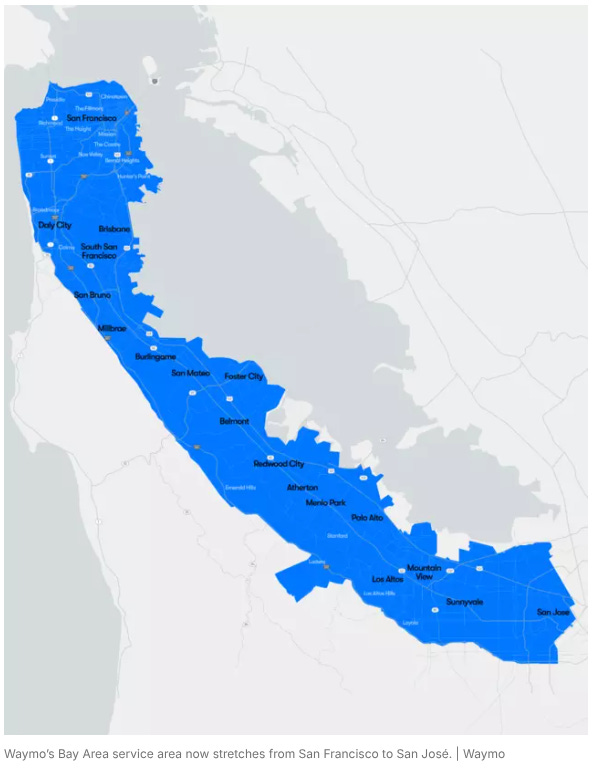
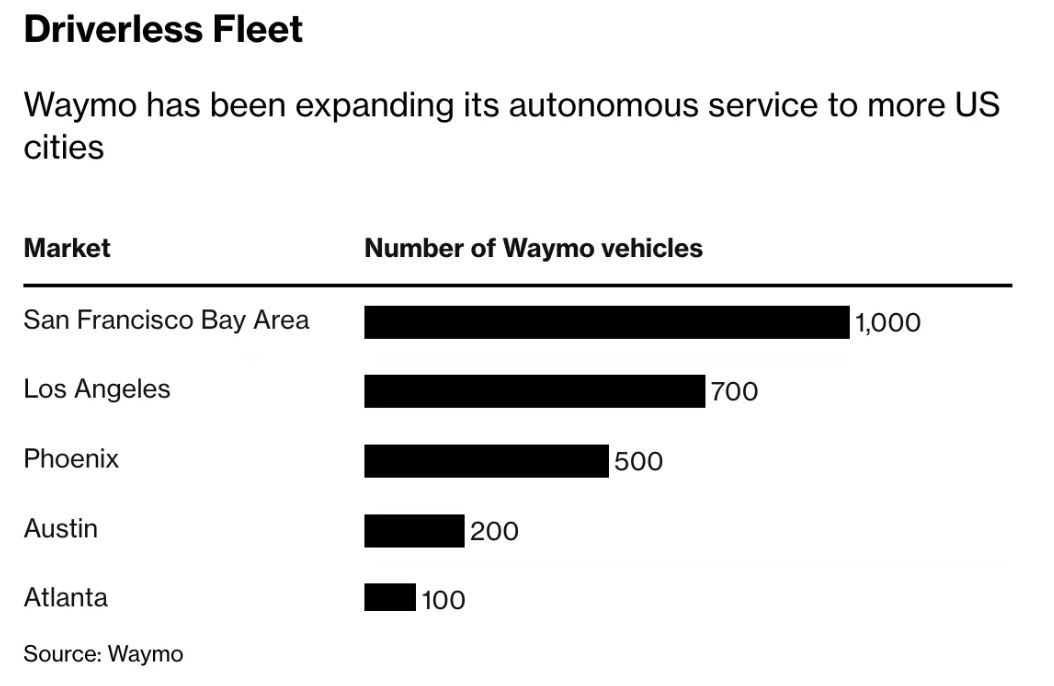
Timothy Lee: The big question about Waymo in 2026 is going to be “how do they get enough cars to service all this new territory?” Three options:
• Keep retrofitting expensive and no-longer-produced I-PACES
• Pay 105% tariffs to import Zeekrs
• Speed-run introduction of Hyundai vehicles
The Hyundai option would obviously be the best for them but I doubt they’ll achieve large-scale production before 2027. They only announced the partnership a year ago and just started testing them publicly a couple of weeks ago.
Samuel Hammond: I lost a good friend to a human driver in DC. The sooner we allow Waymos in the better.
… Public transit should be autonomous too.
One could say this is cherry picking, but the number of (truthful) such tweets about losing a friend to a Waymo is zero, because it has never happened.
Waymo set to deliver DoorDash orders in Phoenix. That presumably means you’ll have to go out to get the food out of the car, which is slightly annoying but seems fine. My actual concern is whether this will be a little slow? Waymos do not understand that when you have hot food, time is of the essence.
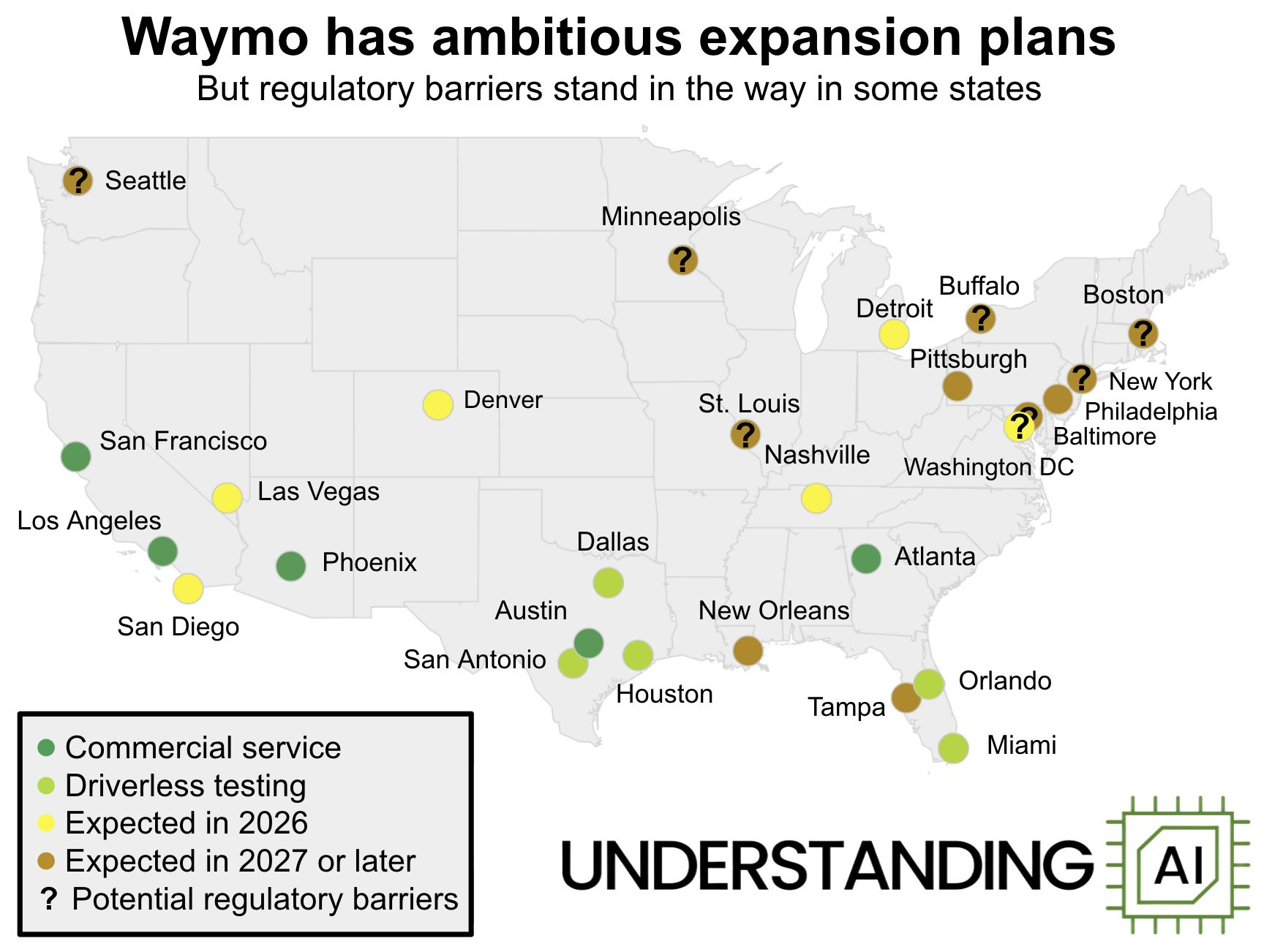
Timothy Lee and Kai Williams: On Tuesday, Waymo announced driverless testing in five cities: Dallas, Houston, San Antonio, Miami, and Orlando. Driverless testing begins immediately in Miami, while the other four cities will begin “over the coming weeks.” Waymo says commercial service will launch in all five cities in 2026.
… And probably several other cities as well. Waymo has previously announced 2026 launch plans in six other US cities — Denver, Detroit, Las Vegas, Nashville, San Diego, and Washington DC — plus London. None of these cities has begun driverless testing yet. But if all goes according to plan, Waymo will be offering service in at least 17 cities by the end of next year — more than triple the number Waymo serves today.
Timothy Lee: Waymo just announced plans to expand to Minneapolis, Tampa, and New Orleans. Here’s an updated map. Waymo didn’t mention 2026 so I put them in the “2027 or later” category. Minneapolis will likely require state legislation so it gets a question mark.
Timothy Lee (December 3): Waymo just announced testing (with safety drivers) in three new cities: Pittsburgh, St. Louis, and Baltimore. Legislation will be needed to enable driverless operation in both Baltimore and St. Louis (our first red-state question mark!).
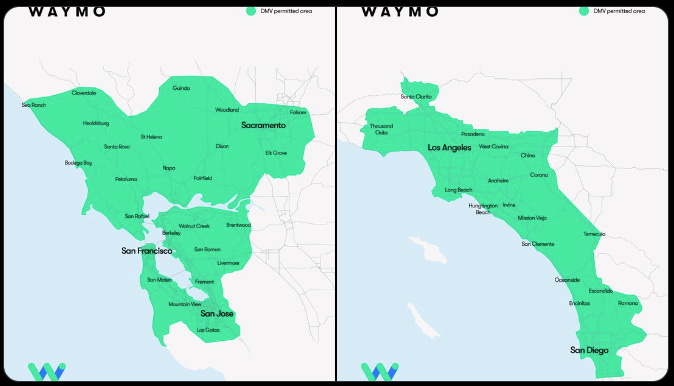
This is not an expanded service area yet, but look at where Waymo is now officially authorized:
Waymo: We’re officially authorized to drive fully autonomously across more of the Golden State.
Next stop: welcoming riders in San Diego in mid-2026! ☀️
It is the state that matters, not the city. That helps.
Timothy Lee: A nuance people are missing here: some of these red-state cities have Democratic mayors. However, AV policy is mostly made at the state level, especially in red states. So city leaders likely couldn’t block Waymo even if they wanted to. That’s certainly the case in California.
Could we do preemption on state laws about self-driving cars? Please?
Peter Wildeford: I wish that even half the energy of “federal pre-emption of all state AI laws” went specifically towards “federal pre-emption of municipal laws banning autonomous vehicles”.
We need to make sure our Waymo future isn’t banned by crazy cities that have no clue what they’re doing.
Neil Chilson: You may know me as a supporter of preemption, but while I think banning autonomous vehicles is absolutely moronic, I think it’s not squarely in the federal domain.
The states preempting the cities was key to getting deployment in California and Texas, but we still have a long way to go.
I actually disagree with Neil, I think this should be in the federal domain.
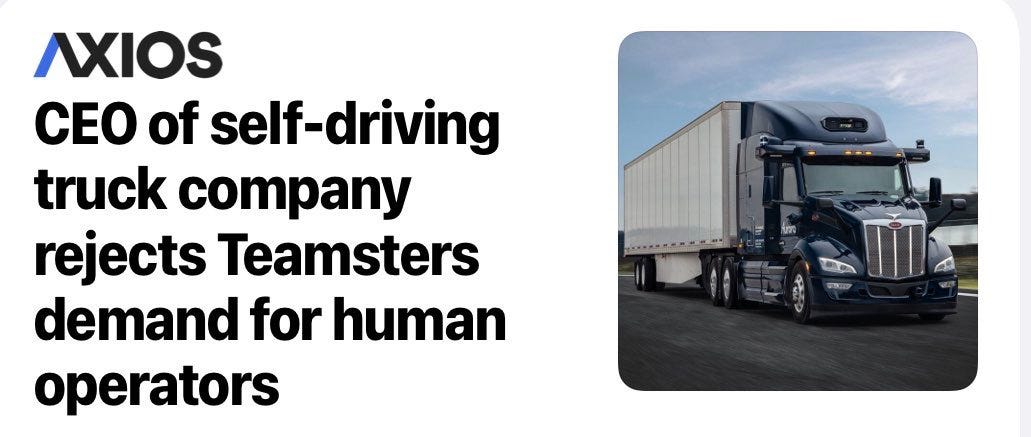
Then there’s the final boss enemies of all that is good and true, those who would permanently cripple our economy so that people could have permanent entirely fake jobs sitting in trucks:
Self-driving trucks should *alwaysbe supervised by a qualified professional to keep our roads safe. It’s a necessary partnership for America’s highways and economy.
Across the pond, could there be anything more Doomed European than an article that says ‘Europe doesn’t need driverless cars’? As with so many things like air conditioning, free speech and economic growth, the European asks, do we really ‘need’ this? Aren’t European roadways already ‘safer’ than American ones now that we’ve slowed them down to make them thus? Wouldn’t this ‘threaten’ European traditions of bikes and public transportation? Aren’t cars ‘inefficient’? Won’t someone please think of the potential traffic issues?
This emphasizes why I would make the case without emphasizing safety.
That seems fine? It’s not even clear it is non-ideal from Waymo’s perspective given their incentives? The risk-reward of using a more aggressive policy seems rather terrible, and worse than a service suspension? What would you have them do here?
Waymo: Navigating an event of this magnitude presented a unique challenge for autonomous technology. While the Waymo Driver is designed to handle dark traffic signals as four-way stops, it may occasionally request a confirmation check to ensure it makes the safest choice.
While we successfully traversed more than 7,000 dark signals on Saturday, the outage created a concentrated spike in these requests. This created a backlog that, in some cases, led to response delays contributing to congestion on already-overwhelmed streets.
We established these confirmation protocols out of an abundance of caution during our early deployment, and we are now refining them to match our current scale. While this strategy was effective during smaller outages, we are now implementing fleet-wide updates that provide the Driver with specific power outage context, allowing it to navigate more decisively.
As the outage persisted and City officials urged residents to stay off the streets to prioritize first responders, we temporarily paused our service in the area. We directed our fleet to pull over and park appropriately so we could return vehicles to our depots in waves. This ensured we did not further add to the congestion or obstruct emergency vehicles during the peak of the recovery effort.
The path forward
We’ve always focused on developing the Waymo Driver for the world as it is, including when infrastructure fails. We are analyzing the event, and are already integrating the lessons from this weekend’s PG&E outage. Here are some of the immediate steps we’re taking:
Integrating more information about outages: While our Driver already handles dark traffic signals as four-way stops, we are now rolling out fleet-wide updates that give our vehicles even more context about regional outages, allowing them to navigate these intersections more decisively.
Updating our emergency preparedness and response: We will improve our emergency response protocols, incorporating lessons from this event. In San Francisco, we’ll continue to coordinate with Mayor Lurie’s team to identify areas of greater collaboration in our existing emergency preparedness plans.
Expanding our first responder engagement: To date, we’ve trained more than 25,000 first responders in the U.S. and around the world on how to interact with Waymo. As we discover learnings from this and other widespread events, we’ll continue updating our first responder training.
This seems exactly right. Waymo has to be risk averse for now given that a single incident could derail their entire program. Over time, as they gain experience, they can act more decisively.
The amount of ‘omg never using a self-driving car again’ or ‘police and fire departments will now fight against self-driving cars to the death’ boggles the mind.
If enough cars on the road were self-driving, then they wouldn’t even need the traffic lights, they could coordinate in other ways, and this would all be moot.
Yes, in the case where the internet goes down entirely or Waymos otherwise systemically fail there will be a bigger problem that might not have a great solution right now, but do you think Waymo hasn’t planned for this?
At most, this says that if we had so many self-driving-only cars that we would be in deep trouble if all the self-driving cars died at once, then we want a solution where the cars are, in such an emergency, something a human could override and drive. That does not seem like such a difficult bar to cross?
The most common crisis scenario where things go haywire is very simple:
There is an evacuation or other reason everyone wants to go from A → B.
The road from A → B becomes completely jammed and stops moving.
Human drivers cannot solve this. Self-driving cars in sufficiently quantities solves this through coordination. Given these are maximally important scenarios where not getting out often risks death, it’s kind of a big deal. Imagine if things were reversed.
To which I say no, it is Holly that is missing the point. The reason why AGI is different is that if you have such a failure, you could be dead or lose control, and be unable to recover from the failure, or suffer truly catastrophic levels of damage. Thus, you need to get such potential difficulties right on the first try, before an incident happens, and you have to do this generally against a potential adversary more intelligent than you that will be out of distribution.
A self-driving car… is a car. It is a normal technology.
Even if something goes systematically wrong with a fleet of such cars, or all such fleets of cars? This is highly recoverable. The damage even for ‘all the Waymos suddenly floor it and crash’ (or even the pure sci-fi ‘suddenly try to do maximum amounts of damage’) is not so high in the grand scheme of things. There are a finite number of things that could happen that involve things going very wrong, and yes you can list all of them and then hardcode what to do in each case.
That is, indeed, how the cars actually learn to drive under normal circumstances. If the regulators want to provide a list of potential incident types and require Waymo to say how they plan to deal with each, including any combination of loss of internet and loss of power and everyone simultaneously fleeing an oncoming tsunami caused by a neutron bomb, then okay, sure, fine, I guess, let’s be overly paranoid to keep everyone happy, it will in expectation cost lives but whatever it takes.
But I think it’s really important, when arguing for AI safety, to be able to differentiate AGI from self-driving cars, and to not draw metaphors that don’t apply.
As everyone knows, the ‘real’ speed limit is by default 10 MPH above the speed limit. You’re highly unlikely to get a ticket, in most places, unless you are both more than 10 MPH and substantially faster than other drivers. If the speed limit is enforced to the letter, that usually involves attempting to trick motorists. We call that a ‘speed trap.’
To be safe, you want to match the speed of other cars around you, so driving the listed speed limit is actively dangerous on many roads.
Ethan Teicher: “The lack of a human driver is no longer the reason [Waymos] stand out most from regular traffic. They do so because they follow the speed limit.
Indeed, cyclists and pedestrians are so used to drivers going 5, 10, or more miles per hour over posted speed limits, that Waymo’s practice of driving by the letter of the law creates a noticeable contrast. So much so that in a recent New York Times article about Zoox entering the autonomous-vehicle fray in San Francisco, the reporters actually had the gall to list law-abiding driving as a downside”
Robin Hanson: Human drivers can block competition from self driving cars by just making traffic laws too onerous to obey, yet insisting that robots (only) must obey them. Seems a robust general strategy for preventing AI competition with humans.
The wrong answer is to current obviously too low numbers, and slow down all cars to the current technical speed limits. That’s profoundly stupid. It’s also scarily plausible that we will end up doing it.
The correct answer is to increase our speed limits across the board to the actual limit, beyond which we can and will ticket you.
This generalizes, as per Levels of Friction.
If AI has to obey the rules and humans don’t, the correct answer wherever possible is to change the rules to what we want both AIs and humans to actually have to follow.
In many other places, this creates a real problem, because the true rules are nebulous and involve social incentives and a willingness to adopt to practical conditions. As Robin Hanson notes, an otherwise highly capable AI that had to formally obey all laws in all ways would find many human tasks impossible or impractical.
I strongly agree that Waymo must pick up the pace. 7% growth per month? That’s it?
CNBC: Waymo crosses 450,000 weekly paid rides as Alphabet robotaxi unit widens lead on Tesla.
May 2023: 10,000 May 2024: 50,000 (14% monthly growth) August 2024: 100,000 (25% monthly) October 2024: 150,000 (22%) February: 2025: 200,000 (7%) April 2025: 250,000 (12%) December 2025: 450,000 (7%)
Right on track for 1M by December 2026.
FWIW this feels way too slow to me. They should be aiming for the ~15% growth rate they achieved in 2024. Hopefully they’re going to figure out their vehicle supply issues and dramatically accelerate in 2027. Tesla has been growing slowly because their technology doesn’t work yet. But they will figure it out in the next year or two and after that I guarantee you Elon won’t be happy with 7% monthly growth.
Timothy Lee: US media tends to cover robotaxis as a Waymo/Tesla race, but globally Waymo’s strongest competition is likely to be Chinese companies like Baidu, WeRide, and Pony. Rough robotaxi counts today:
If enough people lose their jobs at once, society has a big problem.
Ro Khanna: We need smart regulation to protect 3.5 million truck drivers & 2 million long haul drivers. AI should not be used for mass layoffs that drive up short term profits w/ no productivity gains.
Drivers are needed for safety, oversight, edge cases, & maintenance.
I stand with humans over machines, with @LorenaSGonzalez @TeamsterSOB over short term profits for corporate oligarchs.
Roon: what do you think productivity gains are lol.
It’s amazing how easily those opposed to self-driving throw around ‘safety concerns’ when self-driving vehicles are massively safer, or the idea here that gains are ‘short term’ or that there are ‘no productivity gains.’
Even if we literally require a human to be in each truck at all times ‘in case of emergency’ we would still see massive productivity gains, since the trucks would be able to be on the road 24/7.
Maintenance is another truly silly objection. Yes, when you need to maintain something you’d (for now at least) bring the truck to a human. Okay.
That leaves the ever mysterious and present ‘edge cases.’
Chris Albon: I bike everywhere in SF. I barely ever take a taxi/uber/waymo. But if you want to ban Waymo it means you don’t care about cyclists like me.
Waymos will reliably yield to bikes, use its turn signals and obey the rules. When you are biking, the problem is tail risk can literally kill you, so you have to constantly be paranoid that any given car will do something unexpected or crazy. With a Waymo, you don’t have to worry about that.
If you combine self-driving cars with other new smart products, including basic home robots, suddenly assisted living facilities look pretty terrible. They’re expensive and unpleasant, with the upside being that when you need help you really need help. The need for that forces you to buy this entire package of things you mostly don’t want. But what if most of that help was covered?
PoliMath: Crazy prediction time: I think that nursing homes and assisted living facilities are in trouble long-term.
These businesses are currently massive profit centers. Full time care for the elderly is a huge business & everyone assumes it will get bigger as boomers age
But no one wants to move into an assisted care house. They are good for what they are, but it’s a depressing place. It means moving a whole life into the place where you plan to die. That’s no fun. No one wants that. Most people want to age “in place”. They want to keep their home, keep their space, age and die in a familiar setting. What keeps them from doing this?
1) transportation – if they can’t get around to get their meds, get groceries, go to the movies, go to their favorite restaurant, drive to a park, etc, this severely reduces their quality of life. Assisted care helps solve this
2) household chores – Doing the laundry, cooking simple meals, lawn care, self-care (clipping toenails, bathing), these are important things that are harder to do when you get into your 80’s and 90’s
Unsupervised self-driving solves problem #1. The elderly should not be driving. It’s a brutal reality and one they fight against, but the risk factor is extremely high. An autonomous transportation system allows them enormous mobility and autonomy.
In-home robots solve problem #2. Robots that can aid with difficult self-care and household chores allows the elderly to stay in place for longer. This has enormous cost-savings and (more importantly) they can feel like they are in charge of their own lives for longer.
At that point, the biggest challenge is social interaction. This is where assisted care facilities easily out-class these automated solutions. The logistics problem is being solved in front of our eyes and it’s a miracle. But the social problem is not solved. Not even close.
The social problem requires people who want to interact with you, but note that we’ve solved the transportation problem. That makes it a lot easier.
What will happen when a Waymo finally does kill someone? Waymos are vastly safer than human drivers, but are we always going to be one accident away from disaster? The CEO of Waymo says people will accept it. I think she’s right if Waymo gets enough traction first, the question is when that point comes and whether we have reached it yet.
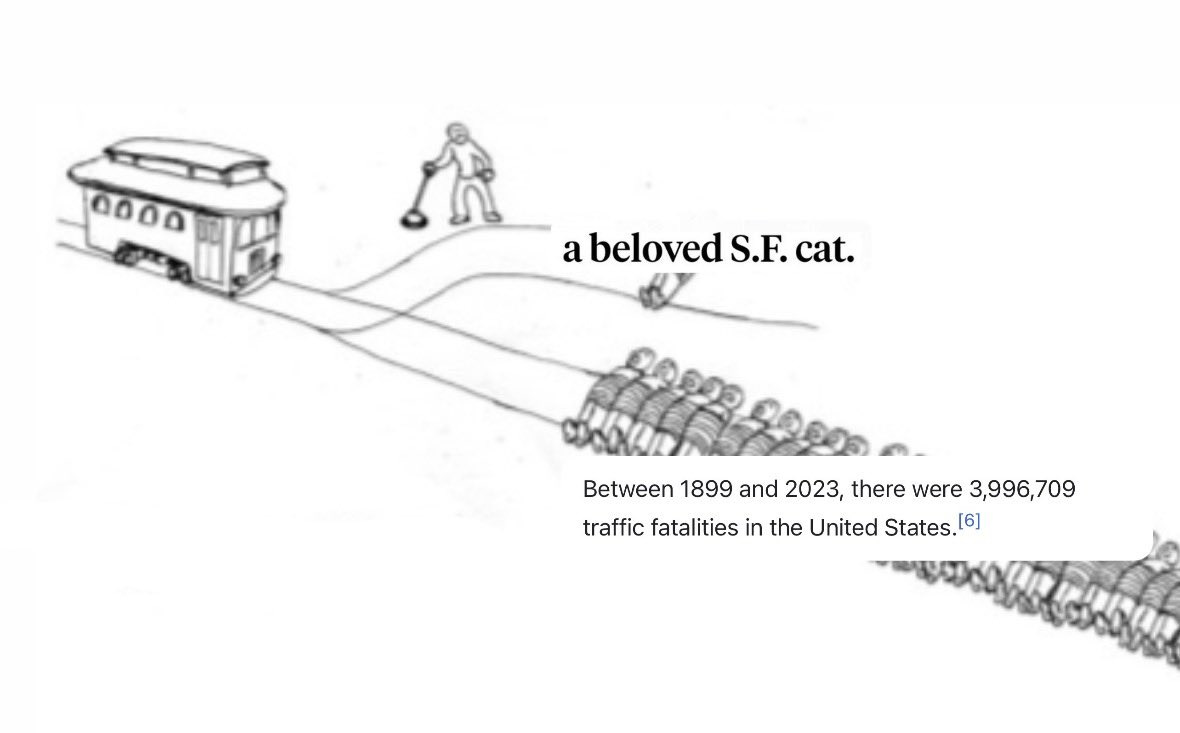
In the meantime, they’re trying to drum up outrage because a Waymo killed a cat, a ‘one-of-a-kind’ mascot of a bodega, something that happens to 5.3 million cats per year whens truck by human drivers. If ‘cat killed by Waymo’ is news then Waymos are absurdly safe.
Rolling Stone: KitKat, known as the “Mayor of 16th Street,” was killed by a Waymo cab last week in San Francisco, sparking calls for more regulation of driverless cars.
Yimbyland: When do you ever see a spread like this about a human driver running over a cat?
You don’t, and yet it happens 15,000 TIMES EVERY DAY.
YES. FIFTEEN THOUSAND CATS ARE RUN OVER EVERY SINGLE DAY.
Mission Loco: A cat ran in front of a car and was run over. This happens 26 MILLION times per year in the US. Now @rachelswan and @JackieFielder_ want to ban vehicles. This is how moronic @Hearst@sfchronicle reporters & @sfbos are.
(The bottom line should also include millions of cats and other pets as well, of course.)
I mean, if they wanted to ban all vehicles that would at least make some sense.
I will note that the 26 million number comes from Merrett Clifton’s extrapolation from 1993 and it’s basically absurd if you think about it, there simply are not enough cats for this to be real. It’s probably more like 2-5 million cats per year. Not that this changes the conclusion that Waymos are obviously vastly safer for cats than human drivers.
The stats are of course in, and if you use reasonable estimates Waymos probably kill on the order of 75x fewer pets, as in a 98%+ reduction in cats killed per mile.
Timothy Lee: NYTimes article quotes someone saying they are “terrified” of Waymo in paragraph 6. Waits until paragraph 33 (out of 44 paragraphs) to mention that they are 91 percent safer than human drivers. How outraged would liberals be if a news outlet covered vaccines like this?
The article does mention that human drivers kill hundreds of cats every year so that’s something.
Even if the rest of AI doesn’t prove that disruptive soon, self-driving will change quite a lot wherever it is allowed to proceed. I too am unreasonably excited.
Andrej Karpathy: I am unreasonably excited about self-driving. It will be the first technology in many decades to visibly terraform outdoor physical spaces and way of life. Less parked cars. Less parking lots. Much greater safety for people in and out of cars. Less noise pollution. More space reclaimed for humans.
Human brain cycles and attention capital freed up from “lane following” to other pursuits. Cheaper, faster, programmable delivery of physical items and goods. It won’t happen overnight but there will be the era before and the era after.
Nikhil: every time I come off a week of taking Waymos in SF:
it feels increasingly strange to return to a non-autonomous city (just as it felt weird to be in cities that didn’t have uber yet in 2014-2016)
I come away feeling like we continue to under-discuss the second order effects of self-driving inevitability + ubiquity
I think the indifference in the air is largely a function of how gradual (relatively) the rollout of AVs has been and will continue to be
The agonizingly slow ramp-up, along with the avalanche of other AI things happening, is definitely taking the focus off of self-driving and making us not realize how much the ground is shifting under our feet. The second order effects are going to be huge. The child mobility and safety improvements are especially neglected.
Roon: i strongly prefer uber to waymo. ubers get you where you need to go much faster. they wait for you when you’re running late. they never suffer catastrophic failure and ignominiously getting stuck behind a truck or something. will be kicked out of san francisco for this take.
also i learn so much from uber drivers it’s so high entropy.
To state the obvious I vastly prefer Waymos, and I am confused by the part about catastrophic failures since it seems obvious that rates of ‘things go wrong’ are higher for an Uber. But yeah, if you actively want to talk to drivers and to have another human in the car, and you care more about speed than a smooth ride, I can see it.
Self-driving cars have been proven vastly safer than human drivers, despite many believing the opposite. The question continues to be, how hard do you push on this?
Human drivers have been grandfathered in as an insanely dangerous thing we have accepted as part of life. We’ve destroyed huge other parts of life in the name of far less serious safety concerns, whereas here we have a solution that is life affirming while also preventing most of a leading cause of death.
Dr. Jon Slotkin: I have a guest essay in @nytimes today about autonomous vehicle safety. I wrote it because I’m tired of seeing children die. Done right, we can eliminate car crashes as a leading cause of death in the United States
@Waymo recently released data covering nearly 100 million driverless miles. I spent weeks analyzing it because the results seemed too good to be true. 91% fewer serious-injury crashes. 92% less pedestrians hit. 96% fewer injury crashes at intersections. The list goes on.
39,000 Americans died in crashes last year. More than homicide, plane crashes, and natural disasters combined. The #2 killer of children and young adults. The #1 cause of spinal cord injury. We’ve accepted this as the price of mobility.
We don’t have to.
In medicine, when a treatment shows this level of benefit, we stop the trial early. Continuing to give patients the placebo becomes unethical. When an intervention works this clearly, you change what you do.
In driving, we’re all the control group.
Cities like DC and Boston are blocking deployment. And cities are not the only forces mobilizing to slow this progress.
It’s time we stop treating this like a tech moonshot and start treating it like a public health intervention that will save lives.
Auerlien reports that ‘broken windows theory’ very much applies to cars. If you don’t keep cars fully pristine then people stop respecting the car and things escalate quickly, and also people care quite a lot. Thus, if a Waymo or other self-driving car gets even a little dirty it needs to head back and get cleaned. And thus, every Waymo I’ve ever ridden in has been pristine.
Johnny v5: just realized waymo means i can go to office hours without haste now
Deepfates: that means you can go to Waymo of them!!