
Until 1970, the US dumped an estimated 17,000 tons of unspent chemical weapons from World War I and II off the coast of the Atlantic Ocean—and that disposal decision continues to haunt commercial fishing operations.
In an article published this week in the Morbidity and Mortality Weekly Report, health officials from New Jersey and the Centers for Disease Control and Prevention report that there were at least three incidents of commercial fishing crews dredging up dangerous chemical warfare munitions (CWMs) off the coast of New Jersey between 2016 and 2023.
The three incidents exposed at least six crew members to mustard agent, which causes blistering chemical burns on skin and mucous membranes. (An example of these types of burns can be seen here, but be warned, the image is graphic.) One crew member required overnight treatment in an emergency department for respiratory distress and second-degree blistering burns. Another was burned so badly that they were hospitalized in a burn center and required skin grafting and physical therapy.
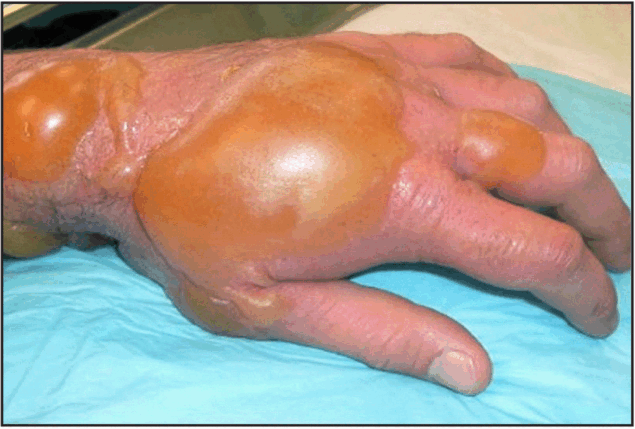
“Recovered CWMs continue to pose worker and food safety risks. Because of ocean drift, storms, and offshore industries, sea-disposed CWMs locations are largely unknown and potentially far from their originally documented dump site,” the health officials write.
It’s not the first such report in MMWR. In 2013, federal health officials reported another three incidents in the mid-Atlantic. The report noted that clam fishermen in Delaware Bay “told investigators that they routinely recover munitions that often ‘smell like garlic,’ a potential indication of the presence of a chemical agent.”
In the three newly reported incidents, one occurred in 2016 off the coast of Atlantic City when a crew was dredging for clams. A munition was brought onboard on a conveyor belt. A crew member noticed it and threw it overboard, but it was subsequently the member who developed arm burns requiring skin grafting. Beyond the health toll, a delay in communicating the incident allowed the clams dredged alongside the munition to move into production. This led to a recall of 192 cases of clam chowder and the destruction of 704 cases of clams.